Time to give soils a lift?
After two incessantly wet winters followed by virtual drought conditions, soil biology is approaching an all-time low in many fields, says Chris Martin, Agrovista’s head of soil health. He urges all growers, including the most ardent regen enthusiasts, to check they are not heading for a costly backward step this autumn and beyond.
Some soils have taken a beating over the past couple of seasons. High and heavy rainfall over the past two winters has pounded fields and severely reduced soil porosity, particularly in less resilient soils carrying poor crops with limited rooting.
Other soils that have decent organic matter levels and well-established winter-sown crops with good rooting have weathered the storms much better. Some actually remain in a very good state, particularly those with deep cracking following the recent dry weather.
However, good and poor soils can often be found on the same farm. The key difference between them is the extent of the connective porosity within the soil. A healthy soil has a good network of pores and channels that enables gases to circulate, water to drain and roots to grow. All this helps biology to thrive, putting energy into the soil and building and cycling and releasing nutrients so crops can flourish.
It’s not only cultivation-based strategies that degrade poor soils. A lot of direct drills use discs, which, through their geometry, have a compressing effect on the soil, so using them on soils that are already tighter than they should has not helped. Crops have grown moderately on the whole and are unable to feed sufficient biology, so these soils lack the energy they need to repair themselves.
In extreme cases, there’s nothing to feed the biology, Soils are virtually dead and have the structure of a brick. Soil without biology is geology, and you can’t grow a 10-tonne crop of wheat on rock.
The key is identifying which soils can be left alone, which need a light touch and which need varying grades of TLC. We need to know where our soils are today, what potential they have and how we can best realise that potential.
In the short term, we need to be looking at crops in the ground, identifying the thinner, poorer areas and mapping them, using eyes, satellite images or drones, whatever suits. We can then employ remedial measures matched to the scale of the problem to start turning these soils around.
We should also be measuring organic matter content and functionality. Many farmers are now testing for organic matter in line with requirements set out under SFI and Farming Rules for Water.
Upgrading to a slightly more detailed test will reveal the potential of that field to hold organic matter and how functional it is, using biological indicators and a carbon-nitrogen ratio assessment. It might cost a few pence more per acre but could potentially save thousands of pounds, providing a clear and attainable target level to build more resilient soils using medium/longer term strategies.
It must be emphasised there are no silver bullets and no quick fix. A poor soil can go backwards quickly, but you can’t create the biology needed to improve it overnight.
Remedial cultivations
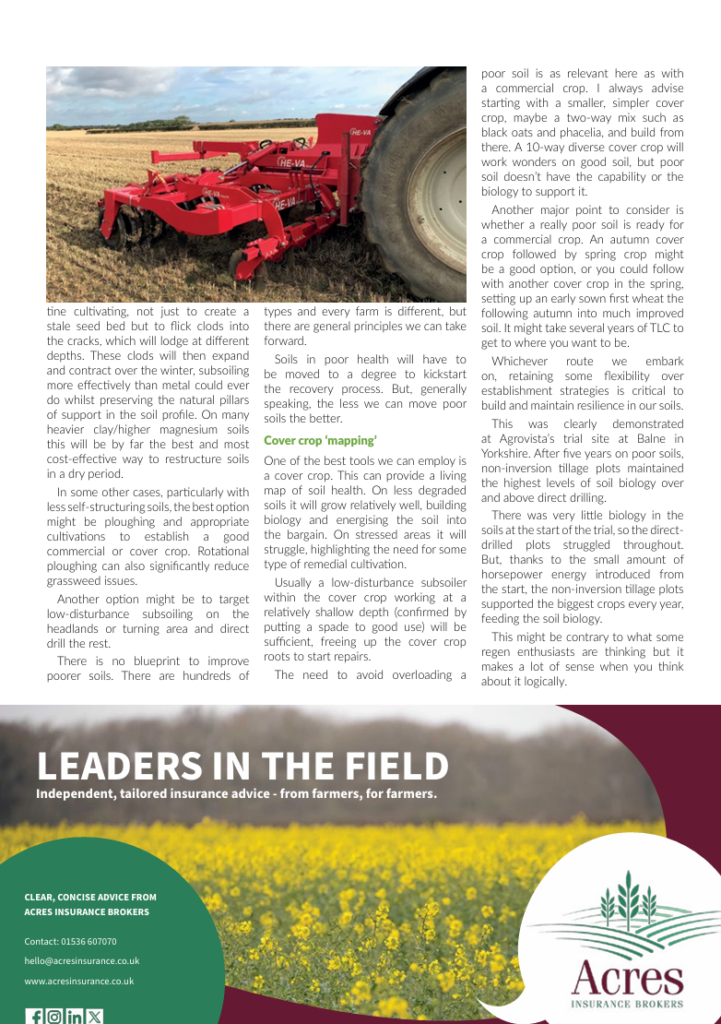
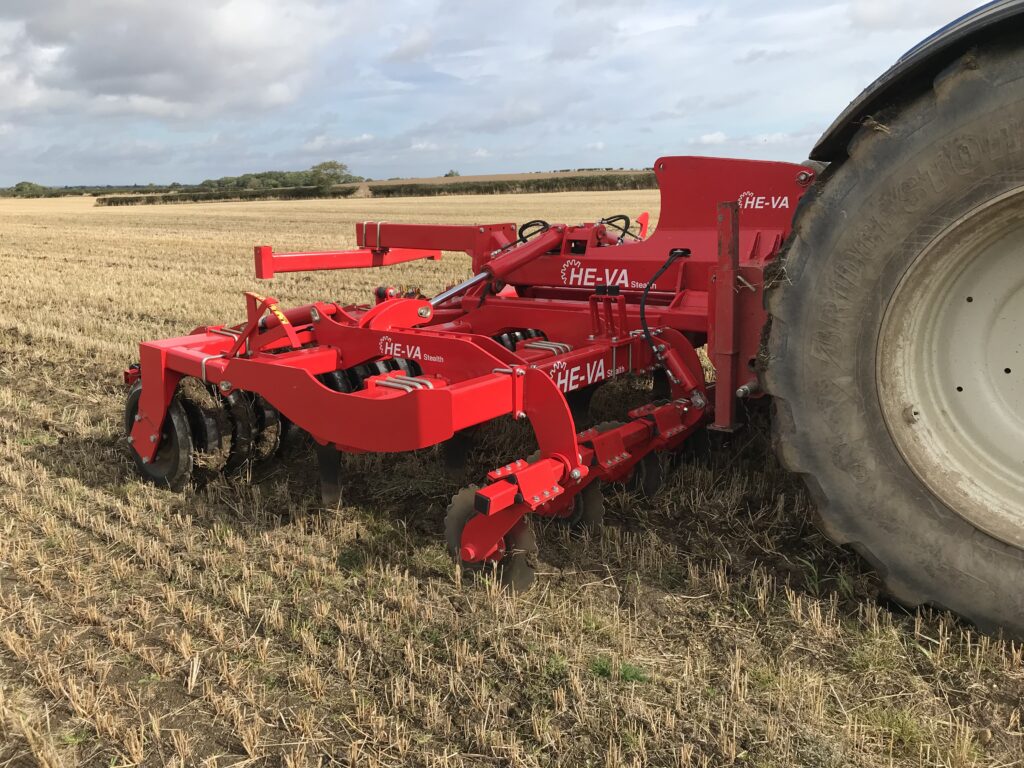
Metal alone will never build structure. It can provide a very useful first step to repairing degraded soils, but we must introduce some life at the same time in the form of roots to ensure the small backward step of cultivation creates a big forward step for the soil.
Knowing where to use cultivations, and to what extent, is crucial. We only want to use enough to create suitable conduits to aerate soils and ease rooting to enable biology to thrive.
As I write this in mid-June, if it stays relatively dry over the next couple of months direct drilling could remain the best option for many healthy resilient soils. Well-cracked, heavier land may benefit from a light discing or shallow tine cultivating, not just to create a stale seed bed but to flick clods into the cracks, which will lodge at different depths. These clods will then expand and contract over the winter, subsoiling more effectively than metal could ever do whilst preserving the natural pillars of support in the soil profile. On many heavier clay/higher magnesium soils this will be by far the best and most cost-effective way to restructure soils in a dry period.
In some other cases, particularly with less self-structuring soils, the best option might be ploughing and appropriate cultivations to establish a good commercial or cover crop. Rotational ploughing can also significantly reduce grassweed issues.
Another option might be to target low-disturbance subsoiling on the headlands or turning area and direct drill the rest.
There is no blueprint to improve poorer soils. There are hundreds of types and every farm is different, but there are general principles we can take forward.
Soils in poor health will have to be moved to a degree to kickstart the recovery process. But, generally speaking, the less we can move poor soils the better.
Cover crop ‘mapping’
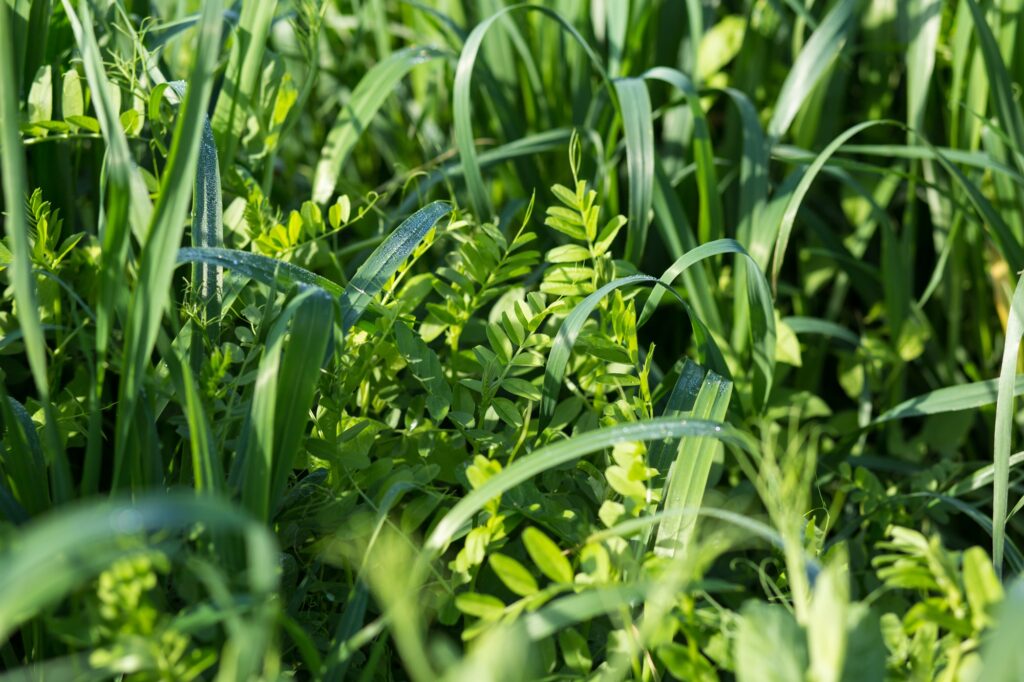
One of the best tools we can employ is a cover crop. This can provide a living map of soil health. On less degraded soils it will grow relatively well, building biology and energising the soil into the bargain. On stressed areas it will struggle, highlighting the need for some type of remedial cultivation.
Usually a low-disturbance subsoiler within the cover crop working at a relatively shallow depth (confirmed by putting a spade to good use) will be sufficient, freeing up the cover crop roots to start repairs.
The need to avoid overloading a poor soil is as relevant here as with a commercial crop. I always advise starting with a smaller, simpler cover crop, maybe a two-way mix such as black oats and phacelia, and build from there. A 10-way diverse cover crop will work wonders on good soil, but poor soil doesn’t have the capability or the biology to support it.
Another major point to consider is whether a really poor soil is ready for a commercial crop. An autumn cover crop followed by spring crop might be a good option, or you could follow with another cover crop in the spring, setting up an early sown first wheat the following autumn into much improved soil. It might take several years of TLC to get to where you want to be.
Whichever route we embark on, retaining some flexibility over establishment strategies is critical to build and maintain resilience in our soils.
This was clearly demonstrated at Agrovista’s trial site at Balne in Yorkshire. After five years on poor soils, non-inversion tillage plots maintained the highest levels of soil biology over and above direct drilling.
There was very little biology in the soils at the start of the trial, so the direct-drilled plots struggled throughout. But, thanks to the small amount of horsepower energy introduced from the start, the non-inversion tillage plots supported the biggest crops every year, feeding the soil biology.
This might be contrary to what some regen enthusiasts are thinking but it makes a lot of sense when you think about it logically.