Written by Patrick Honcoop, founding member of the AgTech Advisory Collective
Last week, I attended the World Agri-Tech summit in San Francisco, one of my favourite conferences of the year. Part of what makes it special is knowing that many of the people I enjoy most in this industry will be there: clients, business partners, fellow entrepreneurs and friends I’ve built relationships with over the years. There’s a certain energy that comes from being in a room where the conversations pick up where they left off.
But beyond the personal side, World Agri-Tech is also one of the few events on the AgTech calendar that genuinely centres investment and partnering. It’s not primarily a tradeshow floor; it’s where you get a real sense of where capital is flowing, how investors are thinking, and what the broader mood of the industry actually is. That combination of community and market intelligence is what keeps bringing me back.
This year’s edition did not disappoint on either front. Here are my reflections.
A quieter room, better conversations
Attendance was lower than in previous editions, a trend I’ve now seen across multiple events this cycle. But fewer attendees didn’t mean less value. If anything, the conversations felt more honest and more meaningful. Less performative optimism, more candid assessments of where the market actually stands.
The dominant sentiment was that we may have reached the bottom of the cycle. I’ve been hesitant to call this too soon, but the signals are becoming increasingly difficult to ignore. Farm fundamentals show modest improvement, and more AgTech scale-ups are achieving real commercial traction. There’s a growing sense that the painful recalibration of the past two years has done its job.
The investment picture: Limited powder now, but more on the way
The investment dynamic deserves close attention because it shapes what happens across the rest of the ecosystem.
A striking number of the funds I spoke with are currently at the end of their fund lifecycle and in the process of raising their next vehicle. That creates an awkward gap: the appetite is there, but the dry powder to deploy is limited right now. Several managers were candid that fundraising took considerably longer than expected, a reflection of LP caution in a period when AgTech returns have been hard to demonstrate.
The practical implication for startups is real: don’t expect a surge of fresh capital in the next few months. But the outlook for 2027 looks meaningfully different, as new funds close and managers return to active deployment mode. For AgTech companies with strong fundamentals, patience remains the right posture.
What was also notable is how some funds are rethinking their model entirely. Rather than operating as traditional AgTech venture funds, a few are repositioning towards a more strategic, corporate-adjacent role, closer to scouting and ecosystem building than pure financial return. Whether this model will prove durable is an open question, but it reflects a broader recognition that the traditional VC playbook has not always translated well into agriculture’s long adoption cycles.
Corporate activity told a similar story. Their presence at the summit was visibly reduced, and those who attended were largely in listening mode rather than deal mode. Managing spend and protecting core business appear to be the dominant priorities for most corporates right now. Strategic partnerships and corporate venture activity have slowed accordingly.
From agentic AI to physical intelligence
Agentic AI was arguably the hottest topic at the summit, which, depending on your perspective, is either exciting or a familiar pattern. But alongside the software-centric conversation, a more grounded framing was gaining traction: physical AI.
Physical AI refers to the integration of artificial intelligence into physical systems – robots, sensors, equipment – rather than treating AI purely as a software or decision-support layer. In practice, this means AI that doesn’t just advise but acts: guiding a robot through a crop canopy, adjusting implement behaviour in real time, or coordinating an autonomous fleet across a field.
It’s a meaningful distinction, and one that resonates with what I’ve argued in my autonomy series: the real value of AI in agriculture will come not from dashboards or recommendations, but from AI embedded in the physical workflow of farming.
The two framings, agentic AI and physical AI, are not mutually exclusive, but they point to different investment theses and different development timelines. Agentic AI in digital platforms can move quickly; physical AI in field equipment takes years to validate at scale. The most interesting companies are likely those building at the intersection: software intelligence that directly drives physical action.
That said, my reaction to the broader AI conversation was mixed. The technology is genuinely interesting, but the energy around it had a familiar feel. We’ve been here before with digital ag, with drones, with carbon platforms. The question is whether the enthusiasm is tracking real agricultural value or simply chasing the next investment hype.
That concern wasn’t mine alone. Several investors I spoke with openly flagged it; some worried that AI could displace products in their own portfolio, particularly in the digital agriculture space. I also spoke with a founder of a digital ag platform who was candid that this question is shaping their strategic thinking right now: if AI can perform the core task their product was built to do, what is the long-term defensibility of the business? It’s a hard question, and I respect that they’re asking it honestly rather than dismissing it. Founders in digital ag should be thinking hard about this.
Startups worth watching
Two companies I encountered at the summit stood out for different reasons, both reflecting the broader theme of physical intelligence moving from concept to application.
Beagle Technology Inc caught my attention with its focus on making implements smarter. Rather than building another autonomous power unit, they are developing intelligent implement solutions for pruning and harvesting in speciality crops, currently part of the Reservoir portfolio. This is precisely the gap I have argued is one of the most underestimated bottlenecks in autonomous farming: you can build an autonomous tractor, but if the implement still requires human supervision, you haven’t removed the operator; you’ve just moved them.
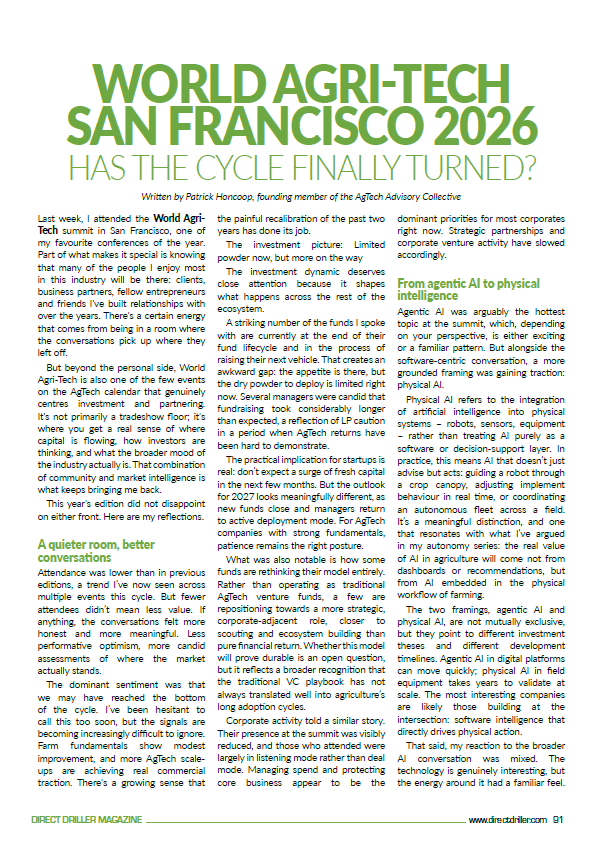
The second company is Winterleap, a Norwegian startup taking a genuinely novel approach to weed and pathogen management. They use microwave technology applied to frozen soil during winter to eliminate weed seed banks, deep-rooted weeds and soil-borne pathogens before the growing season begins. The concept is chemical-free, avoids soil compaction, and makes use of a time window – the winter months – which is typically underutilised in field operations.
I still have open questions. How selective is the treatment? Does it harm beneficial soil organisms alongside the pathogens it targets? And clearly, the approach is geographically constrained to regions with reliably cold winters. But the core idea is interesting: using the winter season as a treatment window rather than a dormant one. In a category, alternative weeding, that is attracting significant innovation across laser, mechanical, and chemical approaches, an approach this differentiated is worth keeping an eye on.
The maturing of AgTech scaleups
The most encouraging signal from San Francisco was the visible maturation of a cohort of AgTech scale-ups. A growing number of companies are moving beyond the pilot stage, demonstrating consistent deployment numbers, repeat customers and increasingly credible unit economics.
What’s changed in the conversation is the framing. A year or two ago, many companies were still optimising for capital raise: telling the story investors wanted to hear, chasing the next valuation milestone. That dynamic has shifted noticeably. More founders are now explicitly focused on building towards break-even, on sustainable business models, on proving that the company can operate without perpetual external subsidy.
One investor perspective that stuck with me: the most interesting investments right now are not about funding technology development, but about funding commercial scaling. The technology has been proven; the question is whether the commercial and operational infrastructure can keep pace. That shift in investor thinking, from supporting ideas to supporting execution, is a healthy sign that the category is maturing.
The part that matters most
Beyond the panels and the tradeshow, the most valuable part of any conference like this is the one that doesn’t show up on the agenda: the people.
For me personally, this summit was a chance to reconnect with clients, business partners and entrepreneurs across the scene – the kind of conversations that move faster in person than they ever do over email or video. There’s a quality of exchange you only get when you’re in the same room, and San Francisco delivered that.
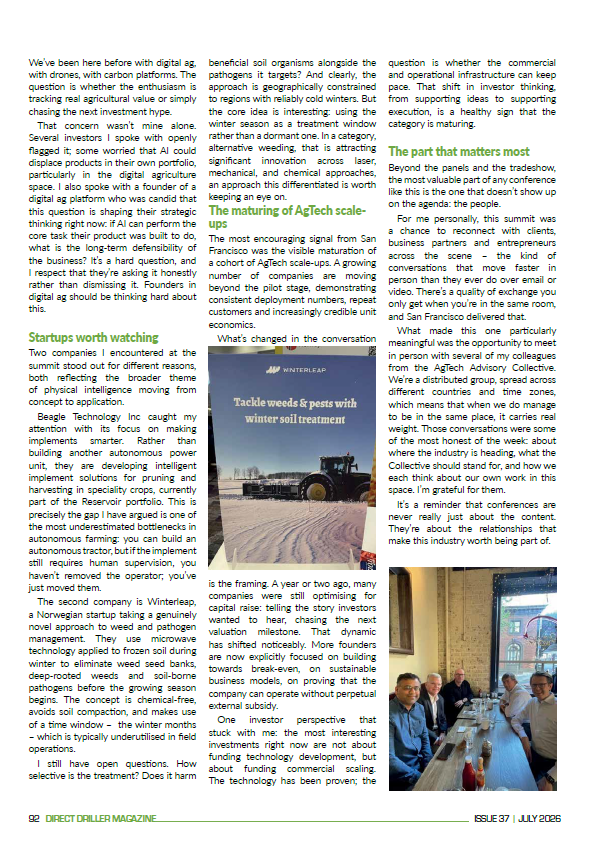
What made this one particularly meaningful was the opportunity to meet in person with several of my colleagues from the AgTech Advisory Collective. We’re a distributed group, spread across different countries and time zones, which means that when we do manage to be in the same place, it carries real weight. Those conversations were some of the most honest of the week: about where the industry is heading, what the Collective should stand for, and how we each think about our own work in this space. I’m grateful for them.
It’s a reminder that conferences are never really just about the content. They’re about the relationships that make this industry worth being part of.
What this really signals
Taken together, World Agri-Tech 2026 painted the picture of an industry at an inflection point, not yet in full recovery, but clearly past the worst of the downturn.
The investment gap is real but might improve. Corporate caution is understandable, but it creates an opportunity for the startups willing to build through the cycle. The AI discussion, both agentic and physical, will separate genuine value creation from hype over the next 12 to 18 months. And the founders who are building towards profitability rather than the next round are the ones having the best conversations right now.
For AgTech companies, the message aligns with what I’ve been emphasising for some time: focus on the problem, demonstrate the value, develop a commercial model and build a business that doesn’t rely on the next funding round to survive.
Looking ahead
The farm economy remains under pressure, and I don’t expect that to change overnight. But I came away from San Francisco feeling something I haven’t felt as strongly in a while: genuine optimism about the direction of this industry.
Not the artificial optimism of a funding boom where enthusiasm outpaces reality and valuations disconnect from commercial substance. Something more grounded than that. The companies I spoke with are working towards real milestones, break-even points, repeat customers and predictable unit economics. Investors are asking tougher questions and writing more thoughtful cheques that reflect what the business currently is, not what it might be in the best-case scenario. That recalibration is healthy. It makes the entire ecosystem feel more honest.
AgTech is maturing. The progress is becoming clear, not just in press releases but in conversations with founders who are cautious rather than euphoric, and investors who are focused rather than scattered. There is something more authentic about this moment than there was two or three years ago, and I believe that matters more than the headline funding numbers.
The farm economy will recover. It always does. And when it does, I believe it will meet an AgTech industry that is meaningfully better prepared to deliver real value than the one it met in the last upcycle.
That, more than anything, is what makes me optimistic about this space.
Patrick Honcoop is an AgTech expert delivering global market insights and empowering AgTech companies to scale and expand internationally.