At Cereals 2026, held this year at Diddly Squat Farm, Agrii presented their vision for the future of agronomy. The press launch of their Smart Connected Farm concept was not about unveiling a single new gadget or another isolated software platform. Instead, it was a practical demonstration of how existing and emerging technologies can be integrated to support agronomists and farmers in making better, more profitable decisions.
Will Charlton, from Seeded Marketing, the PR agency working with Agrii, opened the event by introducing the second volume of their Insight Report series, Tools and Insights for Tomorrow’s Decisions. The core message was clear: technology must serve the relationship between the farmer and the agronomist, not replace it. The human interface remains the foundation of crop management.
Rachel Watling, National Marketing Manager, guided attendees through five distinct stations, each highlighting a different facet of this connected approach. She emphasised that farmers are increasingly concerned about rising costs, unpredictable weather and shrinking margins. In this climate, the ability to make evidence-based decisions is critical. The Smart Connected Farm is designed to support businesses regardless of where they are on their digital journey, integrating tools like variable rate nitrogen, drone imagery and soil sensors into a coherent system.
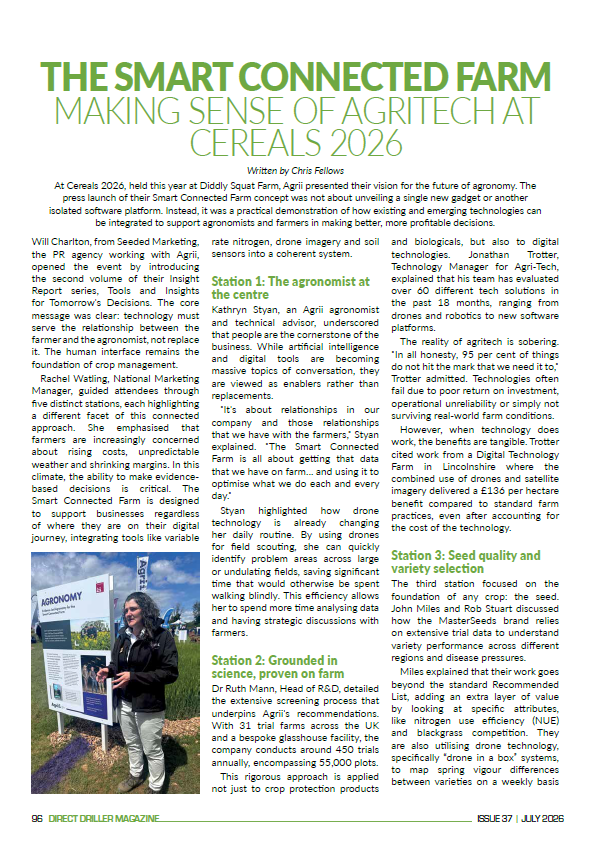
Station 1: The agronomist at the centre
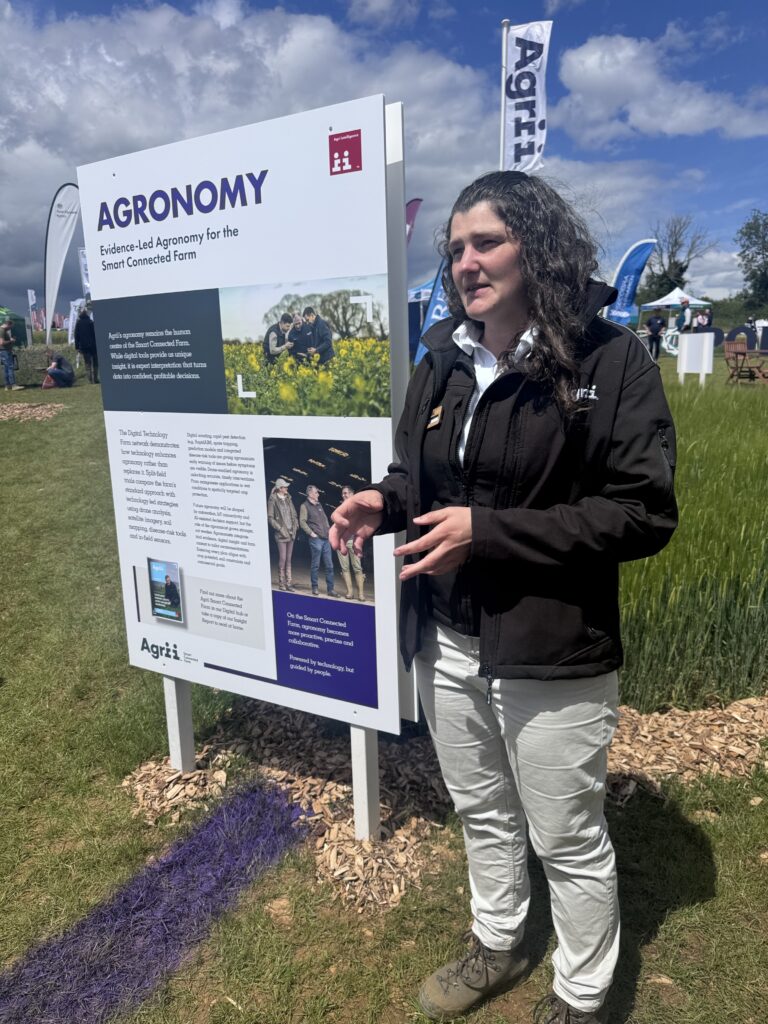
Kathryn Styan, an Agrii agronomist and technical advisor, underscored that people are the cornerstone of the business. While artificial intelligence and digital tools are becoming massive topics of conversation, they are viewed as enablers rather than replacements.
“It’s about relationships in our company and those relationships that we have with the farmers,” Styan explained. “The Smart Connected Farm is all about getting that data that we have on farm… and using it to optimise what we do each and every day.”
Styan highlighted how drone technology is already changing her daily routine. By using drones for field scouting, she can quickly identify problem areas across large or undulating fields, saving significant time that would otherwise be spent walking blindly. This efficiency allows her to spend more time analysing data and having strategic discussions with farmers.
Station 2: Grounded in science, proven on farm
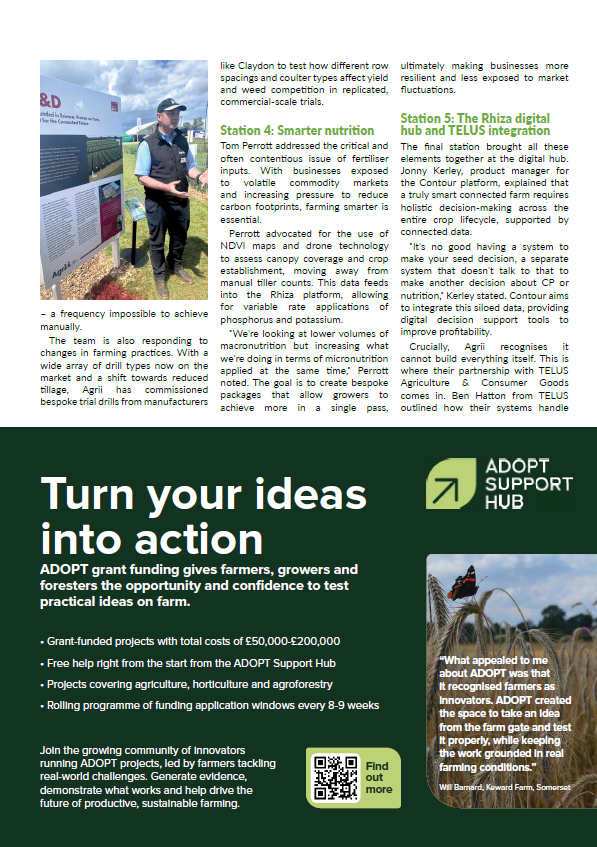
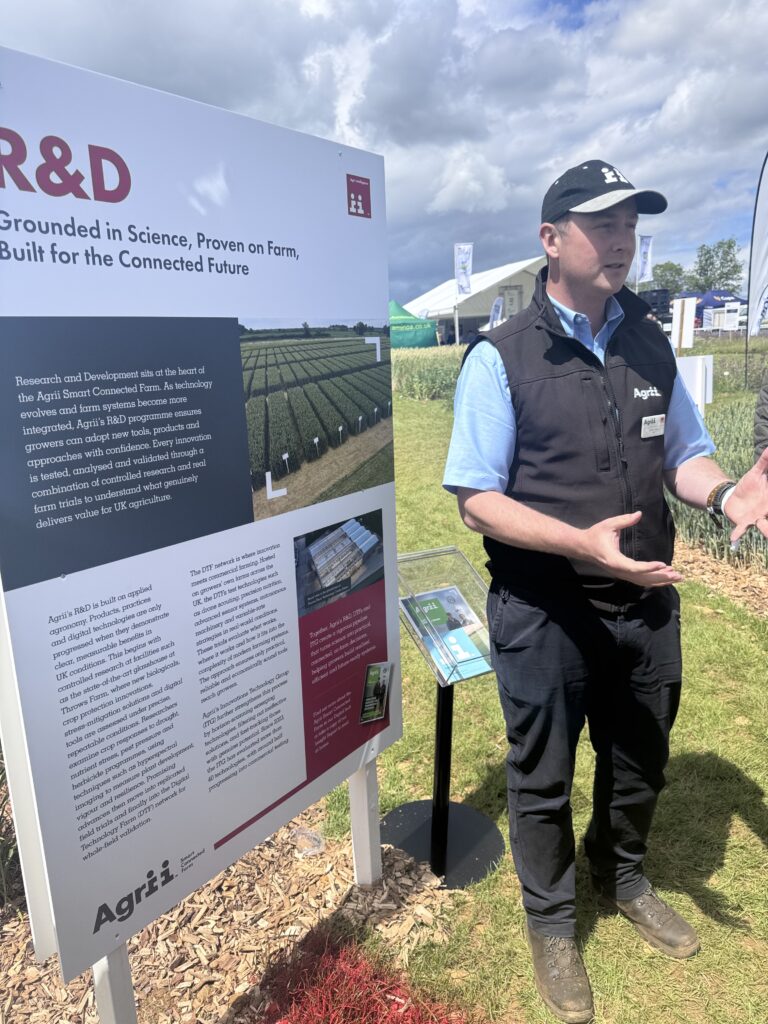
Dr Ruth Mann, Head of R&D, detailed the extensive screening process that underpins Agrii’s recommendations. With 31 trial farms across the UK and a bespoke glasshouse facility, the company conducts around 450 trials annually, encompassing 55,000 plots. This rigorous approach is applied not just to crop protection products and biologicals, but also to digital technologies.
Jonathan Trotter, Technology Manager for Agri-Tech, explained that his team has evaluated over 60 different tech solutions in the past 18 months, ranging from drones and robotics to new software platforms.
The reality of agritech is sobering. “In all honesty, 95 per cent of things do not hit the mark that we need it to,” Trotter admitted. Technologies often fail due to poor return on investment, operational unreliability or simply not surviving real-world farm conditions.
However, when technology does work, the benefits are tangible. Trotter cited work from a Digital Technology Farm in Lincolnshire where the combined use of drones and satellite imagery delivered a £136 per hectare benefit compared to standard farm practices, even after accounting for the cost of the technology.
Station 3: Seed quality and variety selection
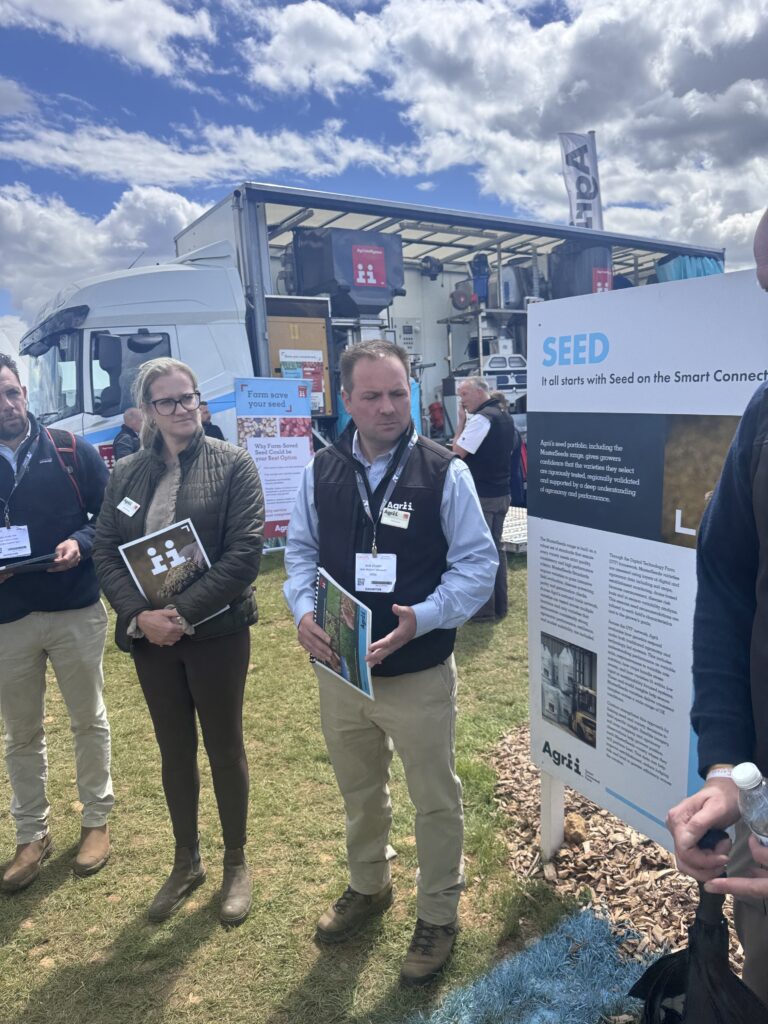
The third station focused on the foundation of any crop: the seed. John Miles and Rob Stuart discussed how the MasterSeeds brand relies on extensive trial data to understand variety performance across different regions and disease pressures.
Miles explained that their work goes beyond the standard Recommended List, adding an extra layer of value by looking at specific attributes, like nitrogen use efficiency (NUE) and blackgrass competition. They are also utilising drone technology, specifically “drone in a box” systems, to map spring vigour differences between varieties on a weekly basis – a frequency impossible to achieve manually.
The team is also responding to changes in farming practices. With a wide array of drill types now on the market and a shift towards reduced tillage, Agrii has commissioned bespoke trial drills from manufacturers like Claydon to test how different row spacings and coulter types affect yield and weed competition in replicated, commercial-scale trials.
Station 4: Smarter nutrition
Tom Perrott addressed the critical and often contentious issue of fertiliser inputs. With businesses exposed to volatile commodity markets and increasing pressure to reduce carbon footprints, farming smarter is essential.
Perrott advocated for the use of NDVI maps and drone technology to assess canopy coverage and crop establishment, moving away from manual tiller counts. This data feeds into the Rhiza platform, allowing for variable rate applications of phosphorus and potassium.
“We’re looking at lower volumes of macronutrition but increasing what we’re doing in terms of micronutrition applied at the same time,” Perrott noted. The goal is to create bespoke packages that allow growers to achieve more in a single pass, ultimately making businesses more resilient and less exposed to market fluctuations.
Station 5: The Rhiza digital hub and TELUS integration
The final station brought all these elements together at the digital hub. Jonny Kerley, product manager for the Contour platform, explained that a truly smart connected farm requires holistic decision-making across the entire crop lifecycle, supported by connected data.
“It’s no good having a system to make your seed decision, a separate system that doesn’t talk to that to make another decision about CP or nutrition,” Kerley stated. Contour aims to integrate this siloed data, providing digital decision support tools to improve profitability.
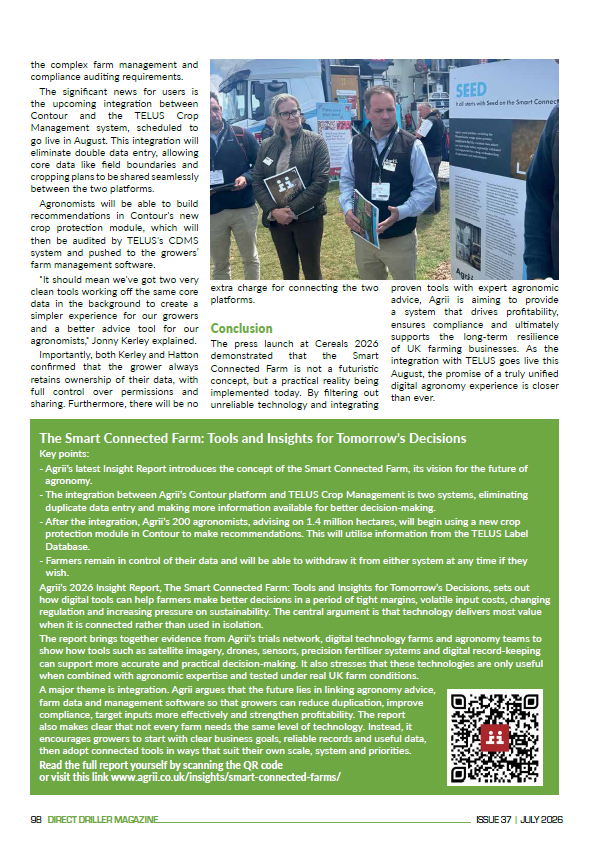
Crucially, Agrii recognises it cannot build everything itself. This is where their partnership with TELUS Agriculture & Consumer Goods comes in. Ben Hatton from TELUS outlined how their systems handle the complex farm management and compliance auditing requirements.
The significant news for users is the upcoming integration between Contour and the TELUS Crop Management system, scheduled to go live in August. This integration will eliminate double data entry, allowing core data like field boundaries and cropping plans to be shared seamlessly between the two platforms.
Agronomists will be able to build recommendations in Contour’s new crop protection module, which will then be audited by TELUS’s CDMS system and pushed to the growers’ farm management software.
“It should mean we’ve got two very clean tools working off the same core data in the background to create a simpler experience for our growers and a better advice tool for our agronomists,” Jonny Kerley explained.
Importantly, both Kerley and Hatton confirmed that the grower always retains ownership of their data, with full control over permissions and sharing. Furthermore, there will be no extra charge for connecting the two platforms.
Conclusion
The press launch at Cereals 2026 demonstrated that the Smart Connected Farm is not a futuristic concept, but a practical reality being implemented today. By filtering out unreliable technology and integrating proven tools with expert agronomic advice, Agrii is aiming to provide a system that drives profitability, ensures compliance and ultimately supports the long-term resilience of UK farming businesses. As the integration with TELUS goes live this August, the promise of a truly unified digital agronomy experience is closer than ever.
The Smart Connected Farm: Tools and Insights for Tomorrow’s Decisions
Key points:
- Agrii’s latest Insight Report introduces the concept of the Smart Connected Farm, its vision for the future of agronomy.
- The integration between Agrii’s Contour platform and TELUS Crop Management is two systems, eliminating duplicate data entry and making more information available for better decision-making.
- After the integration, Agrii’s 200 agronomists, advising on 1.4 million hectares, will begin using a new crop protection module in Contour to make recommendations. This will utilise information from the TELUS Label Database.
- Farmers remain in control of their data and will be able to withdraw it from either system at any time if they wish.
Agrii’s 2026 Insight Report, The Smart Connected Farm: Tools and Insights for Tomorrow’s Decisions, sets out how digital tools can help farmers make better decisions in a period of tight margins, volatile input costs, changing regulation and increasing pressure on sustainability. The central argument is that technology delivers most value when it is connected rather than used in isolation.
The report brings together evidence from Agrii’s trials network, digital technology farms and agronomy teams to show how tools such as satellite imagery, drones, sensors, precision fertiliser systems and digital record-keeping can support more accurate and practical decision-making. It also stresses that these technologies are only useful when combined with agronomic expertise and tested under real UK farm conditions.
A major theme is integration. Agrii argues that the future lies in linking agronomy advice, farm data and management software so that growers can reduce duplication, improve compliance, target inputs more effectively and strengthen profitability. The report also makes clear that not every farm needs the same level of technology. Instead, it encourages growers to start with clear business goals, reliable records and useful data, then adopt connected tools in ways that suit their own scale, system and priorities.
Read the full report yourself by visiting this link www.agrii.co.uk/insights/smart-connected-farms/