In the last issue, I wrote about where agtech is really headed. The short version: not towards autonomous farms, not towards replacing farmers, but towards practical, connected tools that make decisions faster and better. The evidence for that argument has only strengthened since.
This issue, the theme running through the Tech Farmer section is the same one that keeps surfacing wherever farmers and technologists meet: the gap between what gets funded and what actually works on the ground. From San Francisco to Groundswell, from a Somerset peat field to a Lincolnshire digital technology farm, the same tension is visible. The technology is often impressive. The question is always whether it delivers a return this season, on this farm, in these conditions.
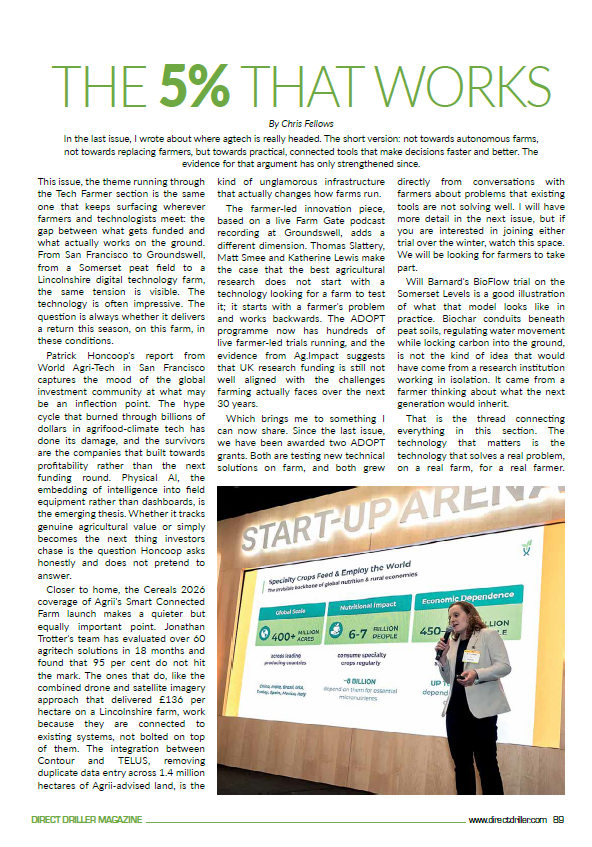
Patrick Honcoop’s report from World Agri-Tech in San Francisco captures the mood of the global investment community at what may be an inflection point. The hype cycle that burned through billions of dollars in agrifood-climate tech has done its damage, and the survivors are the companies that built towards profitability rather than the next funding round. Physical AI, the embedding of intelligence into field equipment rather than dashboards, is the emerging thesis. Whether it tracks genuine agricultural value or simply becomes the next thing investors chase is the question Honcoop asks honestly and does not pretend to answer.
Closer to home, the Cereals 2026 coverage of Agrii’s Smart Connected Farm launch makes a quieter but equally important point. Jonathan Trotter’s team has evaluated over 60 agritech solutions in 18 months and found that 95 per cent do not hit the mark. The ones that do, like the combined drone and satellite imagery approach that delivered £136 per hectare on a Lincolnshire farm, work because they are connected to existing systems, not bolted on top of them. The integration between Contour and TELUS, removing duplicate data entry across 1.4 million hectares of Agrii-advised land, is the kind of unglamorous infrastructure that actually changes how farms run.
The farmer-led innovation piece, based on a live Farm Gate podcast recording at Groundswell, adds a different dimension. Thomas Slattery, Matt Smee and Katherine Lewis make the case that the best agricultural research does not start with a technology looking for a farm to test it; it starts with a farmer’s problem and works backwards. The ADOPT programme now has hundreds of live farmer-led trials running, and the evidence from Ag.Impact suggests that UK research funding is still not well aligned with the challenges farming actually faces over the next 30 years.
Which brings me to something I can now share. Since the last issue, we have been awarded two ADOPT grants. Both are testing new technical solutions on farm, and both grew directly from conversations with farmers about problems that existing tools are not solving well. I will have more detail in the next issue, but if you are interested in joining either trial over the winter, watch this space. We will be looking for farmers to take part.
Will Barnard’s BioFlow trial on the Somerset Levels is a good illustration of what that model looks like in practice. Biochar conduits beneath peat soils, regulating water movement while locking carbon into the ground, is not the kind of idea that would have come from a research institution working in isolation. It came from a farmer thinking about what the next generation would inherit.
That is the thread connecting everything in this section. The technology that matters is the technology that solves a real problem, on a real farm, for a real farmer.