I was recently introduced to the RumboJet technology for tackling docks and other weeds such as ragwort, thistles, dandelions and buttercups in grassland. Buttercups are generally a feature of acidic land and I would recommend a basic soil test and liming if this is the case, however, this high-tech sprayer is ideal for those weeds which do not respond to simple changes in management. By the time this magazine hits the shelves, LAMMA will have been and gone and many of you will have attended and you may have seen this on the CW Agri stand.
Ubiquitous nettles and thistles need no introduction, but it is worth taking a closer look at docks and ragwort, which are problematic. While not mentioned in the literature, rushes and reeds are a major challenge in the wetter parts of the British Isles and Ireland and research has shown that “weed wiping” is one of the most effective controls. It is to be hoped that these will be included in the identification technology at some point, if not already.
An easily-identifiable broad-leaved perennial weed, the dock grows at all elevations under 850 metres, which means that they can be found pretty much anywhere throughout Scotland, England, Ireland and Wales. They are difficult to eradicate for a number of reasons:
- Seed longevity in excess of 5 years (AHDB) or up to 80 years (Corteva)
- Large number of seeds / plant that can be easily spread: 8,000 (AHDB) or 80,000 (Corteva)
- Deep taproots (up to 1.5 metres)
- Plants can regenerate from root fragments
- Plants can be very long lived, especially in pastures
However, that is not to say that if controlled, docks are bad! With their deep taproots they are highly nutritious with a high mineral content and in intense grazing rotations, cattle will eat them so long as they are not allowed to grow too big. Foliar feeding urea + humic acid helps make them more digestible by increasing the Brix levels and this in turn helps control them as they never get to seed. They are not ideal in silage, which perpetuates the problem as slurry from cattle fed on the silage is then returned to the land, so the docks proliferate.
Ragwort is classed as a noxious weed and landowners have a legal obligation to control it. (One would never know, so ubiquitous is this weed!) It is particularly poisonous to horses and often spirals out of control where land is neglected or over-grazed. Sheep eat out the rosettes in early spring and this is one of the few management tools available, but not everyone carries sheep on their farm – and they do require good fencing. It is rarely found on arable land. As with docks, seed longevity is in excess of 5 years and each plant can produce 50-60,000 seeds (AHDB). If your docks and ragwort have become unmanageable, then this new technology is worth looking at.
Targeted precision treatment is always more efficient and herbicide use can be cut by up to 98% using the Rumbojet sprayer. Cutting back on chemicals is a key feature of environmentally friendly farming, but a problem with some herbicides used to treat docks is that they are also toxic to clovers. This way, both the grass / clover sward and the environment are protected.
HOW DOES IT WORK?
Developed initially as part of a university project, the RumboJet was launched in 2022 by the Allgäu Automation company, which is based in Bavaria and focusses on “technological solutions that minimize resource use, protect the environment and soil, and create real added value”. In other words, the perfect fit for regenerative farmers.
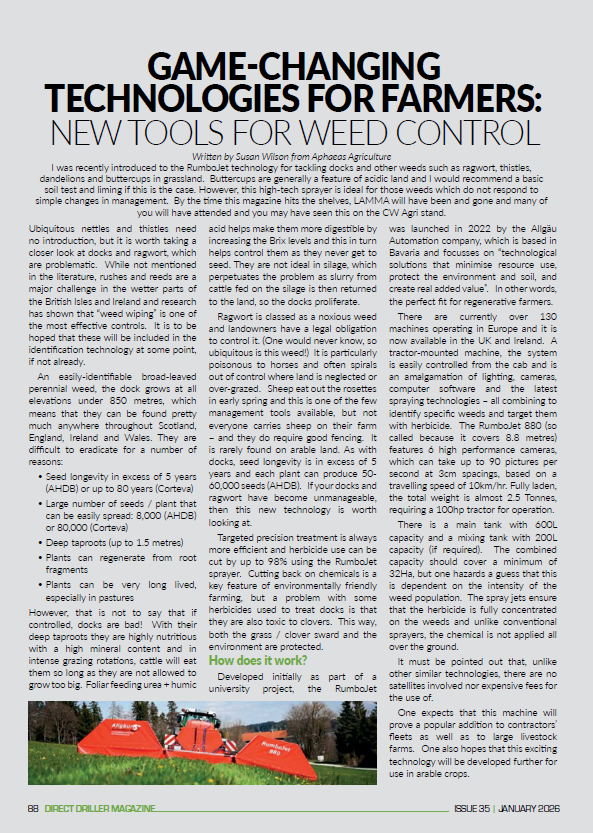
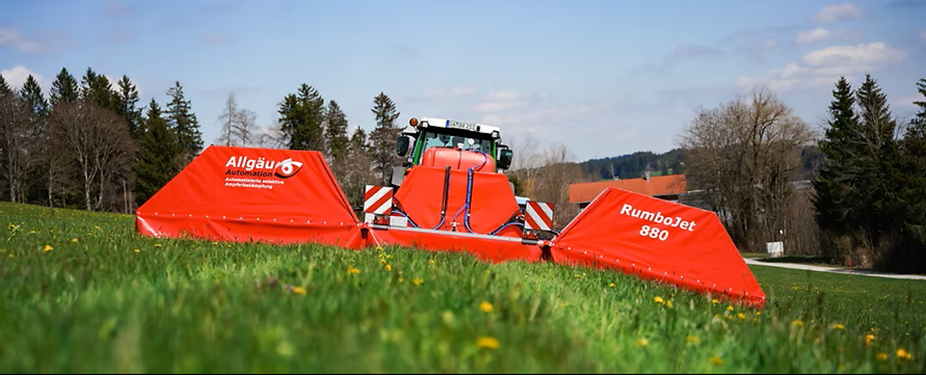
There are currently over 130 machines operating in Europe and now it is available in the UK and Ireland. A tractor mounted machine, the system is easily controlled from the cab and is an amalgamation of lighting, cameras, computer software and the latest spraying technologies – all combining to identify specific weeds and target them with herbicide. The RumboJet 880 (so called because it covers 8.8 metres) features six high performance cameras, which can take up to 90 pictures per second at 3cm spacings, based on a travelling speed of 10km/hr. Fully laden, the total weight is almost 2.5 Tonnes, requiring a 100hp tractor for operation.
There is a main tank with 600L capacity and a mixing tank with 200L capacity (if required). The combined capacity should cover a minimum of 32Ha, but one hazards a guess that this is dependent on the intensity of the weed population. The spray jets ensure that the herbicide is fully concentrated on the weeds and unlike conventional sprayers, the chemical is not applied all over the ground.
It must be pointed out that, unlike other similar technologies, there are no satellites involved nor expensive fees for the use of.
One expects that this machine will prove a popular addition to contractors’ fleets as well as to large livestock farms. One also hopes that this exciting technology will be developed further for use in arable crops.