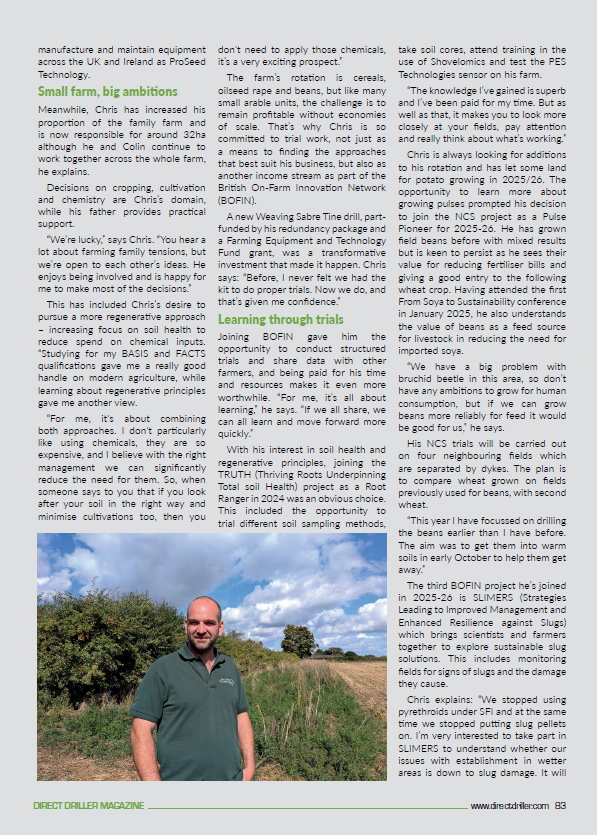
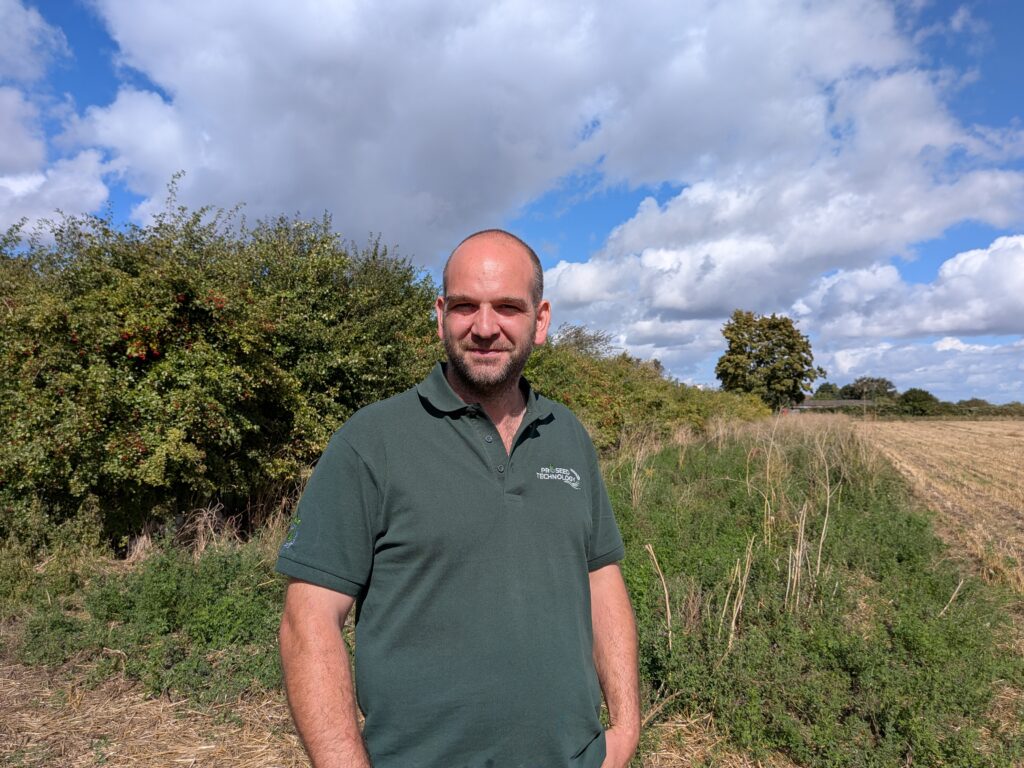
Running both a specialist engineering business and his small family farm in Lincolnshire, Chris Marshall has learned to spot opportunities and adapt quickly. Now, after a successful first year as a farmer trialist in a project led by the British On-Farm Innovation Network (BOFIN), Chris has committed to two more Defra-funded projects.
The instinct to innovate runs deep in the Marshall family. Over the past century, the farm at Gedney Hill near Spalding has produced soft fruit, dairy products, pigs and chickens, potatoes and onions, cut flowers and cereals: each shift marking a decision to adapt to new opportunities and changes in the marketplace.
Chris Marshall is continuing that, using trials and technology to build knowledge, resilience and a sustainable business. However, farming wasn’t his original career plan.
“Much as I loved the farm, I knew there was no job here for me here when I left school,” he says. Instead, he embarked on an engineering apprenticeship scheme and qualified as a foundry engineer. He enjoyed the work, but after 11 years he recognised his dream to work in agriculture and jumped at the chance to join Bayer Crop Science as a seed treatment engineer.
“Working with Bayer gave me a broader view of farming, from agronomy and seed treatments to trials,” Chris says. “I did my BASIS and FACTS qualifications too which really accelerated my interest.” The seasonal commitments of the business – and his ability to work from home – gave him the flexibility to get involved in the family’s arable unit alongside his father, Colin.
And while Chris’s ambitions for the family farm grew, Colin was keen to take a step back. This led them to divide the business, with Chris initially taking on around 8-12ha of the 40ha holding.
In 2022 Bayer made the decision to close its seed treatment business and Chris was made redundant. However, he turned this change into an opportunity and, together with a colleague, bought the seed treatment engineering business from their employer. Now having grown the business further (and recently taken on their first employee), they manufacture and maintain equipment across the UK and Ireland as ProSeed Technology.
Small farm, big ambitions
Meanwhile, Chris has increased his proportion of the family farm and is now responsible for around 32ha although he and Colin continue to work together across the whole farm, he explains.
Decisions on cropping, cultivation and chemistry are Chris’s domain, while his father provides practical support.
“We’re lucky,” says Chris. “You hear a lot about farming family tensions, but we’re open to each other’s ideas. He enjoys being involved and is happy for me to make most of the decisions.”
This has included Chris’s desire to pursue a more regenerative approach – increasing focus on soil health to reduce spend on chemical inputs. “Studying for my BASIS and FACTS qualifications gave me a really good handle on modern agriculture, while learning about regenerative principles gave me another view.
“For me, it’s about combining both approaches. I don’t particularly like using chemicals, they are so expensive, and I believe with the right management we can significantly reduce the need for them. So, when someone says to you that if you look after your soil in the right way and minimise cultivations too, then you don’t need to apply those chemicals, it’s a very exciting prospect.”
The farm’s rotation is cereals, oilseed rape and beans, but like many small arable units, the challenge is to remain profitable without economies of scale. That’s why Chris is so committed to trial work, not just as a means to finding the approaches that best suit his business, but also as another income stream as part of the British On-Farm Innovation Network (BOFIN).
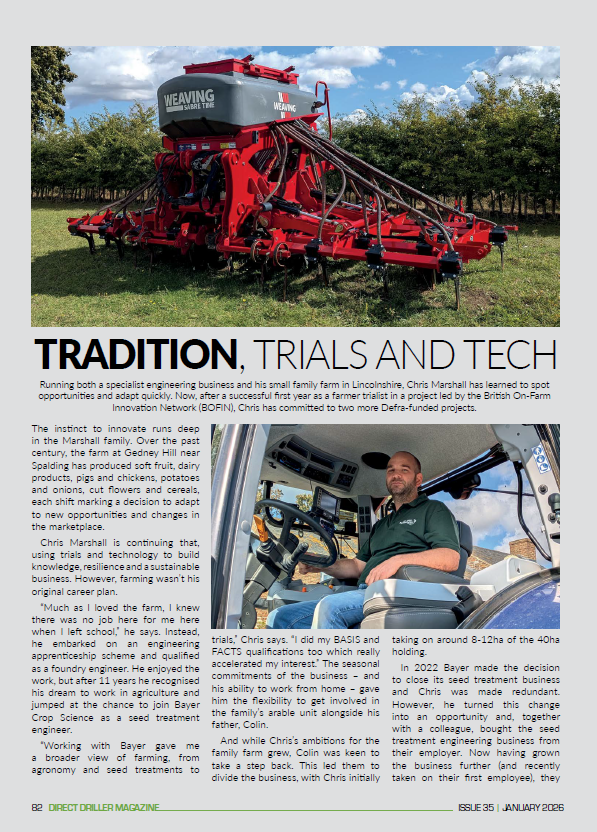
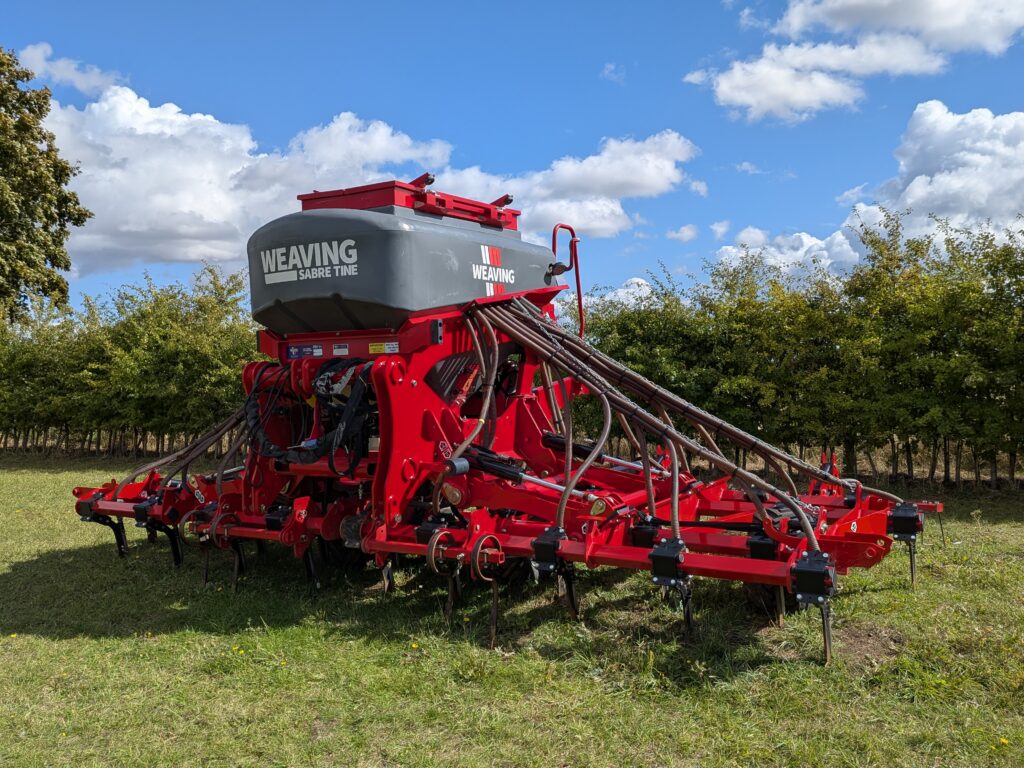
A new Weaving Sabre Tine drill, part-funded by his redundancy package and a Farming Equipment and Technology Fund grant, was a transformative investment that made it happen. Chris says: “Before, I never felt we had the kit to do proper trials. Now we do, and that’s given me confidence.”
Learning through trials
Joining BOFIN gave him the opportunity to conduct structured trials and share data with other farmers, and being paid for his time and resources makes it even more worthwhile. “For me, it’s all about learning,” he says. “If we all share, we can all learn and move forward more quickly.”
With his interest in soil health and regenerative principles, joining the TRUTH (Thriving Roots Underpinning Total soil Health) project as a Root Ranger in 2024 was an obvious choice. This included the opportunity to trial different soil sampling methods, take soil cores, attend training in the use of Shovelomics and test the PES Technologies sensor on his farm.
“The knowledge I’ve gained is superb and I’ve been paid for my time. But as well as that, it makes you to look more closely at your fields, pay attention and really think about what’s working.”
Chris is always looking for additions to his rotation and has let some land for potato growing in 2025/26. The opportunity to learn more about growing pulses prompted his decision to join the NCS project as a Pulse Pioneer for 2025-26. He has grown field beans before with mixed results but is keen to persist as he sees their value for reducing fertiliser bills and giving a good entry to the following wheat crop. Having attended the first From Soya to Sustainability conference in January 2025, he also understands the value of beans as a feed source for livestock in reducing the need for imported soya.
“We have a big problem with bruchid beetle in this area, so don’t have any ambitions to grow for human consumption, but if we can grow beans more reliably for feed it would be good for us,” he says.
His NCS trials will be carried out on four neighbouring fields which are separated by dykes. The plan is to compare wheat grown on fields previously used for beans, with second wheat.
“This year I have focussed on drilling the beans earlier than I have before. The aim was to get them into warm soils in early October to help them get away.”
The third BOFIN project he’s joined in 2025-26 is SLIMERS (Strategies Leading to Improved Management and Enhanced Resilience against Slugs) which brings scientists and farmers together to explore sustainable slug solutions. This includes monitoring fields for signs of slugs and the damage they cause.
Chris explains: “We stopped using pyrethroids under SFI and at the same time we stopped putting slug pellets on. I’m very interested to take part in SLIMERS to understand whether our issues with establishment in wetter areas is down to slug damage. It will be very useful to learn what sort of slug pressure we really have, so I’m looking forward to getting started.”
Towards a sustainable business
While Chris would like to take on more land if the opportunity arises, his ambition is not to expand for the sake of it but instead to create a business that does the right things for the environment, while also stacking up financially.
“I believe we are custodians of the land. We take care of it to hand it on in a better state. I hope I can make the business environmentally and financially sustainable – profitable enough to earn a living – and give my children the opportunity to do the same.”
Get involved
BOFIN is open to anyone interested in agricultural innovation, whether you’re a farmer, consultant, agronomist, scientist, other agri-professional, citizen scientist or ‘just curious’. Farmer members can apply to join trials, but all members are welcome to get involved in knowledge exchange and discussion.
There are still opportunities to join the NCS project as a Pulse Pioneer in 2026. To find out more and to register your interest visit www.bofin.org.uk/GetInvolved
About the projects:
TRUTH (Thriving Roots Underpinning Total soil Health) is funded by the Farming Futures R&D fund, part of Defra’s Farming Innovation Programme. Defra is working in partnership with Innovate UK, the UK’s innovation agency, who are delivering the programme. TRUTH is led by the British On-Farm Innovation Network (BOFIN) alongside partners PES Technologies, UK Agri-Tech Centre, the John Innes Centre and University of Nottingham.
SLIMERS (Strategies Leading to Improved Management and Enhanced Resilience against Slugs) is a three-year £2.6M research programme involving more than 100 farms and seven partners. Funded by Defra’s Farming Innovation Programme and delivered by Innovate UK, the project is led by BOFIN with partners the UK Agri-Tech Centre, Harper Adams University, John Innes Centre, Fotenix, Farmscan AG and Agrivation.
NCS (Nitrogen Efficient Plants for Climate Smart Arable Cropping Systems) is a four-year £5.9m research programme led by PGRO with 17 partners. It aims to enable UK agriculture to bring about a reduction of 3.4Mt CO2e per annum through increased pulse and legume cropping. The ambition is to increase pulse and legume cropping in arable rotations to 20% across the UK from the current 5% and to replace 50% of imported soya meal used in livestock feed rations with home-grown legumes. The NCS Project is funded by the Farming Futures R&D Fund: Climate smart farming, part of Defra’s Farming Innovation Programme, and is delivered by Innovate UK.