Written by Chris Fellows
The promise of a high-tech farming future is here, but for many UK farmers it remains tantalisingly out of reach. We are caught in a dangerous limbo: a “Gramsci Gap” where the old ways of farming are dying, but the new, tech-driven world is struggling to be born.
As a farming journalist (self-declared non-official title), I’ve seen more than my share of glossy brochures and slick presentations showcasing the latest in agritech. Drones that map fields with pinpoint accuracy, robots that zap weeds with lasers, and AI systems that predict yields to the last kilogram. This is the future we’ve been promised: a cleaner, more efficient and more profitable agricultural sector. Yet, for all the hype, a walk around the average UK farm tells a different story. The reality on the ground is one of frustratingly slow adoption.
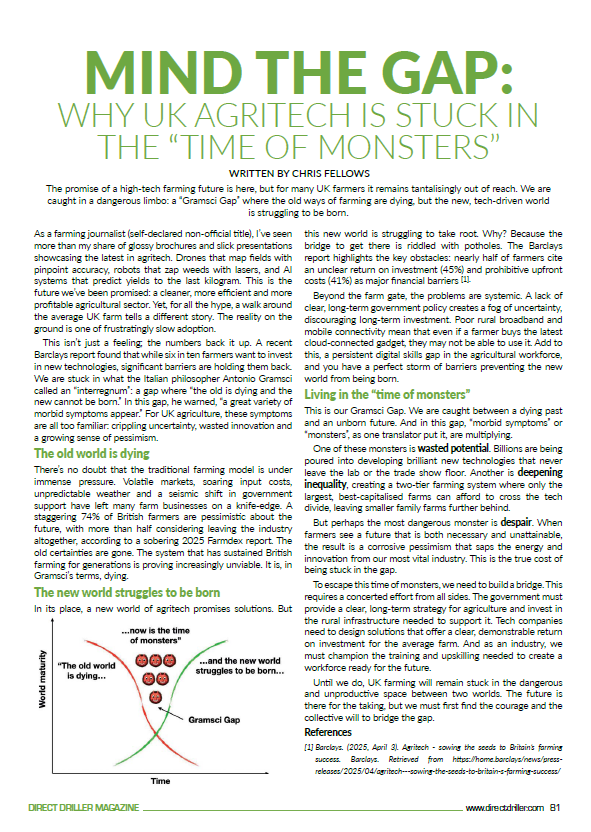
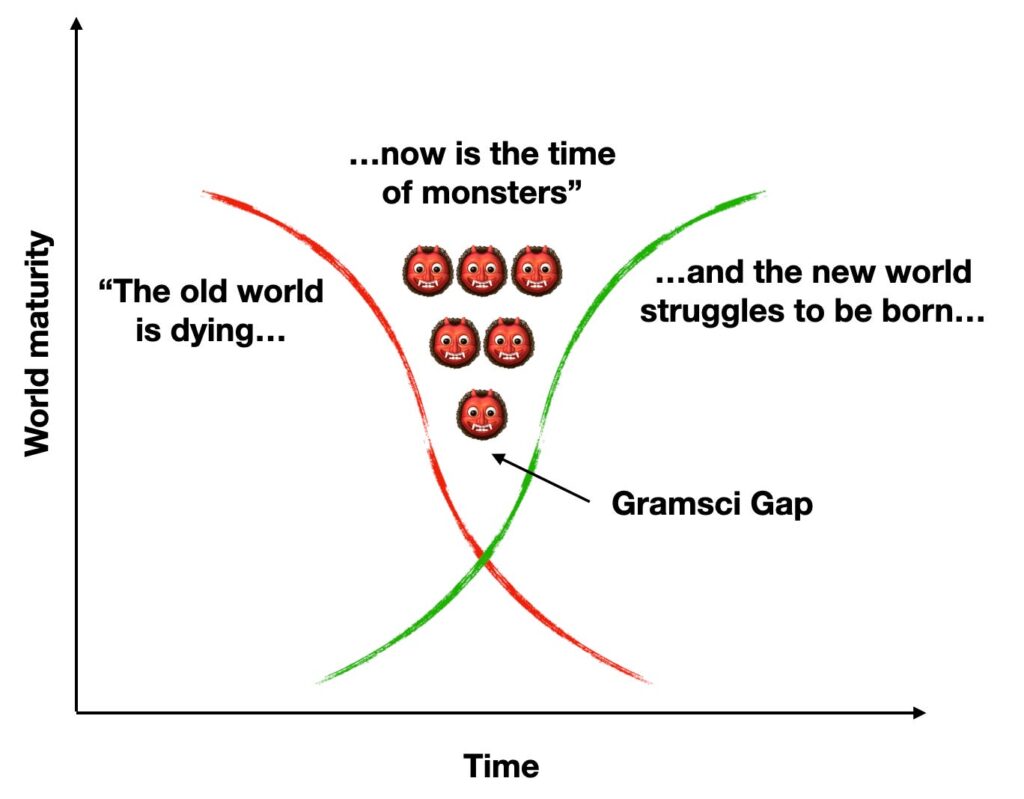
This isn’t just a feeling; the numbers back it up. A recent Barclays report found that while six in ten farmers want to invest in new technologies, significant barriers are holding them back. We are stuck in what the Italian philosopher Antonio Gramsci called an “interregnum”: a gap where “the old is dying and the new cannot be born.” In this gap, he warned, “a great variety of morbid symptoms appear.” For UK agriculture, these symptoms are all too familiar: crippling uncertainty, wasted innovation and a growing sense of pessimism.
The old world is dying
There’s no doubt that the traditional farming model is under immense pressure. Volatile markets, soaring input costs, unpredictable weather and a seismic shift in government support have left many farm businesses on a knife-edge. A staggering 74% of British farmers are pessimistic about the future, with more than half considering leaving the industry altogether, according to a sobering 2025 Farmdex report. The old certainties are gone. The system that has sustained British farming for generations is proving increasingly unviable. It is, in Gramsci’s terms, dying.
The new world struggles to be born
In its place, a new world of agritech promises solutions. But this new world is struggling to take root. Why? Because the bridge to get there is riddled with potholes. The Barclays report highlights the key obstacles: nearly half of farmers cite an unclear return on investment (45%) and prohibitive upfront costs (41%) as major financial barriers [1].
Beyond the farm gate, the problems are systemic. A lack of clear, long-term government policy creates a fog of uncertainty, discouraging long-term investment. Poor rural broadband and mobile connectivity mean that even if a farmer buys the latest cloud-connected gadget, they may not be able to use it. Add to this, a persistent digital skills gap in the agricultural workforce, and you have a perfect storm of barriers preventing the new world from being born.
Living in the “time of monsters”
This is our Gramsci Gap. We are caught between a dying past and an unborn future. And in this gap, “morbid symptoms” or “monsters”, as one translator put it, are multiplying.
One of these monsters is wasted potential. Billions are being poured into developing brilliant new technologies that never leave the lab or the trade show floor. Another is deepening inequality, creating a two-tier farming system where only the largest, best-capitalised farms can afford to cross the tech divide, leaving smaller family farms further behind.
But perhaps the most dangerous monster is despair. When farmers see a future that is both necessary and unattainable, the result is a corrosive pessimism that saps the energy and innovation from our most vital industry. This is the true cost of being stuck in the gap.
To escape this time of monsters, we need to build a bridge. This requires a concerted effort from all sides. The government must provide a clear, long-term strategy for agriculture and invest in the rural infrastructure needed to support it. Tech companies need to design solutions that offer a clear, demonstrable return on investment for the average farm. And as an industry, we must champion the training and upskilling needed to create a workforce ready for the future.
Until we do, UK farming will remain stuck in the dangerous and unproductive space between two worlds. The future is there for the taking, but we must first find the courage and the collective will to bridge the gap.
References
[1] Barclays. (2025, April 3). Agritech – sowing the seeds to Britain’s farming success. Barclays. Retrieved from https://home.barclays/news/press-releases/2025/04/agritech—sowing-the-seeds-to-britain-s-farming-success/