The first three gene-edited cereals are being submitted for approval to be drilled in commercial farm trials in England during 2026. Tom Allen-Stevens explains the new regulatory regime.
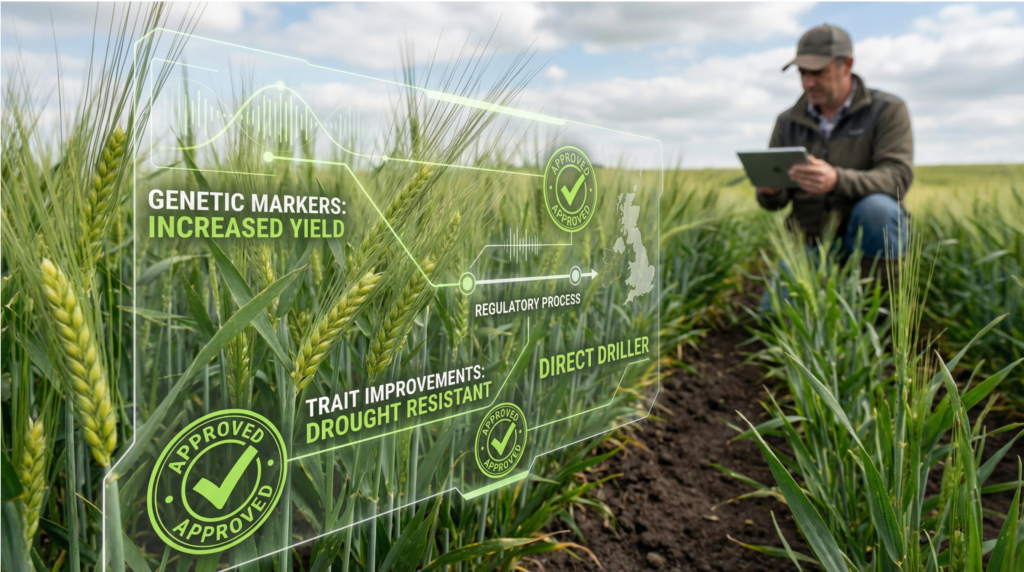
New regulations governing the development, release and marketing of precision-bred crops in England came into force in November, marking a major step in the implementation of the Genetic Technology (Precision Breeding) Act 2023.
The secondary legislation – the Genetic Technology (Precision Breeding) (England) Regulations 2025 – sets out in detail how gene-edited plants can be field-trialled and placed on the market, provided they meet the legal definition of being “precision bred”. This creates a new regulatory route where genetic changes could have arisen through traditional breeding distinct from the route for genetically modified organisms (GMOs).
At the heart of the framework is a two-stage process: notification to Defra for release and marketing of precision-bred plants, and authorisation by the Food Standards Agency (FSA) for food and feed use.
Two winter wheats and a spring barley have been or will be submitted for approval by the John Innes Centre and Rothamsted Research, as part of the Defra-funded PROBITY project (Platform to Rate Organisms Bred for Improved Traits and Yield). Carrying novel traits with potential benefits for farmers, food manufacturers, consumers and UK agriculture’s net zero ambitions, seed is currently being multiplied up and may be planted on commercial farms in England as early as spring 2026 (see panel for more details).
What counts as precision bred?
Under the Act, a precision-bred organism is one in which genetic changes have been made using modern biotechnology, but where the resulting genetic sequences could have arisen naturally or through conventional breeding. This includes techniques such as gene editing, provided no foreign DNA remains in the final organism.
Developers must be able to demonstrate that threshold clearly, and the new regulations spell out the information required to do so.
Releasing precision-bred plants
Anyone intending to release a precision-bred plant into the environment for research – for example, through field trials – must submit a Release Notice to Defra at least 20 days before planting.
One notice can cover multiple trial sites, multiple years and multiple organisations, provided there is a single notifier who takes responsibility. Different plant lines can also be grouped within a single notice, as long as they are of the same species and fall within a shared “general description”.
That general description must include the species involved, the intended trait changes, the types of genetic changes introduced and the techniques used to make them. The notifier must also confirm that all plants covered by the notice meet the legal criteria for precision-bred organisms, and that appropriate measures are in place to prevent material from being marketed prematurely.
The regulations also include transitional arrangements for plants previously notified as Qualifying Higher Plants under earlier rules. Where those plants have already been field-trialled, no new notification is required. Where they have been notified but not yet planted, they can be grown immediately, provided a precision-breeding notification is submitted within three months of the regulations coming into force.
From trials to market
Before a precision-bred plant can be marketed, Defra must formally confirm its status. This requires submission of a Marketing Notice, which is considerably more detailed than a release notification.
Marketing Notices must include comprehensive information on the intended genetic changes, their location and stability, and – critically – evidence on any unintended genetic changes. Developers must describe how they checked for unintended changes, how any were removed, and how they confirmed that the final organism contains only genetic sequences that could arise through traditional processes.
Multiple plants can again be grouped within a single notice, but only where they are from the same species, use the same precision-breeding techniques and share the same trait alterations.
The Advisory Committee on Releases to the Environment (ACRE) has up to 90 days to review the information and provide Defra with a recommendation on regulatory status. ACRE can request further information during that period, which developers must supply within a further 90 days.
Defra also retains the power to revoke a precision-bred confirmation if false or misleading information comes to light, or if new genetic evidence emerges. Where confirmation is withdrawn, any food or feed derived from that plant automatically loses its authorisation.
Food and feed authorisation
Even with Defra confirmation in place, precision-bred plants cannot enter the food or feed chain without approval from the Food Standards Agency (FSA). The FSA framework forms the second stage in the approval process and introduces two regulatory routes.
A Tier 1 route applies where the precision-bred organism clearly meets defined safety and eligibility criteria. Applications under this route are applicant-led and may be subject to audit checks.
Where those criteria are not fully met, applications fall under Tier 2, triggering a more bespoke assessment. In those cases, applicants must submit additional supporting evidence, and the FSA can request further information as part of its evaluation.
While the FSA has not issued detailed information on timelines and review periods, Tier 1 is generally regarded to be a relatively brief, “light-touch” approach. Tier 2 timescales and the cost for developers will depend heavily on the nature of additional information requested. Feeding trials, such as those often required under GMO regulations can take years to complete and are viewed by many commercial developers as prohibitively expensive and time-consuming.
Transparency and enforcement
Both Defra and the FSA are required to maintain public registers of precision-bred organisms, including information from release and marketing notices. While developers can request confidentiality for commercially sensitive information, the general description of a precision-bred organism cannot be withheld.
The regulations also establish inspection and enforcement powers. Inspectors can enter premises where there is reasonable suspicion of non-compliance, take samples and documents, and issue compliance, stop or monetary penalty notices. Decisions can be reviewed and appealed through formal processes.
A new regulatory landscape
Taken together, the regulations complete the legal framework needed to move precision-bred crops from laboratory to field and, ultimately, to market in England. For developers, the emphasis is on robust documentation and traceability. For policymakers, the challenge will be ensuring the system remains proportionate, transparent and trusted as the first commercial applications begin to emerge.
EU framework on NGTs inches forward
The European Union has reached a provisional political agreement on a new regulatory framework for New Genomic Techniques (NGTs) — its term for gene-editing and similar precision-breeding methods — that could reshape how such crops are treated in the EU.
Once formally adopted and published, the agreed rules will create two distinct pathways for NGT plants entering the EU market. Category 1 NGT plants are those with changes that could also occur naturally or through conventional breeding. They will undergo a verification procedure and, if they meet defined criteria, will not be regulated under the current GMO regime. Category 2 NGT plants, with more complex or engineered changes, will still be subject to full GMO-style authorisation, traceability and labelling requirements before they can be marketed.
The agreement also includes measures on transparency, monitoring and oversight of licensing practices and intellectual property, aimed at ensuring farmer and breeder access to new varieties.
These provisional rules still need formal adoption by the European Parliament and Council and will take around two years to apply after publication in the Official Journal. This means commercial NGT crops are unlikely to appear on commercial farms in the EU before 2029–2030. This timeline continues to place the UK’s precision-breeding regulatory framework significantly ahead in practical application.
Farmers set to probe precision-bred cereals
Three of the first crops being submitted to ACRE for approval are being developed as part of the PROBITY project. The three-year £2.2M study, led by the British On-Farm Innovation Network (BOFIN), aims to drill these cereals on up to 10 commercial farms in England during 2026.
The three crops are:
- Wheat with superior processing properties and food safety – This is a line of Cadenza winter wheat, edited by Rothamsted Research to be low in asparagine. This natural amino acid forms acrylamide – a known carcinogen – when baked or toasted. Breakfast cereal and biscuit manufacturers currently use additives or extra processing to avoid acrylamide formation. The low-acrylamide wheat will allow them more flexibility to make potentially healthier and tastier products. The plan is to plant enough wheat in autumn 2026 to process at batch-scale, producing around 50-80t in total.
- Bigger, bolder wheat – A trait first identified in the tetraploid wheat Triticum polonicum, this line of Fielder spring wheat has been edited by John Innes Centre so that it should form longer glumes and grain. Initial assessments have found the change produces wheat with longer grains, but effects on yield and nitrogen use efficiency are not yet known. The plan is to plant the crop on up to eight farms during late autumn and early spring 2026/27 to assess nitrogen regimes, yield and quality through tramline trials.
- High lipid forage – This is an edit that has been made by Rothamsted Research to spring barley to deactivate a gene that breaks down lipids in plant tissue. This results in higher levels of lipid (and energy) in the leaves, stem and grain. The edit has been made to barley, which is quicker to breed than ryegrass, and enough seed has been produced to plant around 6-7ha as early as spring 2026. This will then be made into wholecrop silage and fed to dairy cows with performance closely monitored. If the silage is higher in lipid (and energy), this could improve production efficiency and significantly lower methane emissions. Alongside the trials, Aberystwyth University is working to bring the edit into ryegrass.
The crops will be grown alongside unedited versions of the same variety with the trial protocol geared towards monitoring any effects of the trait on field performance. The farmers will also monitor and record co-existence and storage arrangements to ensure integrity of the precision-bred produce, other crops on the farm and in neighbouring fields.
As a farmer-led project, one key aspect of PROBITY is an emphasis on transparency and openness – discussions are already underway on the Sequence Circle. This community of farmers, scientists and others with an interest in precision breeding, is free to join and is hosted on The Farming Forum.
But while knowledge will be shared far and wide on the new technology and how the crops perform in the field, the produce itself won’t. Grown under closed contracts and research conditions, none of the produce will be made available to the open market. This is to ensure cultivation of the crops in no way compromises the Sanitary and Phytosanitary (SPS) Agreement currently being negotiated with the EU, where precision-bred crops are still treated as genetically modified organisms.
For more on PROBITY and farmer-led trials currently underway, see issue 3 of BOFIN Insight, enclosed with this edition of Direct Driller.
But will you want to grow them?
The only published survey to date capturing UK farmers’ views on gene-edited crops shows strong support for the technology, alongside clear conditions around regulation, trialling and public trust.
The survey, carried out by BOFIN in 2023, explored attitudes to genetically modified organisms (GMOs) and precision-bred organisms (PBOs) among farmers and others involved in agricultural innovation. A total of 85 respondents* took part, of whom 81% were farmers, making it the most detailed publicly available snapshot of farmer sentiment on gene editing at a time when new regulations are now coming into force in England.
The results highlight a marked distinction in how farmers view GMOs compared with precision breeding. While opinions on GMOs were mixed, with 49% saying they would be happy to grow GM crops commercially if approved, support for precision-bred crops was far stronger. More than four-fifths (81%) of respondents said they would be happy to grow precision-bred crops commercially if approved for cultivation in the UK, with only 4% opposed outright.
Farmers described precision breeding as a “common sense” and “science-led” progression from conventional breeding, offering a faster and more targeted route to improved traits. Respondents consistently emphasised the potential for PBOs to contribute to farm business sustainability, resilience and reduced reliance on crop protection inputs, provided the underpinning research was robust and transparent.
The survey also explored attitudes to co-existence measures for those who do not wish to grow precision-bred crops. Views were nuanced. While 25% felt no specific measures were needed, the largest group (35%) supported voluntary agreements in which PBO growers would take responsibility for minimising any risk of cross-contamination. Only 21% favoured mandatory buffer zones set through regulation.
Farmers were asked how traits derived through new genetic technologies should be prioritised, from a choice of food safety, nutrient use efficiency, pest and disease resistance, and drought/salinity tolerance, spanning traits that address both productivity and wider societal benefit. Preference was shown for productivity traits, with food safety seen as lowest priority. However, many respondents stressed that all the traits were important and should be actively pursued.
On research and development, farmers expressed a strong preference for approaches that combine cutting-edge science with farmer-led trialling. Almost equal numbers favoured science-led innovation using the latest genetic tools (45%) with 42% favouring farmer-led development to integrate new traits into practical farming systems.
Taken together, the findings suggest farmers are open – and in many cases enthusiastic – about precision breeding but expect it to be delivered through well-designed on-farm trials, proportionate regulation and clear communication with the public. As one respondent put it: “carrying the customer will be essential”.
More research to assess how farmers and other stakeholders feel about precision-bred crops is currently underway as part of the PROBITY project, and is led by University of Nottingham. Results and progress are published on the Sequence Circle.*All respondents were BOFIN members so results cannot be interpreted as the views of farmers in general. Significantly, 62% of BOFIN members identify as pioneers, keen to try a new technology, according to a survey conducted in 2025. AHDB research conducted in 2021 showed almost 70% of farmers show a strong preference for theorist learning – they prefer to learn from the experience of other farmers.