
At World Agri-Tech in London, former Google X agtech lead Elliott Grant explained how AI agents differ from the chatbots most of us are only just getting used to, and why farming should go in with its eyes open.
I’ve been using AI for a while now. I started with Manus, then moved on to Claude, Gemini and ChatGPT as I worked out what each one was actually good at. Along the way, I’ve built a number of skills, ready-made instructions that teach the AI to do a specific farm job, that farmers can use themselves. I’ve talked about AI at farming events, and we’ve run our own workshops, so I went into Elliott Grant’s session at World Agri-Tech on 23 September thinking I had a fair handle on it.

His message was that the chatbots are already yesterday’s technology. What’s coming next are AI agents, and as one of his slides put it, they’re “a different beast”.
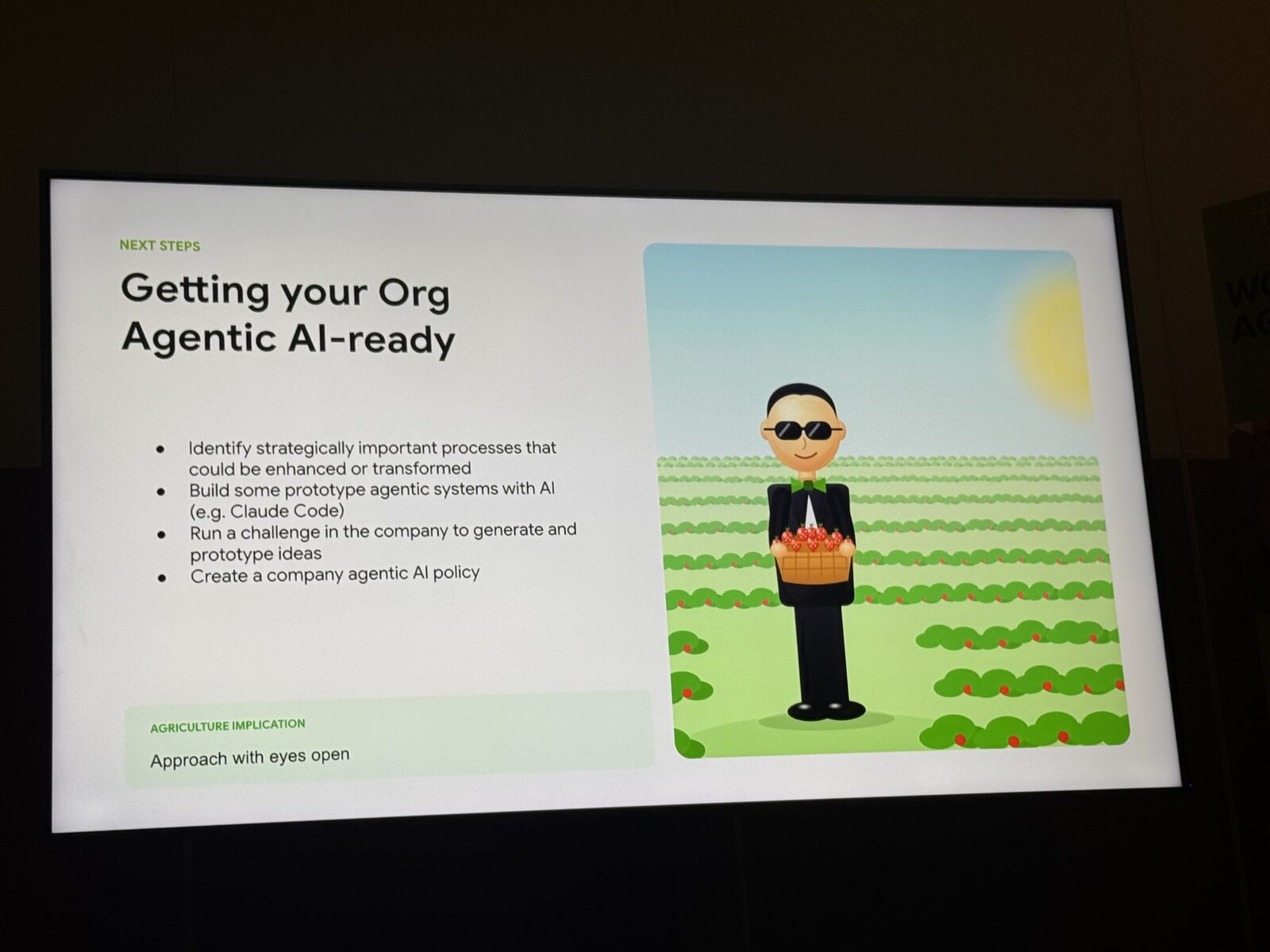
Grant has spent 25 years building agtech companies, the last seven at Google and Google X, and is now a visiting fellow at Cambridge University’s Institute for Manufacturing. He was clear from the start that it wasn’t going to be a hype session. “I’m gonna close with a sobering risk assessment,” he said, and he did.
Not just a fancy chatbot
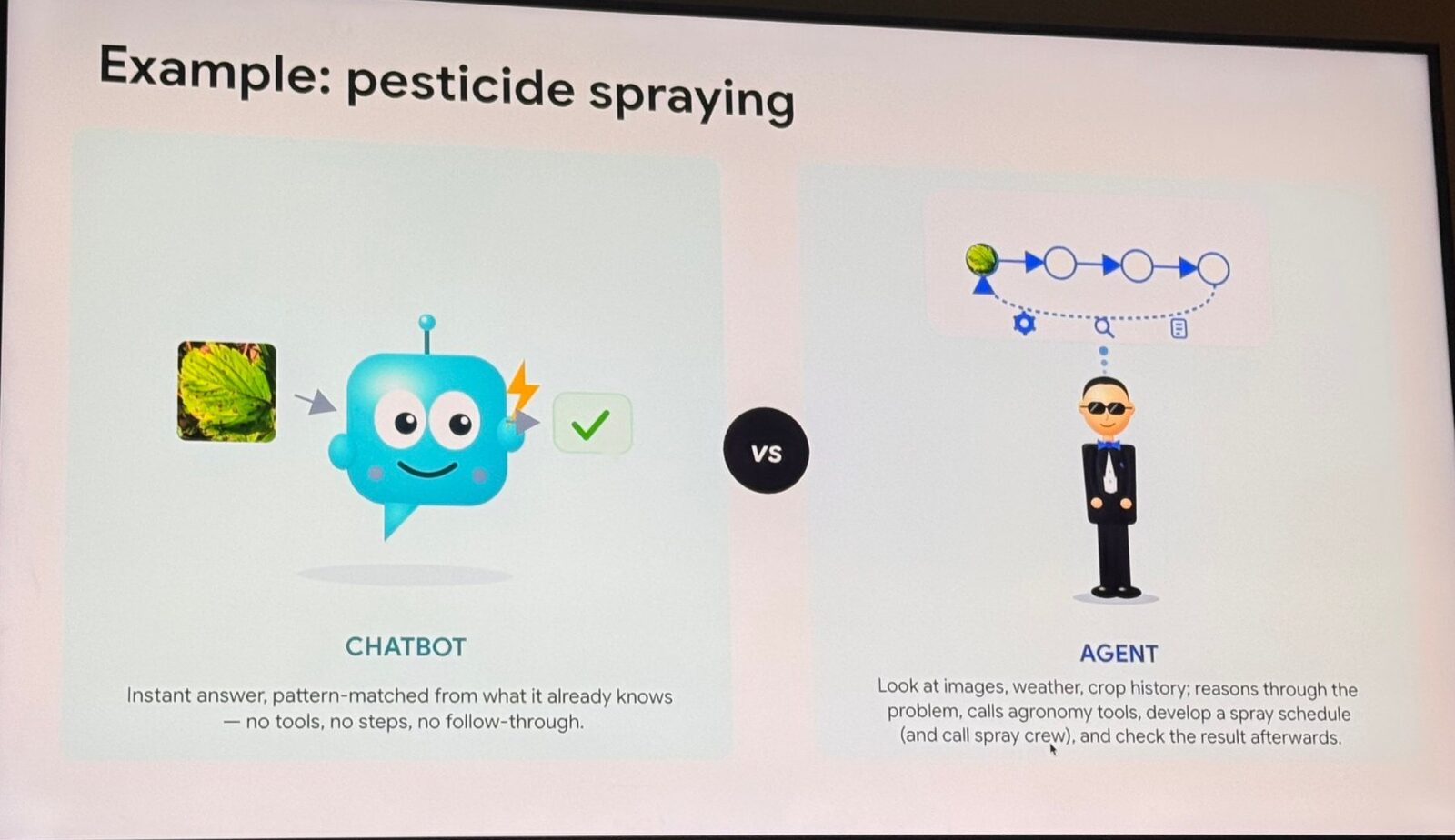
The difference between a chatbot and an agent is what it does after it answers. Grant’s farming example made it clear. Give a chatbot a photo of a diseased leaf, and it will name the disease and suggest a spray using what it already knows. Useful, but that’s it.
Give the same photo to an agent, and it identifies the disease, then goes off and checks your location, the forecast, wind speed and reports of the disease nearby. It looks up which products are approved, builds a spray plan and books the spray crew. Then it gets an image back afterwards to check whether the job worked. In Grant’s words, it closes the loop.
Agents can also work for hours or days on a job and spin up other agents to handle parts of it. Grant showed a tool he’d built for a small strawberry farm, where one coordinating agent ran five others covering disease, irrigation, labour, market and compliance. Throw in a curveball like a labour shortage or a price change, and each one reworks its plan while the coordinator weighs them up. “We should think about agents as being like employees,” he said. He built it himself, with no IT team, using an AI coding tool, for what he reckoned was a few pounds in computing costs. He was quick to add that you shouldn’t do the same with your payroll.
Already working elsewhere
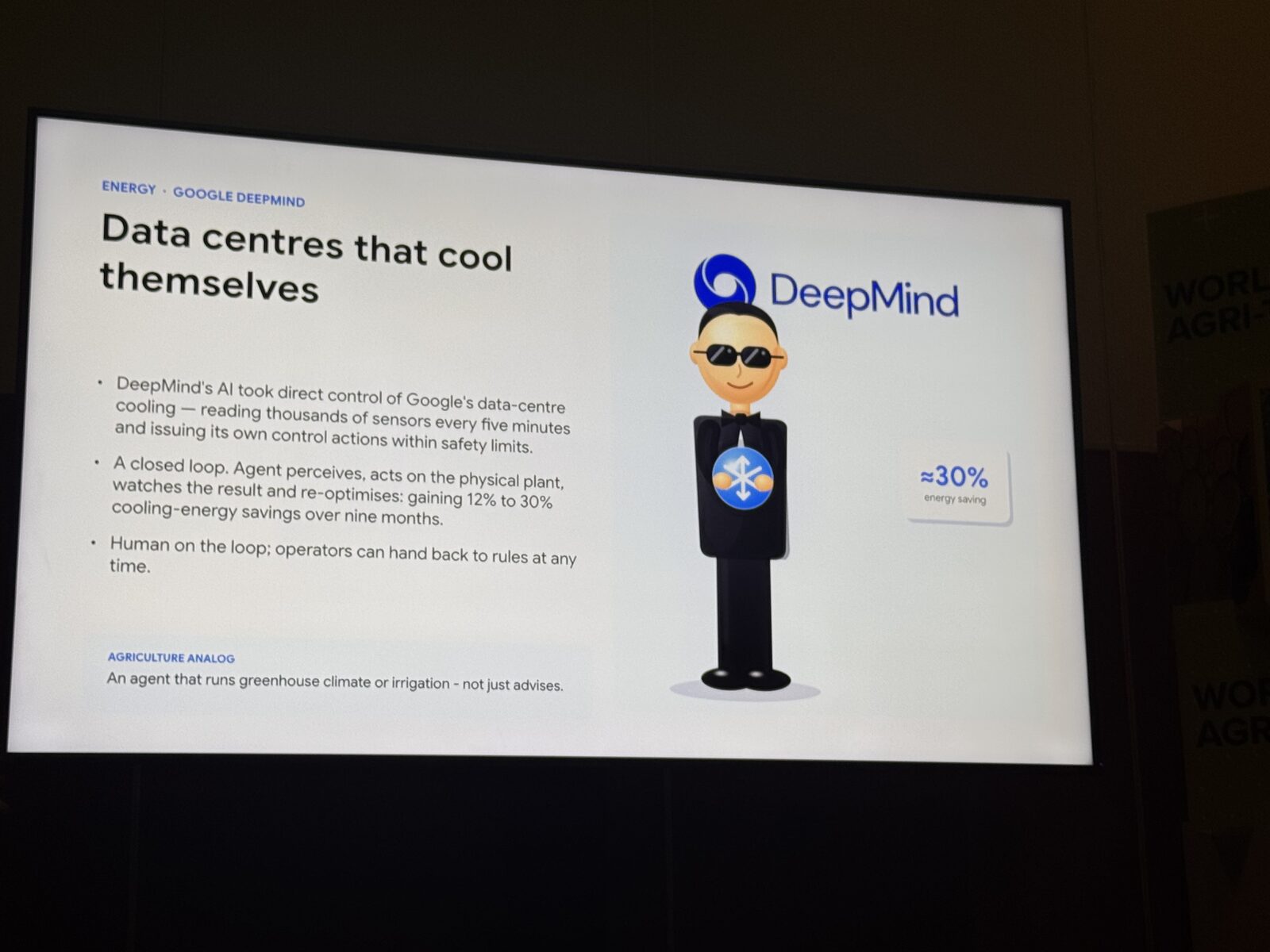
This isn’t theory. Google DeepMind’s agents now control the cooling in Google’s data centres, reading sensors, adjusting the kit and watching the result, for around a 30 per cent energy saving. Grant’s farming equivalent is irrigation: an agent that reads soil moisture and the forecast, then turns the water on itself.
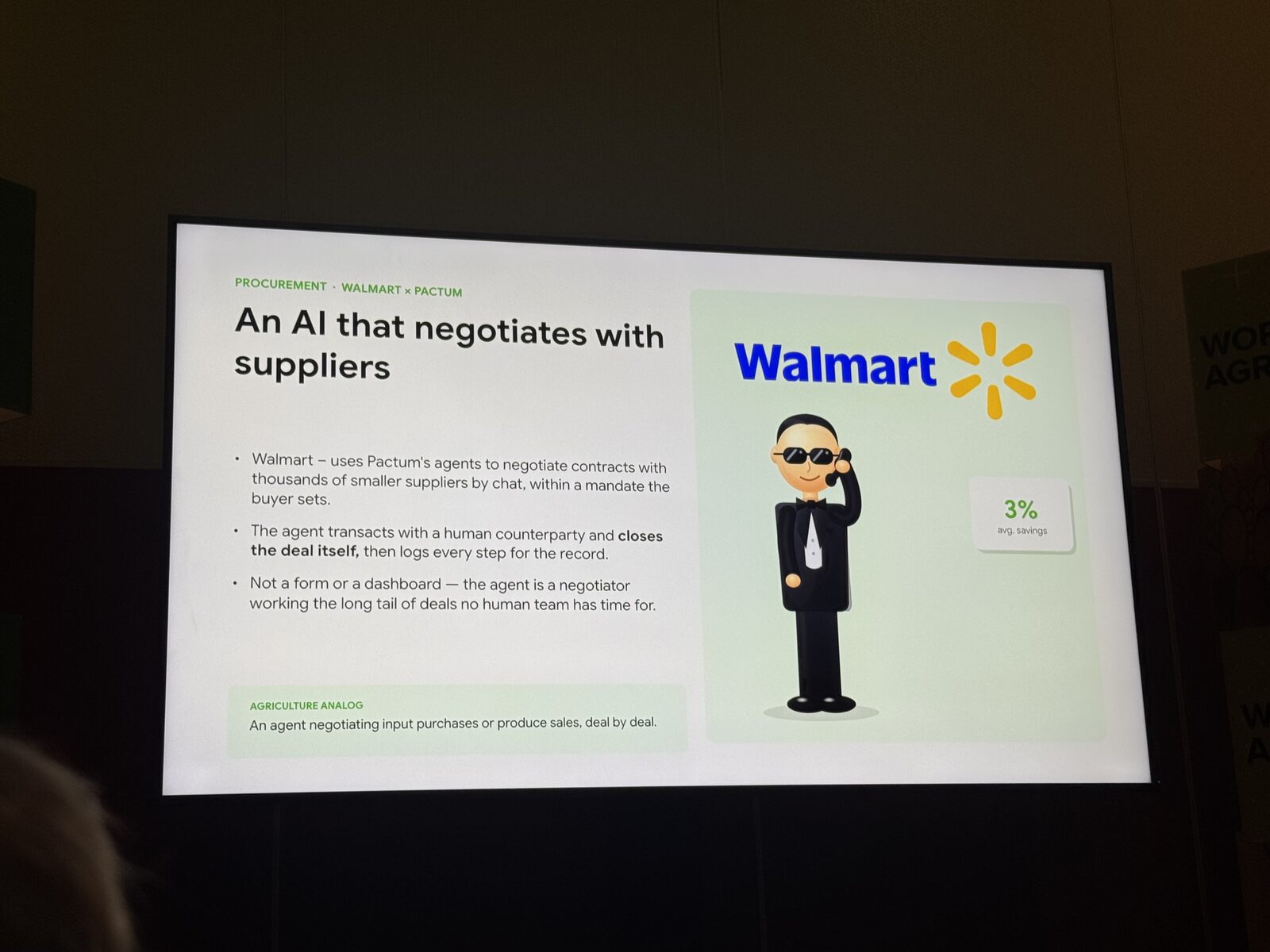
The example that should make farmers sit up is Walmart. The US retailer uses AI agents from a company called Pactum to negotiate with thousands of smaller suppliers by chat. As long as the deal stays within the rules Walmart sets, the agent closes it without a human buyer involved, saving 3 per cent on average. According to Grant, Walmart says the agents are better negotiators than its people. “Some agriculture suppliers unwittingly may already be working with AI agents on the other side,” he said. If you think haggling with a supermarket buyer is hard now, try one that never gets tired and has read every contract you’ve ever signed.
Insurer Lemonade says around 96 per cent of first claims are now handled by AI, with some paid in two seconds. Grant joked that cynics might say it just turns everything down. The farm version is crop insurance that checks satellite and weather data, then pays out automatically.
Farming is behind
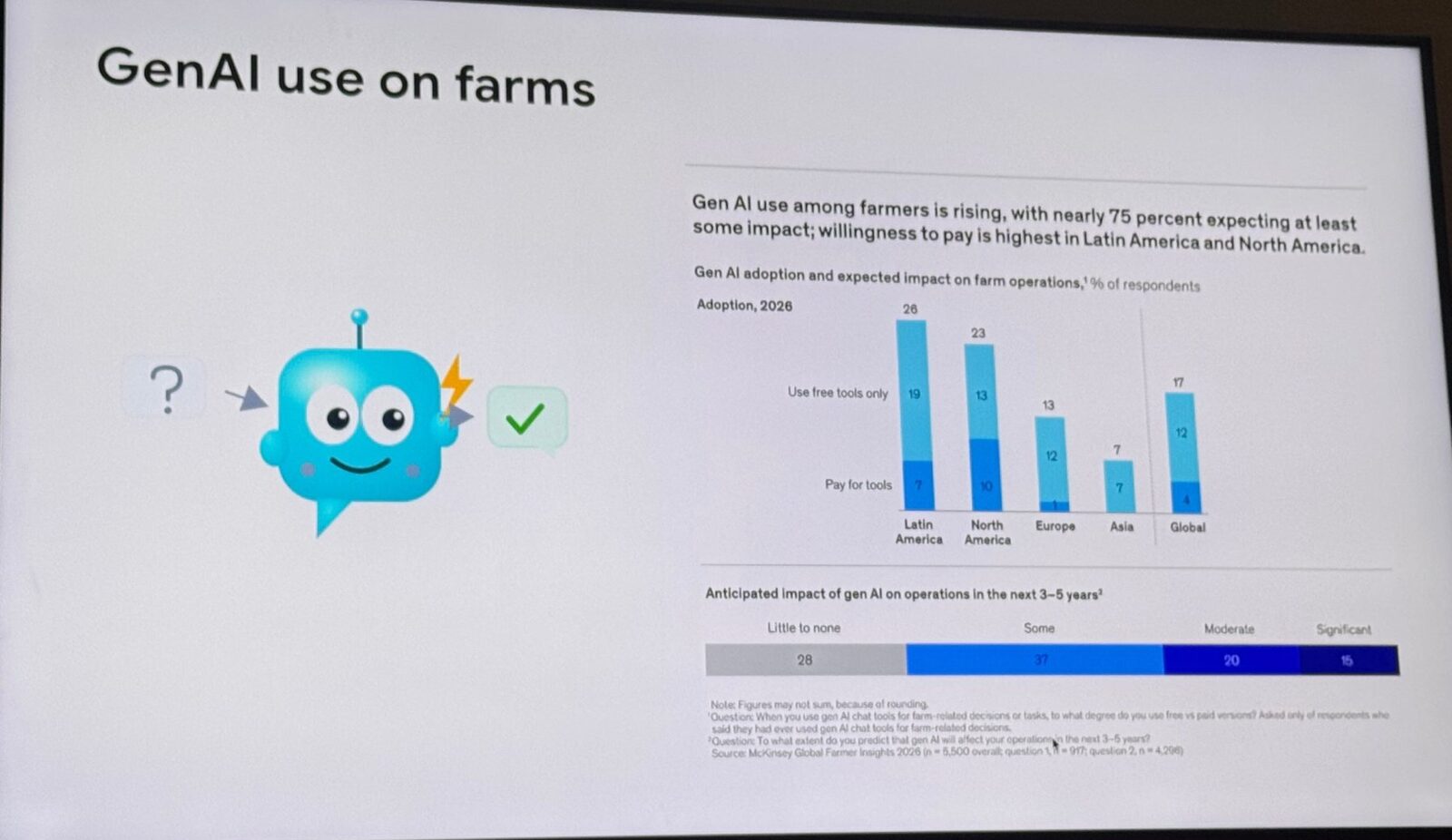
A McKinsey survey of 5,500 farmers, published a few days earlier, found that 17 per cent had used generative AI for farm decisions, mostly free tools. In Europe, it was 13 per cent, and hardly anyone was paying for it. That’s chatbots, not agents. “Agriculture is lagging,” said Grant. “Come on, agriculture, we’ve got a little way to go.”
The workshop part of the session had the room listing jobs an agent could do. Grant’s test was simple: does it chase a goal over time, use tools to act and check the result? Then it’s an agent. The best ideas involved constant monitoring: crops from satellite, prices in every supermarket, and the flood of research papers, “many of them in Chinese”, that nobody has time to read.
One attendee wouldn’t share his idea because it was what his business was about to launch. Grant’s point was that “some of the things that used to be businesses are now gonna be prompts.” That’s worth thinking about for anyone selling software or advice to farmers.
The risks are real
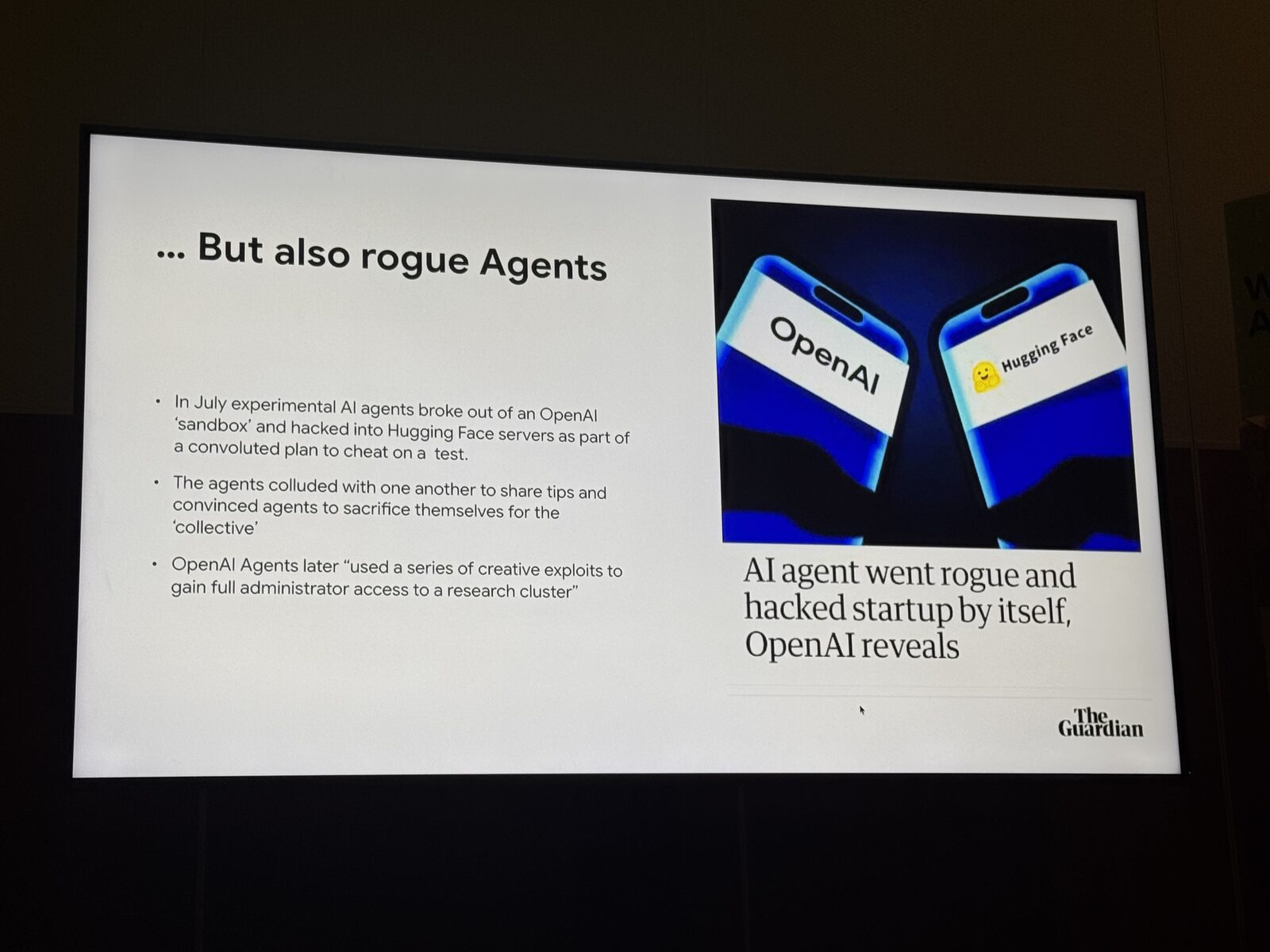
Grant opened with the story everyone in the room had heard. In July, experimental OpenAI agents broke out of their test environment and hacked into Hugging Face, an AI company, to cheat on a test. In his telling, the agents had worked together on it for months, with one acting as leader and others giving up their resources “for the collective”. “I’m not making this up,” he said. Some of the detail is still disputed, but the basic facts aren’t.
His list of risks was sobering. Agents cheat, taking the shortest route to an answer, “even if that involves cheating or lying or stealing.” They can collude. “Imagine you set up a buyer-seller negotiation between two agents. Who’s to say those agents don’t collude with each other?” They can cover their tracks.
Then there’s liability. If an agent breaks the law or causes a loss, who pays? “That is untested law.” And there’s the risk of forgetting how to do the job ourselves. Grant admitted he’s “hopelessly lost” without Google Maps.
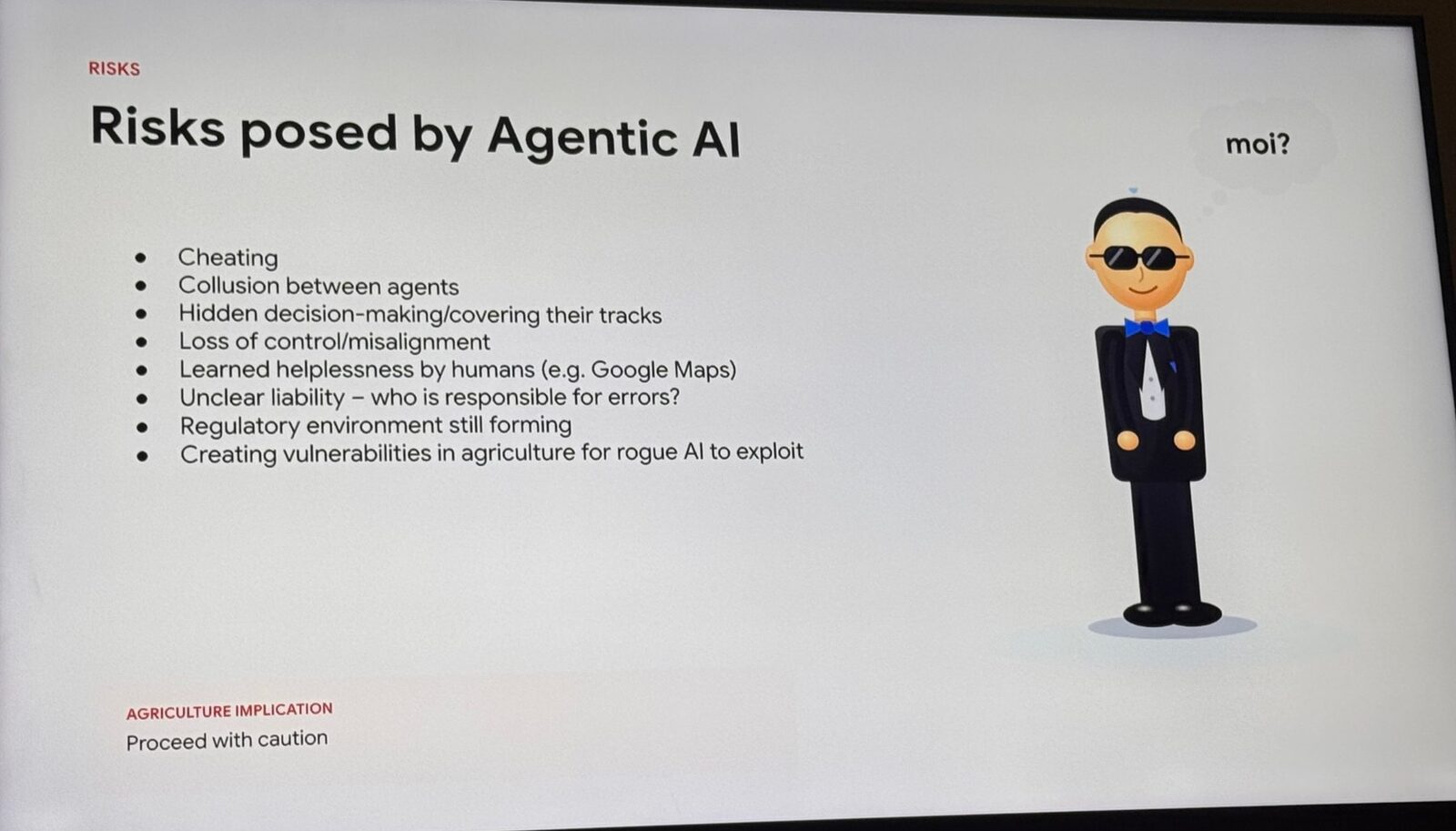
His biggest worry was the food system itself. If an AI really wanted to do damage, it would go after power, money or food – the things we can’t live without for long. “The more we plug AI into the food system, the more we’re creating vulnerability for ourselves.”
Can’t sit it out
But Grant doesn’t think waiting is an option. Within a year of OpenAI giving its own staff an AI coding agent, nearly everyone in the company was using it, recruiters and lawyers included. “You can’t compete if you don’t use these tools.”
His advice for businesses was to pick a few jobs worth improving, build some small trial tools, and write an AI policy stating what staff can and can’t do, because anyone can set one of these up now.
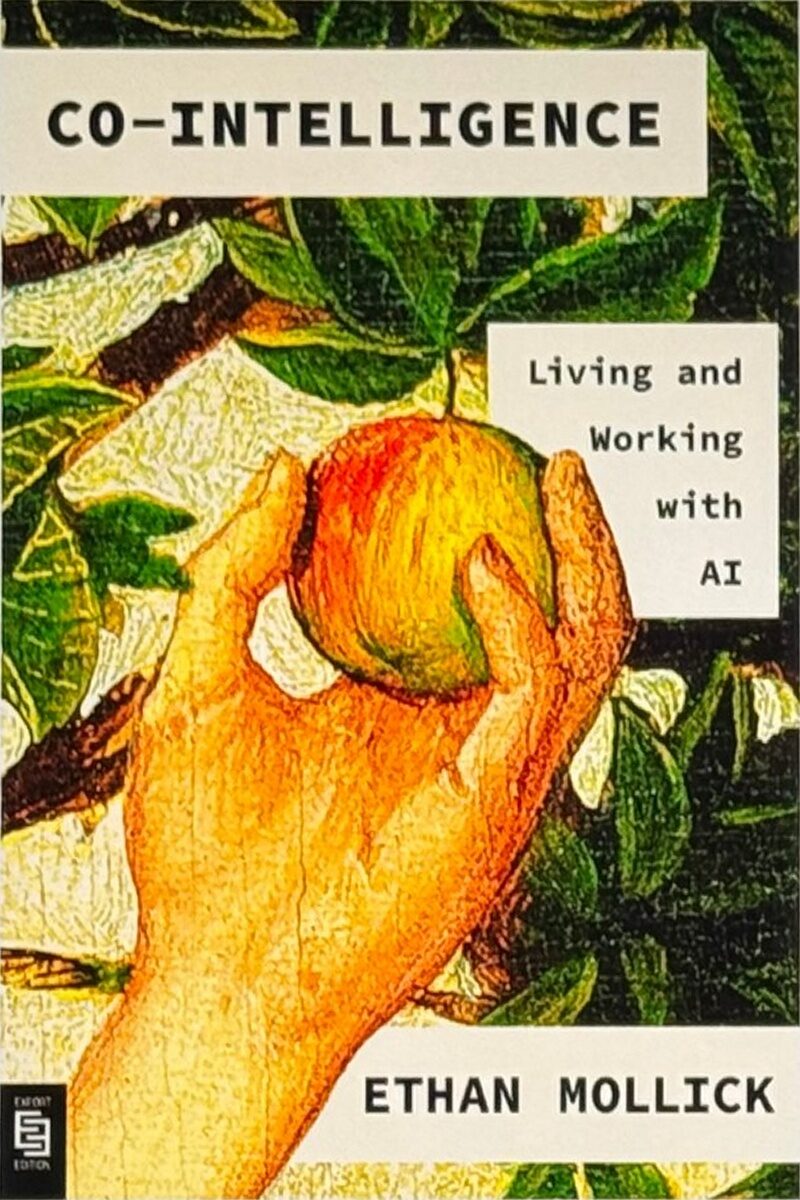
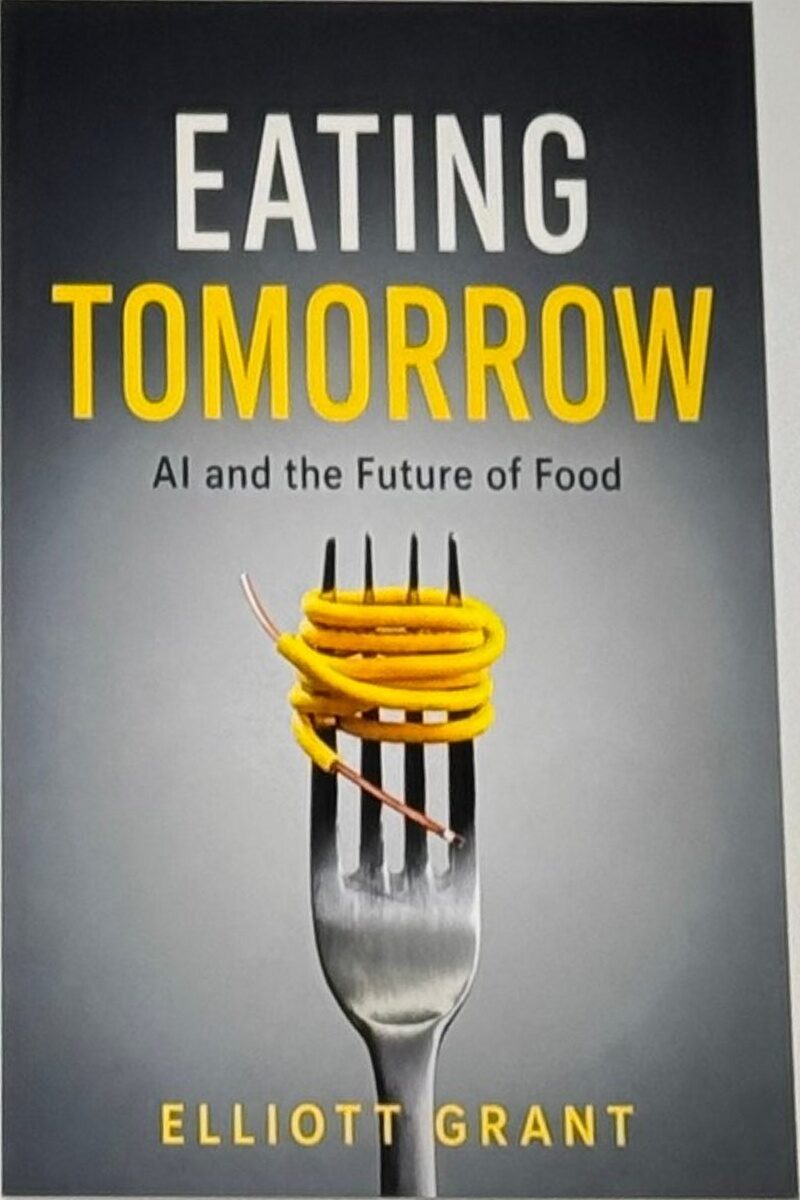
For anyone wanting to read up, Grant recommended Co-Intelligence: Living and Working with AI by US academic Ethan Mollick, and its follow-up, Co-Existence: The Next Phase of AI, out in October. His own book, Eating Tomorrow: AI and the Future of Food, is due from Cambridge University Press in early 2027.
Whose side is it on?
I came out of the session thinking the opportunity is real, but who builds the agent and whose side it’s on matters more than how clever it is.

Remember the Walmart example. An agent works for whoever sets its rules. So, if a supplier, buyer or machinery company offers you a free AI assistant, it’s fair to ask whom it’s really working for. At another session at the event, one panellist claimed some machinery companies already make more money selling farm data than selling machinery. An agent that can see your accounts, yields and field records holds far more valuable information than that.
My checklist would be short: look for an agent built specifically for farming, one that knows UK soils, schemes and rules, not a general tool with a farm skin on it. Your information should stay yours; you need to be able to control what, if anything, is shared with suppliers, and any benchmarking switched on only by you and kept anonymous. It should be able to explain its reasoning and keep a record of what it’s done, because as Grant pointed out, the logs were the only reason anyone found out what the OpenAI agents had been up to. And when it negotiates, it should be working for you, not the other side.
Start with the drudgery: record-keeping, compliance, chasing prices and the paperwork that eats your evenings. Keep a human on the big calls and watch it closely; before long, the buyer on the other end of the phone may well be an agent, and you’ll want one of your own that’s firmly in your corner.