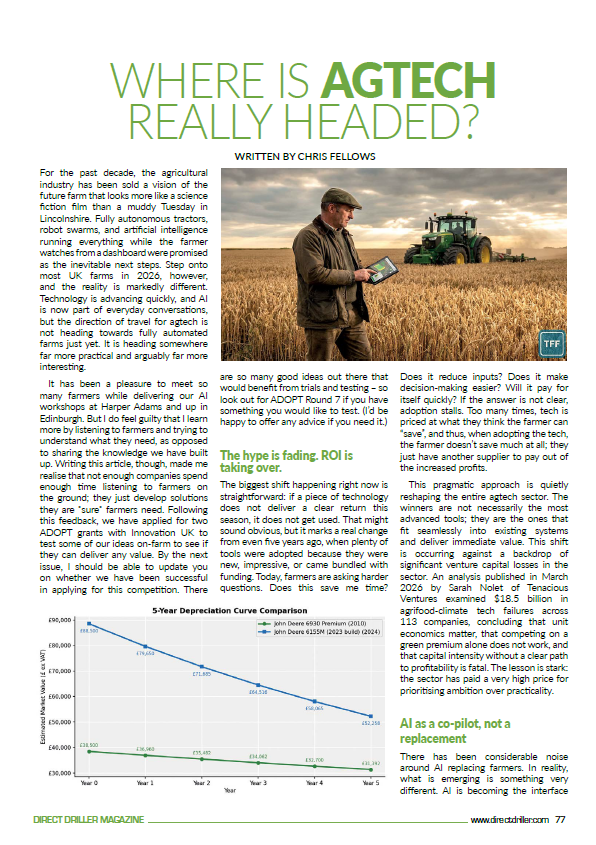
For the past decade, the agricultural industry has been sold a vision of the future farm that looks more like a science fiction film than a muddy Tuesday in Lincolnshire. Fully autonomous tractors, robot swarms, and artificial intelligence running everything while the farmer watches from a dashboard were promised as the inevitable next steps. Step onto most UK farms in 2026, however, and the reality is markedly different. Technology is advancing quickly, and AI is now part of everyday conversations, but the direction of travel for agtech is not heading towards fully automated farms just yet. It is heading somewhere far more practical and arguably far more interesting.
It has been a pleasure to meet so many farmers while delivering our AI workshops at Harper Adams and up in Edinburgh. But I do feel guilty that I learn more by listening to farmers and trying to understand what they need, as opposed to sharing the knowledge we have built up. Writing this article, though, made me realise that not enough companies spend enough time listening to farmers on the ground; they just develop solutions they are “sure” farmers need. Following this feedback, we have applied for two ADOPT grants with Innovation UK to test some of our ideas on-farm to see if they can deliver any value. By the next issue, I should be able to update you on whether we have been successful in applying for this competition. There are so many good ideas out there that would benefit from trials and testing – so look out for ADOPT Round 7 if you have something you would like to test. (I’d be happy to offer any advice if you need it.)
The hype is fading. ROI is taking over.
The biggest shift happening right now is straightforward: if a piece of technology does not deliver a clear return this season, it does not get used. That might sound obvious, but it marks a real change from even five years ago, when plenty of tools were adopted because they were new, impressive, or came bundled with funding. Today, farmers are asking harder questions. Does this save me time? Does it reduce inputs? Does it make decision-making easier? Will it pay for itself quickly? If the answer is not clear, adoption stalls. Too many times, tech is priced at what they think the farmer can “save”, and thus, when adopting the tech, the farmer doesn’t save much at all; they just have another supplier to pay out of the increased profits.
This pragmatic approach is quietly reshaping the entire agtech sector. The winners are not necessarily the most advanced tools; they are the ones that fit seamlessly into existing systems and deliver immediate value. This shift is occurring against a backdrop of significant venture capital losses in the sector. An analysis published in March 2026 by Sarah Nolet of Tenacious Ventures examined $18.5 billion in agrifood-climate tech failures across 113 companies, concluding that unit economics matter, that competing on a green premium alone does not work, and that capital intensity without a clear path to profitability is fatal. The lesson is stark: the sector has paid a very high price for prioritising ambition over practicality.
AI as a co-pilot, not a replacement
There has been considerable noise around AI replacing farmers. In reality, what is emerging is something very different. AI is becoming the interface of the farm. Instead of digging through dashboards, spreadsheets and disconnected platforms, farmers are starting to interact with systems in a more natural way: asking questions, generating plans, and receiving recommendations in real time. It is less about automation and more about decision support at speed.
The shift is from “Here is your data” to “Here is what to do next and why.” That distinction is significant. It reduces mental load, saves time, and makes complex systems genuinely usable in the real world. The farmer remains firmly in control; the technology is simply making that control more informed and more efficient.
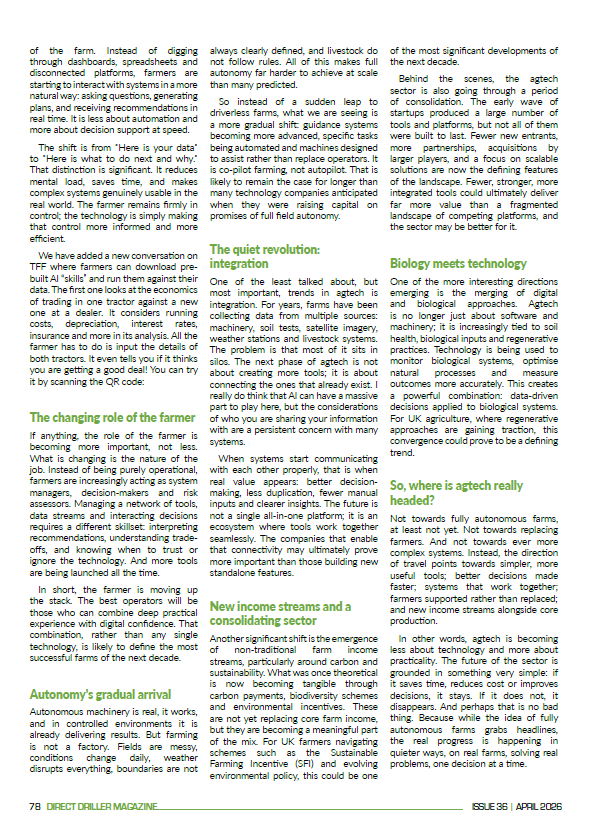
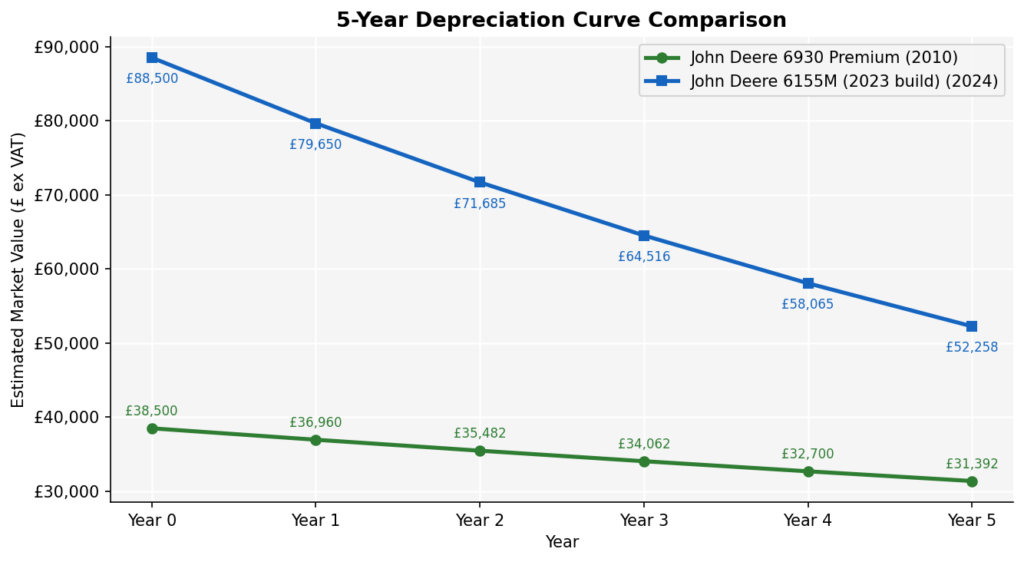
We have added a new conversation on TFF where farmers can download pre-built AI “skills” and run them against their data. The first one looks at the economics of trading in one tractor against a new one at a dealer. It considers running costs, depreciation, interest rates, insurance and more in its analysis. All the farmer has to do is input the details of both tractors. It even tells you if it thinks you are getting a good deal! You can try it by clicking below:
https://thefarmingforum.co.uk/index.php?threads/ai-skills-for-farmers-–-share-what-works.436506
The changing role of the farmer
If anything, the role of the farmer is becoming more important, not less. What is changing is the nature of the job. Instead of being purely operational, farmers are increasingly acting as system managers, decision-makers and risk assessors. Managing a network of tools, data streams and interacting decisions requires a different skillset: interpreting recommendations, understanding trade-offs, and knowing when to trust or ignore the technology. And more tools are being launched all the time.
In short, the farmer is moving up the stack. The best operators will be those who can combine deep practical experience with digital confidence. That combination, rather than any single technology, is likely to define the most successful farms of the next decade.
Autonomy’s gradual arrival
Autonomous machinery is real, it works, and in controlled environments it is already delivering results. But farming is not a factory. Fields are messy, conditions change daily, weather disrupts everything, boundaries are not always clearly defined, and livestock do not follow rules. All of this makes full autonomy far harder to achieve at scale than many predicted.
So instead of a sudden leap to driverless farms, what we are seeing is a more gradual shift: guidance systems becoming more advanced, specific tasks being automated and machines designed to assist rather than replace operators. It is co-pilot farming, not autopilot. That is likely to remain the case for longer than many technology companies anticipated when they were raising capital on promises of full field autonomy.
The quiet revolution: integration
One of the least talked about, but most important, trends in agtech is integration. For years, farms have been collecting data from multiple sources: machinery, soil tests, satellite imagery, weather stations and livestock systems. The problem is that most of it sits in silos. The next phase of agtech is not about creating more tools; it is about connecting the ones that already exist. I really do think that AI can have a massive part to play here, but the considerations of who you are sharing your information with are a persistent concern with many systems.
When systems start communicating with each other properly, that is when real value appears: better decision-making, less duplication, fewer manual inputs and clearer insights. The future is not a single all-in-one platform; it is an ecosystem where tools work together seamlessly. The companies that enable that connectivity may ultimately prove more important than those building new standalone features.
New income streams and a consolidating sector
Another significant shift is the emergence of non-traditional farm income streams, particularly around carbon and sustainability. What was once theoretical is now becoming tangible through carbon payments, biodiversity schemes and environmental incentives. These are not yet replacing core farm income, but they are becoming a meaningful part of the mix. For UK farmers navigating schemes such as the Sustainable Farming Incentive (SFI) and evolving environmental policy, this could be one of the most significant developments of the next decade.
Behind the scenes, the agtech sector is also going through a period of consolidation. The early wave of startups produced a large number of tools and platforms, but not all of them were built to last. Fewer new entrants, more partnerships, acquisitions by larger players, and a focus on scalable solutions are now the defining features of the landscape. Fewer, stronger, more integrated tools could ultimately deliver far more value than a fragmented landscape of competing platforms, and the sector may be better for it.
Biology meets technology
One of the more interesting directions emerging is the merging of digital and biological approaches. Agtech is no longer just about software and machinery; it is increasingly tied to soil health, biological inputs and regenerative practices. Technology is being used to monitor biological systems, optimise natural processes and measure outcomes more accurately. This creates a powerful combination: data-driven decisions applied to biological systems. For UK agriculture, where regenerative approaches are gaining traction, this convergence could prove to be a defining trend.
So, where is agtech really headed?
Not towards fully autonomous farms, at least not yet. Not towards replacing farmers. And not towards ever more complex systems. Instead, the direction of travel points towards simpler, more useful tools; better decisions made faster; systems that work together; farmers supported rather than replaced; and new income streams alongside core production.
In other words, agtech is becoming less about technology and more about practicality. The future of the sector is grounded in something very simple: if it saves time, reduces cost or improves decisions, it stays. If it does not, it disappears. And perhaps that is no bad thing. Because while the idea of fully autonomous farms grabs headlines, the real progress is happening in quieter ways, on real farms, solving real problems, one decision at a time.