
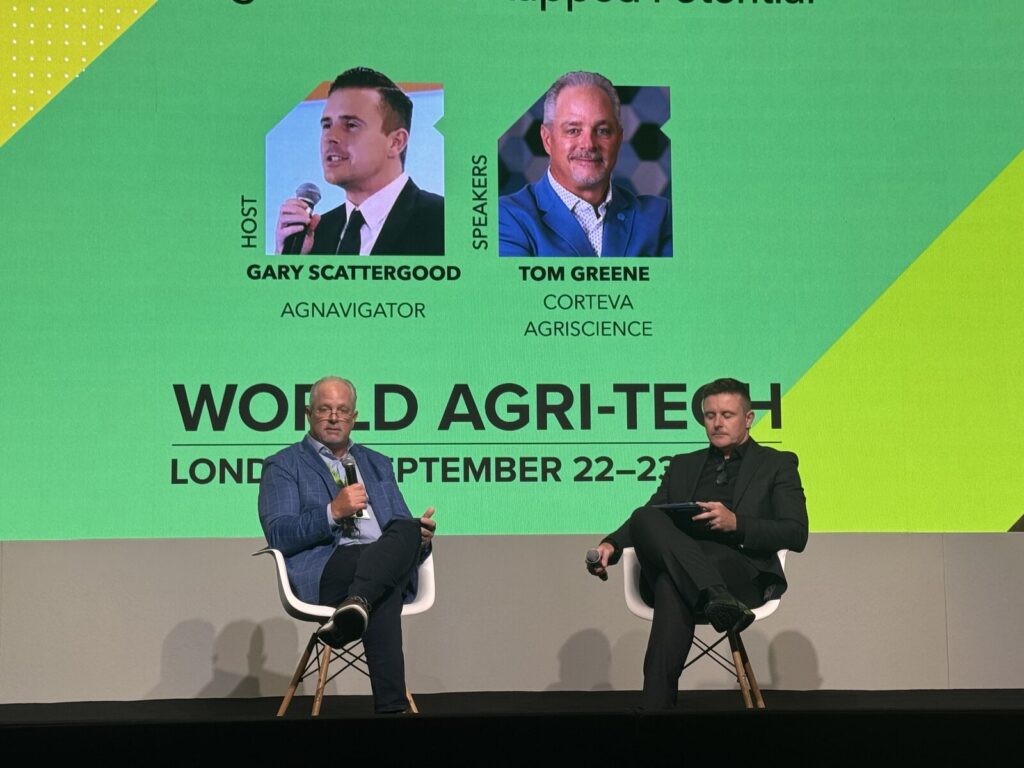
At World Agri-Tech in London, Corteva’s Tom Greene told the main stage that biologicals will only go mainstream if they beat chemistry on the two things farmers care about: how well they work and what they cost.
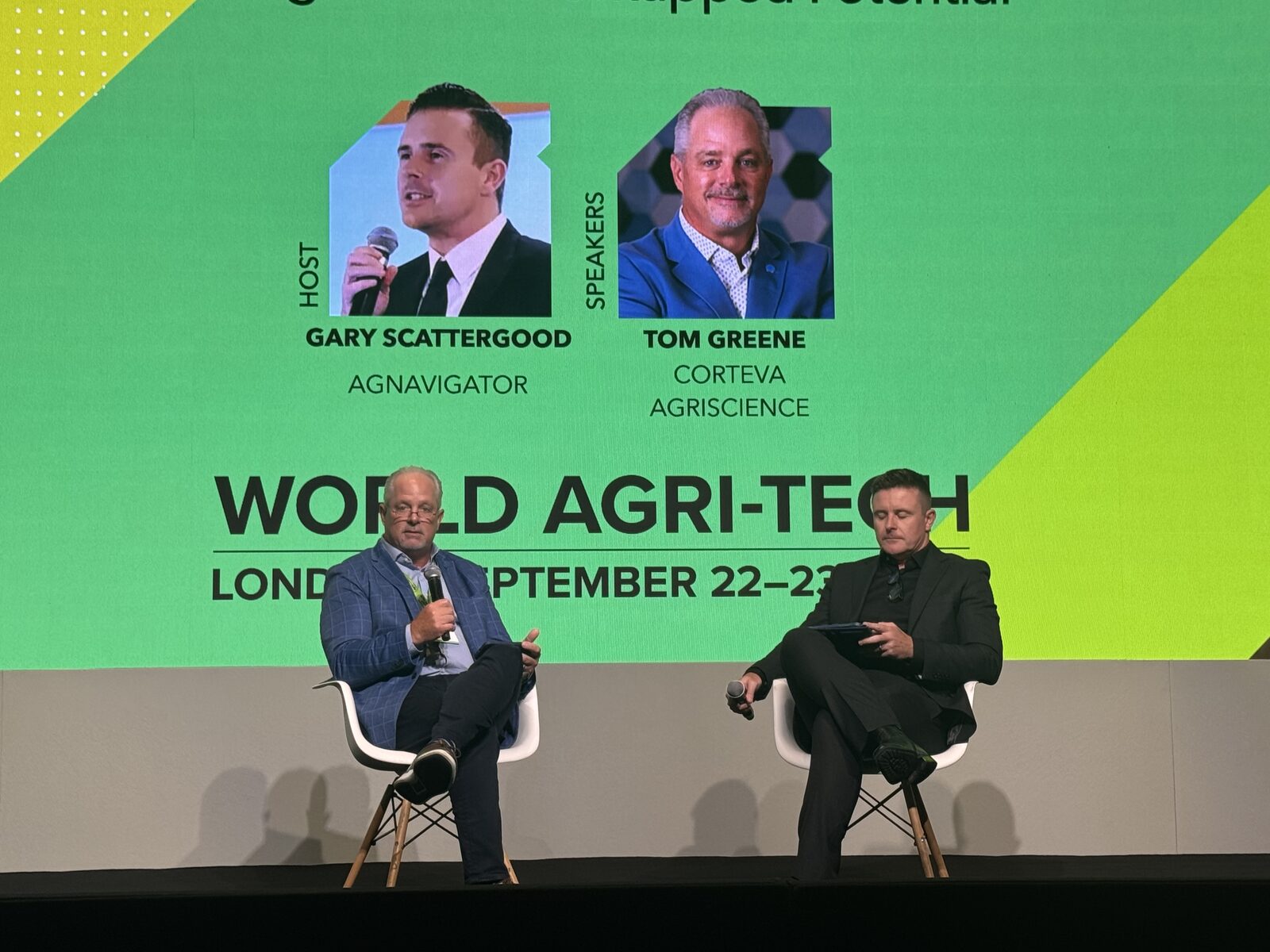
We’ve been told biologicals are the next big wave in farming for a few years now. Most of us have a can of something in the shed that was meant to change everything and didn’t do much. So when Gary Scattergood of AgNavigator sat down with Tom Greene on the main stage at World Agri-Tech London on 22 September, the question was a fair one. What has to happen for biologicals to move from niche to normal on European farms?
Greene has been in the industry going on 28 years and runs Corteva Catalyst, the company’s external innovation and investment arm. His view of the last decade was that the industry has moved from “trying to grow the science, sell the science, demonstrate the science” to delivering products that actually add value on farm.
Performance and price, nothing else
Scattergood quoted a recent McKinsey report: around half of specialist growers worldwide now use at least one biological, dropping to about 40% in more traditional farming. So how do you get those numbers up?
Greene didn’t dress it up. The two biggest drivers are cost and performance. Biologicals are up against a century of research behind synthetic chemistry, “which works great”, and growers expect the same from both. He described the debates he has with the start-ups Corteva backs. “Growers have choices. They can choose a synthetic. Why are they gonna choose your solution if it’s less efficacious and a higher price point? It just doesn’t happen.”
It was refreshing to hear that from someone whose job is backing these products. It’s exactly the test most of us apply in the farm office.
Europe has the pieces, not the rules
Greene reckons Europe is well placed. It has some of the best research institutes in the world, plenty of start-ups and what he called “sophisticated growers” who understand new technology. Roughly a third of the value of the global biologicals market is in Europe.
What’s missing is the regulation. Other regions, Brazil in particular, have grown because they built a framework that lets products through. Europe needs “a science-based, a risk-based” system that gives products derived from nature a quicker route to market. Anyone who has watched a useful product sit in the approvals queue for years will agree with him.
Where BlueN fits
The speaker before him had argued that biofertilisers aren’t scaling, biostimulants are becoming commoditised and the value of biocontrol is being eroded. Greene’s answer was that you have to judge it product by product, and he pointed to BlueN.
It’s a foliar-applied bacterium, Methylobacterium symbioticum, that gets into the leaf through the stomata and lives inside the plant through the season. Greene said it “supplements the plant’s ability to manage nitrogen over the growing cycle”, and that growers are using it to rethink “their nutrient use management holistically”. Corteva describes it as improving nutrient use efficiency through enhanced uptake and utilisation of multiple nutrients, helping to reduce waste and minimise environmental losses.
That matters because typical nitrogen use efficiency in a conventional system is somewhere around 50-60%. For every 200kg N/ha applied, the best part of 80-100kg goes somewhere other than the grain.
Greene said Corteva has seen “tremendous growth” with BlueN in grapes, onions and potatoes, because growers “can see the tonnage increase”. Corteva’s UK trials from 2023 to 2025 back that up, with an average 11 t/ha (8%) lift in marketable sugar beet yield, 3.77 t/ha in potatoes and 1.6 t/ha in maize. Those results also underline the significant opportunity to deliver similar value in wheat and oilseed rape as the pipeline of biological solutions continues to develop. As Greene put it, what grows a market is “reliable products that year in and year out deliver value for the grower”.
A company in two halves
Corteva split into two businesses on 1 October, nine days after the session. The seed side has become Vylor, while Corteva carries on as the crop protection company, biologicals included. Greene said the split would make the business “a little bit more focused” and that biologicals will “continue to be a critical part of our strategic priorities”. Corteva expects to launch seven new active ingredients and five biologicals over the next decade.
Catalyst’s job is to complement Corteva’s internal R&D capabilities by identifying and advancing differentiated science from outside the company. Greene highlighted Solasta Bio, a Scottish company developing small peptides that target insect nerve signals. That’s a new mode of action, which matters when resistance is building.
Not a magic can
The biggest lesson of the last decade, Greene said, is that “biologicals aren’t standalone. They really have to be integrated into a program.” That means formulating them so a grower can say, “I’m gonna mix this with two other synthetics”, and using data to understand where they work. “Biologicals, just like any product, are not gonna work in every environment.”
That’s why trials matter. If the decision sits with the farmer and the agronomist, we need trial data we can trust, from independent sites, over several seasons, on real soils. In Issue 37 we covered Agrovista’s Lamport AgX site in Northamptonshire, where 13 years of systems trials are reporting nitrogen use efficiency of up to 80% against a conventional 60%. That’s the sort of work that moves biologicals from a punt to a planned line in the budget.
Does the shopper care?
The last question was one I’d written in my own notebook. Some of these products are a lot closer to “natural” or organic than much of what’s in the sprayer, but does the consumer care, and will anyone pay us more for using them?
Greene’s answer was straight. “I’m not sure that it matters.” Growers choose on performance, cost and how easily a product fits their system, and “they don’t really care if it’s a synthetic chemistry or a biological”. Margins are tight, so “they’re not gonna pay for sustainability, not gonna pay for being natural if it doesn’t deliver on the farm”. He did see “a little bit of messaging opportunity” downstream.
I’d agree. Where biologicals do matter beyond the farm gate is Scope 3 emissions. Making and spreading nitrogen is one of the biggest parts of an arable crop’s carbon footprint, so every kilo replaced by better efficiency counts towards processors’ and retailers’ targets. If the supply chain wants those savings, it’ll need to share the cost.
Until then, it’s simple. A farmer will look at a trial on ground like his, see the return per hectare and decide whether it’s worth the money. Unless the supply chain is going to fund the transition, and that doesn’t look like the mainstream approach at all, the product has to pay for itself in the field.