By CEO, Steve McLean, UK Agri-Tech Centre
Our ambition is to make the UK the best place to start, grow and scale agri-tech businesses. But that only matters if technologies are proven in real-world, commercial environments – and adopted at scale.
Our strategy is built around helping agri-tech businesses move from innovation to commercial reality – to prove what works, build viable agri-tech businesses and scale impact at pace. That means tackling common barriers: fragmented support, long development timelines, and the realities of designing for complex, working farm environments.
We start with commercial viability – because if it doesn’t stack up, it won’t be adopted. A big part of that is giving companies access to real farming environments across the UK, where their technology can be properly tested and challenged, accelerating the path to commercial adoption.
We work with businesses across robotics, AI, sensors, engineering biology and controlled environment agriculture, but the focus is always the same: can it deliver reliably and commercially in a working farming system?
That’s why our commercial farm network is so important. It is where innovation is proven in real conditions – across different soil types, weather patterns and operational constraints.
There’s also a growing push from policy, supply chains and markets for better data. The Government’s Land Use Framework reflects this shift, with a clear emphasis on productive and sustainable land and the need to evidence outcomes. That’s where agri-tech is becoming critical to delivering meaningful outcomes – particularly in measurement, monitoring and reporting.
In partnership with The Carbon Trust, we are running an accelerator programme that helps businesses develop MRV technologies and move closer to market readiness with tailored support. One of the cohort, Paul-Tech, develops soil stations that provide near real-time insight into soil conditions, combining in-field sensing with weather and satellite data. For farmers, that translates into clearer decisions around inputs – improving productivity whilst reducing cost and environmental impact.
Elsewhere, real-time monitoring technologies, combined with predictive modelling, are enabling earlier detection of nutrient loss and diffuse pollution events – supporting faster intervention and better environmental outcomes.
One example is our work with Lacuna Space and Aberystwyth University, funded by Innovate UK, where satellite-enabled IoT technology is making water-quality monitoring more affordable, reliable and continuous, even in remote areas. By integrating low-cost sensors, satellite communications and user-focused data platforms, this approach enables real-time monitoring of indicators such as nitrates and phosphates – significantly improving on traditional manual sampling.
The result is more frequent, more reliable data, enabling earlier intervention, lower monitoring costs and more effective catchment management.
Connectivity is a key enabler. By allowing sensors to transmit data in areas where traditional networks are unavailable, it unlocks continuous monitoring in locations that have historically been difficult to reach – enabling solutions to scale across more geographies.
Robotics is also playing an increasingly important role in improving productivity, reducing cost and increasing precision in both linear and broadacre crop systems. Our focus is on helping businesses move from prototype to commercial reality, overcoming the practical and operational challenges that can slow adoption.
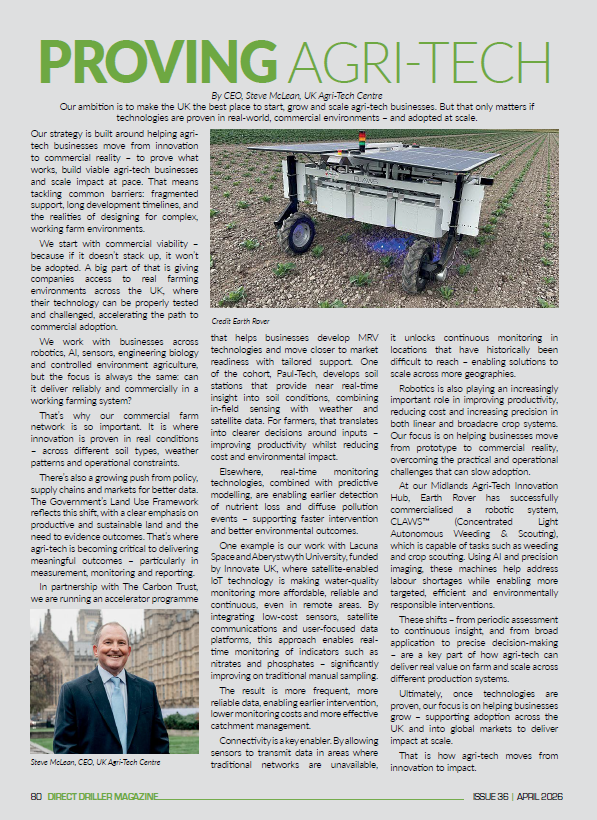
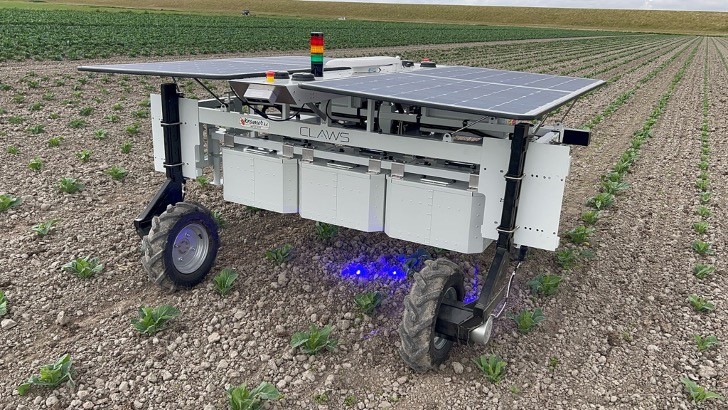
At our Midlands Agri-Tech Innovation Hub, Earth Rover has successfully commercialised a robotic system, CLAWS™ (Concentrated Light Autonomous Weeding & Scouting), which is capable of tasks such as weeding and crop scouting. Using AI and precision imaging, these machines help address labour shortages while enabling more targeted, efficient and environmentally responsible interventions.
These shifts – from periodic assessment to continuous insight, and from broad application to precise decision-making – are a key part of how agri-tech can deliver real value on farm and scale across different production systems.
Ultimately, once technologies are proven, our focus is on helping businesses grow – supporting adoption across the UK and into global markets to deliver impact at scale. That is how agri-tech moves from innovation to impact.