When you walk into Cereals in 2026 (if you can get in past all the influencers who are going to descend on Diddly Squat), it will be immediately clear this is no longer just a machinery show. Gone is the really big kit, with combines and tractors lined up in neat rows. But look closer and something fundamental has shifted. This is now an event about systems, precision and decisions. The conversations are less about horsepower and more about inputs per hectare, labour per acre and resilience per season. Technology is not being showcased for the sake of it; it is being pushed through a much harsher filter: does it actually make farming more efficient, more profitable or more resilient? From AI-led spot spraying to autonomous field platforms, Cereals 2026 will offer one of the clearest snapshots yet of where UK arable farming is really heading.
The shift is significant because it reflects the reality of modern farming under pressure. With volatile weather, tightening margins and a shrinking labour pool, the industry can no longer rely on simply scaling up traditional methods. The focus has moved from blanket applications to targeted interventions, from operator-led performance to system-led autonomy, and from heavy iron to biological understanding. This transition is not just theoretical; it is visible in every corner of the event, demonstrating that the future of farming lies in the intelligent integration of technology and agronomy.
Precision is no longer optional
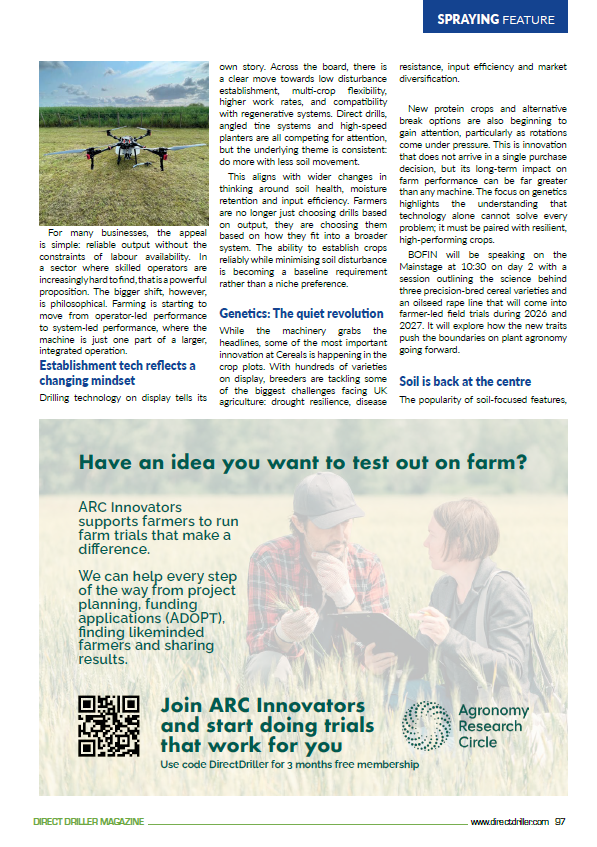
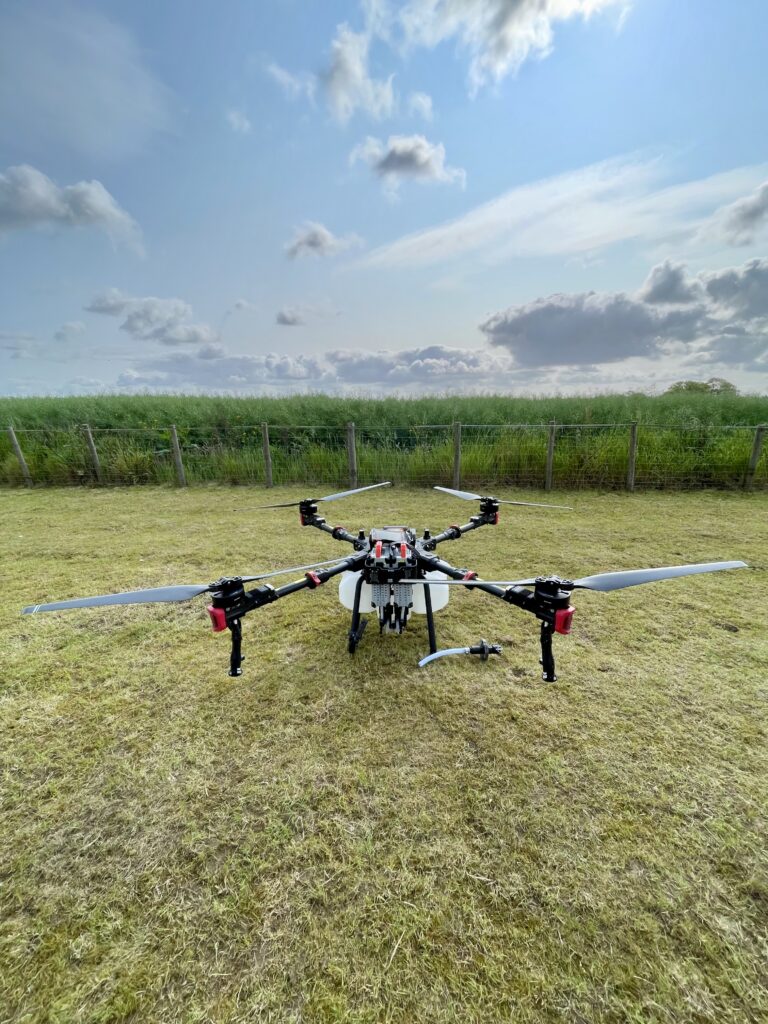
The Sprays & Sprayers Arena remains one of the headline attractions, but its focus has evolved. This is no longer just about bigger booms or higher output; the emphasis is firmly on accuracy, waste reduction and operator simplicity. Closed transfer systems like easyconnect are gaining traction, not because they are flashy, but because they solve a real-world problem: safer handling, less waste and better compliance. Alongside this, nozzle technology, drift reduction systems and integrated software platforms are all converging towards one goal: put the right product in the right place, at the right time, in the right dose. And we are all still asking, “Could drones be the answer?”
But the real shift is what happens when you move from precision application to precision decision-making. The integration of data into these systems means that operators are no longer just driving tractors; they are managing complex, data-driven operations that require a different level of understanding and control.
The rise of “See and Spray”
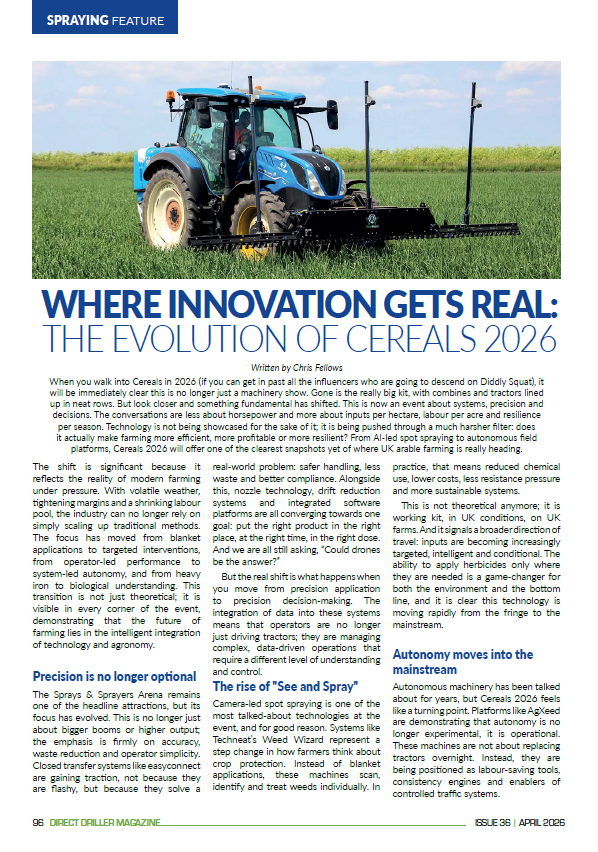
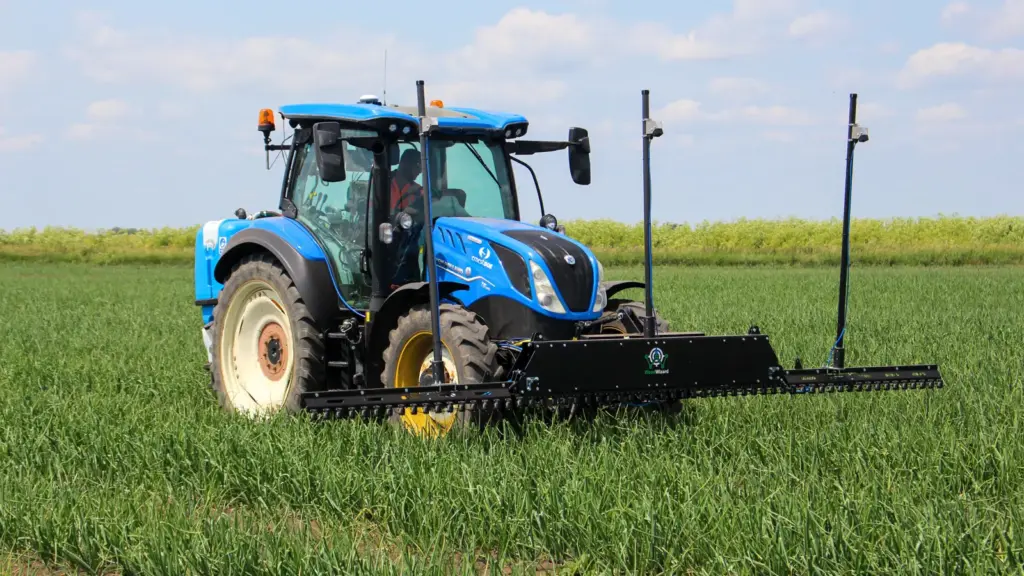
Camera-led spot spraying is one of the most talked-about technologies at the event, and for good reason. Systems like Techneat’s Weed Wizard represent a step change in how farmers think about crop protection. Instead of blanket applications, these machines scan, identify and treat weeds individually. In practice, that means reduced chemical use, lower costs, less resistance pressure and more sustainable systems.
This is not theoretical anymore; it is working kit, in UK conditions, on UK farms. And it signals a broader direction of travel: inputs are becoming increasingly targeted, intelligent and conditional. The ability to apply herbicides only where they are needed is a game-changer for both the environment and the bottom line, and it is clear this technology is moving rapidly from the fringe to the mainstream.
Autonomy moves into the mainstream
Autonomous machinery has been talked about for years, but Cereals 2026 feels like a turning point. Platforms like AgXeed are demonstrating that autonomy is no longer experimental, it is operational. These machines are not about replacing tractors overnight. Instead, they are being positioned as labour-saving tools, consistency engines and enablers of controlled traffic systems.
For many businesses, the appeal is simple: reliable output without the constraints of labour availability. In a sector where skilled operators are increasingly hard to find, that is a powerful proposition. The bigger shift, however, is philosophical. Farming is starting to move from operator-led performance to system-led performance, where the machine is just one part of a larger, integrated operation.
Establishment tech reflects a changing mindset
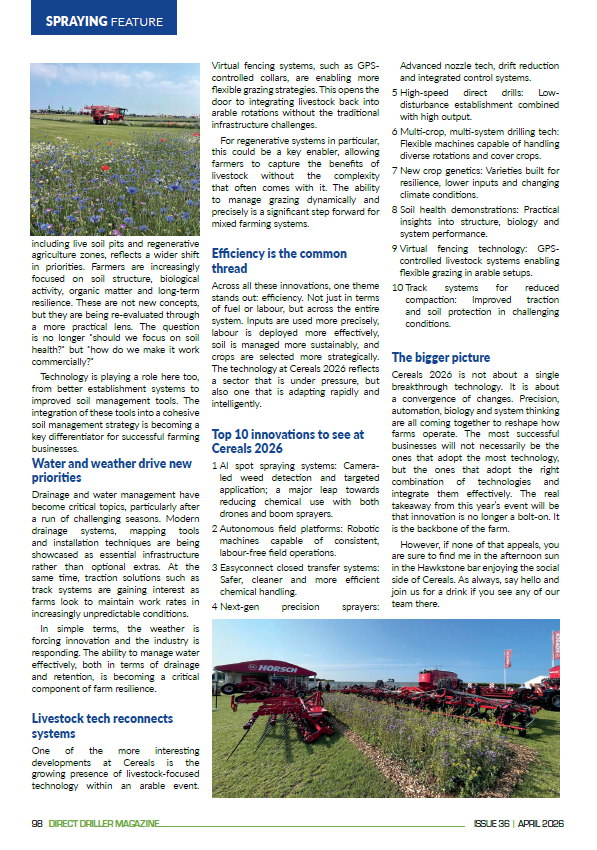
Drilling technology on display tells its own story. Across the board, there is a clear move towards low disturbance establishment, multi-crop flexibility, higher work rates, and compatibility with regenerative systems. Direct drills, angled tine systems and high-speed planters are all competing for attention, but the underlying theme is consistent: do more with less soil movement.
This aligns with wider changes in thinking around soil health, moisture retention and input efficiency. Farmers are no longer just choosing drills based on output, they are choosing them based on how they fit into a broader system. The ability to establish crops reliably while minimising soil disturbance is becoming a baseline requirement rather than a niche preference.
Genetics: The quiet revolution
While the machinery grabs the headlines, some of the most important innovation at Cereals is happening in the crop plots. With hundreds of varieties on display, breeders are tackling some of the biggest challenges facing UK agriculture: drought resilience, disease resistance, input efficiency and market diversification.
New protein crops and alternative break options are also beginning to gain attention, particularly as rotations come under pressure. This is innovation that does not arrive in a single purchase decision, but its long-term impact on farm performance can be far greater than any machine. The focus on genetics highlights the understanding that technology alone cannot solve every problem; it must be paired with resilient, high-performing crops.
BOFIN will be speaking on the Mainstage at 10:30 on day 2 with a session outlining the science behind three precision-bred cereal varieties and an oilseed rape line that will come into farmer-led field trials during 2026 and 2027. It will explore how the new traits push the boundaries on plant agronomy going forward.
Soil is back at the centre
The popularity of soil-focused features, including live soil pits and regenerative agriculture zones, reflects a wider shift in priorities. Farmers are increasingly focused on soil structure, biological activity, organic matter and long-term resilience. These are not new concepts, but they are being re-evaluated through a more practical lens. The question is no longer “should we focus on soil health?” but “how do we make it work commercially?”
Technology is playing a role here too, from better establishment systems to improved soil management tools. The integration of these tools into a cohesive soil management strategy is becoming a key differentiator for successful farming businesses.
Water and weather drive new priorities
Drainage and water management have become critical topics, particularly after a run of challenging seasons. Modern drainage systems, mapping tools and installation techniques are being showcased as essential infrastructure rather than optional extras. At the same time, traction solutions such as track systems are gaining interest as farms look to maintain work rates in increasingly unpredictable conditions.
In simple terms, the weather is forcing innovation and the industry is responding. The ability to manage water effectively, both in terms of drainage and retention, is becoming a critical component of farm resilience.
Livestock tech reconnects systems
One of the more interesting developments at Cereals is the growing presence of livestock-focused technology within an arable event. Virtual fencing systems, such as GPS-controlled collars, are enabling more flexible grazing strategies. This opens the door to integrating livestock back into arable rotations without the traditional infrastructure challenges.
For regenerative systems in particular, this could be a key enabler, allowing farmers to capture the benefits of livestock without the complexity that often comes with it. The ability to manage grazing dynamically and precisely is a significant step forward for mixed farming systems.
Efficiency is the common thread
Across all these innovations, one theme stands out: efficiency. Not just in terms of fuel or labour, but across the entire system. Inputs are used more precisely, labour is deployed more effectively, soil is managed more sustainably, and crops are selected more strategically. The technology at Cereals 2026 reflects a sector that is under pressure, but also one that is adapting rapidly and intelligently.
Top 10 innovations to see at Cereals 2026
- AI spot spraying systems: Camera-led weed detection and targeted application; a major leap towards reducing chemical use with both drones and boom sprayers.
- Autonomous field platforms: Robotic machines capable of consistent, labour-free field operations.
- Easyconnect closed transfer systems: Safer, cleaner and more efficient chemical handling.
- Next-gen precision sprayers: Advanced nozzle tech, drift reduction and integrated control systems.
- High-speed direct drills: Low-disturbance establishment combined with high output.
- Multi-crop, multi-system drilling tech: Flexible machines capable of handling diverse rotations and cover crops.
- New crop genetics: Varieties built for resilience, lower inputs and changing climate conditions.
- Soil health demonstrations: Practical insights into structure, biology and system performance.
- Virtual fencing technology: GPS-controlled livestock systems enabling flexible grazing in arable setups.
- Track systems for reduced compaction: Improved traction and soil protection in challenging conditions.
The bigger picture
Cereals 2026 is not about a single breakthrough technology. It is about a convergence of changes. Precision, automation, biology and system thinking are all coming together to reshape how farms operate. The most successful businesses will not necessarily be the ones that adopt the most technology, but the ones that adopt the right combination of technologies and integrate them effectively. The real takeaway from this year’s event will be that innovation is no longer a bolt-on. It is the backbone of the farm.
However, if none of that appeals, you are sure to find me in the afternoon sun in the Hawkstone bar enjoying the social side of Cereals. As always, say hello and join us for a drink if you see any of our team there.