Written by Chris Fellows
The agricultural sector stands on the precipice of a fundamental shift in how crop protection products are applied, formulated and regulated. Driven by rapid advancements in precision application technology, from AI-guided optical spot sprayers to autonomous drones, the traditional model of broad-acre, high-volume spraying is being systematically dismantled. This technological evolution is not merely changing the machinery in the field; it is forcing a complete rethink of agrochemical formulation, accelerating the development of novel active ingredients, and colliding head-on with the shifting regulatory landscape of the UK-EU Sanitary and Phytosanitary (SPS) agreement.
For UK arable farmers, the convergence of these forces presents both unprecedented opportunities for efficiency and significant risks to the established crop protection toolbox.
The rise of precision and drone application
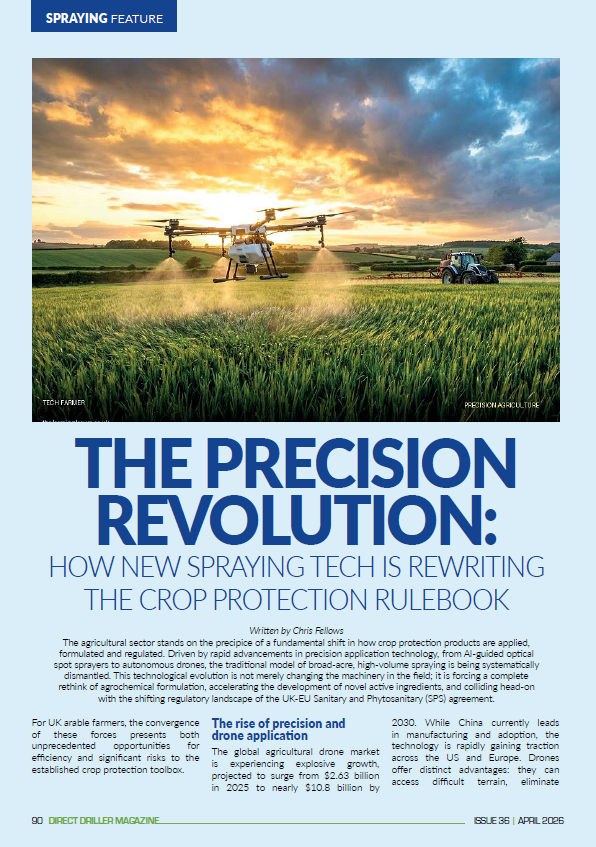
The global agricultural drone market is experiencing explosive growth, projected to surge from $2.63 billion in 2025 to nearly $10.8 billion by 2030. While China currently leads in manufacturing and adoption, the technology is rapidly gaining traction across the US and Europe. Drones offer distinct advantages: they can access difficult terrain, eliminate soil compaction, and operate within tight weather windows when ground conditions might otherwise prevent application.
Simultaneously, ground-based precision spraying is moving from a premium add-on to a standard requirement. Technologies such as Pulse Width Modulation (PWM) enable variable-rate application while maintaining a consistent droplet spectrum, allowing sprayers to adjust output dynamically across a field. More advanced systems, like John Deere’s See & Spray and Bosch’s Smart Spraying technology, utilise artificial intelligence and machine vision to detect individual weeds and apply herbicides only where necessary. In 2024, See & Spray customers in the US reported average herbicide savings of 59% across corn, soybean and cotton fields.
However, this shift toward ultra-low volume (ULV) and highly targeted application creates a significant challenge for agrochemical manufacturers: the products themselves must change.
The reformulation imperative
Historically, crop protection products have been formulated for high-volume, broad-acre application using traditional hydraulic nozzles. Drone spraying and precision spot application operate under entirely different constraints, requiring much lower spray volumes and higher concentrations of active ingredients.
This transition is fundamentally a reformulation challenge. When active ingredients are applied at higher concentrations in lower water volumes, the physical properties of the spray mixture change dramatically. Viscosity becomes a critical factor; if a formulation is too viscous, it can lead to poor atomisation, increased pump wear and inconsistent dosing. Conversely, if viscosity is too low, the risk of drift increases significantly.
Manufacturers are now racing to develop shear-thinning formulations: liquids that remain stable and viscous in the tank but become fluid under the shear stress of pumping and atomisation. Furthermore, the regulatory labels on many existing products mandate minimum water volumes that are incompatible with drone payloads, creating a regulatory bottleneck that must be addressed before these technologies can be fully utilised.
A shrinking toolbox and the SPS threat
As the industry grapples with the technical challenges of precision application, UK farmers are facing a more immediate threat to their crop protection arsenal. The proposed UK-EU SPS agreement, expected to take effect in mid-2027, includes a commitment to “dynamic alignment” with EU rules on pesticide regulation.
While alignment could theoretically provide access to new biopesticides approved in the EU, a “cliff-edge” implementation could be devastating. An analysis by The Andersons Centre, commissioned by CropLife UK, warns that immediate alignment could cost the UK arable, horticulture, and sugar sectors between £500 million and £810 million in the first year alone. (Seems a lot given the price of wheat right now; maybe they know something we don’t.)
Farmers on TFF have highlighted that a sudden alignment would result in the loss of four new active ingredients recently approved in Great Britain but not yet available in the EU, including the cereal fungicides isoflucypram and pydiflumetofen, and the herbicides cinmethylin and bixlozone. Furthermore, 15 actives currently used in over 100 UK products, such as flufenacet, prochloraz and metribuzin, are no longer permitted in the EU and would likely be withdrawn.
“The prospect of losing access to such key crop protection tools, and hundreds of millions of pounds with them through loss of yield, would be catastrophic,” warned NFU Crops Board chair Jamie Burrows, emphasising the need for a phased transitional approach.
Innovation in active ingredients
The dual pressures of regulatory restriction and the demand for precision application are driving a new wave of innovation in active ingredients. With herbicide resistance reported in 75 countries and affecting over 100 crops, the need for novel modes of action has never been more urgent.
One of the most promising developments is emerging from Cambridge-based startup Bindbridge, which recently secured $3.8 million to develop a new class of herbicides using targeted protein degradation. Inspired by advancements in cancer therapeutics, this approach uses “molecular glues” to tag specific proteins within a weed for destruction by the plant’s own cellular machinery. Because this method degrades rather than merely inhibits the target protein, it has the potential to overcome existing resistance mechanisms and could operate at application rates up to 100 times lower than traditional chemistries. Bindbridge’s initial focus is on developing a broad-spectrum replacement for glyphosate.
Meanwhile, established players are also bringing new tools to market. Syngenta recently announced its VIRESTINA™ technology, a fourth-generation ACCase-inhibitor designed to control grass weeds that have developed resistance to glyphosate and clethodim.
The biostimulant and biopesticide sectors are also experiencing rapid growth, with the European biostimulants market projected to reach $3.08 billion by 2030. Precision application technologies are critical enablers for these biological products, which often require highly accurate and timely placement to be effective.
Conclusion
The future of crop protection is undoubtedly precision-driven. As drones and AI-guided sprayers become commonplace, the agrochemical industry must adapt, delivering highly concentrated, stable formulations designed for ultra-low volume application. While the looming UK-EU SPS agreement threatens to restrict access to vital existing chemistries, it also underscores the urgent need for the next generation of active ingredients.
For the UK arable sector, navigating this transition will require careful management of the regulatory landscape, investment in new application technologies, and a willingness to adopt novel chemistries. The era of “spray and pray” is ending; the era of precision chemistry has arrived.