In direct drilling systems, every pass carries weight. With fewer opportunities to intervene through cultivation, crop protection strategies need to be both precise and adaptable. As a result, spray application is under increasing scrutiny – not just in terms of efficacy but also cost control and environmental responsibility.
Maximising the performance of each litre applied has become central to success. This means not only selecting the right chemistry, but ensuring it is delivered accurately, consistently and only where required.
A number of key principles now underpin modern application techniques:
- Accurate targeting of inputs across variable field conditions
- Minimising overlaps and misses, particularly on irregular field shapes
- Adjusting tank mixes to suit specific areas or restrictions
- Opportunities for band spraying within row-based systems
- Maintaining optimal droplet size across changing forward speeds
- Keeping boom height stable to reduce drift and improve coverage
These factors are particularly relevant in low-disturbance systems, where residue levels, soil structure and crop establishment methods can all influence spray performance.
With over 50 years’ experience in application technology, AMAZONE continues to refine how these challenges are addressed. However, in a direct drilling context, accuracy alone isn’t enough — work rates, simplicity and reliability are equally critical. Spray windows can be tight, and technology must support decision-making rather than slow it down.
Ease of operation is therefore a key focus. Integrated software and hardware systems are designed to be intuitive, reducing set-up time and simplifying operation in the cab. Automation plays a major role here. For example, Comfort-Pack Plus manages the filling process by calculating exactly how much liquid is required for the task, even when working from application maps. This helps to avoid unnecessary leftovers while keeping turnaround times to a minimum. Fast induction rates and automatic cleaning functions further streamline the process.
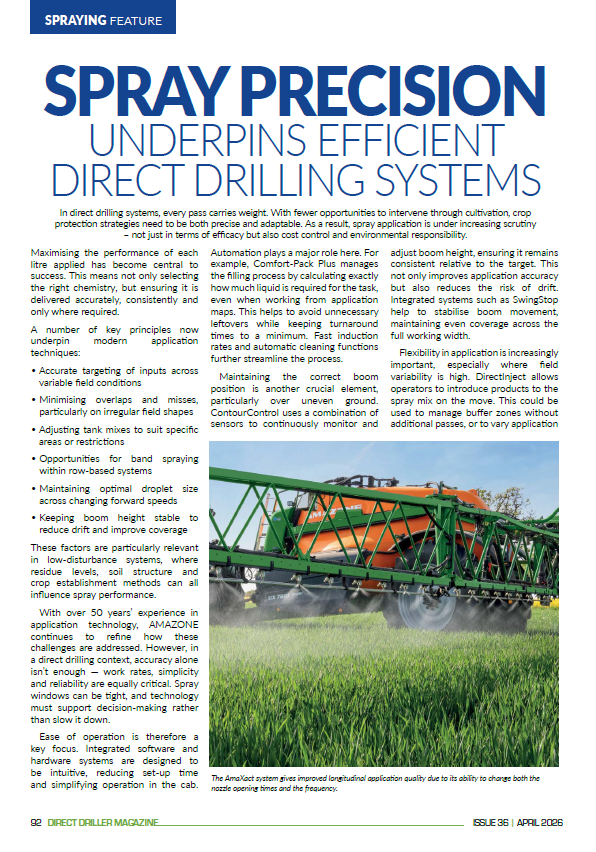
Maintaining the correct boom position is another crucial element, particularly over uneven ground. ContourControl uses a combination of sensors to continuously monitor and adjust boom height, ensuring it remains consistent relative to the target. This not only improves application accuracy but also reduces the risk of drift. Integrated systems such as SwingStop help to stabilise boom movement, maintaining even coverage across the full working width.
Flexibility in application is increasingly important, especially where field variability is high. DirectInject allows operators to introduce products to the spray mix on the move. This could be used to manage buffer zones without additional passes, or to vary application rates across different areas of the field, whether based on crop potential or weed pressure. In systems where mapping and data are already widely used, this level of control fits naturally.
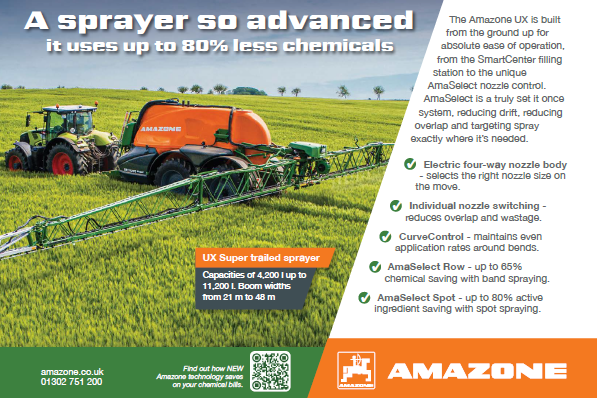
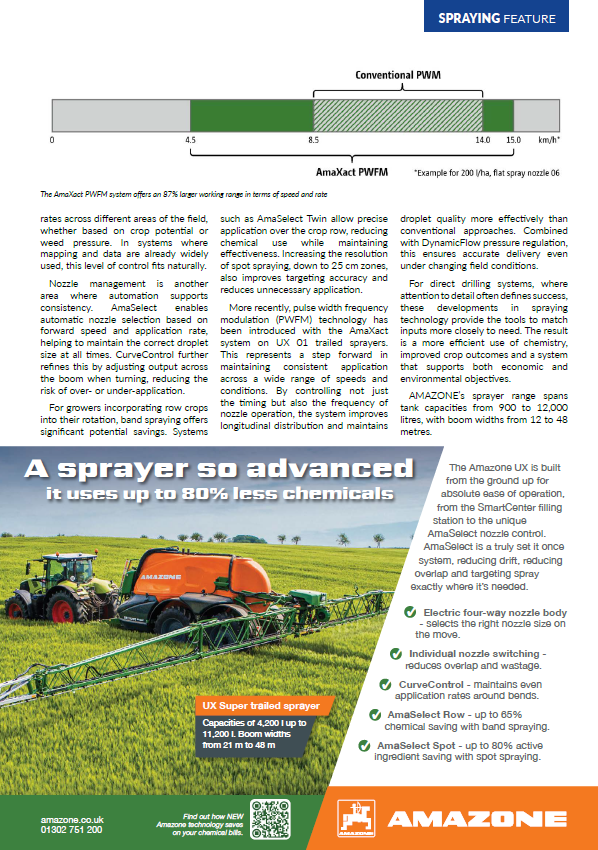
Nozzle management is another area where automation supports consistency. AmaSelect enables automatic nozzle selection based on forward speed and application rate, helping to maintain the correct droplet size at all times. CurveControl further refines this by adjusting output across the boom when turning, reducing the risk of over- or under-application.
For growers incorporating row crops into their rotation, band spraying offers significant potential savings. Systems such as AmaSelect Twin allow precise application over the crop row, reducing chemical use while maintaining effectiveness. Increasing the resolution of spot spraying, down to 25 cm zones, also improves targeting accuracy and reduces unnecessary application.

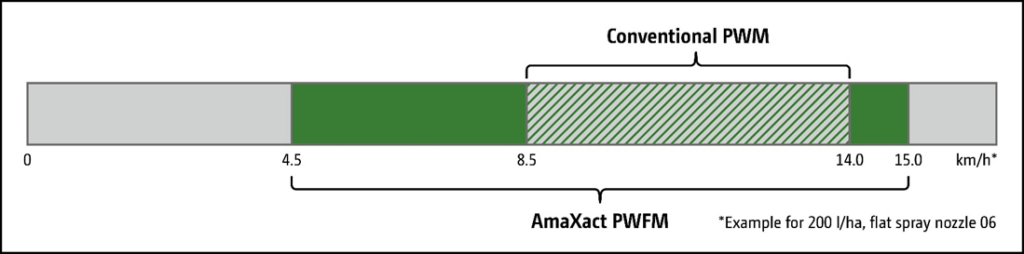
More recently, pulse width frequency modulation (PWFM) technology has been introduced with the AmaXact system on UX 01 trailed sprayers. This represents a step forward in maintaining consistent application across a wide range of speeds and conditions. By controlling not just the timing but also the frequency of nozzle operation, the system improves longitudinal distribution and maintains droplet quality more effectively than conventional approaches. Combined with DynamicFlow pressure regulation, this ensures accurate delivery even under changing field conditions.
For direct drilling systems, where attention to detail often defines success, these developments in spraying technology provide the tools to match inputs more closely to need. The result is a more efficient use of chemistry, improved crop outcomes and a system that supports both economic and environmental objectives.
AMAZONE’s sprayer range spans tank capacities from 900 to 12,000 litres, with boom widths from 12 to 48 metres.