
How an olive-derived compound could save UK Oilseed rape from the cabbage stem flea beetle
By Chris Fellows
For nearly a decade, arable farmers across the United Kingdom and Northern Europe have been fighting a losing battle against a formidable, albeit tiny, adversary: the cabbage stem flea beetle (Psylliodes chrysocephala, or CSFB). Following the European Union’s 2013 ban on neonicotinoid insecticidal seed treatments – a regulatory decision driven by concerns over environmental and pollinator health – the agricultural sector was left with a gaping hole in its pest management arsenal [1]. Without neonicotinoids, CSFB populations surged dramatically, with larval numbers in the UK increasing tenfold shortly after the ban [1].
Growers were forced to rely almost exclusively on pyrethroid insecticide sprays. However, this over-reliance created immense selection pressure, rapidly accelerating the development of pyrethroid resistance across Europe. Today, there are virtually no fully susceptible CSFB populations left in the UK [1]. The consequences have been devastating. In regions like the south-east of England, entire crops have been decimated, forcing farmers to abandon winter oilseed rape (OSR) in favour of alternative, often less profitable, crops [1]. The UK, once the fifth-largest exporter of OSR globally, has transitioned into a net importer, costing the economy an estimated £1 billion annually [1].
The industry desperately needs a breakthrough. Now, a collaborative research effort between Rothamsted Research and ApresLabs Ltd has unveiled a highly promising, naturally derived solution that could turn the tide: SYN-A.
The science of synergy: What is SYN-A?
When insects develop metabolic resistance to insecticides, their bodies overproduce specific detoxification enzymes that break down the chemical before it can reach its target site and kill the pest. In the case of the cabbage stem flea beetle, resistance to pyrethroids is largely driven by the heightened activity of cytochrome P450 monooxygenases and esterase enzymes [1].
To combat this, scientists look to “synergists” – compounds that are not inherently toxic on their own but enhance the lethality of an insecticide by inhibiting the pest’s detoxification pathways. While synthetic synergists like piperonyl butoxide (PBO) have been used in agriculture and public health for decades, there is a growing demand for more sustainable, naturally derived alternatives.
Enter SYN-A. Discovered, developed and patented by Dr Graham Moores, founder of ApresLabs Ltd, SYN-A is a novel, natural synergist extracted from the unsaturated fatty acids found in olive oil [2].
“I have long felt that synergists should be utilised to a greater extent in agriculture,” Dr Moores commented. “SYN-A is a natural extract that allows a reduction in insecticidal rates whilst still overcoming resistance problems, with the concomitant environmental benefits this brings” [2].
In a recent peer-reviewed study published in Pest Management Science, researchers demonstrated that SYN-A effectively inhibits both cytochrome P450 and esterase activity in CSFB in a dose-dependent manner [1]. By blocking these crucial metabolic pathways, SYN-A strips the beetle of its chemical defences, leaving it highly vulnerable to pyrethroid insecticides once again.
Laboratory breakthroughs: Restoring pyrethroid efficacy
To quantify the impact of SYN-A, the research team, led by Dr Samantha Cook and Dr Patricia Ortega-Ramos, conducted rigorous glass vial bioassays. They exposed adult cabbage stem flea beetles to the synthetic pyrethroid lambda-cyhalothrin, both alone and in combination with SYN-A.
The results were striking. When applied alone at the full recommended field rate, lambda-cyhalothrin achieved a dismal mortality rate of just 22%, underscoring the severe level of resistance present in the tested beetle populations [1]. However, when the insecticide was combined with SYN-A, mortality skyrocketed.
Figure 1 – CSFB mortality in glass vial bioassays
Effect of SYN-A and PBO synergists combined with insecticides
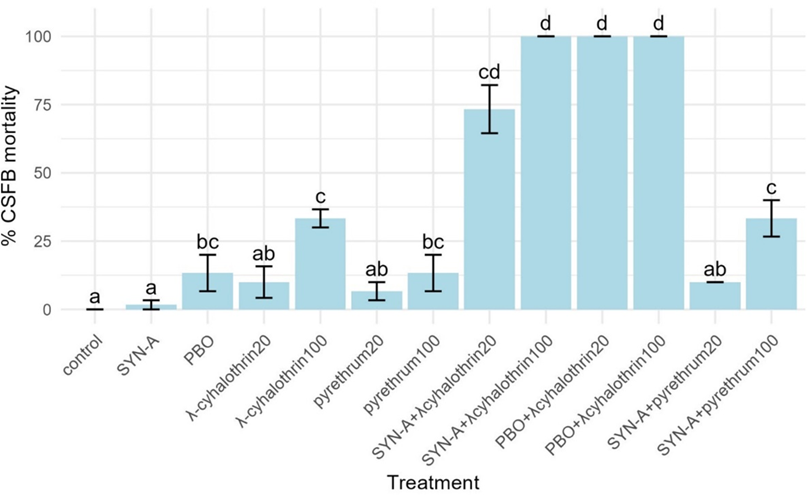
As illustrated in Figure 1, the addition of SYN-A to lambda-cyhalothrin at the full field rate resulted in 93% mortality – more than a threefold increase compared to the insecticide alone [1]. Even more remarkably, the synergistic effect was so potent that applying just 20% of the standard lambda-cyhalothrin field rate alongside SYN-A achieved 68% mortality. This means that a drastically reduced dose of insecticide, when paired with the olive-derived synergist, provided 2.2 times greater control than the full-rate insecticide applied on its own [1].
Dr Samantha Cook highlighted the urgency of these findings: “CSFB is the No. 1 insect pest of farmers right now due to their inability to control it using traditional insecticides… This tiny beetle is threatening oilseed rape production throughout the UK and much of Europe. The industry badly needs alternatives, but these are some way off in the development pipeline” [2].
The ability to achieve superior pest control while slashing the volume of active synthetic chemicals applied to the field represents a massive leap forward for integrated pest management (IPM).
Figure 2 – Insecticide dose reduction potential with SYN-A
Efficacy vs insecticide load across treatment scenarios

Figure 2 visualises this dose reduction potential. By utilising SYN-A, farmers could theoretically reduce their pyrethroid inputs by 80% while simultaneously tripling the mortality rate of resistant beetles compared to current standard practices [1].
From lab to leaf: Simulated field trials
While glass vial bioassays provide excellent baseline data, agricultural environments are infinitely more complex. To validate their findings, the researchers progressed to simulated field experiments. Oilseed rape plants were treated with various combinations of insecticides and synergists, and adult beetles were introduced to assess both mortality and feeding damage.
The simulated field trials mirrored the laboratory successes. Lambda-cyhalothrin alone yielded a mere 20% mortality rate among recovered beetles. In stark contrast, the combination of SYN-A and lambda-cyhalothrin boosted mortality to 75% [1].
Figure 3 – Simulated field experiment results
CSFB mortality and oilseed rape plant damage by treatment
Beyond simply killing the pests, the treatment significantly protected the crop. As shown in Figure 3, plants treated with the SYN-A and lambda-cyhalothrin mixture exhibited at least a 50% reduction in feeding damage (measured by the proportion of damaged plants and the number of feeding holes per leaf) compared to those treated with the insecticide alone [1].
The researchers also tested an organic pyrethrum extract in hopes of finding a fully natural control method. Unfortunately, pyrethrum – which degrades rapidly under ultraviolet light – failed to provide adequate control in the simulated field environment, even when combined with SYN-A, yielding only about 6% mortality [1]. For now, the most viable path forward relies on pairing SYN-A with existing synthetic pyrethroids.
The environmental catch: Protecting beneficial parasitoids
While SYN-A offers a powerful mechanism to break CSFB resistance, the study also uncovered a critical environmental caveat that farmers and agronomists must carefully navigate.
In agriculture, natural enemies play a vital role in keeping pest populations in check. For the cabbage stem flea beetle, one of the most important natural predators is Microctonus brassicae, a beneficial parasitoid wasp. Female wasps use their ovipositor to inject an egg directly into the adult flea beetle. The wasp larva then develops inside the living host, eventually killing the beetle when it emerges to pupate [1].
“It provides important natural control of CSFB and needs to be protected and encouraged in the farmed environment,” noted Dr Patricia Ortega-Ramos [2].
Because SYN-A works by inhibiting fundamental metabolic enzymes, it does not discriminate between pest and beneficial insect. The researchers found that SYN-A inhibited cytochrome P450 and esterase activity in M. brassicae just as effectively as it did in the flea beetle [1].
When the parasitoid wasps were exposed to lambda-cyhalothrin alone, they exhibited a surprising degree of natural tolerance, with 100% survival at the 20% field rate and roughly 67% survival at the full field rate [1]. However, when SYN-A was introduced into the mix, this natural tolerance was completely erased.
Figure 4 – Non-target impact on parasitoid wasp (Microctonus brassicae)
Mortality following exposure to synergists and insecticides
As depicted in Figure 4, the combination of SYN-A and lambda-cyhalothrin – at both the 20% and 100% field rates – resulted in 100% mortality for the beneficial parasitoid wasps [1].
This stark finding underscores a fundamental principle of synergist use: while they allow for a reduction in the total volume of insecticide applied, they fundamentally increase the toxicity and potency of the chemical mixture to both target and non-target organisms.
The path forward: Precision and Integrated Pest Management
The discovery of SYN-A presents a double-edged sword, but one that can be wielded effectively with careful management. The ability to restore pyrethroid efficacy and potentially reduce insecticide application rates by 80% aligns perfectly with ambitious European Union targets to minimise pesticide use and environmental impact [1] [2].
However, the severe impact on M. brassicae dictates that SYN-A cannot be used indiscriminately as a blanket spray. Instead, it must be integrated into a highly precise Integrated Pest Management (IPM) framework.
The authors of the study emphasise that successful implementation will require strategic temporal targeting. By closely monitoring the phenology (life cycle timing) of both the cabbage stem flea beetle and its parasitoid wasp, agronomists could time the application of SYN-A and pyrethroids to coincide with peak pest vulnerability while avoiding the windows of maximum parasitoid activity [1]. Furthermore, advances in formulation technology, such as microencapsulation, could help localise the delivery of the synergist directly to the pest’s feeding sites, thereby reducing environmental drift and non-target exposure [1].
With few new active insecticidal ingredients coming to market and existing chemicals failing due to resistance, the agricultural industry is in a precarious position. Compounds like the olive-derived SYN-A offer a vital lifeline, extending the useful life of current chemistries and buying researchers time to develop long-term, sustainable alternatives.
The next step for SYN-A involves larger-scale field trials under realistic farming conditions to validate these promising laboratory and semi-field results [2]. If successful, and if managed with a deep respect for the broader agricultural ecosystem, this natural olive extract could soon become a cornerstone in the fight to save UK oilseed rape.
References
[1] Ortega-Ramos, P. A., Moores, G. D., & Cook, S. M. (2026). SYN-A, a naturally derived synergist, restores pyrethroid efficacy against cabbage stem flea beetle but negatively impacts its parasitoid Microctonus brassicae. Pest Management Science.
[2] Rothamsted Research. (n.d.).SYN-A, a natural olive-derived compound, controls insecticide-resistant cabbage stem flea beetle. https://www.rothamsted.ac.uk/news/syn-natural-olive-derived-compound-controls-insecticide-resistant-cabbage-stem-flea-beetle-2