
Written by Joe Stanley, Head of Sustainable Farming, The Allerton Project
Farmers may be increasingly lacking in harvestable yield, but one commodity we aren’t short of is shiny reports proclaiming the unmitigated benefits of regenerative agriculture and its potential to fundamentally rewire our food system. Taken at their most effusive, such documents and the organisations behind them ascribe to “regen” the near-magical ability to reduce synthetic inputs to zero, eliminate cultivations and increase yield – while generating sufficient natural capital to require a second bank account in which to hold the proceeds.
The on-farm reality tends to be somewhat less dramatic, with incremental improvement (and not infrequent backsliding) being the experience of most practitioners, not least when faced with the reality of attempting to implement a systems change in the midst of some of the most challenging weather to face farmers in many generations. Almost everyone agrees that the appropriate regen practices in the appropriate context will benefit a farm business over time; what is less certain are the timescales of those improvements and the costs of implementing them.
The Allerton Project was commissioned by Nestlé UK&I to investigate the economic realities of “the regenerative transition” over five years on three model 600ha arable farms in the East of England: Sand, Loam and Clay. We conducted this work in partnership with the Andersons Centre, who based Loam Farm’s transition on their own long-running Loam Farm dataset and created the other two farms for this project. The results were recently released in a major report, From Risk to Reward: Investigating the Economic Transition to Regenerative Farming.
The transition from a “conventional” to a more “regenerative” system was modelled over five years in the absence of any external support, such as the Sustainable Farming Incentive, green finance or supply chain incentives, and was therefore judged on its own farming merits. Each farm was presumed to be 2:1 owned to rented, with representative rotations and establishment strategies for their context, and the financial figures generated were at the pre-rent and finance point.
The modelled transition presumed very “conventional” farming systems in the baseline year, with the “transition” representing nothing overly dramatic: a gradual progression towards reduced cultivations and direct drilling, cover and catch cropping, the return of some crop residues to the soil and the introduction of grazed livestock. The modelled results were then sense-checked by a panel of expert farmers to ensure that they remained rooted to the reality on the ground of those who had already made this transition.
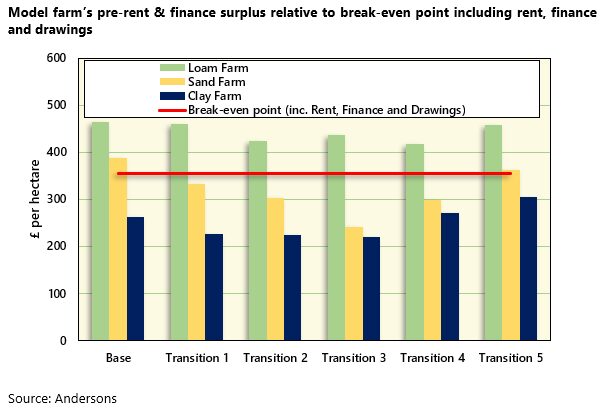
As can be seen in Figure 1, the initial picture is striking. From the baseline year, all three farms see a decline in profitability from which none recovers before year four. This equates to an average per-hectare deficit of £73 for Clay Farm, £119 for Loam Farm and £399 for Sand Farm over the five-year term.
What is driving this decline? There are savings to be made during the transition – reduced fuel, reduced labour, reduced depreciation from a more efficient machinery fleet – yet as our panel of farmers highlighted, in reality, some of these initially modelled savings can be less significant than hoped. With less autumn cultivations, it doesn’t necessarily follow that staff can or will be let go – though they may be redeployed to more profitable activities. A changing climate and differing soil types can also make reliance on one single drill or cultivator risky, reducing the real-world potential to consolidate machinery fleets and horsepower.
On the debit side, a reduction in yield was presumed during the transition – but not, for most crops, a particularly dramatic one, with Loam and Clay Farms seeing an 8 per cent and 5 per cent drop at worst. (Sand saw a 19 per cent drop, largely a result of poorer sugar beet yields.) Sand Farm also saw more costs associated with planting both cover and summer catch crops (remembering the absence of any support scheme), while Clay Farm was so badly impacted by the complete lack of straw sales that only 50 per cent of straw was modelled to be chopped to protect the bottom line.
While the long-term importance of more regen practices to invest in farm resilience is referenced repeatedly in the report (and is shown to be the major motivating factor from the farmer poll conducted as part of the work), what can’t be escaped is the short-term reduction in farm income resulting from the transition. In a sector making good money and able to reinvest in future resilience, that would not be a serious matter. But a mere glance at the P&L of most arable businesses over the last few years (and even much of the last few decades) shows that many farm businesses are unable to accept even short-term pain for longer-term gain, especially when much that is being asked of them in the form of more sustainable farming practices is to deliver on the goals of both government and the supply chain.
Related to this, the other significant point to note from Figure 1 is the fundamental lack of profitability for two of our three farms throughout this process, with Sand Farm producing losses in four of the five years of the transition and Clay Farm losing money in all five – as well as in the baseline year. For Sand Farm, this represents an average deficit of £50/ha per year to break even over the five-year model; for Clay Farm, £106.
With English farmers facing, according to provisional figures, the worst harvest since 1984 (to join similarly disastrous seasons in 2020, 2024 and 2025), and with commodity prices in real terms at historic lows, this matters. The regenerative transition as desired by government and the supply chain can – in the short term – increase farm business risk. In a negative cash flow environment, that can’t simply be brushed under the carpet.
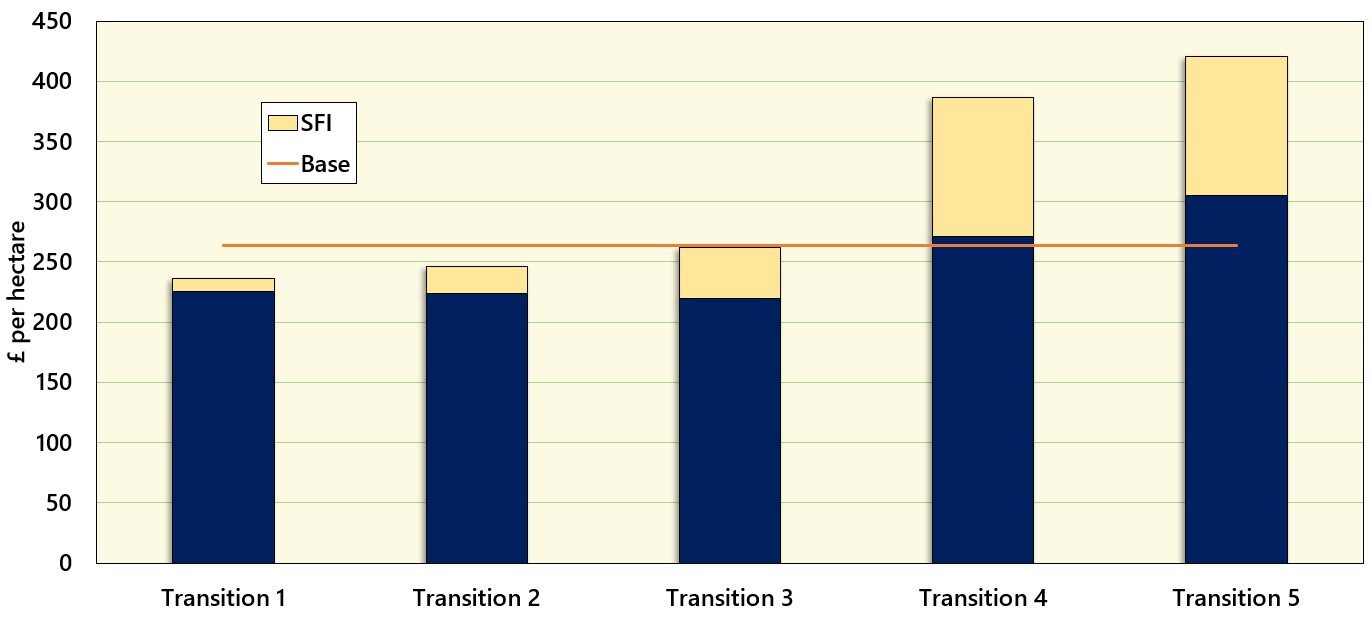
We did look at what a modest SFI scheme would deliver and how that would change the picture. As can be seen in Figure 2, even the staged introduction of relatively few options (cover and catch crops, no-till farming and low-input harvested cereal) made a significant difference to pain inflicted by the transition. However, given the 18-month hiatus in SFI funding up to September 2026 and subsequent farce surrounding its 352-minute application window, it’s clear that this is not a reliable source of support (whatever ministers might claim). Indeed, according to the Farming Roadmap, the very future of SFI looks highly uncertain from 2030, with Defra openly stating that they plan to stop funding so-called “transitional options”, such as cover crops and reduced tillage, from that date, with higher regulatory baselines “the stick” and the private sector supposedly coming to fill the gap.
Therefore, it’s great that Nestlé is sufficiently curious to have commissioned this report by The Allerton Project, and better still that they have taken such interest in the results. As a company, Nestlé is one of the global leaders in its regenerative aspirations, with a target of 50 per cent of key commodity products to be sourced from regenerative production methods by 2030, and a slew of promising pilots and initiatives already in place to help build more resiliently farmed landscapes. Yet it is for Nestlé and the rest of the food value chain to reflect on what more they need to do to help farmers build the resilience and sustainability that are a key part of their own business models going forward, and also of the pressure that needs to be placed by all stakeholders on government to ensure that the rug of even the limited public funding which is available today isn’t pulled away before a sustainable financial mechanism is in place to maintain high-quality, domestic food production here in England.
Key findings from the report:
- There is a challenging transition period. Farm profitability declines during the five-year RT across all soil types. However, there is a strong upward trajectory of profitability by year five, indicating a potential end to the “transitional” period in the short-medium term and thereafter.
- Risk must be more evenly shared. 82 per cent of farmers surveyed felt the risks associated with the RT should be more evenly spread across the supply chain. A more collaborative partnership between farmers and those who rely on the produce they generate is essential.
- Climate change is adding to the challenge. Many regenerative practices farmers are seeking to adopt are becoming increasingly more challenging in a climate of more consistent extremes.
- Short-termism is stifling the transition. The RT is a long-term proposition, yet the food and farming landscape is littered with short-term thinking. There must be more joined-up thinking that supports farmers to invest in the health of our soils and landscapes.
- Regen is a route to resilience. It’s difficult to justify the RT to farm businesses on its own financial merits. However, the RT brings wider benefits for farm and supply chain resilience.
- Knowledge exchange and training are crucial. There is a learning cost to the RT, and moving away from the status quo requires mindset change. Farmers learn best from other farmers, but government and supply chain must help facilitate learning to accelerate the success of transition.