
In the last issue, I looked at the EU reset and what it could mean for glyphosate. Since then, an American regen group has told its own regulator, in some detail, how farmers can get a crop in without a desiccant. I’ve read the lot, and some of the numbers are worth a look
In the last issue, writing up the Bayer day at Hinton, I touched on the EU reset. Bayer were increasingly confident CRD would mirror the EU’s 10-year renewal of glyphosate but expected us to lose it as a pre-harvest desiccant. Since then, things have moved on a bit. Or rather, they haven’t.
GB approval runs out on 15 December. HSE promised a 60-day public consultation for the summer and, as I write, it still hasn’t opened. Answering a written question on 5 October, minister Sir Stephen Timms said HSE is considering extending the approval beyond December on its current terms, and Farmers Weekly reckons a one-year rollover is now the most likely outcome.
The reason for the delay isn’t hard to spot. The government wants the SPS agreement in force by around mid-2027, and the plan is dynamic alignment, which means GB would mirror future EU decisions on active substances and MRLs. Negotiations are still going, and nothing is final. But if we end up following Brussels, it’s hard to see pre-harvest glyphosate surviving for long.
So the useful question isn’t really whether we lose it; it’s what we do instead.
The Americans are asking the same question
Here’s the bit I didn’t expect. The US, which most of us think of as glyphosate’s spiritual home, is now looking for ways to farm without desiccants. The Environmental Protection Agency has launched a $30 million Innovation Challenge to find practical, affordable alternatives to spraying crops off before harvest.
One of the groups that responded is American Regeneration, a regenerative farming charity. Their submission went in on 30 September, and it’s not a campaign leaflet; it’s built on peer-reviewed trials from the US, Canada and Australia, plus conversations with growers, buyers and certifiers.
The first thing that jumped out was the scale. Nobody in the US actually knows how much land gets desiccated because the federal surveys don’t record it separately. Estimates run from about 3 per cent of wheat nationally to as much as 80 per cent of small grains and oilseeds in places like North Dakota. In other words, it’s a cool, wet, short-season habit. Where crops dry down naturally in the field, farmers mostly don’t bother.
Sound familiar? That’s the same split we’d see between a Cambridgeshire wheat crop and spring barley in the north of Scotland.
Back to the swather
The main alternative they put forward is one plenty of us will remember: swathing. And the numbers they quote for it are better than I expected.
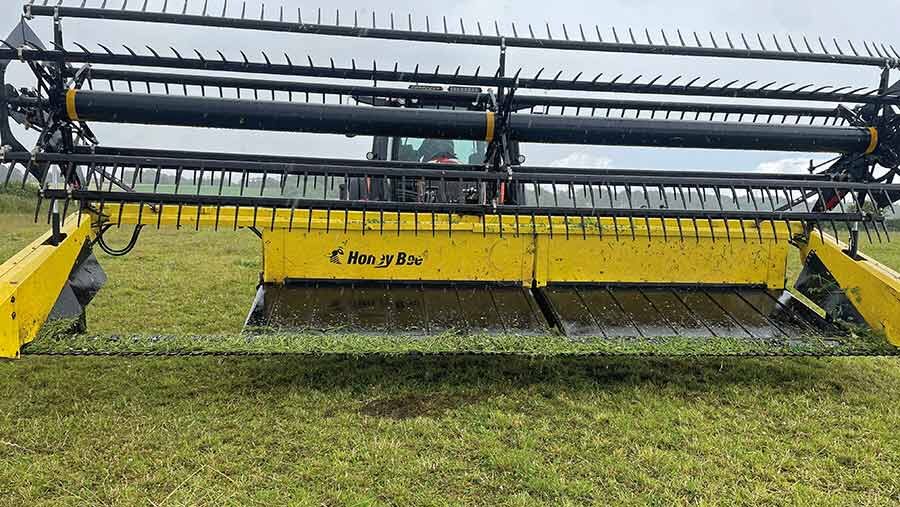
In a Canadian canola trial by the Prairie Agricultural Machinery Institute, four harvest methods were compared. Swathing had the lowest seed loss, at 1.1 bushels an acre against up to 2.8 for the desiccated straight-cut treatments. Roughly, that’s 60kg/ha on the floor versus 160kg/ha. It was also the cheapest, at $25.73 an acre all in, against $38.97 to $42.56 for the chemical options. So about a third cheaper, and less seed left behind.
It’s the same story in lentils. University of Saskatchewan work found that in a cool, wet harvest, early desiccation knocked milling efficiency below 70 per cent, while early swathing kept it above 85 per cent. In Australia, mungbean growers worried about being shut out of export markets ran commercial-scale trials and found windrowed crops dried down quicker and graded better.
Now, I’m not daft. The Canadian prairies in August are not Aberdeenshire in a wet September, and swaths sitting in the rain for a fortnight is exactly why a lot of people gave up on it. The report admits as much: it needs an extra pass, extra kit and someone who still knows how to set a swather up. That skill has drained away as desiccants took over.
Varieties and drilling dates
The other big lever is breeding and timing. Even maturity and shatter tolerance come up again and again. Canadian researchers found that early-sown, even oilseed crops with pod-shatter resistance could skip desiccation altogether, whether they were swathed or straight-cut. Most of us are already growing pod-shatter-resistant rape, so that one’s closer than it sounds.
Earlier drilling gives crops more time to ripen and dry naturally before the weather turns. They also mention intercropping, chickpeas with linseed in their case, as a way of evening up a crop in a decent year.
We’ve done this before
The potato section is the one UK growers can probably speak to best. University of Wisconsin trials found flailing then flaming the haulm did as well as two sprays of diquat, on yield and on skin set. We lost diquat over here in 2020, and potato growers have had to work this out the hard way since.
There’s also a useful snippet a bit closer to home. At the Scottish Government’s Pesticides Stakeholder Group in June, Teagasc reported that losing glyphosate for desiccation in Ireland was having minimal impact so far. SRUC has been asked to look at what aligning with the EU would mean for Scottish crops. Others round the table were far less relaxed about it, and I’d want to see the SRUC work before drawing any conclusions.
The buyers may get there first
What struck me most is that the report doesn’t really pin its hopes on the regulator; it points at the buyers.
Richardson International, Canada’s biggest agribusiness, stopped taking desiccated oats back in 2020. The American Malting Barley Association won’t have pre-harvest desiccant-treated barley at all, because of what it does to malting quality. And a “Glyphosate Residue Free” certification scheme in the US, carrying brands like Oatly and Chobani, was worth $778 million in sales by 2022.
I’d be surprised if our own maltsters and oat millers weren’t watching that closely. Interestingly, NatureScot asked at that same Scottish meeting whether the Scotch Whisky Association would help research malting barley varieties suited to growing with little or no glyphosate.
Money with a market attached
The part of the submission I like best is what they want done with the $30 million. Rather than pour it into new chemistry or gadgets that can’t yet keep up with a combine, they want most of it spent scaling up what already works:
- Shared swathers and training, run through co-ops and farmer groups, so a small or mixed farm isn’t buying a machine it uses for three weeks a year
- Farmer-to-farmer networks and demo farms in the areas that rely on desiccants most
- Conventional breeding for even-ripening and determinate varieties
- A 10% cap for newer kit like electrical weeding and bioherbicides
And crucially, they want every award tied to a food brand signing a binding, multi-year contract to buy desiccant-free crop, ideally with a premium. That’s the bit our own policymakers should copy. A ban with no market behind it is just another cost dumped on the farm. A ban with a buyer queuing up for the grain is a different conversation.
What it means for direct drillers
For this magazine’s readers, the important thing to keep hold of is that the EU rule is about desiccation, not the pre-drilling spray to kill off cover crops and stale seedbeds. That’s the use most no-till and regen systems actually depend on.
It’s worth being clear about what the EU actually banned, because it isn’t a window of time. The regulation says uses “to control the time point of harvest or to optimise threshing” can’t be authorised. Spraying before harvest to control weeds is still allowed, as long as it fits integrated pest management rules. The days-before-harvest interval stays on each product label. Here, Roundup ProActive XL can go on up to 7 days before harvest on wheat and barley, and 14 days on oilseed rape. The EU didn’t push that out to 30 or 60 days; it just stopped anyone calling it desiccation.
The timing matters too. The government wants the SPS deal in force by mid-2027. If alignment comes in as a hard cut-off rather than with a transition, desiccation could be gone in time for harvest 2027. In which case, I suspect we’ll all discover an awful lot of weeds in our crops next July that urgently need killing seven days before the combine goes in. Either that, or we pray for another proper summer harvest and plenty of sunshine.
The Glyphosate Renewal Group, the manufacturers backing renewal in GB, argue that glyphosate is essential to regenerative farming because it lets us control weeds without moving soil. They’re right about that. But they’re also arguing for an exception to keep desiccation in any SPS deal, and my worry is the two get lumped together. If we spend all our energy defending the pre-harvest spray, the bit we really can’t do without risks getting caught in the crossfire.
Regen growers are better placed than most here. We already think in rotations, cover crops and soil biology, and the report makes the point that healthier soils and more diverse rotations cut the need for inputs generally. Plenty of you will have dropped routine desiccation years ago and found harvest wasn’t nearly as bad as you feared. Others will have been pushed that way by the price. When glyphosate became scarce and costly during Covid, a lot of us looked hard at whether that pre-harvest pass was really earning its keep. Prices have roughly halved since, but they’re still about 50% above pre-Covid levels.
So I’d like to hear from you. Who’s still swathing, or has gone back to it? Who’s harvested without a desiccant through a properly wet year, and what did it cost you? Did the Covid price spike change your habits for good? If we’re going to lose it, I’d rather we wrote the guide ourselves than waited for Brussels or the HSE to write it for us.