
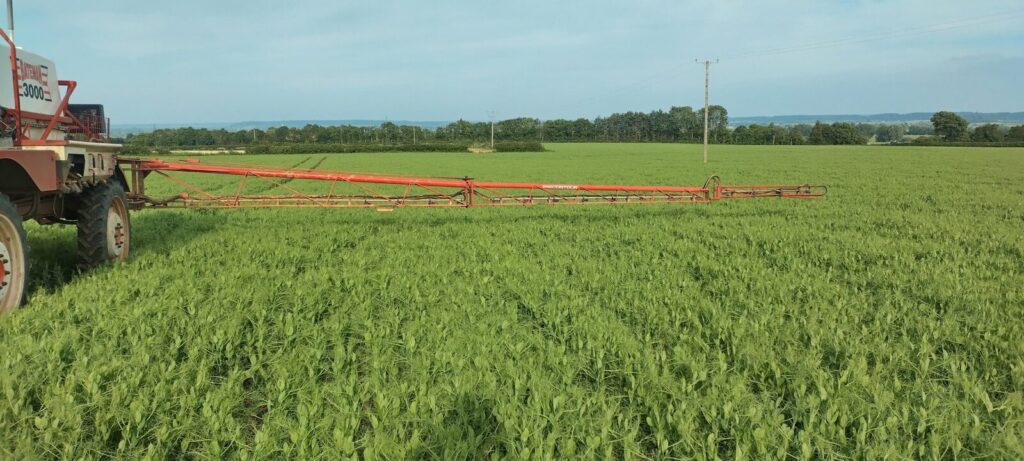
Jerry Alford reports on the many encouraging results from the three-year LEGUMINOSE trials that explored the value of intercropping cereals and pulses
The Horizon Europe LEGUMINOSE project has been investigating intercropping of cereals and pulses over the past three years and has now completed the field trials phase. The UK farmer-led trial was designed as a Soil Association Innovative Farmers Field Lab. The only requirements were that the intercrop constituents grown together were cereals and pulses and that each trial site included neighbouring strips of intercrops and a strip each of the two monocrops, allowing close comparisons to be made of the effect of intercrops on soil and crop.
Although not an organic trial, most of the 25 trial plots did not use fertiliser or agrochemicals. As a consequence, some interpretation of results for organic farmers is possible through comparisons between those that had inputs and those that did not.
In general, over three years of trials, the intercrop plots were 20-30% more productive than the monocrops using the Land Equivalent Ratio (LER) as a measure. LER is the area of land that would be needed to grow an equivalent quantity of total crop as the intercropped area, and this accounts for the lower relative yield of pulses than cereals. Generally, values of 1.2 to 1.3 are common and, although the dry 2025 did show a lower value, it was above 1 across the trial plots.
Yield effects of intercropping
Yield of crops is key to profitability, and one of the benefits of intercrops is the way that the components respond to weather. 2024 was a wet year suiting pulses, while 2025 was very dry, less suitable for pulses though cereals were less affected. Comparing crop yields directly between monocrop and intercropped plots is easier if we compare the cereal or pulse yield of the half hectare proportion of the intercrop with the half hectare yield of monocrop.
The graph (Figure 1) shows that cereal yields were similar between mono and intercrops in 2024, and monocrop pulses did well. However, in 2025, intercrop cereals out-performed monocrop cereals with the pulse yield being slightly lower. As an example of the additional resilience, in one trial area, yield of beans at one end of the field was very poor while oats did well. However at the other field end, the opposite situation occurred, meaning that there was a crop to harvest in all parts of the field. This might not have been the case with a monocrop.
Effect of intercrops on grain protein
One additional effect of intercropping was seen in grain protein levels. Intercrops were found to have around 1% more grain protein than monocrops across all the crop mixes in the European project. The UK plots saw slight increases, but the samples were from a farm that had used artificial fertiliser.
Whether this is due to lower cereal plant densities, different availability of nitrogen late in the season, direct interaction between cereal and legume, or differences in nutrient availability in an intercrop is not clear. But there is evidence that in legume-cereal systems, cereals are typically more competitive for soil nitrogen sources, causing the legume component to compensate by increasing symbiotic atmospheric nitrogen fixation, leading to improved nitrogen use efficiency. The trial has demonstrated that in the absence of additional nitrogen fertiliser, grain protein is higher in intercrops than in neighbouring monocrop cereals.
Effect of nitrogen fertiliser
Some non-organic farms used artificial nitrogen, at half the standard rate for monocrop cereals, to increase cereal yield. The consequence was a reduction in the LER, from 1.4 to 1.29 in 2024 and 1.07 to 1 in 2025 (Figure 2, top right). Similar results were found in field trials at Reading University run as part of the LEGUMINOSE project. They found that increasing amounts of nitrogen reduced the grain protein increase, lessening the benefit of intercropping.
Effect of sowing system
The farmer-led nature of the project meant that trialists were free to experiment within their own plots. So it was possible to compare between sowing both crops in separate or mixed rows, and so investigate the effect of intercrop competition and interrow competition. 2025 was not a good year for pulses but the competition for water within rows appeared to penalise the mixed crop, with yields of pulses being only around 5% of total in the mixed rows but around 20% in alternate rows.
In a normal UK summer, the ratio was closer to 50:50 in a mixed row trial. This difference was shown by an increased LER for the alternate row crop despite lower plot yields (Figure 3, middle right). Drills capable of drilling separate rows are expensive but in an organic system, where beans could be ploughed in followed by a cultivator drill to plant the cereal, the effect of interrow and intra-row plants could be a hybrid approach.
Plough-based vs min-till
Many farmers prefer to plant beans using a plough-based system to ensure they are deep enough, and ploughing is common in organic systems to bury overwinter covers and as part of the weed control strategy.
Corvid predation, particularly rooks on shallow planted beans, was an issue throughout the trial, especially when bean seed was drilled to the same depth as the cereal. In one trial, part of a wider trial comparing regenerative systems and conventional approaches to a whole rotation, a diverse crop system using an intercrop of oats and beans was compared with monocrop beans drilled into ploughed or min-tilled ground. The results from one year show an increased yield from intercropping and also from ploughing, with the intercrop bean yield exceeding the half hectare direct-drilled bean yield (Figure 4, see page 27). The intercrop produced a similar yield of oats.
Pest disease and weed control
One other perceived benefit of intercrops is a reduction in pest and diseases, because of either disruption of movement through the mixed crops or through an increase in beneficial predators.
No trialists used any insecticides or fungicides and only one reported any issues with crop disease but, as part of the trial, plots on two farms were visited three times during the growing season and assessed for plant disease (net blotch in barley), pests (cereal weevil – Oulema species) and beneficial hoverfly eggs and larvae (Syrphid species). Using canes to mark test sites, the same locations were assessed each time and results shown as heat maps.
UK results will be reported separately but in 2024, Czech Republic trials found that net blotch severity was more severe in the monocrop with greater than 58% of crops showing severe infection on the top three leaves but with a significantly less severe infection in the intercrop. Severe infection was also more localised in the intercrop.
Cereal weevil damage was found on 20.5% of the upper three leaves in monocrop barley but only 14.5% of cereal plants in the intercrop.
The hoverfly analysis showed a higher level of hoverfly eggs and larvae per plant in the pea monocrop. Since predator populations are linked to availability of food this means that there was more food (aphids) present in the monocrop than in the intercrop and, looking at the ratio of pests to beneficials, this can be factored into the analysis. With pea aphids affecting plants directly through feeding on sap and carrying viruses, intercrops are therefore a means of keeping aphid populations down below the threshold where control is required.
Protein production
One key role for intercrops is in production of animal feed as a higher protein whole crop. However, analysis of crop yields from the trials did show that the intercrop, even if harvested at maturity, together produced more protein per hectare than an equivalent area of monocrop pulse (Figure 5, above)
Across all the plots in 2025, the combined samples were calculated to have an average of 15% crude protein, although they peaked in individual plots at 20%. If milling facilities are available, a mixed cereal/pulse blend could be used to produce a whole livestock feed for youngstock and, with suitable balancing for essential amino acids with high quality protein, a ration for dairy cows, pigs or poultry.
Conclusions
Intercropping has commonly been used organically as a crop late in the rotation to help hold fertility levels and provide weed control. The higher crop yields, indicated by LER values and also the higher half-hectare plot yields indicate an economic reason as well. With protein for livestock feed increasingly dependent on imported products, intercropping does provide a more resilient method to produce UK protein with some reduction of risk. There are still areas that need resolution – such as marketing – but, for on-farm use, the benefits are clear.
The results demonstrate that intercrops work better in a zero-nitrogen system such as organic, but there are still benefits if small amounts of fertiliser are used. Furthermore, the aspects of pest and disease control are relevant across all systemas, and intercropping has a role in integrated pest management (IPM) through reducing the need for chemical control products or to reduce risk when no chemical use is possible.
Economically, there are extra costs from planting two species – in terms of extra seed, time and possible separation. But if growing for on-farm use as animal feed rather than buying in concentrate feeds, intercropping does provide more on-farm resilience and self-sufficiency.