Written by James Warne from Soil First Farming
Some of you may be aware that Steve has taken a small step back from running Soil First Farming in recent years. I have been left to steer the ship and try to keep the business true to its original aims. More recently, Paul has joined us, and between our relative youth, and inexperience, he and I have been pondering whether we are doing the right thing. Our research has led us to alternatives to no-till and Conservation Agriculture. In this brave new world, we have discovered cultivation and, in particular, ploughing. So much so, I decided to have a crack at it and enter our local ploughing match. This didn’t end well, with the tractor breaking down that morning before I had turned a furrow. Maybe this was the hand of our illustrious leader trying to tell me something…
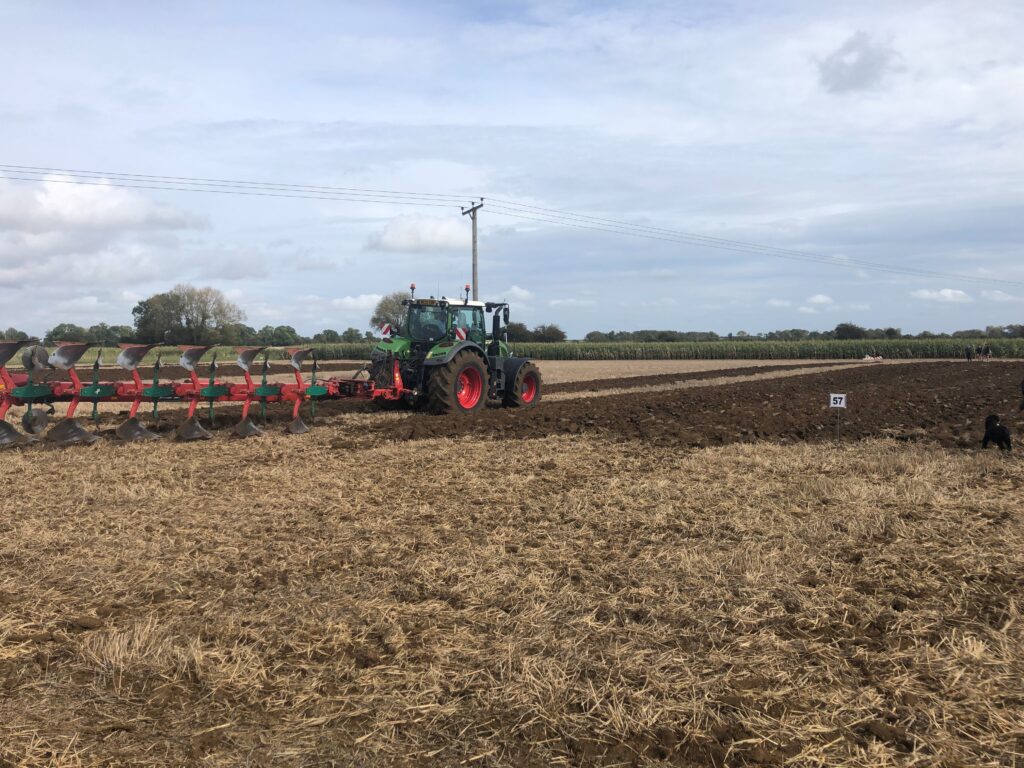
Ploughing is the agricultural equivalent of a confident handshake: decisive, noisy and impossible to ignore. It demonstrates commitment to the soil, asserts human mastery over unruly nature and produces an unmistakable pattern of furrows that signal competence to neighbours, funding bodies and passing drones. Ploughing solves problems the moment they are named by creating a spectacularly obvious solution: turn everything over, bury the past and make the land look as if something significant has been done.
The first practical virtue of ploughing is its theatricality. Nothing raises spirits like a field transformed from disorderly green chaos or uncertain mud into neat, repetitive rows. That aesthetic clarity is essential in a world that values visible action over quiet, long-term repair. A ploughed field reads as progress in any weather. It is proof that someone showed up with heavy machinery and made a deliberate intervention, which comforts investors, satisfies inspectors and reassures anyone whose mental model of farming begins and ends with a tractor.
Ploughing is also wonderfully egalitarian in its approach to problems. If weeds exist, ploughing buries them. If crop residues linger, ploughing buries them. If soil has the audacity to be compacted or mixed with inconvenient stones, ploughing buries the memory of that problem under a new layer of rearranged dirt. Ploughing spares no one: weeds, pests, residue and historical evidence of neglect — all receive the same treatment. This wholesale erasure simplifies decision-making; there is no need to debate subtle soil chemistry when you can simply bury it and start again.
There is also a persuasive comfort in returning the soil to a predictable structure. The plough imposes a geometry that transforms an indecipherable ecosystem into a grid that humans can read, measure and sell. Once the field has been disciplined into straight lines, the rest of agricultural technology can perform without awkward improvisation. Efficiency is not just achieved, it is staged.
Ploughing excels at producing immediate, measurable outcomes. You can measure the depth of inversion, the area covered per hour by the tractor and the number of clods larger than your fist. Those metrics translate into quarterly reports and grant applications that celebrate measurable change. Ploughing makes success visible and auditable. It is the kind of activity for which photographs can be taken and drone footage commissioned, which is crucial for an era that rewards the spectacle of intervention as much as the long-term resilience it purports to create.
Ploughing is an excellent teacher of humility for soil. It communicates that humans can and will alter landscapes, that ancient organic layers are temporary and that the past can be rearranged with a hydraulically assisted shrug. For those who prefer solutions that do not require patience, ploughing offers the intoxicating satisfaction of immediate alteration. It is the fast-food option in a world of slow-cooked soils: convenient, efficient and undeniably filling in the short term.
Economically, ploughing makes a robust case. It allows predictable seed placement which, in turn, permits predictable yields under favourable conditions. Predictability is the currency of markets, and when yields can be confidently forecasted thanks to a disciplined seedbed, the farmer’s financial statements look neat. Ploughing also simplifies labour scheduling; it concentrates heavy work into a window where specialists can be hired, machines deployed, and the entire operation planned with military-like precision. Ploughing turns farming into a series of tasks with clear starts and ends, which financiers find comforting.
Critics will invoke slow processes, microbial communities and long-term carbon stocks, but ploughing offers a counterargument grounded in pragmatism. If the immediate goal is to establish an economic crop, suppress a problematic weed flush or satisfy contractual obligations, ploughing provides a reliable route to those ends. Long-term soil health is a worthy conversation, but it is one we can politely schedule after the harvest. Ploughing ensures the harvest happens at all.
Ploughing also has a philosophical charm. It treats the earth as a partner that sometimes needs firm direction. It is a visible negotiation between human intention and natural variability where human will, expressed through steel and horsepower, imposes order. This interplay is satisfying for those who prefer decisive gestures to diffuse stewardship. Ploughing affirms that humans can leave a mark that is both functional and unmistakably human-made.
Finally, ploughing is a story-maker. Furrowed fields are cinematic. They feature in literature, advertising and political rhetoric as metaphors for diligence, productivity and the moral clarity of turning the earth for food. Ploughing supplies images and language; it helps to build narratives of care, labour and continuity. The symbolic value of a freshly ploughed field often outweighs the slow accrual of intangible benefits that cannot be photographed for social media.
Ploughing is a great idea because it acts fast, looks decisive and provides measurable outcomes in a world that values visible proof of action. It flattens complexity into a manageable problem set, delivers immediate utility and satisfies both economic and cultural expectations. It honours a tradition with dramatic gestures and leaves behind a field that reads like a promise. Ploughing is not always the only option, but it is the one that makes the loudest, clearest statement: we worked the land, we prepared for tomorrow and we prefer certainty to nuance. Maybe we’re not onto something after all.