October 2025
So nice to be looking towards the 2026 cropping and putting 2025 behind us. I think that the ‘25 cropping will be remembered for all the wrong reasons for quite some time and it’s one we hope won’t be repeated!
Can you believe that we are talking about next year’s cropping already? Where has the year gone? I saw my first Christmas advertising of the season this September — it only seems like yesterday we were taking the decorations down!
Crops performed better than I expected here, but they were still down from our normal average — by 25%. However, it could have been worse and I had also kept inputs down, so there was a margin for profit. Spring beans was by far the worst crop, as they especially need water to help them prosper and that was something the farm kept missing out on. On several occasions rain was forecast for the area, but when it was due, the rain showers I could see in the sky seemed to skirt around us.
Another season brings a fresh set of challenges. One to meet head on is to ensure that nutrition is balanced in the crop from the outset. This starts us out on the front foot by keeping pests and disease at bay. No crop becomes ill or is attacked by chance; there is always a reason for decline. We finally got rain in early September and cover crops are motoring on now. As the year is moving on, I have foliar fed some of them and that investment will pay dividends for the carbon bank and the following cash crop. As we still have fairly long autumnal days, cashing in on that sunlight must be the priority for me, aimed at maximising efficiency for carbon sequestration and ground cover.
I have a little giggle when I hear people say that regen farming is just a passing phase! Do they really think that we can continue mining fossil fuels and applying poisons to our land? I have read a few papers that report that residues of pesticides have remained in soils for years, even decades, and where land has been converted into organic, the residues remain many years after the last application. I often feel that these residues have a particular impact on cover crops on the farms that have used high rates of herbicides for many years, meaning that biology has been dramatically inhibited and said chemicals cannot be broken down. This just leads to degraded soils moving forward. We cannot continue to farm in that direction, turning a blind eye and hoping that the problem is going to go away.
I understand the financial pressure that people are under and sometimes we must make decisions that we would sooner not have to make, but to just bury your head in the sand and think the problem is going to disappear is madness to me. As Einstein is believed to have said: “Insanity is doing the same thing over and over again and expecting a different result.” All soil ever wants to do is heal. The problem is that human beings always think they know better and want to control the situation, which we have made a complete mess of in the short time that we have been on the planet! We must come up with a system where we can farm in harmony with Mother Nature and not fight against her.
With pesticide use rising by 25% from 2.8 million tonnes in 2010 to 3.5 million tonnes in 2022, is that a sign that pesticides are working? Or has their use risen due to the lack of results obtained? Has yield or profitability gone up in line with this rise? In my mind, most have gone backwards! So, isn’t it time that we as farmers come up with a system where we are far less dependent on synthetic inputs? It does take a determined focus to achieve this, but it’s well worth the effort. Once you have a working soil, the whole farm ecosystem responds! It all starts with getting your soil working and, subsequently from there, everything flourishes, including profitability.
At Green Farm Collective, we have had a busy year and are still working hard to secure buyers of our wheat, offering a premium back to the grower. I really feel that this is another issue where we need to stand together and not let regeneratively produced food be sold without a premium back to you on farm. Regardless of who we are selling to, if we sell ourselves short now, it will be a difficult one to resurrect. We need to endorse regenerative farming and be rewarded and applauded for contributing to the numerous, sustainable benefits that come from farming this way. Benefits to the planet and benefits to the future generations. The clock is ticking, and people deserve to have the choice to buy and consume food produced in a manner that is nutritious to them and generations to come, while still having a planet that is inhabitable and productive.
Our first load of the season was delivered to the mill in early September, which felt like a great victory to all of us at GFC. Our flour is distributed and sold by Eurostar commodities and has been nominated for the prestigious Sustainability Initiative of the Year award at the Baking Industry Awards 2025. This is a nomination that we are all very excited about and so proud to be recognised for after all the hard work that we have done and continue to do running along with Eurostar commodities. Like all things in life, the more effort you put in, the more you get out. Life is what you make it.
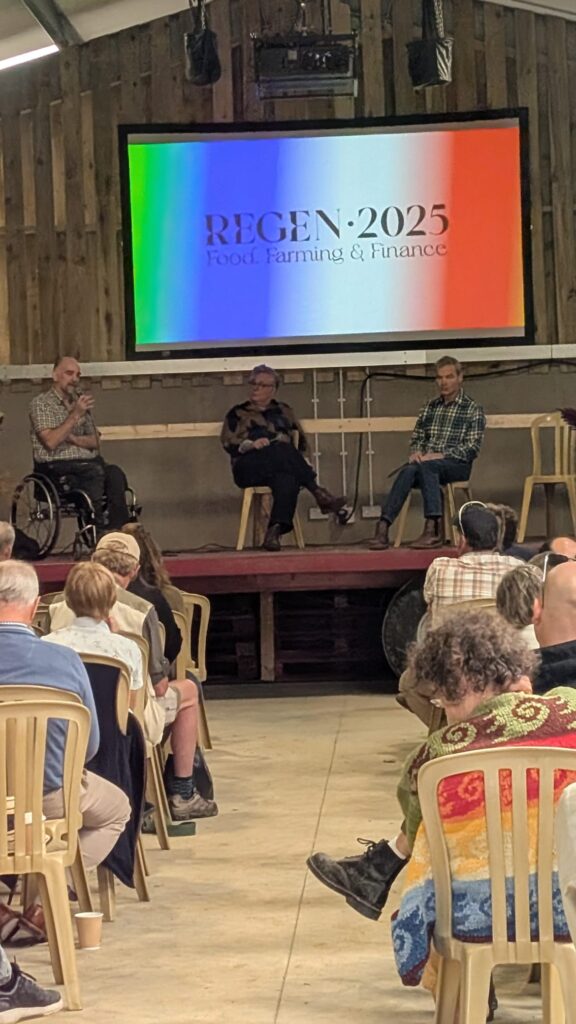
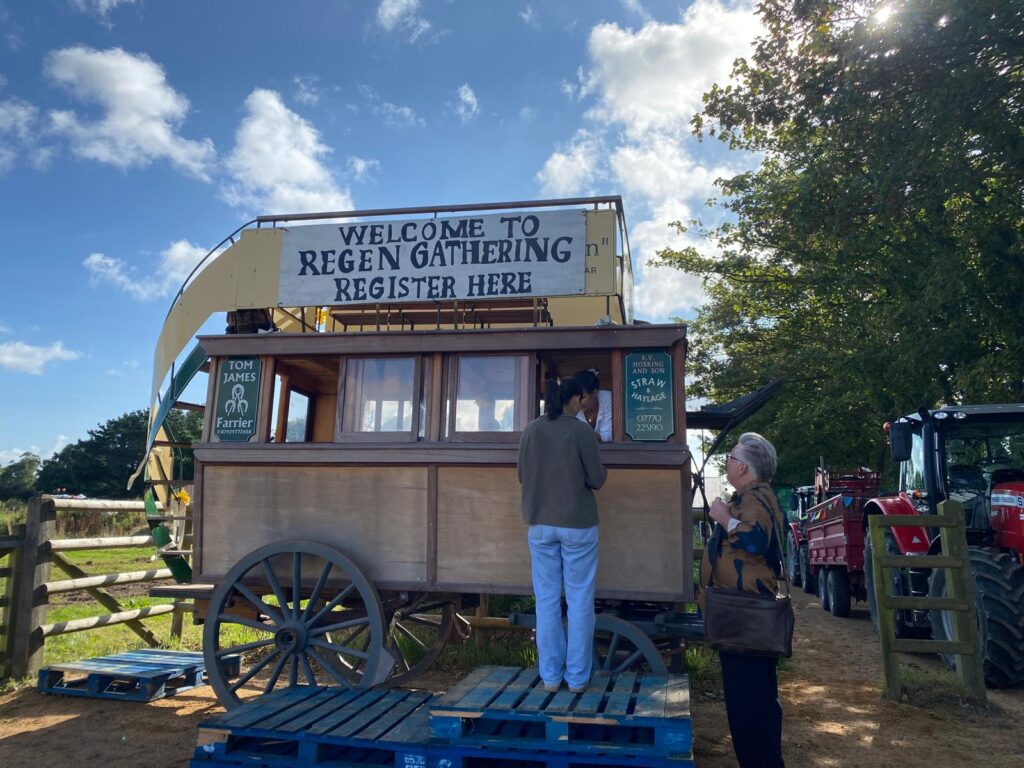
Lastly, in early September, I was very fortunate to be invited to speak in Jersey at a new rural community event organised by India Hamilton and Taylor Smythe. It was superbly hosted by the Le Tacheron family, who also ordered up some wonderful weather for the few days. I, along with Andy Neal and Ian Wilkinson, was invited to speak on the great debate of glyphosate vs tillage. We have given this talk many times, including at Groundswell last July. It always stimulates heated discussion, especially from people who are dogmatic stalwarts of the plough. We had plenty of those in the audience, since we all know potatoes are the main crop in Jersey, where some are growing continuously! Personally, I think that shallow ploughing, if necessary, is not a big evil if there is a legitimate reason for doing so and only done in a long rotation.
However, soil health is always my top priority and as proved in the trial done here for the glyphosate trial, not disturbing the soil results in retention of carbon, less nitrous oxide emissions and a stable structure. Over the period of three weeks, we could see the glyphosate was degraded and not held within the soil. Porosity of the soil was more stable with not moving the soil, whereas the high tillage piece had slumped after three weeks, which is what I would have expected. That was starting with a high biological soil, which broke the glyphosate down quickly. If results had been different, I may have looked at that thing called the plough. (Not on your nelly!) Additionally, I feel that the results would be totally different in a non-biological soil, where glyphosate would be hanging around for far longer.
Jersey is a lovely island, and I met some fantastic people – thank you for looking after me. We just need to take their ploughs off them and let what soil they have recover! With Jersey being such a small island, it could easily be the flagship of the world on how to farm in harmony with Mother Nature. It could lead the way developing working soils along with their clean air and water, but as with the rest of the UK, it will take a unified and concerted farming desire from us all to keep nutritious food supplied to the nation and the rest of the world.