Adapted for Direct Driller readers based on a paper by Dr Stephen Pearce from Rothamsted Research and the Czech Institute of Experimental Botany
If there’s one crop that keeps British farming grounded, it’s wheat. From milling and feed markets to exports, it sits at the centre of most arable rotations. Yet after decades of breeding and agronomy improvements, yield progress seems to have slowed, and the question facing the industry is clear: where will the next gains come from?
A team of scientists at Rothamsted Research believe part of the answer lies deep within the plant’s own biology. Their latest findings shed new light on how wheat controls its height and grain development — and how small changes in key genes could help breeders fine-tune yield and plant structure in the years ahead.
The growth hormone story
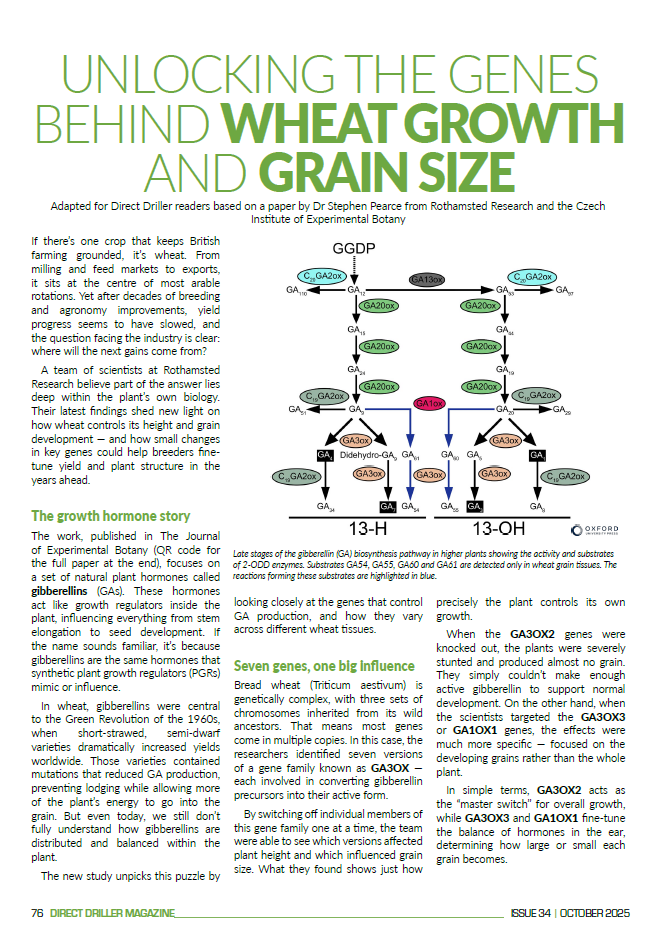
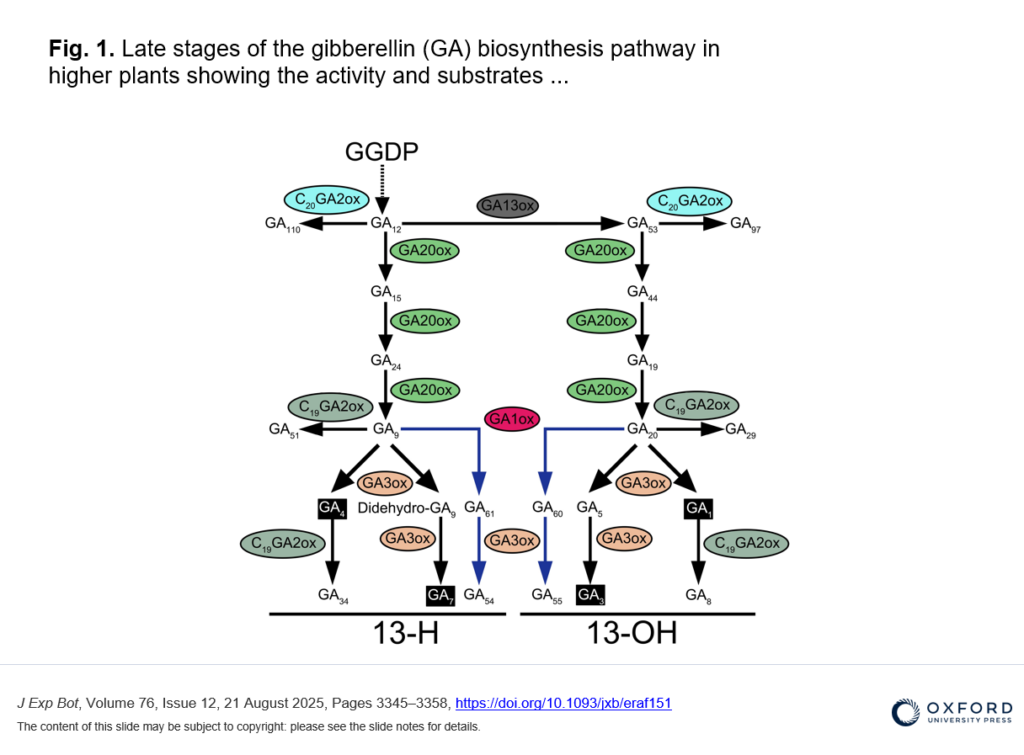
The work, published in The Journal of Experimental Botany (link for the full paper at the end), focuses on a set of natural plant hormones called gibberellins (GAs). These hormones act like growth regulators inside the plant, influencing everything from stem elongation to seed development. If the name sounds familiar, it’s because gibberellins are the same hormones that synthetic plant growth regulators (PGRs) mimic or influence.
In wheat, gibberellins were central to the Green Revolution of the 1960s, when short-strawed, semi-dwarf varieties dramatically increased yields worldwide. Those varieties contained mutations that reduced GA production, preventing lodging while allowing more of the plant’s energy to go into the grain. But even today, we still don’t fully understand how gibberellins are distributed and balanced within the plant.
The new study unpicks this puzzle by looking closely at the genes that control GA production, and how they vary across different wheat tissues.
Seven genes, one big influence
Bread wheat (Triticum aestivum) is genetically complex, with three sets of chromosomes inherited from its wild ancestors. That means most genes come in multiple copies. In this case, the researchers identified seven versions of a gene family known as GA3OX — each involved in converting gibberellin precursors into their active form.
By switching off individual members of this gene family one at a time, the team were able to see which versions affected plant height and which influenced grain size. What they found shows just how precisely the plant controls its own growth.
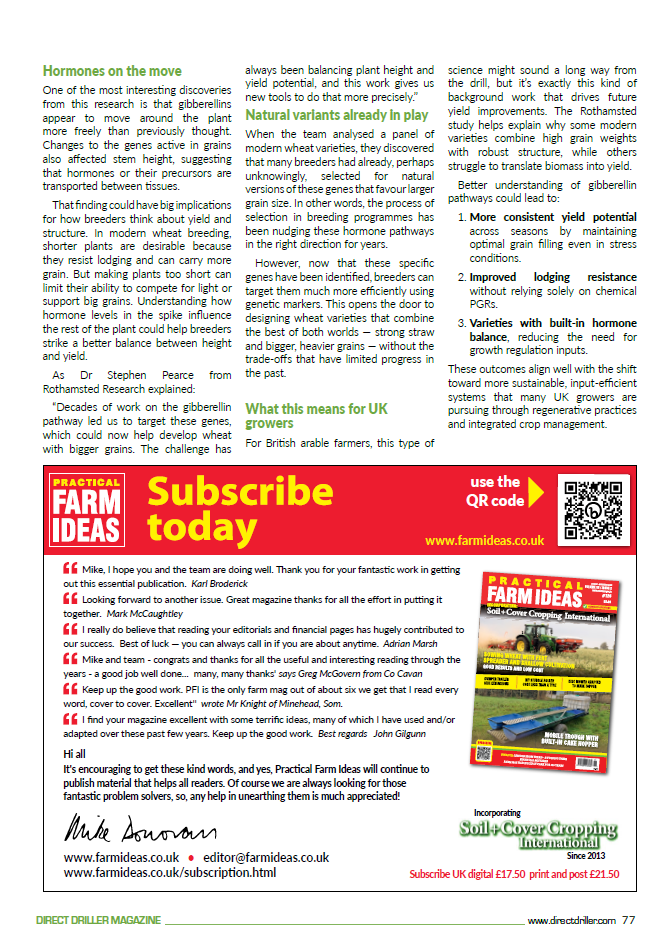
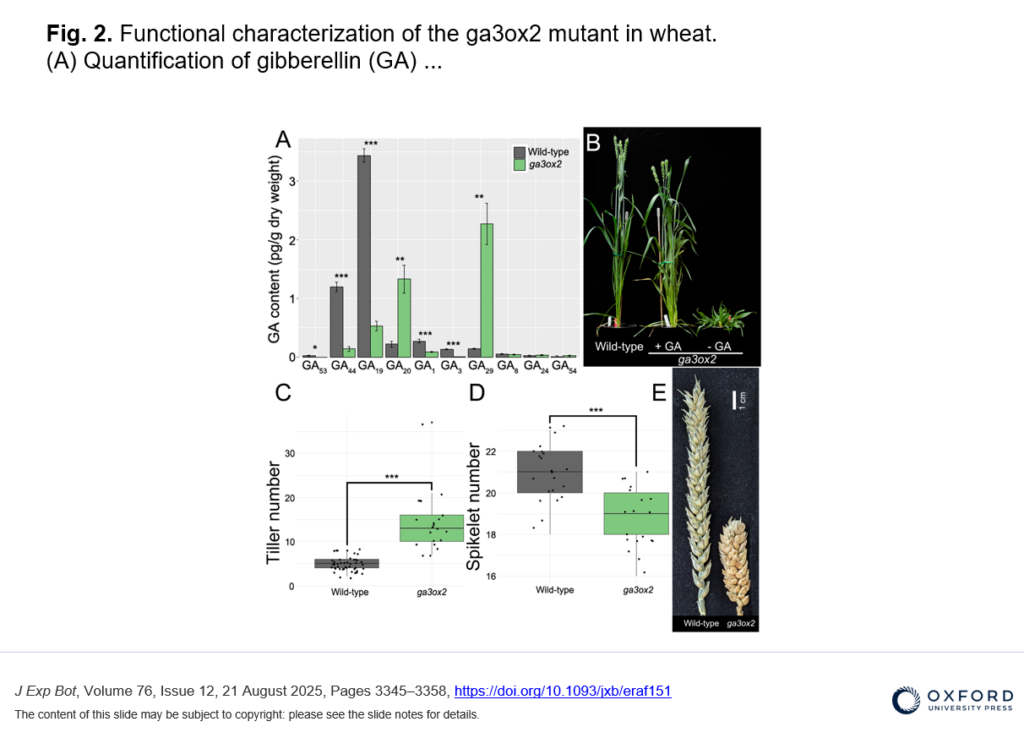
When the GA3OX2 genes were knocked out, the plants were severely stunted and produced almost no grain. They simply couldn’t make enough active gibberellin to support normal development. On the other hand, when the scientists targeted the GA3OX3 or GA1OX1 genes, the effects were much more specific — focused on the developing grains rather than the whole plant.
In simple terms, GA3OX2 acts as the “master switch” for overall growth, while GA3OX3 and GA1OX1 fine-tune the balance of hormones in the ear, determining how large or small each grain becomes.
Hormones on the move
One of the most interesting discoveries from this research is that gibberellins appear to move around the plant more freely than previously thought. Changes to the genes active in grains also affected stem height, suggesting that hormones or their precursors are transported between tissues.
That finding could have big implications for how breeders think about yield and structure. In modern wheat breeding, shorter plants are desirable because they resist lodging and can carry more grain. But making plants too short can limit their ability to compete for light or support big grains. Understanding how hormone levels in the spike influence the rest of the plant could help breeders strike a better balance between height and yield.
As Dr Stephen Pearce from Rothamsted Research explained:
“Decades of work on the gibberellin pathway led us to target these genes, which could now help develop wheat with bigger grains. The challenge has always been balancing plant height and yield potential, and this work gives us new tools to do that more precisely.”
Natural variants already in play
When the team analysed a panel of modern wheat varieties, they discovered that many breeders had already, perhaps unknowingly, selected for natural versions of these genes that favour larger grain size. In other words, the process of selection in breeding programmes has been nudging these hormone pathways in the right direction for years.
However, now that these specific genes have been identified, breeders can target them much more efficiently using genetic markers. This opens the door to designing wheat varieties that combine the best of both worlds — strong straw and bigger, heavier grains — without the trade-offs that have limited progress in the past.
What this means for UK growers
For British arable farmers, this type of science might sound a long way from the drill, but it’s exactly this kind of background work that drives future yield improvements. The Rothamsted study helps explain why some modern varieties combine high grain weights with robust structure, while others struggle to translate biomass into yield.
Better understanding of gibberellin pathways could lead to:
- More consistent yield potential across seasons by maintaining optimal grain filling even in stress conditions.
- Improved lodging resistance without relying solely on chemical PGRs.
- Varieties with built-in hormone balance, reducing the need for growth regulation inputs.
These outcomes align well with the shift toward more sustainable, input-efficient systems that many UK growers are pursuing through regenerative practices and integrated crop management.
A genetic roadmap for breeders
For plant breeders, the paper provides something extremely valuable: a clear genetic map of where to look for useful variation. The seven GA3OX genes each act in slightly different tissues and at different stages of development. By selecting combinations that give the right gibberellin balance, breeders could produce varieties that reach an ideal height under UK conditions while still delivering strong grain size and weight.
This could also help make breeding for resilience faster. Rather than screening thousands of plants in the field, breeders can now use molecular markers linked to these GA genes to predict how a line will behave. That means shorter breeding cycles and a better chance of combining complex traits like height, tiller number, and grain mass.
The long path to applied genetics
The Rothamsted group’s discovery builds on decades of work into gibberellin biology. The first dwarfing genes used in the Green Revolution (Rht1 and Rht2) were found to reduce gibberellin response, effectively making the plant insensitive to the growth hormone. The new research takes that understanding one step further, showing how wheat actually manufactures the hormone in the first place.
It’s a reminder that yield progress often depends on small, carefully tuned changes rather than single “silver bullet” genes. As Dr Pearce and his co-authors note, GA3OX2 is essential for basic growth, so knocking it back too far would cripple the plant. But small adjustments to GA3OX3 or GA1OX1 expression could subtly increase grain size without upsetting the rest of the system.
The bigger picture — feeding the future
With the global wheat demand predicted to rise by 50% by 2050, incremental genetic gains are going to be crucial. The world’s available farmland is not increasing, so yield per hectare must continue to improve. The Rothamsted study provides a roadmap for doing just that — using genetic insight to make each plant a little more efficient in how it uses its own growth regulators.
In the UK, where growers face both yield plateaus and climate uncertainty, understanding hormone balance could also contribute to stability. Plants that regulate their own gibberellins more precisely may cope better with variable moisture or heat stress, reducing the swings in grain size seen in dry or late seasons.
Looking ahead
While the study is still at the research stage, it represents another piece of the puzzle in understanding how wheat growth is controlled. The next steps will likely involve testing these gene variants under real-world growing conditions, to see how they interact with environmental stresses, nitrogen levels, and other agronomic factors.
This is where partnerships between scientists, breeders and farmers become vital. Translating gene-level discoveries into field-ready varieties depends on feedback from the field — how plants behave under tramlines, not just under glasshouse lights.
As with previous Rothamsted breakthroughs, the benefits will filter through over time. The varieties that reach farm trials in the coming decade may owe much of their yield stability or grain weight to the subtle tweaks being identified in this research.
Key takeaways for growers
- Rothamsted scientists identified seven GA3OX genes that regulate gibberellin production in wheat.
- The GA3OX2 genes control overall plant height, while GA3OX3 and GA1OX1 influence grain size and weight.
- Gibberellin hormones appear to move between tissues, linking grain development and plant stature.
- Modern varieties already carry natural variants of these genes that breeders have selected for larger grains.
- Understanding and using these pathways could help develop wheat with higher yields, balanced height, and less need for PGRs.