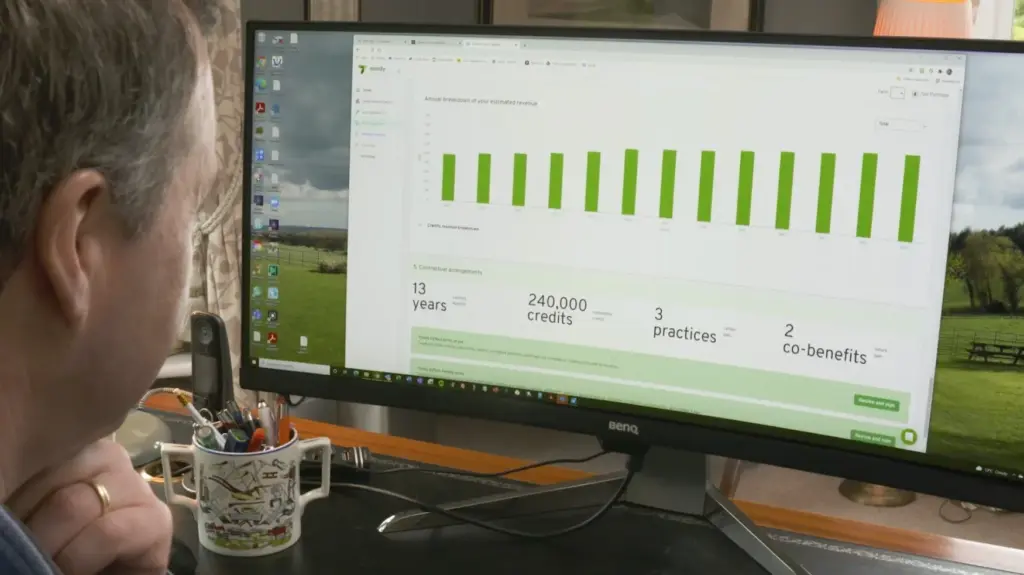
Climate instability, market volatility, and supply chain shocks aren’t coming, they’re here. The farms that weather them will be the ones that built resilience into their soil, water systems, and financial models. Not to just endure, but to farm well: with margin, with options, with a
business that actually works.
Written by Kiera Holland from Trinity AgTech
When half your neighbours couldn’t drill last autumn because the heavy land never dried, could you? When fertiliser prices more than doubled, could your farm maintain lower input costs while maintaining yield? When the drought hit in July, did your wheat still fill?
These aren’t hypothetical questions anymore. The farms that handled those shocks better aren’t just surviving, they’re farming profitably while their neighbours bleed cash on emergency inputs, failed crops, or fields they can’t even access. That’s not luck. That’s soil that holds water. Nutrient cycling that doesn’t collapse when input prices spike. Water management that keeps fields workable when others flood.
Ecosystem function that stabilizes production when weather patterns break. But here’s the problem: You’ve never been able to see it all in one place. You know your yield maps and input costs. But you’ve never seen your soil health, water management, carbon stocks, and biodiversity functioning on the same page as your bank balance. You can’t answer the questions that determine your farm’s future: What will your natural capital look like in five years? If you shift to reduced tillage or integrate cover crops, what’s the actual impact on your ecosystem services and your bottom line? Which practice changes deliver the highest return?
Your agronomist knows the practices are working. But when you ask “What’s the financial value of the natural systems I’m building?” there’s been no answer you can take to the bank. No measurement with scientific rigour. No adherence to international standards that hold up
when lenders, insurers, and premium schemes write cheques. Just marketing claims and inconsistent unverifiable methodologies.
That’s the gap that’s cost you visibility, and likely money. You can’t manage what you can’t measure. And right now, you’re managing the natural capital that determines your farm’s future with no instruments at all.
Understanding What Your Farm’s Natural Systems Are Already Doing
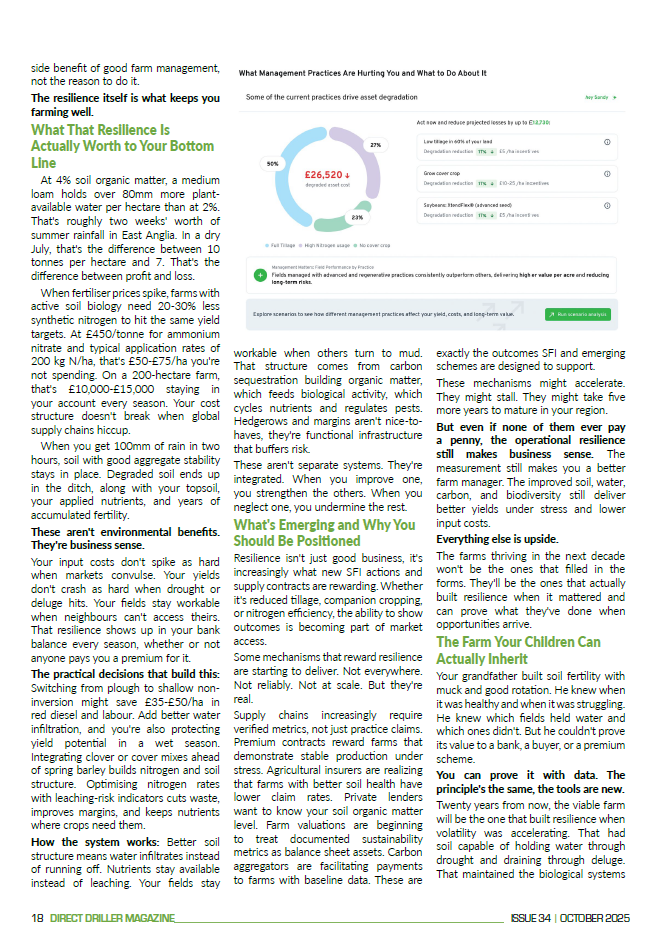
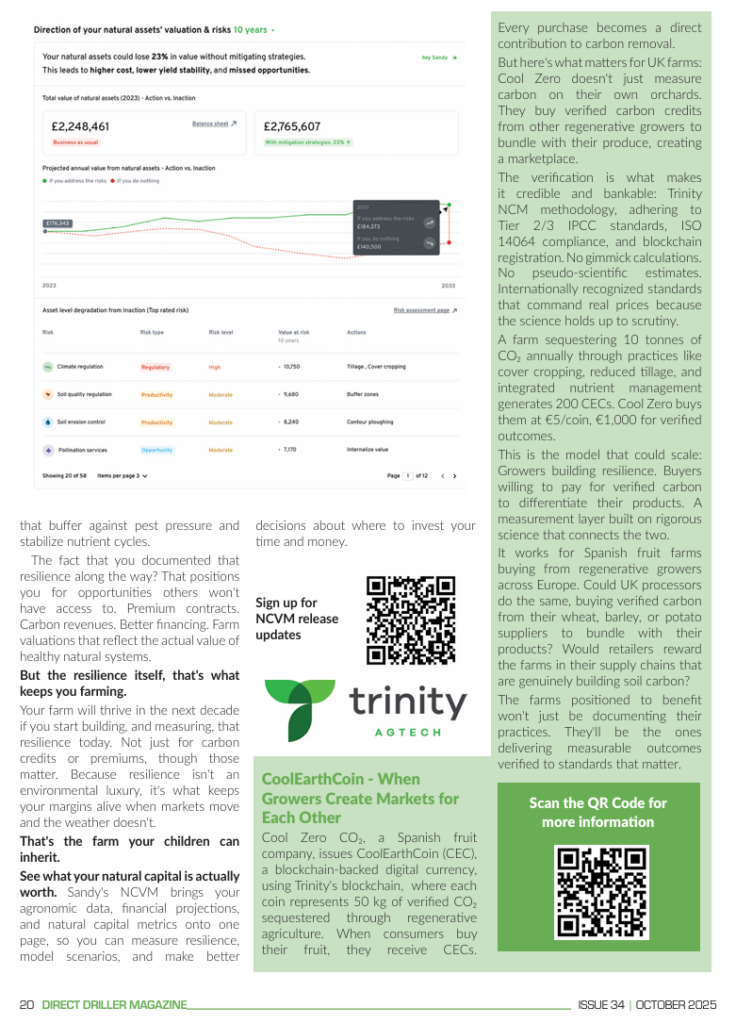
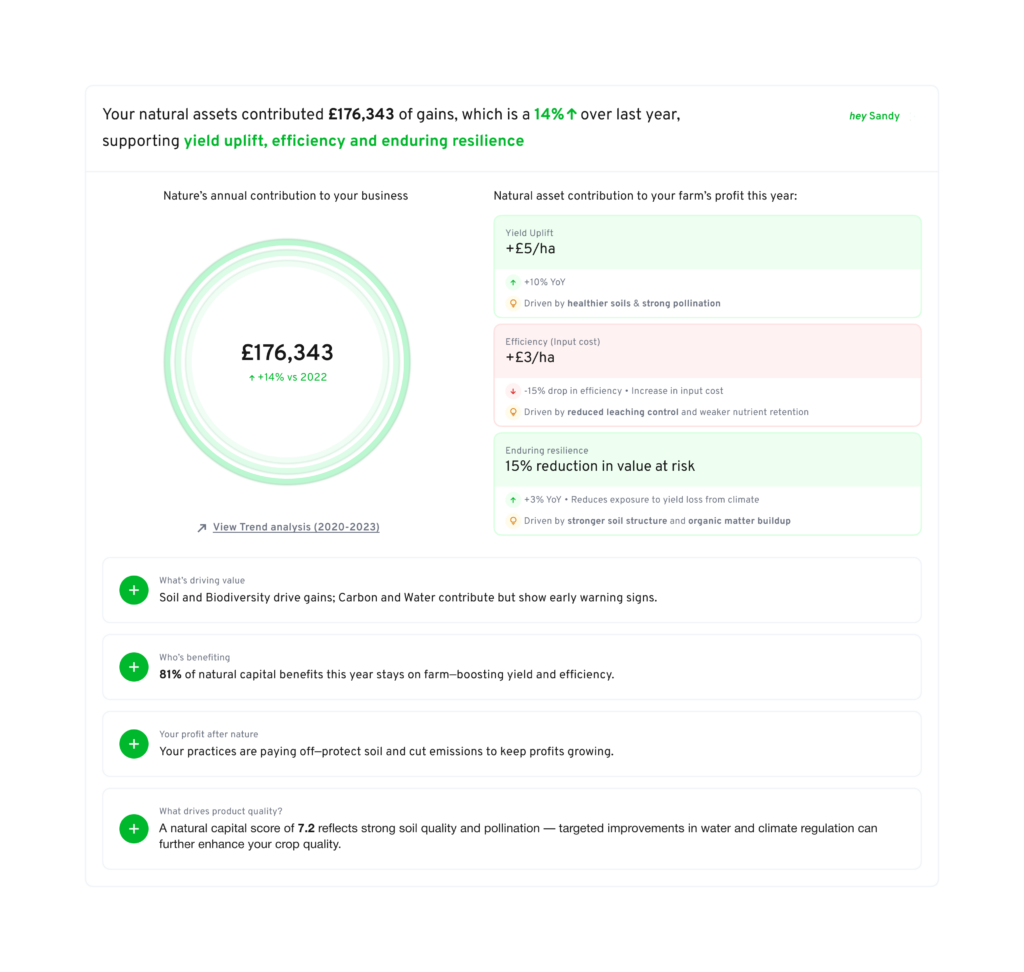
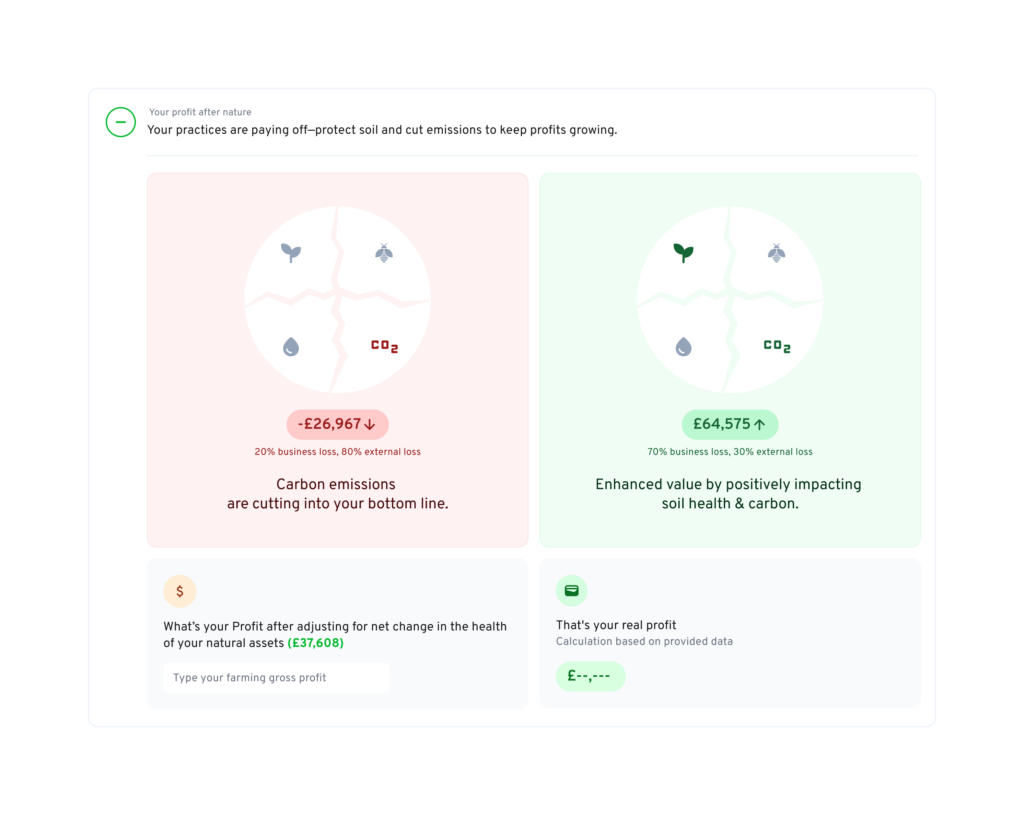
Sandy helps you see what your farm’s natural systems are already doing, and where you can strengthen them. It brings together your agronomic data, financial projections, and natural capital metrics under a single framework. Not as corporate jargon, but as a practical answer to a simple question: What is your farm actually worth, and is that value going up or down? You already measure machinery depreciation and seed ROI. Sandy lets you measure your soil structure, water-holding capacity, and carbon stocks the same way, as assets that either appreciate or degrade, and that directly affect your bottom line.
The approach recognises that your farm generates value across four critical areas: Soil Health, Nitrogen & Water Management, Carbon Sequestration, and Biodiversity. These areas are deeply interconnected. When you improve soil structure, you simultaneously improve
water-holding capacity, reduce nitrate leaching, increase carbon sequestration, and support biodiversity. The Sandy NCVM, Natural Capital Management Module integrates your existing data with satellite monitoring and natural capital assessment built on internationally recognized standards. You see which fields are improving fastest, where to focus effort for the best return, and what your ROI is on organic matter gains. You can model scenarios before you commit capital. When premium contracts, carbon schemes, or improved financing become available, you have the documentation ready.
This isn’t measurement for measurement’s sake. It’s decision support. It’s knowing where to invest your time and money for the highest return. It’s having evidence that your farm is getting stronger, not weaker. And if that measurement also positions you for SFI payments, premium contracts, or carbon revenue? That’s a side benefit of good farm management, not the reason to do it.
The resilience itself is what keeps you farming well.
What That Resilience Is Actually Worth to Your Bottom Line
At 4% soil organic matter, a medium loam holds over 80mm more plant-available water per hectare than at 2%. That’s roughly two weeks’ worth of summer rainfall in East Anglia. In a dry July, that’s the difference between 10 tonnes per hectare and 7. That’s the difference
between profit and loss. When fertiliser prices spike, farms with active soil biology need 20-30% less synthetic nitrogen to hit the same yield targets. At £450/tonne for ammonium nitrate and typical application rates of 200 kg N/ha, that’s £50-£75/ha you’re not spending. On a 200-hectare farm, that’s £10,000-£15,000 staying in your account every season. Your cost structure doesn’t break when global supply chains hiccup.
When you get 100mm of rain in two hours, soil with good aggregate stability stays in place. Degraded soil ends up in the ditch, along with your topsoil, your applied nutrients, and years of accumulated fertility.
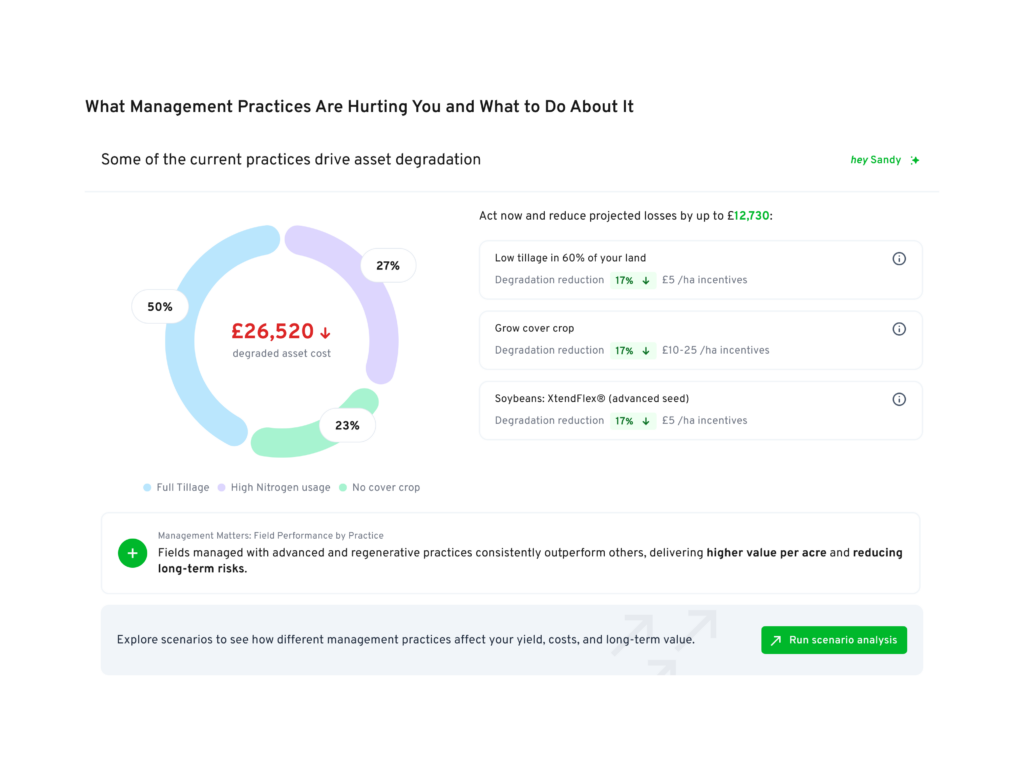
These aren’t environmental benefits. They’re business sense.
Your input costs don’t spike as hard when markets convulse. Your yields don’t crash as hard when drought or deluge hits. Your fields stay workable when neighbours can’t access theirs. That resilience shows up in your bank balance every season, whether or not anyone pays
you a premium for it.
The practical decisions that build this: Switching from plough to shallow non-inversion might save £35-£50/ha in red diesel and labour. Add better water infiltration, and you’re also protecting yield potential in a wet season. Integrating clover or cover mixes ahead of spring barley builds nitrogen and soil structure. Optimising nitrogen rates with leaching-risk indicators cuts waste, improves margins, and keeps nutrients where crops need them.
How the system works: Better soil structure means water infiltrates instead of running off. Nutrients stay available instead of leaching. Your fields stay workable when others turn to mud. That structure comes from carbon sequestration building organic matter, which feeds
biological activity, which cycles nutrients and regulates pests. Hedgerows and margins aren’t nice-to-haves, they’re functional infrastructure that buffers risk.
These aren’t separate systems. They’re integrated. When you improve one, you strengthen the others. When you neglect one, you undermine the rest.
What’s Emerging and Why You Should Be Positioned
Resilience isn’t just good business, it’s increasingly what new SFI actions and supply contracts are rewarding. Whether it’s reduced tillage, companion cropping, or nitrogen efficiency, the ability to show outcomes is becoming part of market access. Some mechanisms that reward resilience are starting to deliver. Not everywhere. Not reliably. Not at scale. But they’re real. Supply chains increasingly require verified metrics, not just practice claims. Premium contracts reward farms that demonstrate stable production under stress. Agricultural insurers are realizing that farms with better soil health have lower claim rates. Private lenders want to know your soil organic matter level. Farm valuations are beginning to treat documented sustainability metrics as balance sheet assets. Carbon aggregators are facilitating payments to farms with baseline data. These are exactly the outcomes SFI and emerging schemes are designed to support.
These mechanisms might accelerate. They might stall. They might take five more years to mature in your region.
But even if none of them ever pay a penny, the operational resilience still makes business sense. The measurement still makes you a better farm manager. The improved soil, water, carbon, and biodiversity still deliver better yields under stress and lower input costs. Everything else is upside. The farms thriving in the next decade won’t be the ones that filled in the forms. They’ll be the ones that actually built resilience when it mattered and can prove what they’ve done when opportunities arrive.
The Farm Your Children Can Actually Inherit
Your grandfather built soil fertility with muck and good rotation. He knew when it was healthy and when it was struggling. He knew which fields held water and which ones didn’t. But he couldn’t prove its value to a bank, a buyer, or a premium scheme. You can prove it with data. The principle’s the same, the tools are new. Twenty years from now, the viable farm will be the one that built resilience when volatility
was accelerating. That had soil capable of holding water through drought and draining through deluge. That maintained the biological systems that buffer against pest pressure and stabilize nutrient cycles.
The fact that you documented that resilience along the way? That positions you for opportunities others won’t have access to. Premium contracts. Carbon revenues. Better financing. Farm valuations that reflect the actual value of healthy natural systems. But the resilience itself, that’s what keeps you farming. Your farm will thrive in the next decade if you start building, and measuring, that resilience today. Not just for carbon credits or premiums, though those matter. Because resilience isn’t an environmental luxury, it’s what keeps your margins alive when markets move and the weather doesn’t.
That’s the farm your children can inherit.
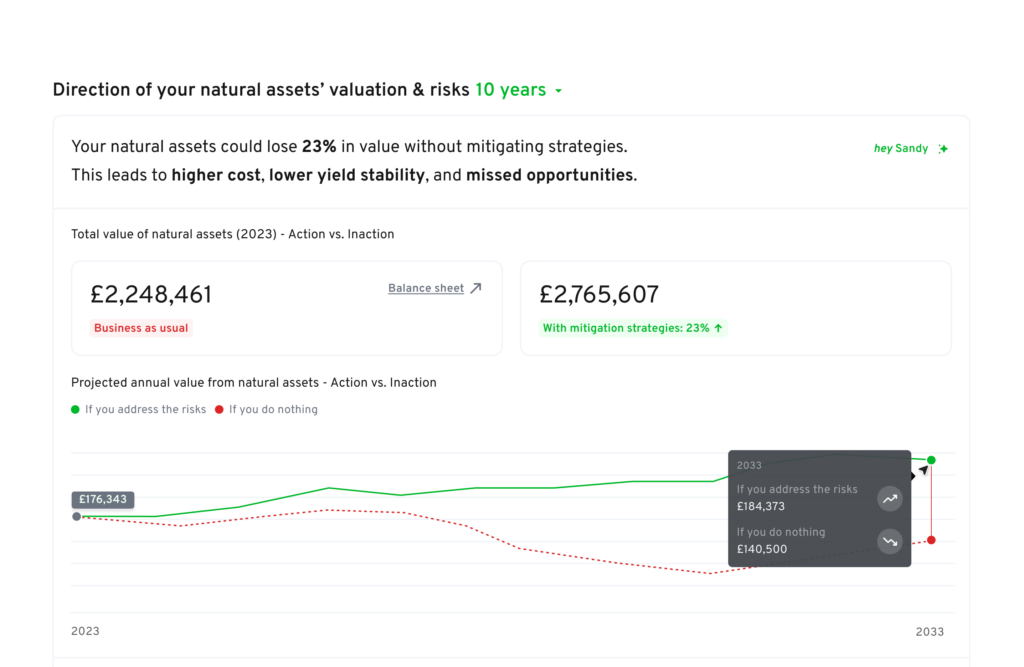
See what your natural capital is actually worth. Sandy’s NCVM brings your agronomic data, financial projections, and natural capital metrics onto one page, so you can measure resilience, model scenarios, and make better decisions about where to invest your time and money.
Sign up for NCVM release updates here.
CoolEarthCoin – When Growers Create Markets for Each Other
Cool Zero CO₂, a Spanish fruit company, issues CoolEarthCoin (CEC), a blockchain-backed digital currency where each coin represents 50 kg of verified CO₂ sequestered through regenerative agriculture. When consumers buy their fruit, they receive CECs. Every purchase becomes a direct contribution to carbon removal.
But here’s what matters for UK farms: Cool Zero doesn’t just measure carbon on their own orchards. They buy verified carbon credits from other regenerative growers to bundle with their produce, creating a marketplace. The verification is what makes it credible and bankable: Trinity NCM methodology, adhering to Tier 2/3 IPCC standards, ISO 14064 compliance, and blockchain registration. No gimmick calculations. No pseudo-scientific estimates. Internationally recognized standards that command real prices because the science holds up to scrutiny.
A farm sequestering 10 tonnes of CO₂ annually through practices like cover cropping, reduced tillage, and integrated nutrient management generates 200 CECs. Cool Zero buys them at €5/coin, €1,000 for verified outcomes. This is the model that could scale: Growers building resilience. Buyers willing to pay for verified carbon to differentiate their products. A measurement layer built on rigorous science that connects the two. It works for Spanish fruit farms buying from regenerative growers across Europe. Could UK processors do the same, buying verified carbon from their wheat, barley, or potato suppliers to bundle with their products?
Could retailers reward the farms in their supply chains that are genuinely building soil carbon? The farms positioned to benefit won’t just be documenting their practices. They’ll be the ones delivering measurable outcomes verified to standards that matter.
Read more about the Cool Earth Coin here.