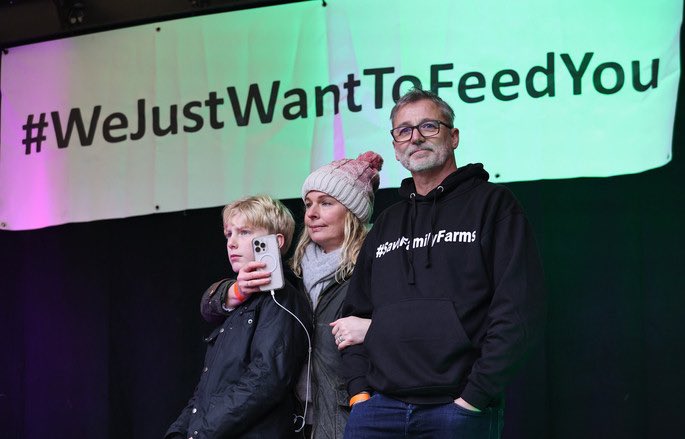
From the Field to Westminster: A Year That Changed Farming
It’s been about 18 months since my last contribution to Direct Driller, and during that time, a lot has changed — both on my farm and in British agriculture. I’ve always tried to be open and honest in these pieces. They’re not polished PR, not a government briefing and not a sales pitch for some new magic bullet. They’re simply the reflections of a working farmer who has spent most of his life in fields rather than meeting rooms.
This time, though, it’s been harder to put pen to paper. Not because there hasn’t been anything to write about, but because the past year and a half has felt like a whirlwind; politically, personally and practically. It’s been a year of frustration, unexpected activism and stubborn resilience. And, if I’m honest, it’s been one of the most pivotal periods of my farming career.
The turning point was late October 2024, when Rachel Reeves delivered her Budget. For most people outside the industry, it was just another political speech. But for family farms like mine, it was a seismic moment. With a few lines of policy, she fundamentally altered the landscape for succession, inheritance and the security of multi-generational businesses that have shaped the British countryside for centuries.
Agricultural Property Relief (APR) and Business Property Relief (BPR) are not obscure technicalities to us; they are the backbone of how farms survive from one generation to the next. Those reliefs aren’t “tax loopholes” as some columnists like to sneer. They’re the recognition that farms are not just businesses but working, living assets — often asset-rich but cash-poor — that need multigenerational stability over decades, not just this year’s balance sheet.
When Reeves announced those changes, it felt like the rug had been pulled from under us. Years of careful planning; not just spreadsheets, but conversations with accountants, lawyers and most importantly, my own family, suddenly looked fragile. What had felt like a steady, if challenging, path into the future now had a massive political faultline running through the middle of it.
I’ve never set out to be a campaigner; I’m a farmer. I’m at my best in a tractor cab or a shed full of machinery, not waving a placard or giving media interviews. But when those announcements landed, something inside me shifted. It wasn’t just about our own family business, it was about what this meant for countless others across the country who quietly keep the nation fed and its landscape managed.
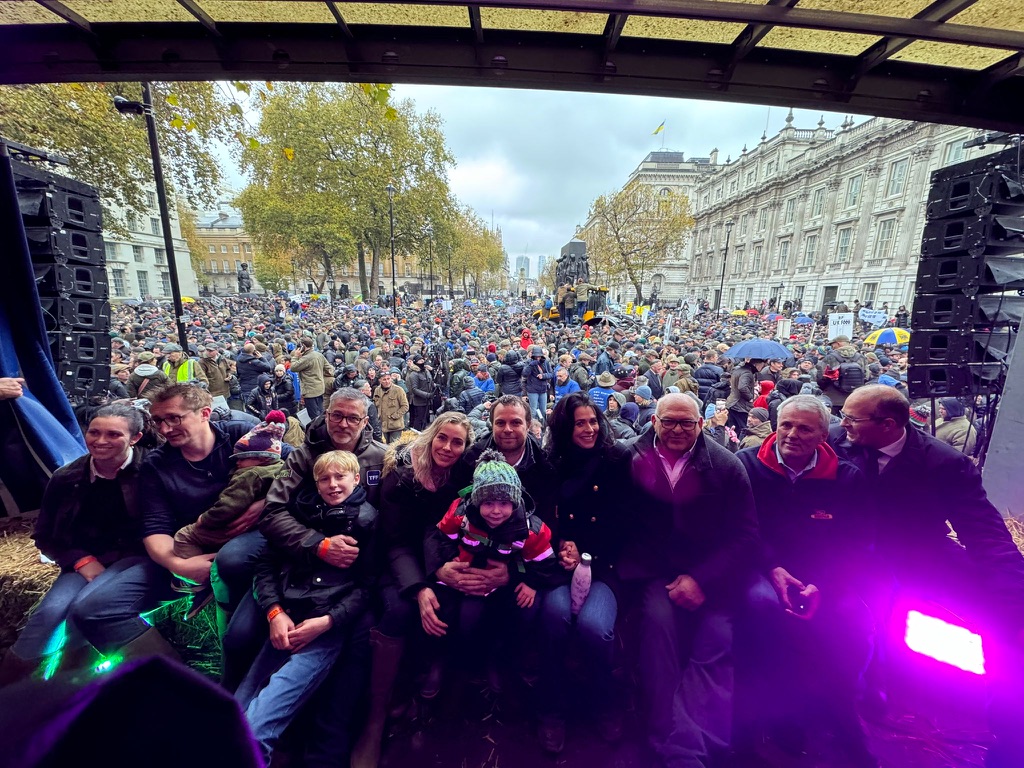
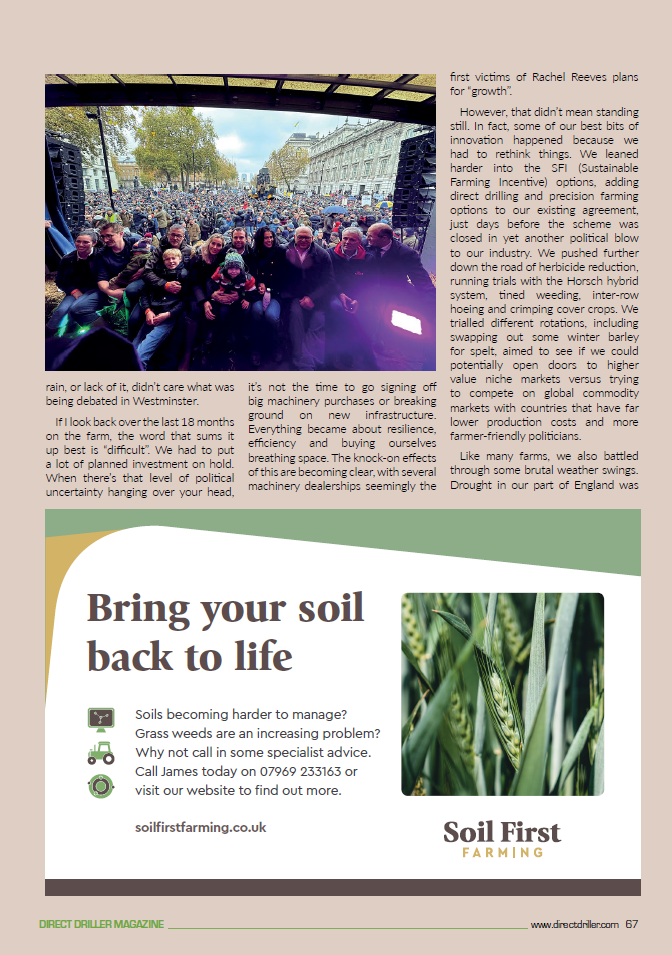
And so, almost without intending to, I found myself helping to organise a national protest. A few of us, farmers like Oliver Harrison, Andrew Ward, Martin Williams and James Mills, started talking and then planning on forums and in WhatsApp groups. What began as a loose conversation turned into one of the largest farmer-led demonstrations in a generation.
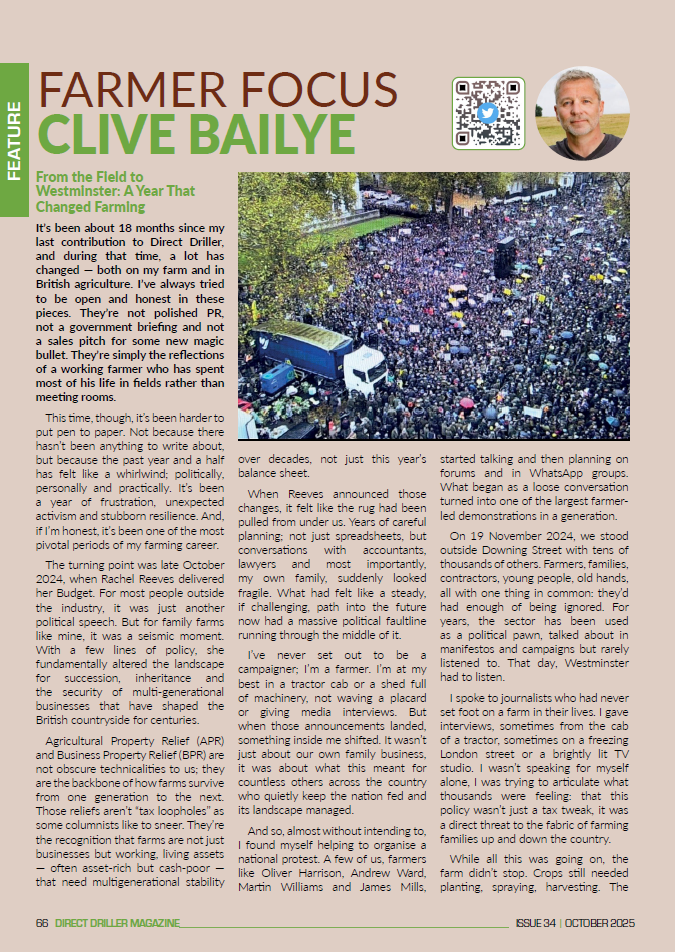
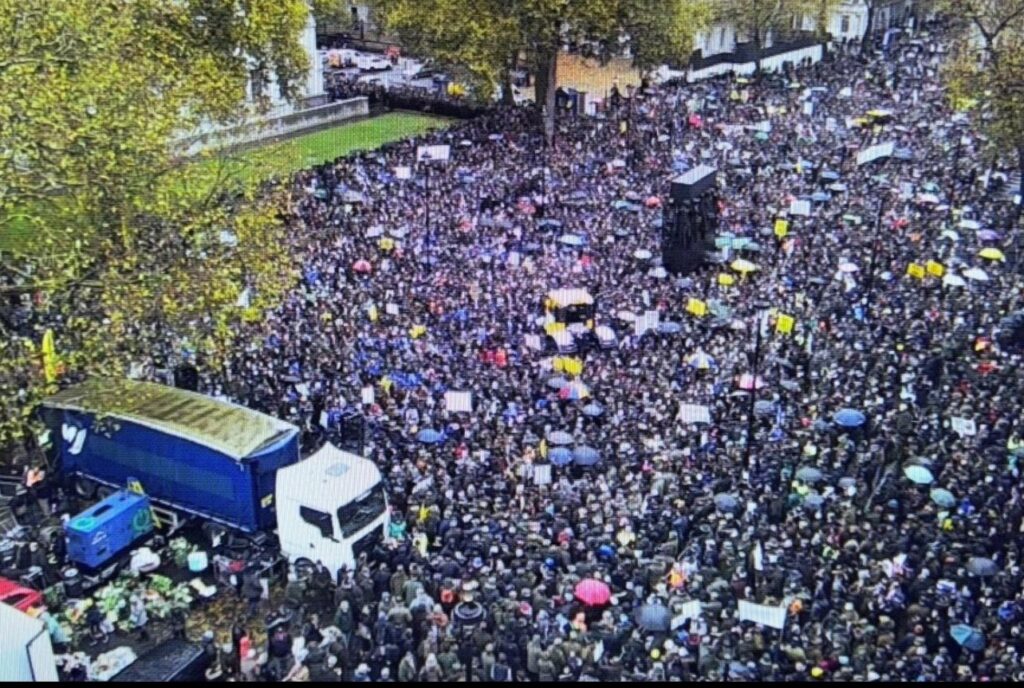
On 19 November 2024, we stood outside Downing Street with tens of thousands of others. Farmers, families, contractors, young people, old hands, all with one thing in common: they’d had enough of being ignored. For years, the sector has been used as a political pawn, talked about in manifestos and campaigns but rarely listened to. That day, Westminster had to listen.
I spoke to journalists who had never set foot on a farm in their lives. I gave interviews, sometimes from the cab of a tractor, sometimes on a freezing London street or a brightly lit TV studio. I wasn’t speaking for myself alone, I was trying to articulate what thousands were feeling: that this policy wasn’t just a tax tweak, it was a direct threat to the fabric of farming families up and down the country.
While all this was going on, the farm didn’t stop. Crops still needed planting, spraying, harvesting. The rain, or lack of it, didn’t care what was being debated in Westminster.
If I look back over the last 18 months on the farm, the word that sums it up best is “difficult”. We had to put a lot of planned investment on hold. When there’s that level of political uncertainty hanging over your head, it’s not the time to go signing off big machinery purchases or breaking ground on new infrastructure. Everything became about resilience, efficiency and buying ourselves breathing space. The knock-on effects of this are becoming clear, with several machinery dealerships seemingly the first victims of Rachel Reeves plans for “growth”.
However, that didn’t mean standing still. In fact, some of our best bits of innovation happened because we had to rethink things. We leaned harder into the SFI (Sustainable Farming Incentive) options, adding direct drilling and precision farming options to our existing agreement, just days before the scheme was closed in yet another political blow to our industry. We pushed further down the road of herbicide reduction, running trials with the Horsch hybrid system, tined weeding, inter-row hoeing and crimping cover crops. We trialled different rotations, including swapping out some winter barley for spelt, aimed to see if we could potentially open doors to higher value niche markets versus trying to compete on global commodity markets with countries that have far lower production costs and more farmer-friendly politicians.
Like many farms, we also battled through some brutal weather swings. Drought in our part of England was reminiscent of 1976. Yields were under pressure, prices were at a 20-year low and inflation pushed costs higher, meaning margins were tighter than ever. But that’s where regenerative principles and no-till systems came into their own. When the weather is extreme, having resilient soil structure is not some theoretical buzzword; it’s the difference between getting a crop in or staring at dust, and that lower fixed-cost structure I’ve been laser-focused on for 18 years now becomes the difference between profit and loss.
I’ve spoken before about the practical side of farming, but what hit me hardest this time wasn’t the work itself, it was the mental load. Running a farm is challenging enough when you know the rules of the game. When those rules are ripped up overnight, it adds a weight that’s hard to explain to anyone who hasn’t felt it.
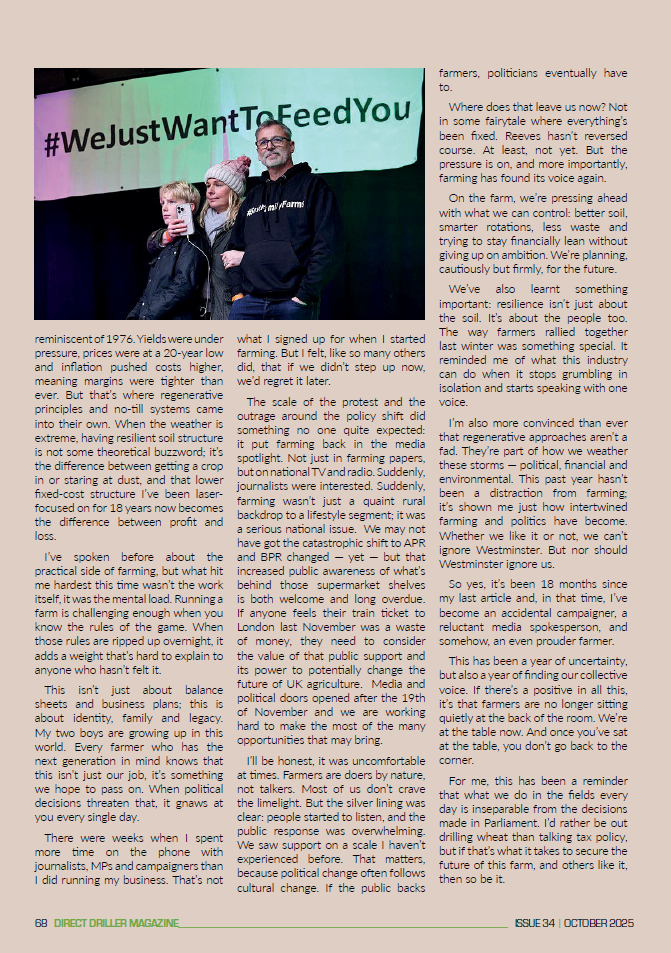
This isn’t just about balance sheets and business plans; this is about identity, family and legacy. My two boys are growing up in this world. Every farmer who has the next generation in mind knows that this isn’t just our job, it’s something we hope to pass on. When political decisions threaten that, it gnaws at you every single day.
There were weeks when I spent more time on the phone with journalists, MPs and campaigners than I did running my business. That’s not what I signed up for when I started farming. But I felt, like so many others did, that if we didn’t step up now, we’d regret it later.
The scale of the protest and the outrage around the policy shift did something no one quite expected: it put farming back in the media spotlight. Not just in farming papers, but on national TV and radio. Suddenly, journalists were interested. Suddenly, farming wasn’t just a quaint rural backdrop to a lifestyle segment; it was a serious national issue. We may not have got the catastrophic shift to APR and BPR changed — yet — but that increased public awareness of what’s behind those supermarket shelves is both welcome and long overdue. If anyone feels their train ticket to London last November was a waste of money, they need to consider the value of that public support and its power to potentially change the future of UK agriculture. Media and political doors opened after the 19th of November and we are working hard to make the most of the many opportunities that may bring.
I’ll be honest, it was uncomfortable at times. Farmers are doers by nature, not talkers. Most of us don’t crave the limelight. But the silver lining was clear: people started to listen, and the public response was overwhelming. We saw support on a scale I haven’t experienced before. That matters, because political change often follows cultural change. If the public backs farmers, politicians eventually have to.
Where does that leave us now? Not in some fairytale where everything’s been fixed. Reeves hasn’t reversed course. At least, not yet. But the pressure is on, and more importantly, farming has found its voice again.
On the farm, we’re pressing ahead with what we can control: better soil, smarter rotations, less waste and trying to stay financially lean without giving up on ambition. We’re planning, cautiously but firmly, for the future.
We’ve also learnt something important: resilience isn’t just about the soil. It’s about the people too. The way farmers rallied together last winter was something special. It reminded me of what this industry can do when it stops grumbling in isolation and starts speaking with one voice.
I’m also more convinced than ever that regenerative approaches aren’t a fad. They’re part of how we weather these storms — political, financial and environmental. This past year hasn’t been a distraction from farming; it’s shown me just how intertwined farming and politics have become. Whether we like it or not, we can’t ignore Westminster. But nor should Westminster ignore us.
So yes, it’s been 18 months since my last article and, in that time, I’ve become an accidental campaigner, a reluctant media spokesperson, and somehow, an even prouder farmer.
This has been a year of uncertainty, but also a year of finding our collective voice. If there’s a positive in all this, it’s that farmers are no longer sitting quietly at the back of the room. We’re at the table now. And once you’ve sat at the table, you don’t go back to the corner.
For me, this has been a reminder that what we do in the fields every day is inseparable from the decisions made in Parliament. I’d rather be out drilling wheat than talking tax policy, but if that’s what it takes to secure the future of this farm, and others like it, then so be it.