Written by Mike Harrington from Edaphos
I have written articles for DD magazine on phosphorus and potassium so it’s time to complete the set and take a look at nitrogen. Nitrogen inputs are generally framed as merely a commodity input in agriculture — something to be bought, applied and managed. However, nitrogen is far more than that. It is a ‘living element of the ecosystem’, tightly woven into the biology of our soils, plants and climate. Understanding its role within natural cycles is fundamental to transitioning away from extractive models of farming and towards systems that regenerate soil health, build resilience and biodiversity, and improve long-term productivity.
Whilst over 90% of the nutritional content of a plant is the holy trinity of carbon, hydrogen and oxygen, nitrogen is the next biggest number and the nutrient we spend the most time and money on. Healthy plants typically contain 3–4% nitrogen in their above-ground tissues — far more than most other essential nutrients and this is because nitrogen is central to some of the most vital biological processes in a plant:
- It’s a key component of chlorophyll, enabling photosynthesis — converting sunlight, water and carbon dioxide into sugars.
- It forms amino acids, which make up proteins. These proteins are the machinery and structure of plant cells.
- It’s critical in energy transfer and genetic material (DNA and RNA).
In short, without nitrogen, plants cannot grow, reproduce or survive. However, more is not always better and there is a weak link between nitrogen applied and yield.
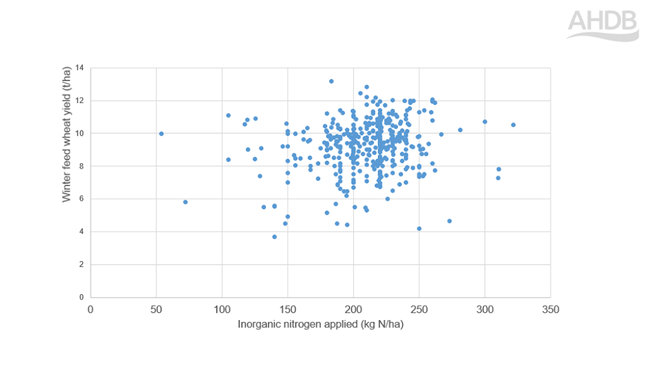
Figure 1. The weak relationship between wheat yield and total inorganic nitrogen applied. Based on 405 Farmbench results (2018–21) for conventional first winter feed wheat on clay loam soils
https://ahdb.org.uk/news/does-it-pay-to-cut-nitrogen-fertiliser – Source
In the soil, nitrogen exists in three main forms: organic nitrogen (found in decomposing residues, soil organic matter and microbes), ammonium (NH₄⁺) and nitrate (NO₃⁻). Most of the nitrogen in our soils, up to 95 to 99%, is in organic forms, locked up in humus and microbial biomass. This nitrogen isn’t immediately available to plants but becomes plant-accessible through microbial activity, especially under warm, moist, aerobic conditions. In conventional systems, synthetic fertilisers bypass this cycle, supplying nitrate or ammonium directly. In regenerative systems, our goal is to stimulate and feed the soil food web so it can mineralise nitrogen naturally and cycle it efficiently, supporting this process with limited, yet highly efficient, inputs.
There are two primary natural sources of nitrogen, atmospheric nitrogen (N₂) that, while inert in its gaseous form, becomes bioavailable through fixation either by lightning or biological nitrogen-fixing organisms. In UK climates, lightning contributes little, typically under 10 kg N/ha/year. However, in a well-structured soil you should have 25% air and that air is 78% N, so you can have nearly 20% N in the soil but not in the right form… So, it’s back to the microbes again. Biological nitrogen fixation is far more significant in regen systems. Rhizobia bacteria, in symbiosis with legumes like clover, vetch and lucerne, can fix over 150 kg N/ha/year under ideal conditions. There are a range of other nitrogen-fixing bacteria including Azotobacter, Azospirillum and Pseudomonas (in Bioplus T, one of Aiva’s own N fixing solutions), and there is now a plethora of other biological nitrogen options in the marketplace, which although once much misunderstood, are now rapidly gaining evidential study support.
In regenerative farming, we view the nitrogen cycle as a living, biological process, not a chemical one. Microbes play the starring role in immobilisation (soil microbes absorb ammonium and nitrate to build their own bodies), mineralisation (when microbes die or digest high-nitrogen residues, like manures or legumes, they release ammonium back into the soil) and nitrification (in well-aerated soils, ammonium is converted to nitrate by bacteria [Nitrosomonas and Nitrobacter]. Nitrate is highly mobile in the soil and vulnerable to leaching). In the UK, with our frequent rain and heavy soils, nitrate leaching and denitrification are major pathways of nitrogen loss, especially in winter and on compacted or waterlogged soils; our rules for applying nitrogen reflect this.
Understanding how nitrogen is lost from the system is crucial for regenerative fertility management. This could be via leaching (nitrate is water-soluble and easily washed beyond the root zone. This not only wastes nutrients but contributes to water pollution (eg, nitrate-sensitive zones in England), denitrification (in saturated soils, microbes convert nitrate into gases like N₂ and N₂O, a potent greenhouse gas), volatilisation (ammonia gas can be lost from surface-applied manures and urea, especially on high pH soils or during warm, windy weather) or crop removal (harvested crops take nitrogen off-farm).
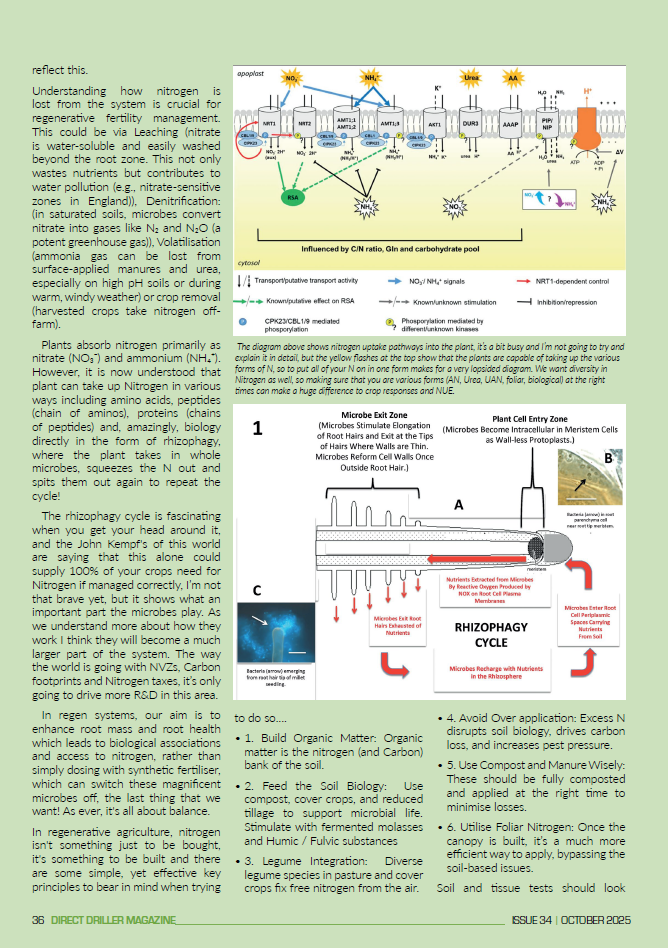
Plants absorb nitrogen primarily as nitrate (NO₃⁻) and ammonium (NH₄⁺). However, it is now understood that plants can take up nitrogen in various ways including amino acids, peptides (chain of aminos), proteins (chains of peptides) and, amazingly, biology directly in the form of rhizophagy, where the plant takes in whole microbes, squeezes the N out and spits them out again to repeat the cycle!
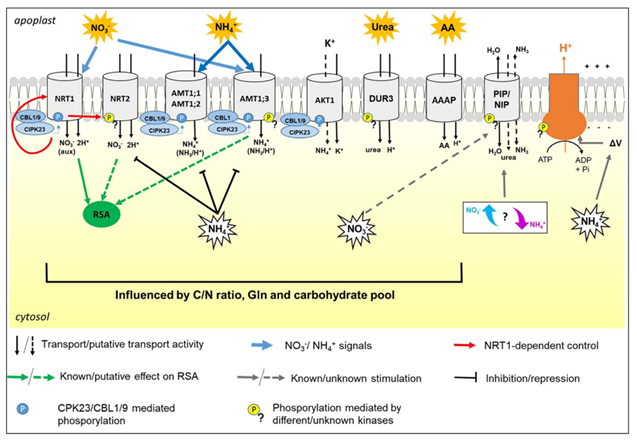
The diagram above shows nitrogen uptake pathways into the plant. It’s a bit busy and I’m not going to try and explain it in detail, but the yellow flashes at the top show that the plants are capable of taking up the various forms of N, so to put all your N on in one form makes for a very lopsided diagram. We want diversity in nitrogen as well, so making sure that you are adding various forms (AN, Urea, UAN, foliar, biological) at the right times can make a huge difference to crop responses and NUE.
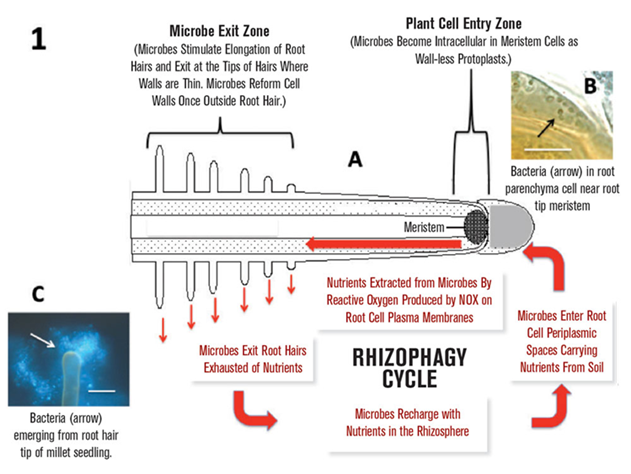
The rhizophagy cycle is fascinating when you get your head around it, and the John Kempfs of this world are saying that this alone could supply 100% of your crops need for nitrogen if managed correctly. I’m not that brave yet, but it shows what an important part the microbes play. As we understand more about how they work I think they will become a much larger part of the system. The way the world is going with NVZs, carbon footprints and nitrogen taxes, it’s only going to drive more R&D in this area.
In regen systems, our aim is to enhance root mass and root health, which leads to biological associations and access to nitrogen, rather than simply dosing with synthetic fertiliser, which can switch these magnificent microbes off — the last thing that we want! As ever, it’s all about balance.
In regenerative agriculture, nitrogen isn’t something just to be bought, it’s something to be built and there are some simple, yet effective key principles to bear in mind when trying to do so:
- 1. Build Organic Matter: Organic matter is the nitrogen (and carbon) bank of the soil.
- 2. Feed the Soil Biology: Use compost, cover crops and reduced tillage to support microbial life. Stimulate with fermented molasses and humic / fulvic substances.
- 3. Legume Integration: Diverse legume species in pasture and cover crops fix free nitrogen from the air.
- 4. Avoid Over Application: Excess N disrupts soil biology, drives carbon loss and increases pest pressure.
- 5. Use Compost and Manure Wisely: These should be fully composted and applied at the right time to minimise losses.
- 6. Utilise Foliar Nitrogen: Once the canopy is built, it’s a much more efficient way to apply, bypassing the soil-based issues.
Soil and tissue tests should look beyond just NPK and should include but not be limited to organic matter levels, active carbon, soil respiration (CO₂ burst), microbial biomass, tissue analysis, sap analysis, SNS and N sensor. All of these will give you a reading for N in one form or another — there might be bit of conversion/and or blind faith required! But they are all giving you information. If we can’t measure it, we can’t manage it, and reducing your N too much could cause a cascade of issues. Staying on top of the data is critical as these all start to build a picture of the limiting factors in your system.
As part of the industrial move towards climate change mitigation, we are now expected to minimise the negative by-products of synthetic N and the introduction of chemical stabilisers has been a recent step towards this. It’s worth understanding how these work but that’s for another article. However, a few examples of these would be Advance Shield (an NBPT-reducing volatilisation from urea), N-Serve® (nitrapyrin inhibiting nitrification to reduce losses), and ESN® and Instinct® (slow-release coatings and inhibitors). These products are often promoted as insurance policies against losses and legal prosecution — but they’re still treating the symptoms, not the cause. Our focus should be on the living soil structure, cover crops and water management to reduce losses naturally.
We like to apply partner products too when we are applying high rates of nitrogen, but normally carbon-based inputs, such as molasses, fermented molasses, humic and fulvic acids. These all have the potential to improve uptake efficiency of the applied synthetic fertiliser. I have sold these types of products for 20 plus years and there is a big difference using some straight molasses compared to a true humic acid. Some of it is down to the complexity of the materials: Molasses is full of simple sugars which the bacteria will love and consume very quickly but this will be very boom and bust and will also feed up some of the soil borne pathogens. More complex materials like fermented molasses (where many of the sugars have been converted to alcohol and removed), will feed a wider range of the soil food web and give you a better partnership. Even more complex materials like humic acids are more likely to be feeding the fungi in the soil and that is the key. Most conventionally farmed soils will be bacterially dominated and, again, it’s balance we need, so any help we can give to the fungi will be positive one. We have run independent trials on Nurture N as a partner to UAN and they have shown that you could cut back your N by up to 20% and maintain/improve yield from increased NUE. Well worth looking into if you are not already using one.
Finally, regenerating nitrogen cycles is about restoring balance — not forcing yields through chemical intervention. In the UK, with our temperate climate, diverse soils and mixed farming heritage, we have the ideal conditions to farm regeneratively. Rather than seeing nitrogen as a product, let’s start seeing it as a function of healthy, living soil.