No one can attend or probably even watch the replays of all the Groundswell Sessions. That’s what Mike Abram’s new Substack newsletter The Regenerative Farmer is promising to help with, but first Mike explains why he started the newsletter
Change is coming.
“It’s made farming exciting again.”
Over and over that’s the phrase I’m hearing about those farmers who have made the jump into farming regeneratively. And if it is not exciting, then it is making farming “interesting” again.
For the past generation, farming had become relatively easy, particularly in the arable sector. Excellent research and development from chemical and plant breeders had led farmers to be able to grow crops in the UK where a seed or a can would solve most, if not all of the problems one would face.
But nature fought back…while suffering at the same time. Resistance to chemicals decreased their efficacy, while the perceived damage to the environment has led to drastic changes in how easy it is to register pesticides.
The result is many farmers are now beginning to believe a change in approach is needed.
Enter regenerative agriculture.
Five years’ ago, I wrote the above intro to my new Substack newsletter called The Regenerative Farmer. Reading it now, nothing much has changed per se. I don’t have to tell readers of Direct Driller about how many farmers are still excited about trying to farm in a different way, although, I’m sure some of you will think the term regenerative farming has become vaguely meaningless and overused.
Techniques like cover cropping, reduced cultivations and direct drilling are much more commonplace. Some are integrating livestock into arable rotations very successfully, while the first regenerative premiums have come on stream from the likes of Wildfarmed and Green Farm Collective. The Groundswell Festival has become a beacon for regenerative farming and goes from strength to strength.
But that success has brought challenges too. Regenerative farming has definitely reached the attention of corporates. In some ways that is good — without corporate buy-in, regenerative farming will never scale to a place where it really changes the way we produce food, but equally the risk is regenerative farming becomes just another marketing slogan co-opted by big companies for their own benefit, sometimes at the expense of the farmer’s best interests.
And make no mistake, for regenerative farming to really change the world, commercial success is necessary, and in the UK that’s being hampered by a government seemingly hell-bent on making farmers’ lives as difficult as possible with its changes in policy on inheritance tax, changes to National Insurance contributions and slow decision-making on future iterations of the Sustainable Farming Incentive.
My world has changed a little in the past five years too.
In 2020 I was at the beginning of my freelance career, slightly concerned in the middle of COVID whether I was doing the right thing and whether I would have enough work. The Substack newsletter was a little side project designed to keep me busy when times were slow. But the slow times never came, which is why I published a grand total of about six articles — all slight variations of articles I had sold to a farming magazine in the UK — before my workload and a general acceptance that writing for magazines was going to be much better for the bank balance, brought the Substack to a halt.
But it has always been at the back of my mind, and I remain intrigued whether I can build an audience for my content on Substack. It is a site that offers writers the chance to showcase their work. New articles are emailed to subscribers when published, which you can also read on Substack’s app or website. It can be free or paid for, just like you would buy a magazine.
Ideally, I would be using The Regenerative Farmer to produce original content, but it’s a bit chicken and egg. It’s difficult for me to justify the time to produce original content without paying subscribers, but without original content I’m not likely to get many people to subscribe!
And while I’m continuing to attract enough work through my freelance journalism endeavours, I have less incentive or need to build the Substack.
But I am willing to invest a little bit of time again — not with completely original journalism, but with something that I think could be of value — and you, my readers, will soon tell me through your subscriptions (free or otherwise) whether that is the case.
That brings me back to Groundswell and in general to the rise in content on podcasts and YouTube about regenerative farming. There’s so much that it is impossible for one person to have enough time to consume it all, and I want to see if I can help.
So, my idea is to use some AI tools to help summarise every Groundswell Session as they come online on YouTube. Quick to read and digest, and if one tweaks your interest, a link will take you back to the source material to watch or listen.
Direct Driller has kindly agreed to publish one or two with a link to my Substack to help me build an audience.
Here’s a couple of examples to show you what it looks like.
To subscribe to the Groundswell Sessions at the Regenerative Farmer Substack: https://regenerativefarmer.substack.com/
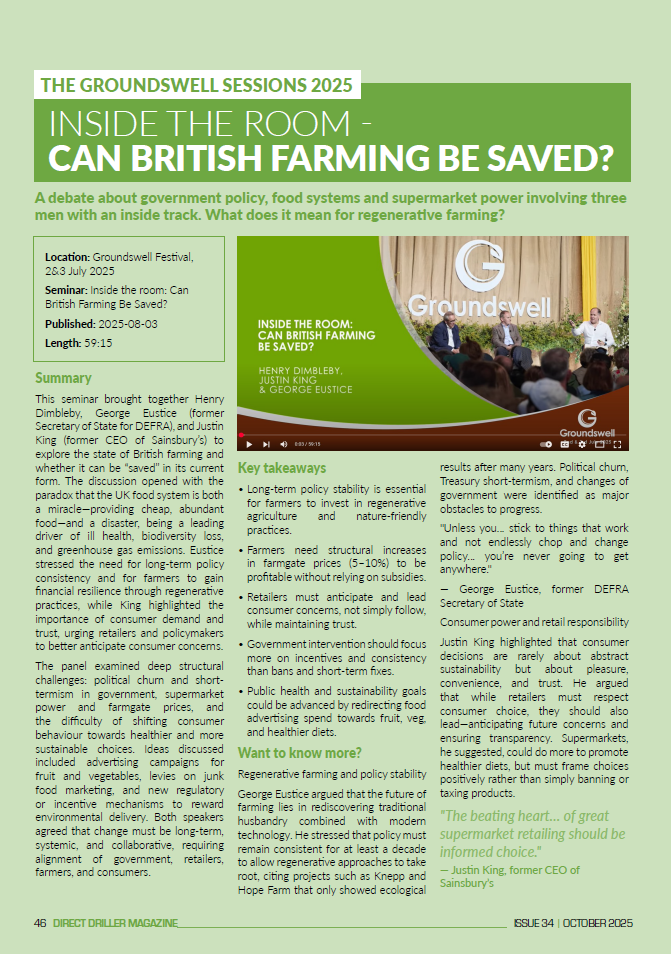
The Groundswell Sessions 2025: Inside the room – can British Farming be saved?
A debate about government policy, food systems and supermarket power involving three men with an inside track. What does it mean for regenerative farming?
Sep 18, 2025
Location: Groundswell Festival, 2 & 3 July 2025
Seminar: Inside the room: Can British Farming Be Saved?
Published: 2025-08-03
Length: 59:15
Summary
This seminar brought together Henry Dimbleby, George Eustice (former Secretary of State for DEFRA), and Justin King (former CEO of Sainsbury’s) to explore the state of British farming and whether it can be “saved” in its current form. The discussion opened with the paradox that the UK food system is both a miracle — providing cheap, abundant food — and a disaster, being a leading driver of ill health, biodiversity loss and greenhouse gas emissions. Eustice stressed the need for long-term policy consistency and for farmers to gain financial resilience through regenerative practices, while King highlighted the importance of consumer demand and trust, urging retailers and policymakers to better anticipate consumer concerns.
The panel examined deep structural challenges: political churn and short-termism in government, supermarket power and farmgate prices, and the difficulty of shifting consumer behaviour towards healthier and more sustainable choices. Ideas discussed included advertising campaigns for fruit and vegetables, levies on junk food marketing, and new regulatory or incentive mechanisms to reward environmental delivery. Both speakers agreed that change must be long-term, systemic and collaborative, requiring alignment of government, retailers, farmers and consumers.
Key takeaways
- Long-term policy stability is essential for farmers to invest in regenerative agriculture and nature-friendly practices.
- Farmers need structural increases in farmgate prices (5–10%) to be profitable without relying on subsidies.
- Retailers must anticipate and lead consumer concerns, not simply follow, while maintaining trust.
- Government intervention should focus more on incentives and consistency than bans and short-term fixes.
- Public health and sustainability goals could be advanced by redirecting food advertising spend towards fruit, veg and healthier diets.
Want to know more?
Regenerative farming and policy stability
George Eustice argued that the future of farming lies in rediscovering traditional husbandry combined with modern technology. He stressed that policy must remain consistent for at least a decade to allow regenerative approaches to take root, citing projects such as Knepp and Hope Farm that only showed ecological results after many years. Political churn, Treasury short-termism and changes of government were identified as major obstacles to progress.
“Unless you… stick to things that work and not endlessly chop and change policy… you’re never going to get anywhere.”
— George Eustice, former DEFRA Secretary of State
Consumer power and retail responsibility
Justin King highlighted that consumer decisions are rarely about abstract sustainability but about pleasure, convenience and trust. He argued that while retailers must respect consumer choice, they should also lead — anticipating future concerns and ensuring transparency. Supermarkets, he suggested, could do more to promote healthier diets, but must frame choices positively rather than simply banning or taxing products.
“The beating heart… of great supermarket retailing should be informed choice.”
— Justin King, former CEO of Sainsbury’s
Supermarkets, farmers and pricing
The debate over supermarket power revealed contrasting views. Eustice supported regulatory mechanisms to ensure fair contracts and raise farmgate prices structurally, while King warned that interventions risked raising processor margins rather than helping farmers. Instead, he promoted retailer-farmer partnerships, such as Sainsbury’s dairy development group, which paid a premium for agreed practices and enabled valuable peer learning among farmers.
Public health and food advertising
The panel agreed that obesity and diet-related disease impose a massive economic and social burden. Both speakers supported redirecting a portion of junk food advertising budgets into high-quality campaigns promoting fruit, vegetables and healthy eating. They pointed to past successes, such as Sainsbury’s nutrition labelling and fish sourcing policies, as evidence that supermarkets can shift consumer behaviour when they take a lead.
Trade, environment and political trust
Eustice reflected candidly on trade negotiations, criticising concessions made in the Australia deal and highlighting how poor political processes undermined farmers. Both he and King linked public scepticism and the rise of right-wing populism to failures by political and business leaders to get ahead of public concerns. They argued that greater honesty, transparency and shared long-term vision are essential to rebuilding trust.
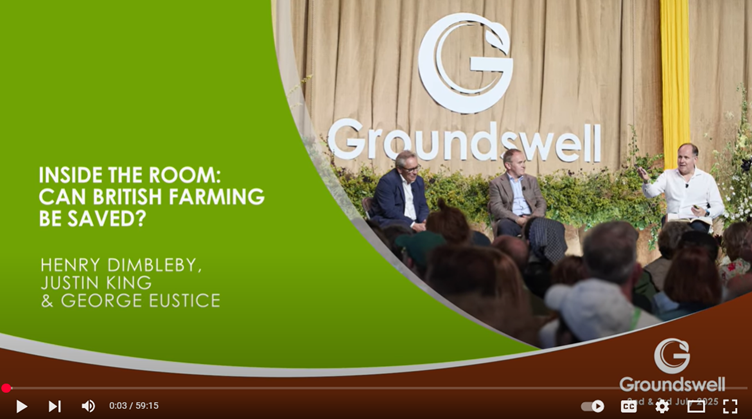
NOTE: Link for digital version: Watch the whole seminar session on YouTube
The Groundswell Sessions 2025: “Silvohorticulture — integrating trees into vegetable production”
A much more technical session, with Soil Association’s Ben Raskin and grower Andy Dibben explaining why agroforestry can help with vegetable production
Oct 02, 2025
Location: Groundswell Festival, 2 & 3 July 2025
Seminar: Silvohorticulture —integrating trees into vegetable production
Published: 2025-09-26
Length: 55:57
Summary
In this seminar, Ben Raskin (Soil Association) and Andy Dibben from Abbey Home Farm share over 20 years of experience combining horticulture with agroforestry. They explain how integrating trees into vegetable systems can deliver multiple benefits, from shade and wind protection to improved soil health and water management. Their central message is that trees are not a luxury in horticulture but a vital tool for building climate resilience.
Through practical examples from their farms, they show how trees can stabilise yields, enhance product quality and extend growing seasons. They also highlight the commercial opportunities of silvohorticulture, where trees provide not only environmental services but also products, such as fruit, woodchip, timber or even specialist crops for floristry and medicine. The discussion stresses that diversity — both of crops and tree species — is key to adapting to uncertain weather and future climates.
Key takeaways
- Shade from trees reduces heat stress, improves vegetable quality and extends shelf life.
- Shelterbelts cut wind damage, conserve soil and boost pollinator activity.
- Trees aid water management by acting as natural soakaways in floods and reducing evaporation in drought.
- Agroforestry systems provide organic matter and fertility, lowering reliance on external inputs.
- Tree species choices should balance productivity, biodiversity and climate resilience, with diversity central to reducing risk.
Digging deeper
Shade as a tool
Andy explained how crops such as lettuces, brassicas, potatoes and even tomatoes suffer under prolonged heat. Integrating trees creates dappled shade, which improves visual quality and yield, while also extending shelf life. In glasshouses, nectarines and apricots have been used to create natural shading that regulates growth and prevents disorders like tomato ripening issues or pepper sunburn.
“The trees cost £10 each, and nature does the rest of the work.” — Andy Dibben, head grower, Abbey Home Farm
Wind protection and microclimate
Ben emphasised that shelterbelts not only prevent physical crop damage but also create warmer, more stable microclimates. This allows earlier planting and extends the season for marginal crops such as courgettes and sweetcorn. Reduced wind also retains soil on farms and encourages pollinator activity. Pollinators are more effective in calmer conditions, boosting both biodiversity and yields.
Water management
Trees play a dual role in handling excess rain and drought. Their roots fracture soil, improving infiltration, while organic matter from leaves and root decay increases water retention. Andy noted that with abstraction licences under increasing scrutiny, reducing evaporation and transpiration losses is vital for future viability.
Soil, fertility and added outputs
Ben described how coppiced alleys and woodchip can improve nutrient retention and soil biology. By mimicking natural cycles, farmers can reduce reliance on fertilisers and pesticides. Trees also offer saleable products: fruit, nuts, floristry stems, timber, coppice poles and even materials for biodegradable products. These outputs add diversity and resilience to farm income.
Species choice and future resilience
When asked about tree selection, both speakers highlighted aligning species to farm objectives. Apples, coppice species like hazel and alder, and hedgerow trees for biodiversity were all used. At the same time, trialling less conventional crops such as almonds or figs is seen as necessary experimentation in an unpredictable climate. Diversity in genetics and provenance is essential to guard against disease and climate risks.
“Diversity is absolutely key… you wouldn’t just go in and plant one species from one provenance all over the farm because that’s inherently risky.” — Ben Raskin, Soil Association
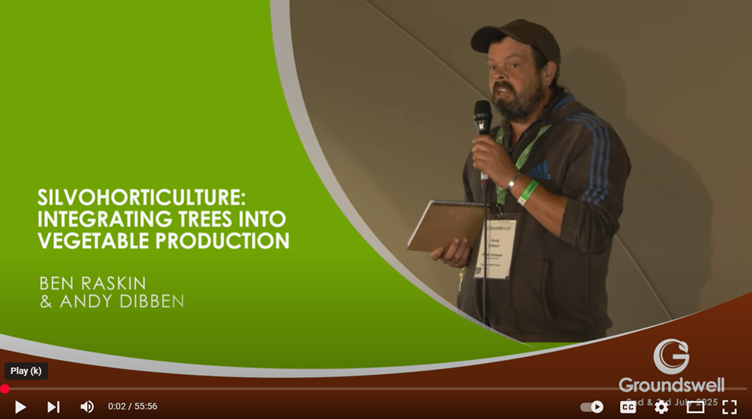
Note: Link for digital: Watch the whole seminar on YouTube
To subscribe to the Groundswell Sessions at the Regenerative Farmer Substack: https://regenerativefarmer.substack.com/