Written by Chris Fellows
Soap box time – as this is a pet hate of mine. Having been involved in regen for quite a few years, I do feel that it has been hijacked for commercial gain by many businesses without them putting in the hard yards to implement the proper practices. There are several articles in this issue about regen farming and what is means in 2025 and I’d agree it is a personal journey and therefore not easy to define. So, considering that farmers struggle to define what this is, how is it possible for companies to promote their products as regenerative?
Adverts will often claim that something is regen or carbon zero because they plant a few trees – it drives me nuts. Not just because trees take years to sequester carbon (and not die/burn in the process), but because it’s not real accounting. If it doesn’t happen in the same year the company create the emissions, then it’s not carbon neutral in the current year.
However, it seems it’s not just me as a marketeer who is annoyed by these claims (which have felt to me to be unregulated). The Digital Markets, Competition and Consumers Act 2024 (DMCC Act) was introduced six months ago in April 2025. It signals a new era in accountability for companies making environmental claims and gives power to the consumer to challenge greenwashing. So, get a pen in hand (or fingers on keyboards) as you can now complain like you have never complained before!
What is the DMCC Act?
The DMCC Act brings sweeping reforms to UK consumer protection law. It grants the Competition and Markets Authority (CMA) new powers to investigate and penalise misleading practices, particularly those involving greenwashing.
For businesses, the DMCC Act empowers the CMA to act without court involvement and significantly increases the risks of making vague or misleading environmental claims.
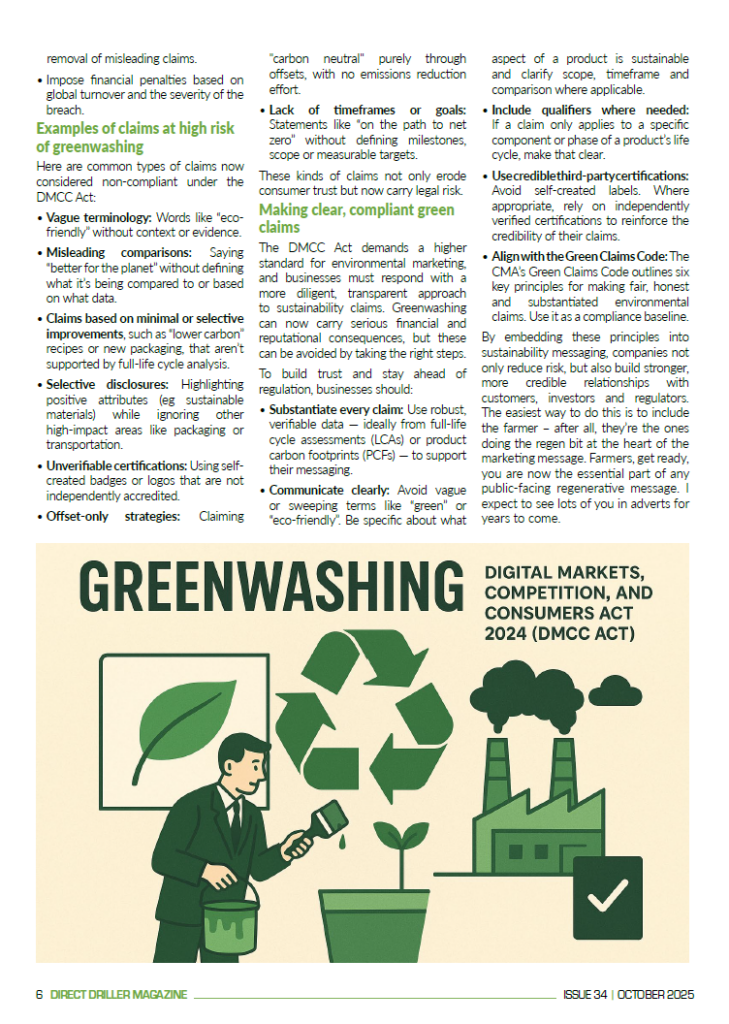
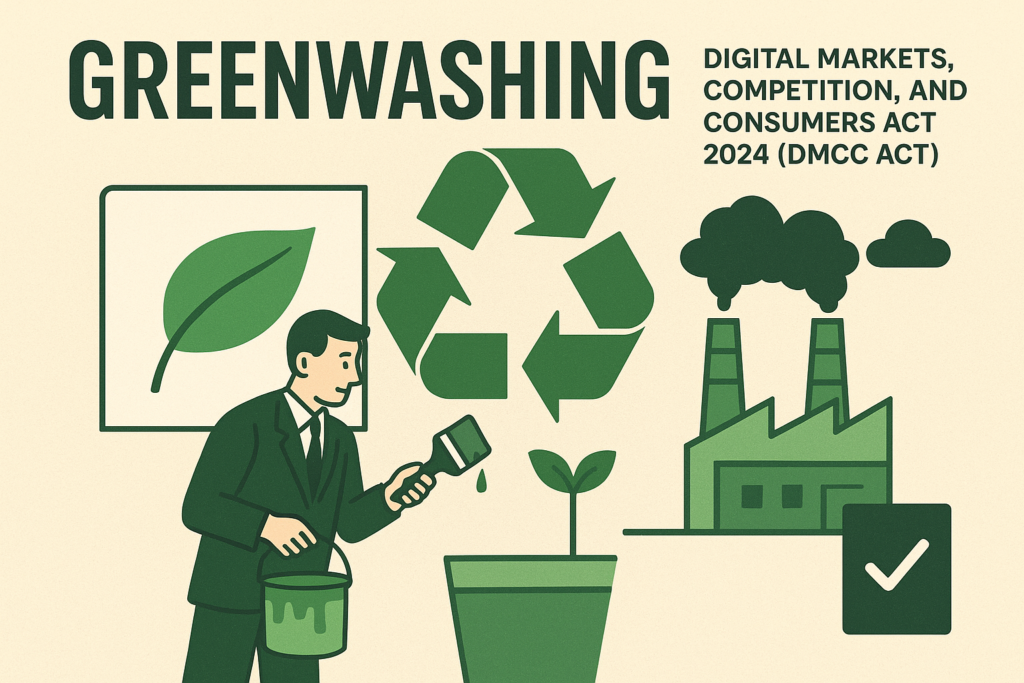
Simply put, greenwashing is the process of marketing something as eco-friendly, green or sustainable when it is actually none of these things. It’s not good.
Why environmental claims are under scrutiny
This act is a massive positive for regen farmers as it’s finally recognising how important the products we grow are at a consumer level. Environmental marketing claims are now one of the CMA’s key enforcement priorities. With the rise in consumer demand for sustainable products, businesses are under pressure to differentiate themselves. But with that comes the responsibility to ensure those claims are clear, accurate and verifiable.
The DMCC Act introduces two critical shifts:
- Provisional Infringement Notices (PINs) can now be issued based solely on suspicion, posing reputational risk even without proof of wrongdoing.
- Substantial financial penalties can be enforced for breaches of consumer law, including misleading environmental messaging.
In short, detail matters more than ever. Broad or unsupported claims like “eco-friendly”, “green” or “regen” are no longer acceptable unless they’re backed by rigorous, transparent data.
What powers does the CMA now have?
Under the Digital Markets, Competition and Consumers Act, the CMA can:
- Initiate investigations based on reasonable suspicion, without a court order.
- Issue public PINs, warning businesses that their claims may breach consumer law, even before a formal investigation concludes.
- Enforce operational changes, such as requiring updates to staff training or removal of misleading claims.
- Impose financial penalties based on global turnover and the severity of the breach.
Examples of potential fines:
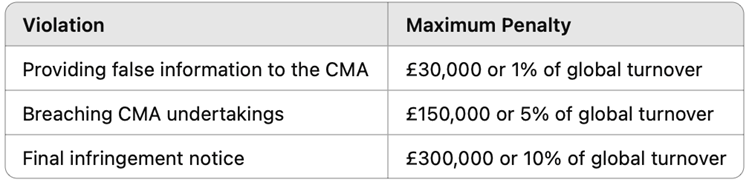
Note: Penalties are based on whichever is higher — fixed amount or percentage of global turnover.
Examples of claims at high risk of greenwashing
Here are common types of claims now considered non-compliant under the DMCC Act:
- Vague terminology: Words like “eco-friendly” without context or evidence.
- Misleading comparisons: Saying “better for the planet” without defining what it’s being compared to or based on what data.
- Claims based on minimal or selective improvements, such as “lower carbon” recipes or new packaging, that aren’t supported by full-life cycle analysis.
- Selective disclosures: Highlighting positive attributes (eg sustainable materials) while ignoring other high-impact areas like packaging or transportation.
- Unverifiable certifications: Using self-created badges or logos that are not independently accredited.
- Offset-only strategies: Claiming “carbon neutral” purely through offsets, with no emissions reduction effort.
- Lack of timeframes or goals: Statements like “on the path to net zero” without defining milestones, scope or measurable targets.
These kinds of claims not only erode consumer trust but now carry legal risk.
Making clear, compliant green claims
The DMCC Act demands a higher standard for environmental marketing, and businesses must respond with a more diligent, transparent approach to sustainability claims. Greenwashing can now carry serious financial and reputational consequences, but these can be avoided by taking the right steps.
To build trust and stay ahead of regulation, businesses should:
- Substantiate every claim: Use robust, verifiable data — ideally from full-life cycle assessments (LCAs) or product carbon footprints (PCFs) — to support their messaging.
- Communicate clearly: Avoid vague or sweeping terms like “green” or “eco-friendly”. Be specific about what aspect of a product is sustainable and clarify scope, timeframe and comparison where applicable.
- Include qualifiers where needed: If a claim only applies to a specific component or phase of a product’s life cycle, make that clear.
- Use credible third-party certifications: Avoid self-created labels. Where appropriate, rely on independently verified certifications to reinforce the credibility of their claims.
- Align with the Green Claims Code: The CMA’s Green Claims Code outlines six key principles for making fair, honest and substantiated environmental claims. Use it as a compliance baseline.
By embedding these principles into sustainability messaging, companies not only reduce risk, but also build stronger, more credible relationships with customers, investors and regulators. The easiest way to do this is to include the farmer – after all, they’re the ones doing the regen bit at the heart of the marketing message. Farmers, get ready, you are now the essential part of any public-facing regenerative message. I expect to see lots of you in adverts for years to come.