Ocotber 2025
I mentioned a couple of months ago that we’re dividing the farm into two so that my brother Paul and I can do our own things. It’s been an interesting year with some tricky weather, but pleasingly, we spent very little on any of the crops, so yields of 5 to 6 t/ha of wheat paid off. This is particularly true of the Wildfarmed crops. They had a pre-drilling glyphosate, no other sprays and only 80kg of N (it got so dry, it wasn’t worth adding any more), and came in at 14% protein, which should make quite a good premium on top of their generous wheat price.
I’ve talked to a few farmers who aren’t planning on sowing much (if any) wheat this autumn. As a result of the split, I now find myself with most of the cattle, a Massey 135 (1967 pedigree) and not much else and no labour beyond my long-suffering son, Matthew. So, my fixed costs are low, and I can’t get very enthusiastic about paying contractors’ rates to grow crops which will break even at best, when I could fallow the land and clean it up, restore some fertility and possibly graze the cattle.
We’ve therefore planted a load of cover crops from seed that was knocking about in the shed, giving us the option to slot in a spring crop if things look more positive then or cash in on the SFI if that ever reappears. Meanwhile, the cattle are getting a few more herbal leys, which will enable us to cut the one expensive facet of our current system, which is housing the animals. I say housing, but most of them spend the month or two when it’s too wet safely grazing in a corral.
I’m converting a Victorian walled garden into a corral for them this year. It’s got a rubble floor, dating back to when Grandad let the yard to a dodgy builder 45 years ago. It’s been a dumping ground ever since, but it’ll make a good draught-free home for when the beasts need it. We’ll put a layer of tree surgeon’s woodchip on the bottom and add straw as required, which makes for top-grade compost once the animals have made their contributions.
We are sowing some wheat as, apart from anything else, we’ll want to have a bit of straw baled up for this job. We pulled out one herbal ley last year and had a crop of beans off it this year (not a great success), so I felt that we should go for the wheat option. I’m eyeing up some others which are five or six years into a four-year planned ley. They keep producing, so there’s not a great temptation to spray them off.
This is one time when the lure of the plough (which doesn’t spend much time in my breast) looms. When getting rid of a medium-term ley, it’s hard to destroy satisfactorily with glyphosate, although you do get to keep a nice living mulch of clovers. I’ve been advised many times that the plough is your friend here, but I can’t quite bring myself to dig the old thing out of the Groundswell carpark. There is some debate as to whether extreme soil disturbance hits the leatherjackets and wireworms enough to make a difference to the following wheat crop, which would be useful in terms of skipping the requirement for plonking beans in this point of the rotation. I suppose there’s only one way to find out…
Our min-till potatoes are ready for harvest. We’ve had problems getting anyone with a potato harvester interested in trying to lift them in a no-till situation, as all the tubers are lying on the surface of the soil under a blanket of straw and the mainstream equipment all needs some soil to make the lifting work. So, this year we min-tilled the ground first, planted the spuds in the three inches of disturbed soil and then laid the straw on top. They’ve grown very well considering what a dry year it was, so, fingers crossed, we’re hoping they’ll be machine harvestable. Meanwhile, if there’s anyone out there who fancies designing a simple lifter that would pick spuds off the ground, flick the straw away and fit on a Massey 135, then please get in touch. I think the no-till method is best suited to old-fashioned acre plots fit for supplying your local community.
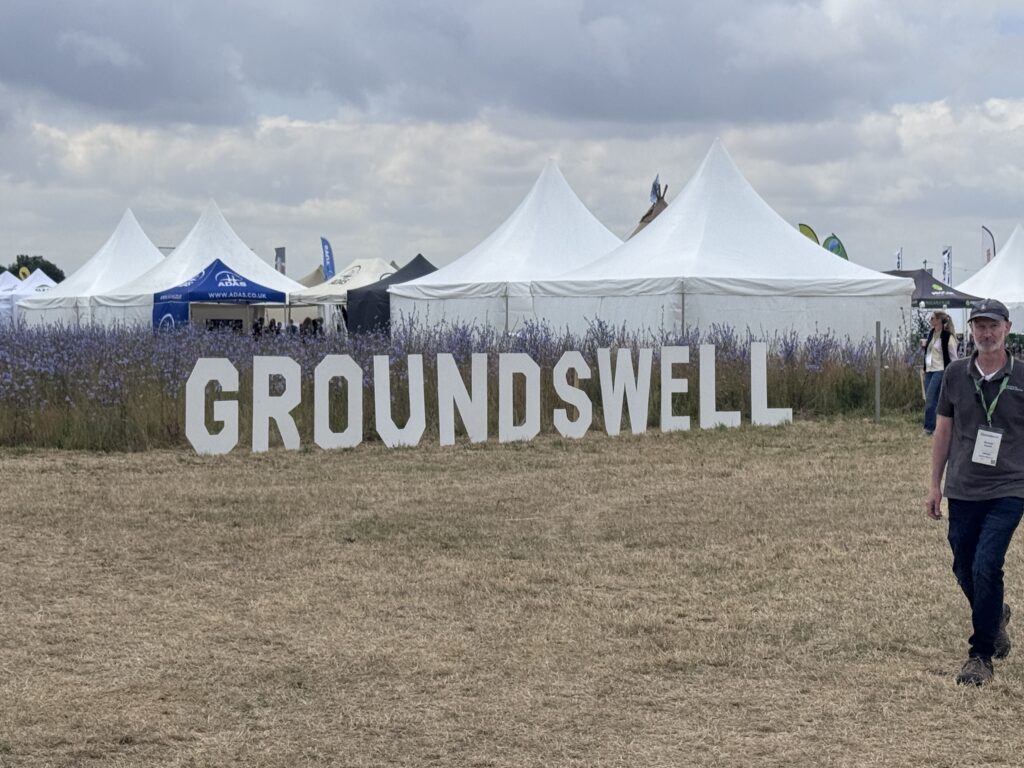
In other news, we’re preparing for next year’s Groundswell event. A request for applications for sessions has just gone out, so if anyone reading feels that they have something useful to present, now is the time to fill in the form on our website and see if it hits the mark with our judging committee. Be warned though, competition is strong and unfortunately we have to be ruthless — if we had three times the number of tents, we’d still need to cull a lot of the applications. Sad for those declined, but terrific news for the movement itself that there is so much enthusiasm out there.
Our Groundschool project is delayed by bats in the barn but come next April we hope to get building, and the pause has given us a chance to finesse exactly what we’ll do and how we’ll do it. Which is another way of saying, like so much of the regenerative story, we’re still making it up as we go along.