Ocotober 2025
It is a year since my last piece in Direct Driller and what a year it has been!
On the back of a reasonably good previous financial year and with the prospect of BNG money hitting our bank account, we decided to spend over half a million pounds and invest in a new dryer and handling equipment to finish off the new grain store building that we put up a few years ago.
So far so good, but as we hit late spring 2025, the wheels started to drop off. Progress with grain plant install was a bit slower than anticipated and the continuing drought meant that Harvest ’25 was obviously going to be much earlier than usual. To compound this stress, the progress of obtaining a Section 106 legal agreement for our BNG scheme was happening at a painfully slow rate. (A S106 is needed to register as a BNG site and enable sales of units to happen.) In the end it took a year to obtain the agreement!
The black hole that was opening up in the cashflow (and the prospect of it getting worse after harvest, as by this stage it was becoming apparent that yields would be significantly down), was, in hindsight, beginning to cause me raised stress levels.
This was further compounded by personal issues and the whole situation was responsible (I believe) for me falling from a height doing something really stupid, in contravention of my own Health and Safety risk assessments. The accident could have been fatal but luckily I got away with a sore head for a week or so and an artery bypass graft in my left arm.
The knock-on effects of the accident proved extremely stressful to everyone in the business, from my colleague who had to deal with it at the time to the owners of the farm who are ultimately culpable for Health and Safety breaches. The Health and Safety investigation was thorough and draining and not something I would wish to repeat.
I would urge any of you who are responsible for Health and Safety in your businesses to ensure that your systems are robust and legal compliance is complete. It is very easy to overlook small things that can be HSE breaches, such as not wearing seatbelts in UTVs. Do you check your ladders quarterly and log the results? Are your electric roller shutter doors inspected every six months? Do you use LOLER-tested man cages for planned jobs? (These should only be used in emergencies, otherwise it’s ladder or hired cherry picker!)
Some of the HSE rules and guidance are impractical in my opinion. For instance, it is safer to clean gutters using a man cage on a telehandler than it is to climb a ladder and carry out an awkward reach. But unfortunately, we are bound by present rules.
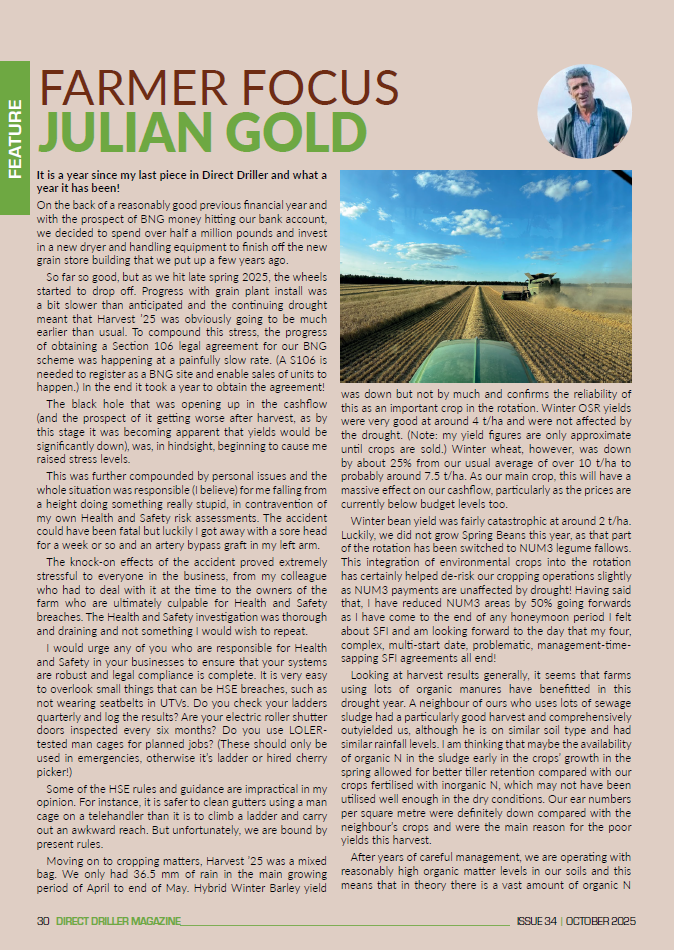
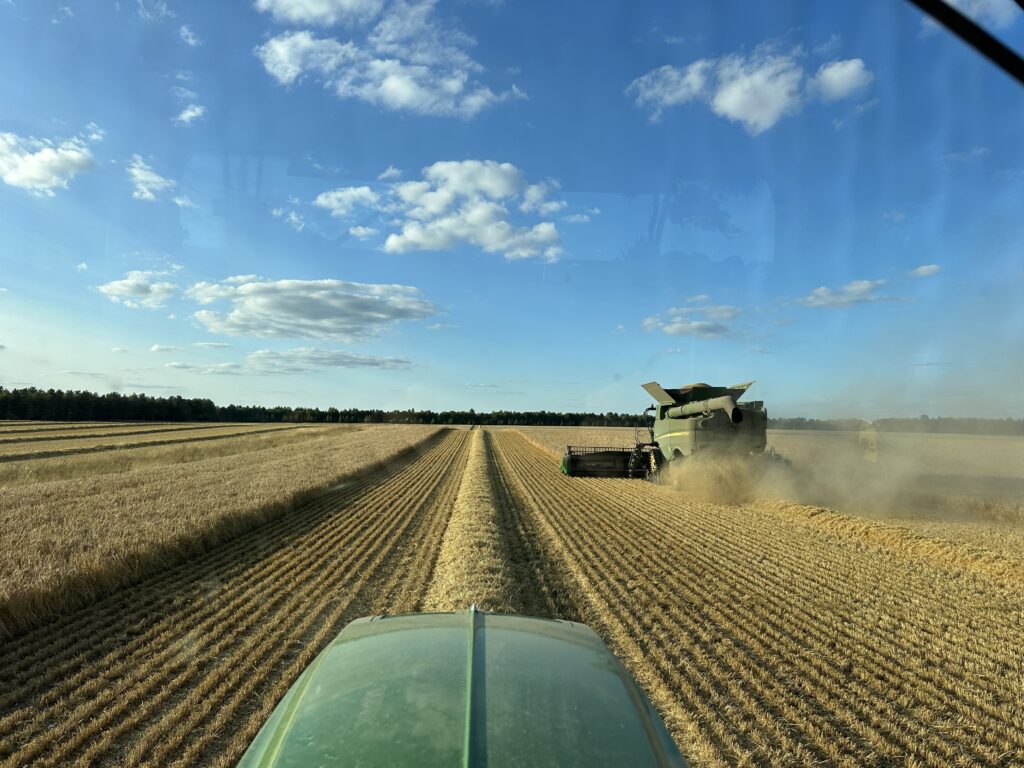
Moving on to cropping matters, Harvest ’25 was a mixed bag. We only had 36.5 mm of rain in the main growing period of April to end of May. Hybrid Winter Barley yield was down but not by much and confirms the reliability of this as an important crop in the rotation. Winter OSR yields were very good at around 4 t/ha and were not affected by the drought. (Note: my yield figures are only approximate until crops are sold.) Winter wheat, however, was down by about 25% from our usual average of over 10 t/ha to probably around 7.5 t/ha. As our main crop, this will have a massive effect on our cashflow, particularly as the prices are currently below budget levels too.
Winter bean yield was fairly catastrophic at around 2 t/ha. Luckily, we did not grow Spring Beans this year, as that part of the rotation has been switched to NUM3 legume fallows. This integration of environmental crops into the rotation has certainly helped de-risk our cropping operations slightly as NUM3 payments are unaffected by drought! Having said that, I have reduced NUM3 areas by 50% going forwards as I have come to the end of any honeymoon period I felt about SFI and am looking forward to the day that my four, complex, multi-start date, problematic, management-time-sapping SFI agreements all end!
Looking at harvest results generally, it seems that farms using lots of organic manures have benefitted in this drought year. A neighbour of ours who uses lots of sewage sludge had a particularly good harvest and comprehensively outyielded us, although he is on similar soil type and had similar rainfall levels. I am thinking that maybe the availability of organic N in the sludge early in the crops’ growth in the spring allowed for better tiller retention compared with our crops fertilised with inorganic N, which may not have been utilised well enough in the dry conditions. Our ear numbers per square metre were definitely down compared with the neighbour’s crops and were the main reason for the poor yields this harvest.
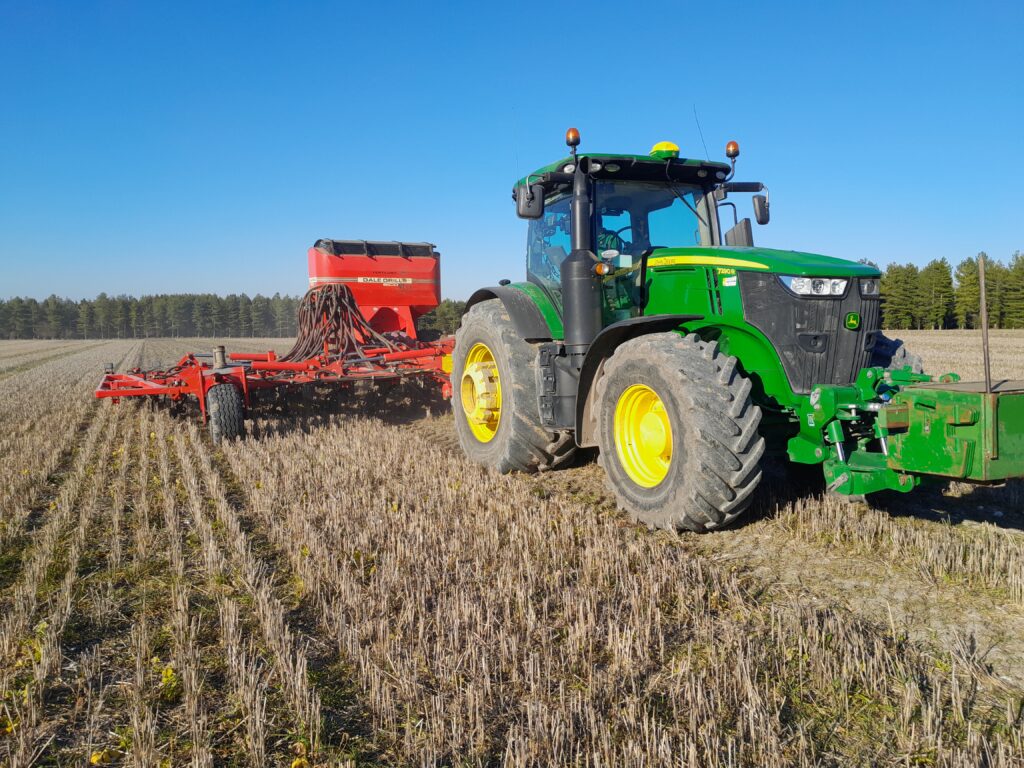
After years of careful management, we are operating with reasonably high organic matter levels in our soils and this means that in theory there is a vast amount of organic N in our soils for crops to utilise (eg a field with OM result of around 4.7% and organic carbon of around 2.7% would theoretically have more than 5,000 kg/ha of N available in the top 15cm to be used at 100% efficiency, compared with a typical application of 200 kg/ha of inorganic N applied and used at around 60% efficiency!). It is therefore disappointing that our yields were not closer to our neighbour’s, but that is part of the excitement and mystery of dealing with such a complex, fascinating medium as soil: The N is there in the system, but the soil is not necessarily giving it to the crops in a way that helps the farmer’s short-term bottom line!
To finish off this piece, I must return to stress and HSE.
A few weeks ago, we were notified that a tenancy that we have on a neighbouring estate will end in September next year. (We have had this ground for the last 20 years and it is 25% of our cropping area.) This is another big blow and will have a large negative financial impact on our business. It has precipitated the need for a redundancy on the farm and we are presently going through this process. This has created another stress point for all involved in the business as we have had years of loyal service from all of our employees and no one wishes to see the workforce shrink.
I am sorry that this report is a bit gloomy but I think it highlights a couple of problems in our industry at present:
STRESS: Is widespread in agriculture and is potentially a killer in numerous ways. It’s very important to talk to someone and not internalise problems. (I tend to close in on myself and end up spiralling down a metaphorical negative plughole if I am not careful.)
HEALTH AND SAFETY: HSE are anticipating that this may be the worst year yet for fatal accidents in agriculture. The ongoing poor financial situation which is leading many farmers to shed labour and carry higher stress levels is also predisposing to a higher accident rate. Therefore, it’s very important to prioritise Health and Safety. Even if there are no accidents in a business, any near-misses or incidents involving HSE inspectors can get expensive as the department is self-funding and charges for all visits, emails, etc even if the business is not being fined for breaches.
I promise my next report will be more upbeat!