Christmas time is approaching and yet another year has passed. My last piece was in June, and it was warm, it was dry, then wet, and hopes were high for the approaching harvest time. Harvest 2025 was special to me because it was the first harvest in many years that I did not drive the combine from start to finish. Luckily, my brother volunteered and he’s actually doing a much better combine-driving job than me, having the good attention and patience to drive according to the loss monitor. Apparently, that makes a huge difference with volunteers, post-harvest. Who would have guessed.
Let’s dig into the evaluations, learnings, trials and future perspectives from this year.
Harvest 2025:
Yields were surprisingly good (slightly above our average in all crops), being saved by a good rainfall event in early May. Winter wheats yielded 9 ton/ha. It was clear that good pre-crops (beans) were the highest yielding. Pre-crop OSR was also above but the yield potential was reduced because of horrendous slug grazing back in the autumn of 2024. Then, spring barley as pre-crop turned out to be a very poor pre-crop yet again. My agronomist herbicide injury in that particular field did not help either.
Spring faba beans were alright, averaging 5 ton/ha in better soils and 4 ton/ha in sandier soils. Winter OSR did really well. No-till OSR with new undersowed livingmulch mixture did 3.8 ton/ha on a sandy soil type. Subsoiler drilled (depth 28cm) on clay soil did 4.8 ton/ha and was a really nice crop all season, except for an odd headland where the agronomist (me) burned the crop with either residual ALS-chemistry from a wheat spray or a too high dose of foliar potassium together with the two fungicide applications in the OSR. This year I have learned to be careful, especially with foliar potassium in OSR and I have rediscovered that old generic cheap fungicides are just as good in OSR than the new expensive premium fungicides.
Winter milling oats were this year’s big winner yet again. For the second year in a row, we managed to get 9.5 ton/ha of oats off the field. Unfortunately, 2025 has been a national high yield year for all crops, which has reduced oat prices as well. If we factor in the lower fertiliser requirement and cheap fungicide programme required for oats, compared to winter wheat at slightly lower yield but higher price, then winter milling oats and winter feed wheat turns out at similar gross margin on our farm. Because of this and the much-improved pre-crop value of oats compared to barley, we have changed our crop rotation for 2026 and put in only winter and spring oats and no spring barley.
Biannual cereal crop experiment 2025:
One particular fun experiment I did for 2025 was the biannual winter cereal trial. I drilled winter hybrid barley and winter hybrid wheat on 1 August 2024. Then, combined the barley on 10 July 2025 and the wheat in the early days of August 2025. We managed to keep these crops for a full year in the field. I’m exploring multiple potential benefits from an ultra-early winter cereal drilling day: 1) Less grass weeds because we are ahead of the grass weed autumn germination window (similar to our grass seed growing guides), 2) ultra-low plant population with huge tiller numbers leads to more efficient resource use/partitioning, 3) large plants with many tillers for improved weed competition, 4) if we were mechanical weeding we would have good and dry conditions in September for mechanical weed control, 5) autumn cut/graze opportunity, 6) explosive spring growth and earlier harvest which allows better cover crop and/or livingmulch regrowth.
Anyway. Importantly, the hybrid winter barley in the trial was one of these brand-new Syngenta varieties (SY Zoomba) which is BYDV resistant. And there was absolutely no BYDV infection in the barley. The yield was a satisfying 10 ton/ha. In the tramline next door was the winter hybrid wheat. It was not BYDV tolerant/resistant and it was completely destroyed by BYDV infection. I did not even care to properly measure the yield, but it was at least half the yield compared to our traditional wheats. For 2026 we are redoing the biannual cereal experiment but only with BYDV-resistant winter hybrid barley. Unfortunately, I didn’t manage to source BYDV tolerant winter wheat in time for the early August drilling day.
Livingmulch farming system in 2025:
My main trial field of the livingmulch farming system was 25ha with the winter milling oats. This field has now carried a WOSR at 3.8 ton/ha, winter wheat at 9 ton/ha and now a winter milling oat crop of 9.5 ton/ha. After each crop we have managed to take a lucerne forage cut 6-7 weeks after the combine. (The very same lucerne plants which were undersown together with the WOSR back in August 2022). First year was 3,000 kgDM/ha, then 2,000 kgDM/ha and this year we got 1,700 kgDM/ha. As expected, the lucerne stand seems to become thinner throughout the years, which is also why for my new livingmulch field we have started to add a little bit of red/white clover to the mix. I’m actually impressed at how successful and easy-to-manage this particular field has been. Every spring I’m anxious that the lucerne won’t survive our chemical mowing (herbicide) strategy but then two weeks prior to cereal harvest, it grows slightly above the cereal crop and lets us know it’s ready to make harvest difficult should it turn out to be a wet harvest season. The main drawback for the livingmulch system is that I can’t control thistles (hence you need a clean field to start with) and that the seed cost is expensive up front. I need at least two good autumn growth seasons for my lucerne-based livingmulch to break even compared to drilling summer cover crops. Now I have got three autumn seasons out of this one planting and time will tell if we spray the lucerne off in the summer of 2026 ahead of winter OSR. Currently I’m undecided.
What benefits do I want to gain from my livingmulch system?
1) Keep fields green and capture as much sunlight as possible, 2) easier and more reliable green manure/cover cropping compared to traditional summer cover crops, 3) increase crop competition against grass weeds allowing more winter cereal crops in my rotation, 4) fixate nitrogen and capture nutrients from depth, 5) deep soil percolation from the massive lucerne roots increasing water infiltration and summer water usage which prepares the field ahead of a wet winter season, 6) sell crop residues because the livingmulch provides sufficient soil armour and soil feed.
Important management tips for the livingmulch system:
I think the lucerne-based livingmulch system is ideal to deliver on the above objectives. However, there are a few key basics which need to be understood before you endeavour into livingmulch farming systems. Firstly, we need to talk about crop competition and niche differentiation. Lucerne is a tap root and will leave empty topsoil available for our companion winter cereal to thrive in. This is the reason, I think, that lucerne is a great livingmulch companion compared to the dense and shallow-rooted white clover, which will provide severe root competition against fibrous winter cereal crop roots. Secondly, we need to manage the above ground biomass of the livingmulch in the key yield forming period of our main cash crop (winter cereal). That means either row mowing or chemical mowing using selective herbicides to temporarily stunt the lucerne growth, allowing the cash-crop cereal to canopy and make its yield potential (critical yield forming period for wheat is two weeks prior and two weeks after flowering), assuming you have achieved sufficient amount of big tillers. If you don’t get this right the lucerne can and will outcompete your winter cereal with severe yield consequences. If done right, it’s my experience that the yield penalty is somewhere between 0-500 kg/ha. Thirdly, post cash-crop harvest, it’s important to mow the field to the appropriate height for fresh optimum livingmulch regrowth (similar to how you initiate regrowth in a grass seed production field) because you need to remove the sick legume leaves (from chemical mowing), remove old lignified legume stems for proper regrowth initiation and you need a short cereal stubble for good sunlight reach onto the legume crown shoots.
Can we merge the biannual cereal experiment with the livingmulch system?
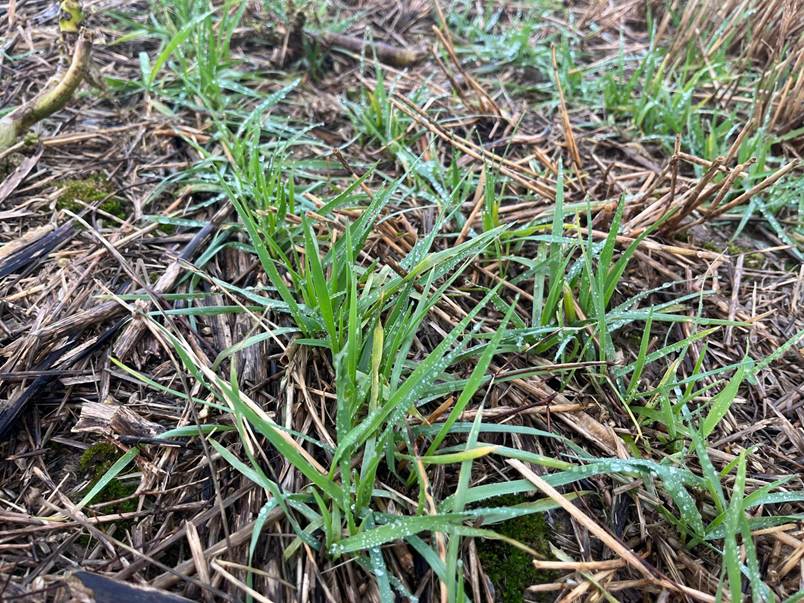
One fun and exciting trial I have established for harvest 2026 is a merger between the biannual winter cereal trial and the livingmulch system. The logic is straightforward: if we must go with the mower right after cash-crop harvest in early August to initiate livingmulch regrowth, why not just drill next season’s winter cereal at the same time. Then we will, technically speaking, establish our biannual winter cereal as an undersown crop in the bottom of the livingmulch for the next 6-7 weeks until we graze or take a forage cut on the livingmulch in mid/late September. Seven weeks is not critical for a cereal/grass to stay in the dark below the canopy, as long as they have got at least two leaves prior to canopy closure. (We know this from undersowing grass seed crops in spring cereals.)
By undersowing the winter cereal in the livingmulch green manure phase (post cash-crop harvest until forage cut seven weeks later) I hope to gain additional benefits compared to the ones mentioned above: 1) Glyphosate-free no-till made possible by the intense plant competition from the livingmulch species, 2) more forage production for cut/graze because the winter cereal will add a little bit of green leaves, 3) no rush to get the winter cereal seeded in late September because it’s already there, 4) no winter cereal seeding deadline so might be able to get a second forage cut or light graze from the livingmulch phase before winter.
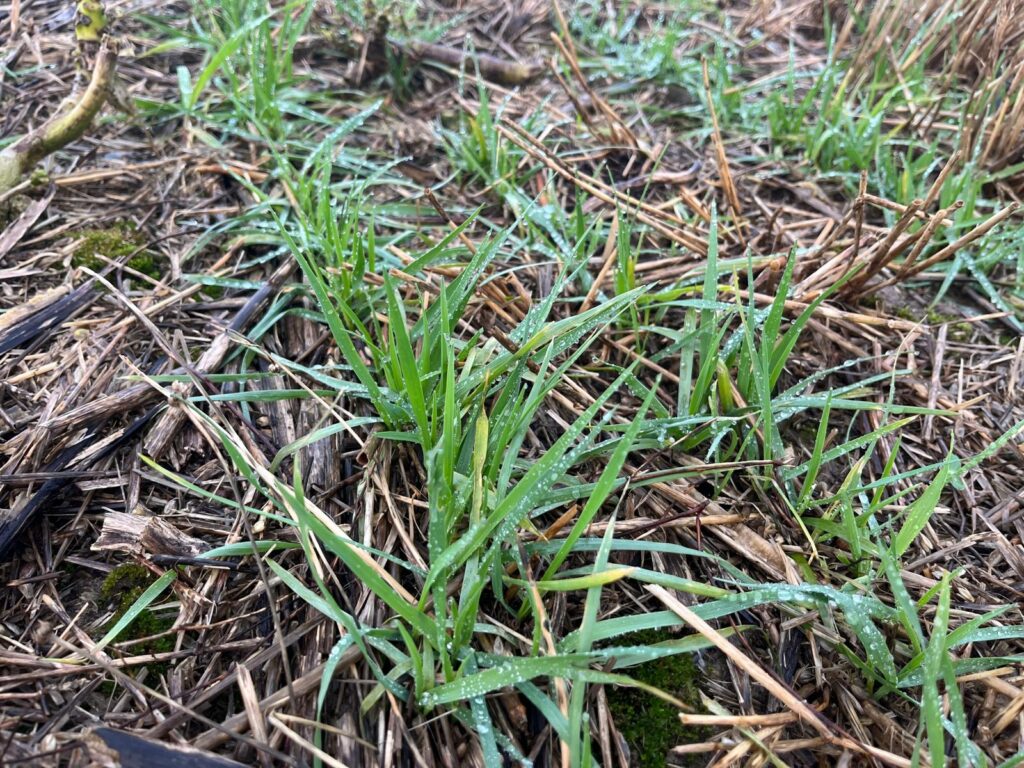
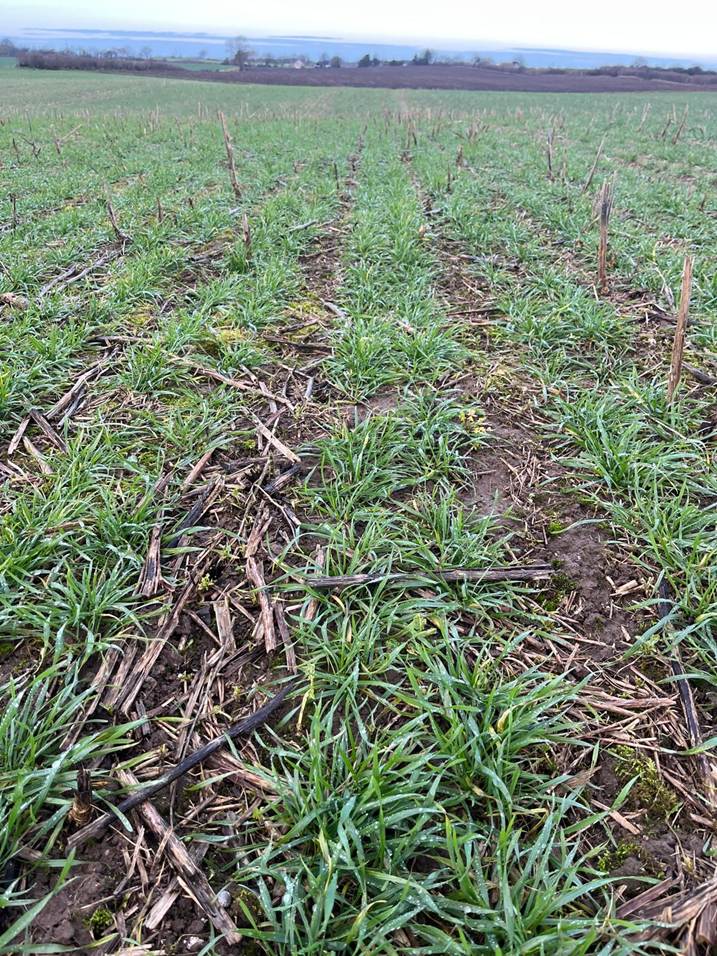
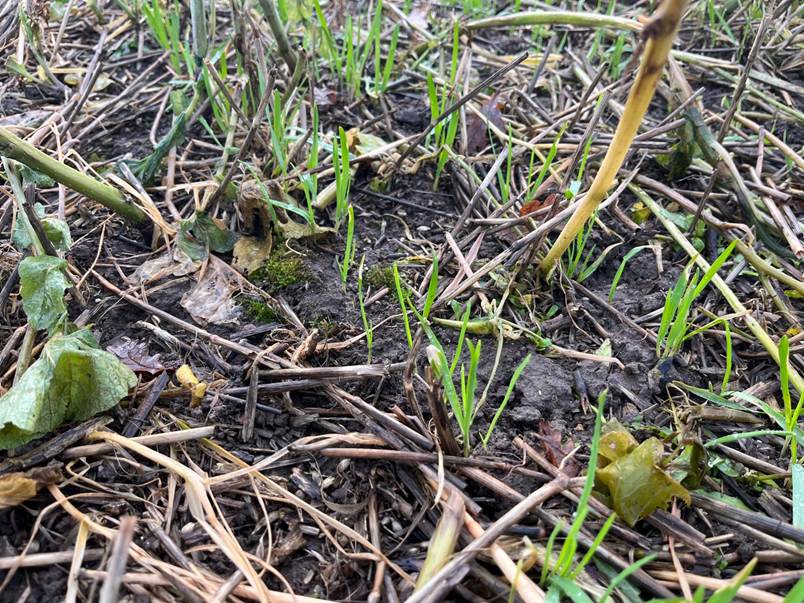
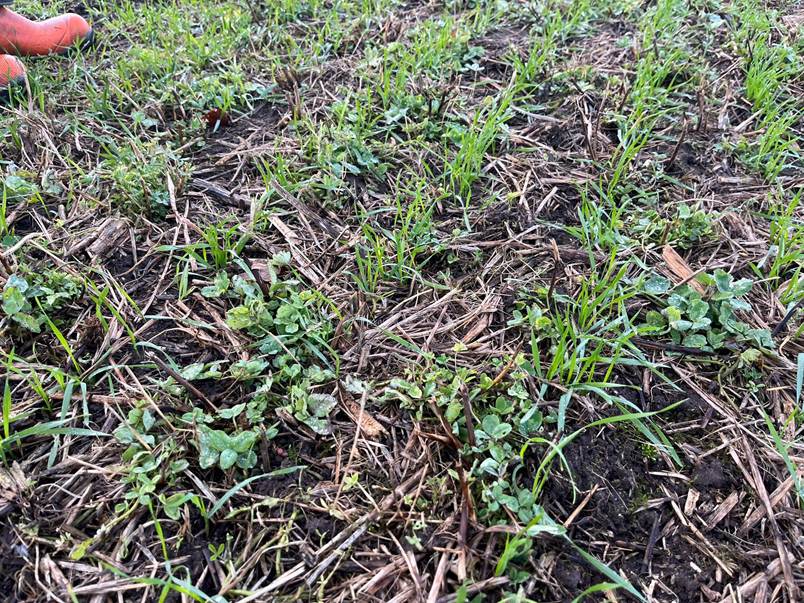
Currently in autumn 2025, the trial has been going to plan. We managed to seed the Syngenta BYDV-resistant hybrid barley (SY Zoomba) on 8 August after WOSR harvest, which itself was undersown with a new livingmulch of lucerne and red/white clover. Then on 20 September we took a forage cut on the livingmulch, liberating the much-shaded barley plants. We were also set back by some slug grazing, which was solved using a good dose of slug bait. Then in early October, we applied some soil residual herbicides to prevent overwinter germination of grass weeds. Here in the middle of December it looks like the barley plants have slowly recovered from the forage cut while the legumes are shutting down for winter. I’m very excited to follow this trial through next year.
Status of crops for harvest 2026
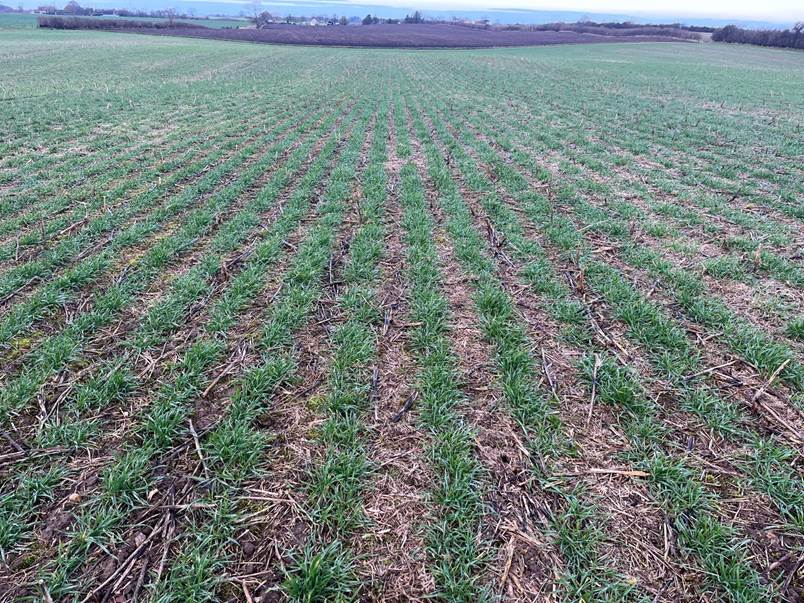
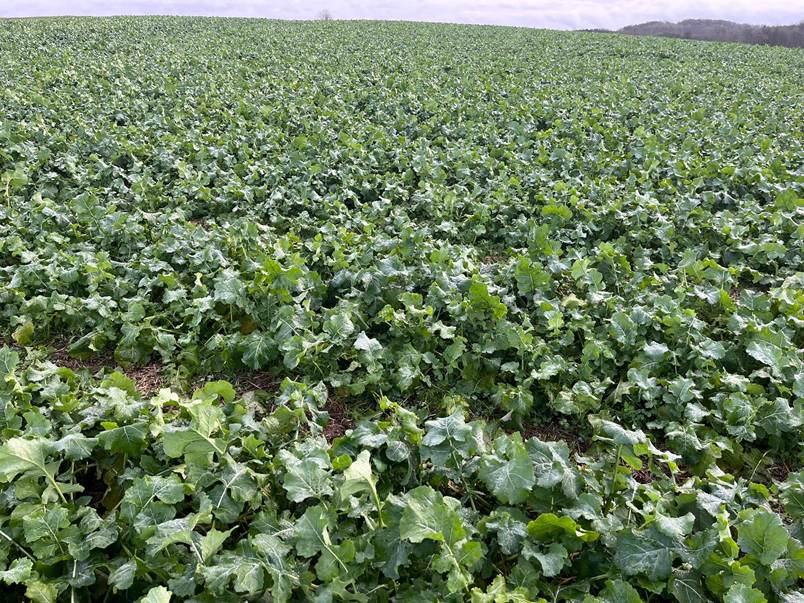
Crops for harvest 2026 look brilliant at the moment – the best it has looked for many years. No major slug grazing and good drilling conditions in September and October 2025 makes the crops look promising here before the calendar turns to 2026.
Again this year we have decided to seed bed place NPK fertiliser with our drill. Applying all P/K at the time of drilling should maximise use efficiency and gain agronomic benefits (increased tillering and overwintering, etc) while allowing for cheap spring fertiliser (AMS, Urea, N32, N34). We have sufficient soil fertility also aided by our long-term no-till system, so we apply 50% of expected crop removal of P/K.
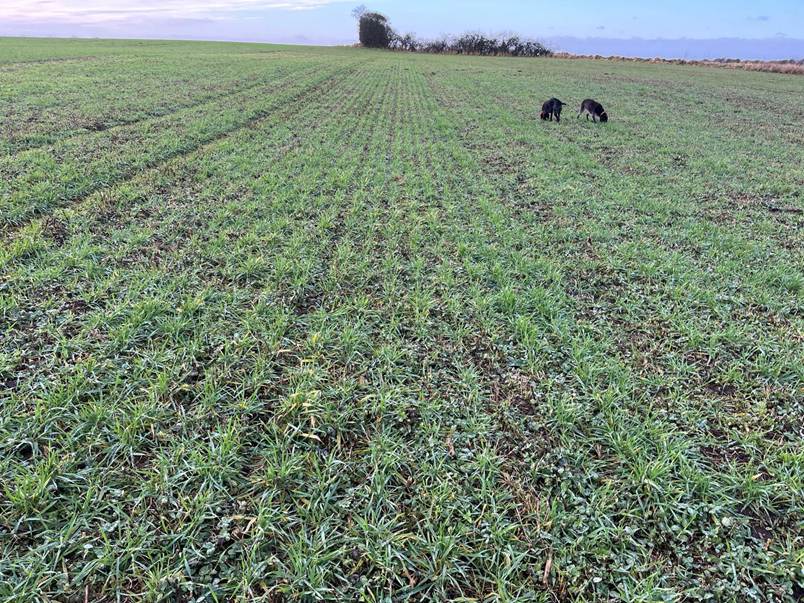
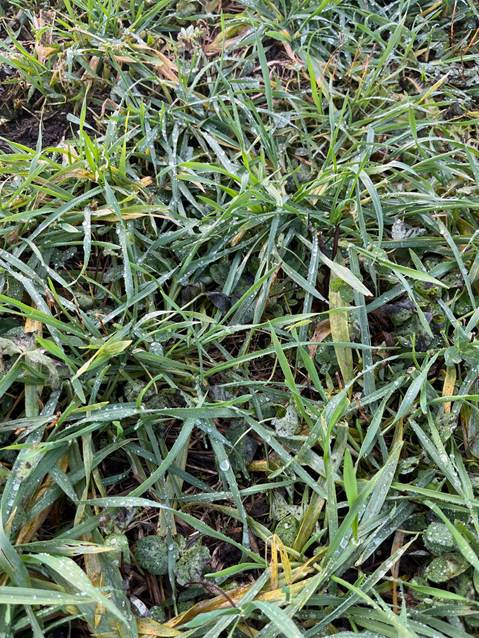
This autumn we have two main drilling date windows for our winter wheat. The first window is around 7 September and the second is around last week of September. The early drilling date of 7 September is because of some Danish nitrogen leaching legislation where we can grow early drilled winter wheat instead of mandatory nitrate catch crops. There’s plenty of risk and challenges to growing early planted wheat: mainly grass weed issues but also aphid vectored BYDV. Therefore, I have made a small on-farm trial this autumn where we grow two new BYDV-tolerant winter wheat varieties (RGT Grouse and RGT Goldfinch from the UK) and a new hybrid winter wheat (SU Hybingo) and compare them to our standard line wheat (this particular field is KWS Scope). I won’t get into detail, but I really hate how difficult Brexit has made trading with the UK. One full month of back-and-forth paperwork with the authorities just to import UK trial seed material into EU/DK. But it’s really a great effort from the brilliant RAGT team. The hybrid winter wheat is super-expensive seed material and must be drilled at half the population (125 pl/m2) to normal line wheat (250 pl/m2) in this trial just to come close to a realistic chance of similar gross margin. We do not spray insecticides to winter cereals in general so it will be fun to follow this field through and see how the yields compare at harvest time.
Another interesting comparison we replicate for the 2026 season is one field of winter OSR no-till established compared to another field He-Va Subsoiler drilled (losing to a depth of 28cm). First year we saw no difference on comparable soil types. Second year there was a difference but not similar soil types. This year (2026), soil types are similar but the subsoiler drilled field was in need of remediating some compaction and water-lodging issues which we have good experience repairing with the subsoiler established winter OSR.
Winter oat crops are drilled with three weeks’ difference. The first field in the last week of September after a summer catch crop, then another field was drilled last week of October after a normal autumn cover crop. It’s nice to get good easy weather conditions to do some proper no-till planting green which we succeeded in doing with the oats this autumn.
On the machinery front we don’t have much investment planned. I have bought a Griffith Elder Grain Brain continuous flow auger scale for our combine so we can improve how we measure plot yields for our on-farm trials and get a proper reliable yield measurement for each field. I’m looking forward to get going with that system next harvest.
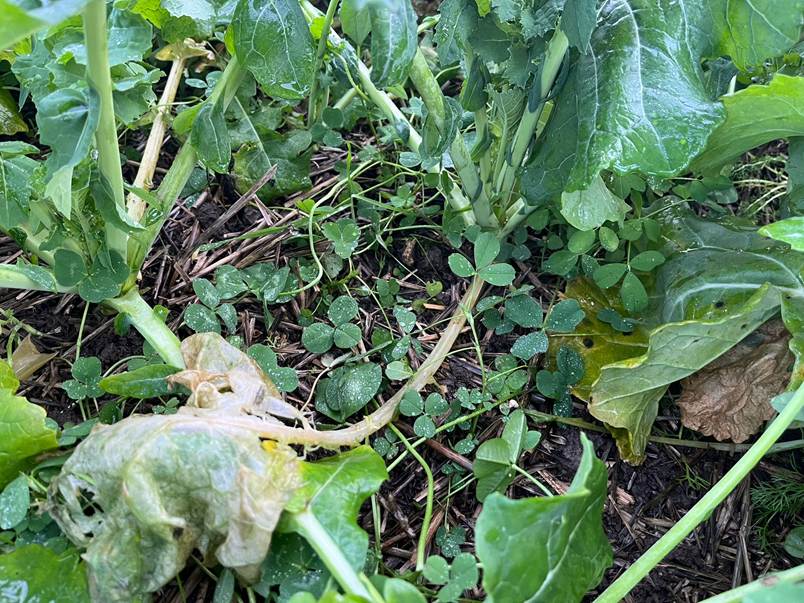
On the livingmulch front we currently have an old fourth crop year field, then a second crop year field and a new first crop year field of winter OSR undersown with a mixture of lucerne and red/white clover. That is plenty to manage and learn from as well.
When you read this, Christmas will have already passed, and we’ll be in the new year. I wish you all a merry Christmas and a happy and hopefully successful new year. I can’t wait to see what 2026 will bring and what we will learn and discuss one year from now.