The much-awaited report from Minette Batters on farm profitability was released by Defra shortly before Christmas. Tom Allen-Stevens summarises what it means for soil pioneers.
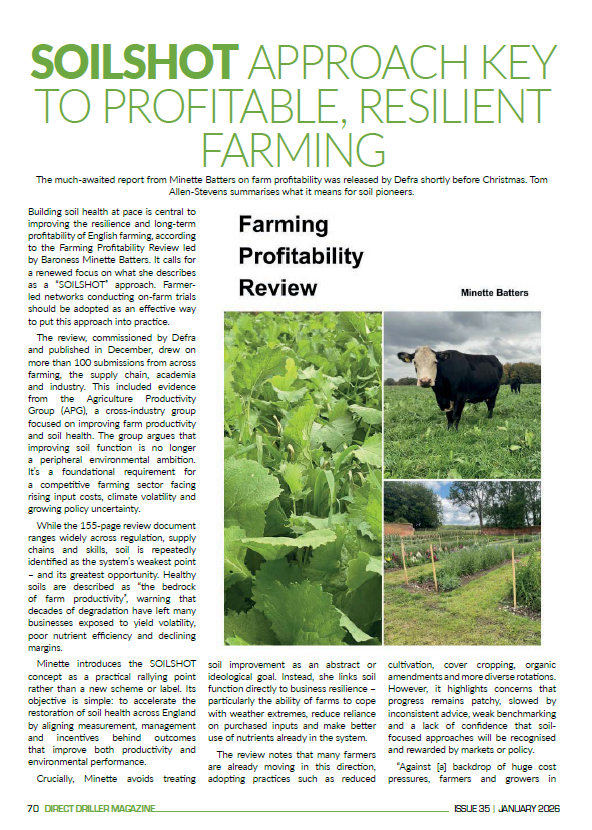
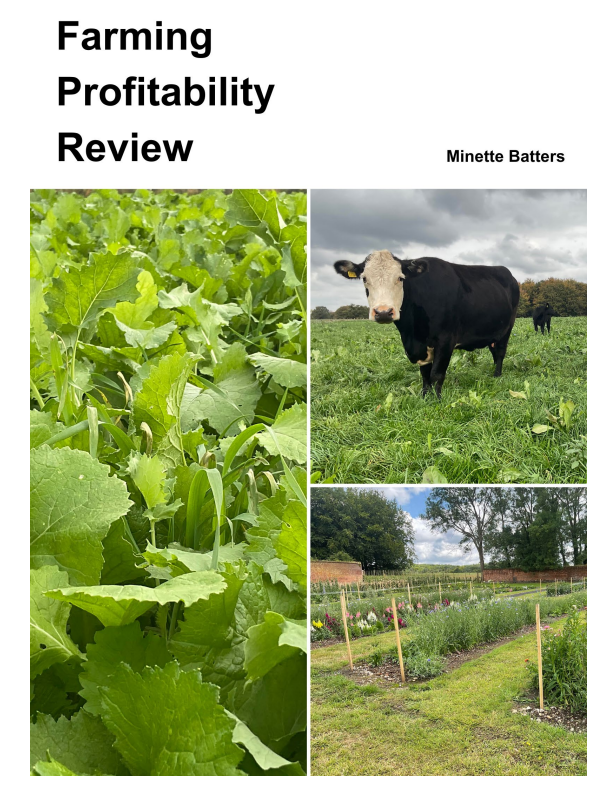
Building soil health at pace is central to improving the resilience and long-term profitability of English farming, according to the Farming Profitability Review led by Baroness Minette Batters. It calls for a renewed focus on what she describes as a “SOILSHOT” approach. Farmer-led networks conducting on-farm trials should be adopted as an effective way to put this approach into practice.
The review, commissioned by Defra and published in December, drew on more than 100 submissions from across farming, the supply chain, academia and industry. This included evidence from the Agriculture Productivity Group (APG), a cross-industry group focused on improving farm productivity and soil health. The group argues that improving soil function is no longer a peripheral environmental ambition. It’s a foundational requirement for a competitive farming sector facing rising input costs, climate volatility and growing policy uncertainty.
While the 155-page review document ranges widely across regulation, supply chains and skills, soil is repeatedly identified as the system’s weakest point – and its greatest opportunity. Healthy soils are described as “the bedrock of farm productivity”, warning that decades of degradation have left many businesses exposed to yield volatility, poor nutrient efficiency and declining margins.
Minette introduces the SOILSHOT concept as a practical rallying point rather than a new scheme or label. Its objective is simple: to accelerate the restoration of soil health across England by aligning measurement, management and incentives behind outcomes that improve both productivity and environmental performance.
Crucially, Minette avoids treating soil improvement as an abstract or ideological goal. Instead, she links soil function directly to business resilience – particularly the ability of farms to cope with weather extremes, reduce reliance on purchased inputs and make better use of nutrients already in the system.
The review notes that many farmers are already moving in this direction, adopting practices such as reduced cultivation, cover cropping, organic amendments and more diverse rotations. However, it highlights concerns that progress remains patchy, slowed by inconsistent advice, weak benchmarking and a lack of confidence that soil-focused approaches will be recognised and rewarded by markets or policy.
“Against [a] backdrop of huge cost pressures, farmers and growers in England are being asked to do more to be compliant with environmental legislation and regulation, with less funding and no certainty,” notes Minette. She calls for clearer signals and better coordination across government, advisers and supply chains to support change, responding to concerns that farmers are saddled with carrying the “risk of transition”.
The review draws on evidence suggesting soil health should be treated as an economic asset rather than a compliance issue. This highlights the need for practical, farmer-led measurement that links soil condition to performance indicators such as yield stability, nutrient use efficiency and input costs, rather than relying solely on compliance metrics or one-off tests.
The review stresses that soil improvement must be outcomes-focused, not prescriptive. It warns against rigid rule-making that could discourage innovation or fail to account for regional differences in soil type, climate and farming system. Instead, Minette argues for a framework that rewards progress and learning, recognising that rebuilding soil health is a long-term process rather than a quick fix.
The SOILSHOT approach is positioned within the review as a unifying principle – a way of aligning environmental ambition with commercial reality. By improving soil structure, biology and organic matter, the review suggests farms can reduce exposure to volatile fertiliser prices, improve water infiltration and retention, and stabilise yields in increasingly unpredictable seasons.
Importantly, the report also links soil health to the wider credibility of agriculture. Minette argues that demonstrating progress on soils provides a tangible, evidence-based way for farming to show it is delivering public value, strengthening trust with policymakers, consumers and supply chains.
However, the review is clear that delivery will depend on collaboration beyond government alone. Farmer-led innovation, trusted advice and robust on-farm evidence are all identified through evidence submissions as essential to making SOILSHOT more than just a slogan.
This is where independent networks and practical knowledge exchange are seen as critical. Peer-to-peer learning, real-world trials and transparent sharing of results are endorsed as more effective than top-down instruction in driving change at scale.
The review concludes that if soil health can be placed at the heart of both policy and business decision-making, it offers one of the most credible routes to closing the productivity gap while meeting environmental goals. But it cautions that momentum will be lost unless farmers are supported with the tools, confidence and evidence needed to act.
Five ways to help deliver SOILSHOT
The Farming Profitability Review points to clear gaps between ambition and delivery on soil health, and notes the contribution of farmer-led innovation. Five practical roles emerge that will help translate SOILSHOT into action:
- Farmer-led evidence
Building a credible evidence base rooted in commercial reality is key to delivery. It’s not enough just to make improvements to soil health – if progress is to be meaningful it must be measured.
Gathering baseline indices on organic matter, for example, is a good start. This is now incorporated into the Sustainable Farming Incentive (SFI) for those lucky enough to have an agreement, and there are other options available to baseline and start to benchmark progress.
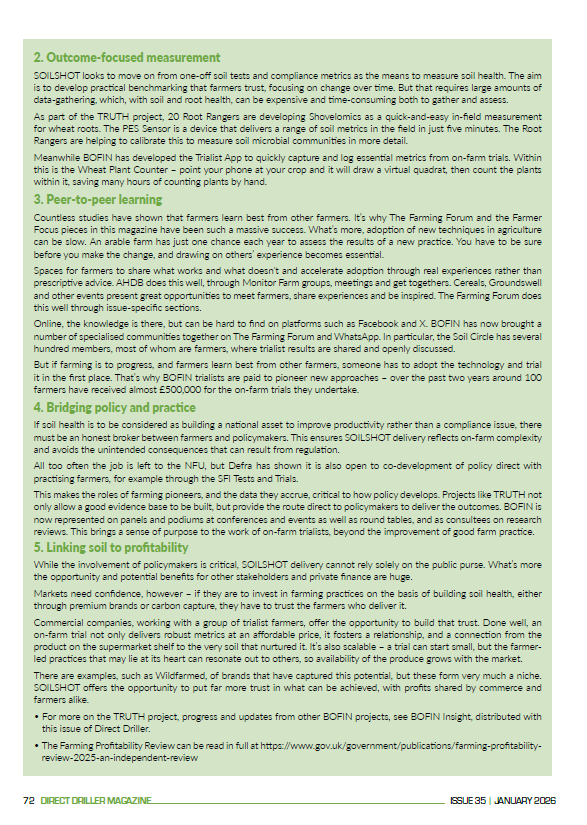
The Soil Health scorecard developed through AHDB’s GREATsoils initiative has developed this approach, capturing metrics from a visual assessment (VESS) and earthworm count. The Defra-funded TRUTH Project (Thriving Roots Underpinning Total soil Health) is taking this one step further. Led by BOFIN, scientists are working with farmers to develop metrics to understand root health and soil microbial communities.
The project is one example of on-farm trials that link soil health metrics directly to yield stability, nutrient efficiency and margins. The aim of the support that BOFIN provides is to give farmers meaningful results that can be utilised in a commercial sense as well as benchmarked.
- Outcome-focused measurement
SOILSHOT looks to move on from one-off soil tests and compliance metrics as the means to measure soil health. The aim is to develop practical benchmarking that farmers trust, focusing on change over time. But that requires large amounts of data-gathering, which with soil and root health can be expensive and time-consuming both to gather and assess.
As part of the TRUTH project, 20 Root Rangers are developing Shovelomics as a quick-and-easy in-field measurement for wheat roots. The PES Sensor is a device that delivers a range of soil metrics in the field in just five minutes. The Root Rangers are helping to calibrate this to measure soil microbial communities in more detail.
Meanwhile BOFIN has developed the Trialist App to quickly capture and log essential metrics from on-farm trials. Within this is the Wheat Plant Counter – point your phone at your crop and it will draw a virtual quadrat, then count the plants within it, saving many hours of counting plants by hand.
- Peer-to-peer learning
Countless studies have shown that farmers learn best from other farmers. It’s why The Farming Forum and the Farmer Focus pieces in this magazine have been such a massive success. What’s more, adoption of new techniques in agriculture can be slow, an arable farm has just one chance each year to assess the results of a new practice. You have to be sure before you make the change, and drawing on others’ experience becomes essential.
Spaces for farmers to share what works and what doesn’t, accelerate adoption through real experiences rather than prescriptive advice. AHDB does this well, through Monitor Farm groups, meetings and get togethers. Cereals, Groundswell and other events present great opportunities to meet farmers, share experiences and be inspired. The Farming Forum does this well through section specific sections.
Online the knowledge is there, but can be hard to find on platforms such as Facebook and X. BOFIN has now brought a number of specialised communities together on The Farming Forum and WhatsApp. In particular, the Soil Circle has several hundred members, most of whom are farmers, where trialist results are shared and openly discussed.
But if farming is to progress, and farmers learn best from other farmers, someone has to adopt the technology and trial it in the first place. That’s why BOFIN trialists are paid to pioneer new approaches – over the past two years around 100 farmers have received almost £500,000 for the on-farm trials they undertake.
- Bridging policy and practice
If soil health is to be considered as building a national asset to improve productivity, rather than a compliance issue, there must be an honest broker between farmers and policymakers. This ensures SOILSHOT delivery reflects on-farm complexity and avoids the unintended consequences that can result from regulation.
All too often the job is left to the NFU, but Defra has shown it is also open to co-development of policy direct with practising farmers, for example through the SFI Tests and Trials.
This makes the roles of farming pioneers, and the data they accrue, critical to how policy develops. Projects like TRUTH not only allow a good evidence base to be built, but provide the route direct to policy-makers to deliver the outcomes. BOFIN is now represented on panels and podiums at conferences and events, as well as round tables, and as consultees on research reviews. This brings a sense of purpose to the work of on-farm trialists, beyond the improvement of good farm practice.
- Linking soil to profitability
While the involvement of policy-makers is critical, SOILSHOT delivery cannot rely solely on the public purse. What’s more the opportunity and potential benefits for other stakeholders and private finance are huge.
Markets need confidence, however – if they are to invest in farming practices on the basis of building soil health, either through premium brands or carbon capture, they have to trust the farmers who deliver it.
Commercial companies, working with a group of trialist farmers, offers the opportunity to build that trust. Done well, an on-farm trial not only delivers robust metrics at an affordable price. It fosters a relationship, and a connection from the product on the supermarket shelf to the very soil that nurtured it. It’s also scalable – a trial can start small, but the farmer-led practices that may lie at its heart can resonate out to others, so availability of the produce grows with the market.
There are examples, such as Wildfarmed, of brands that have captured this potential, but these form very much a niche. SOILSHOT offers the opportunity to put far more trust in what can be achieved, with profits shared by commerce and farmers alike.
- For more on the TRUTH project, progress and updates from other BOFIN projects, see BOFIN Insight, distributed with this issue of Direct Driller.
- The Farming Profitability Review can be read in full at https://www.gov.uk/government/publications/farming-profitability-review-2025-an-independent-review