Written by George Hepburn and Olivia Bye from Aiva Fertilisers
A simple topic made to be complex, carbon underlies the health and value of our soil ecosystems. Building reservoirs of carbon, and the variety of options available is where things become shrouded.
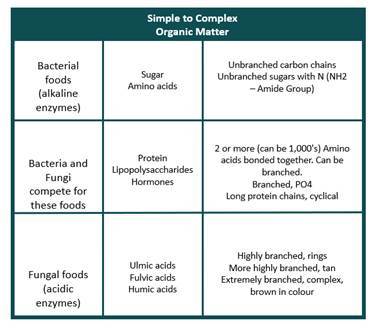
The sliding scale of carbon begins at its simplest form, molasses. Components of sugar are organic carbon atoms, a simple source of energy for biological processes. The levels of fructose, sucrose, and glucose vary between sources, ultimately determining their digestibility and longevity in the soil for biology. Levels of fructose and glucose are important for metabolism and the production of energy, while the counterpart, sucrose, is considered more stable and is responsible for energy transport and storage.
Molasses, being a simple source of energy for biology, encourages a rapid growth of bacteria, leading to a primary peak and subsequent troughs in the population. For the modern farmer, creating a bloom of bacteria is not the end goal, as creating a balanced ratio of bacteria to fungi is more desired under the overarching goal of building reserves of soil carbon, for whole farm resilience. Molasses will get you a quick reaction that reaches the halfway line, but to get to your goal, stacking a simple and more complex sugar will help achieve a more sustainable level of growth under a healthier soil environment.
More complex carbons can be farmyard manure, fish hydrolysate along with amino, humic & fulvic acids. These create the foundation of any good soil community by feeding a range of biology, with a longer soil persistency, creating a wider soil food web which will reward a farmer with richer soil health benefits. Proteins common in legume residues or fish hydrolysates, and in turn amino acids, can help supply nitrogen to the plant in a more organic form. Sea2Soil displays impressive levels of fish proteins, amino acids, and trace elements. This technology allows farmers to skip a step in the amino acid to protein pathway, ensuring the plant does not exhaust itself in the process, leaving more energy for yield building. A key example as to why your choice of carbon is important for a farms unique end goal.
Using compost or brewing a compost tea can multiply the microbial populations native to your soil. Brewing with multiple food additives supplies the energy needed for rapid reproduction and produces a probiotic tea to stimulate the soil. The quality of compost and its final inoculant depend on the variety of food and the maturity of the compost components.
On the further end of the scale are the components of soil humus: humic, fulvic, and ulmic acids. While they are not a direct, nor rapid, food source for soil biology in the same capacity as a simple sugar, the carbon structures and processes they influence are long-term life sources and habitat fabrication for all matter of micro and macro soil biology. For cation exchange capacity, soil aggregation and pH buffering humic acids are to thank while efficient nutrient availability and uptake are attributed to fulvic acids. Introducing humic and fulvic acids as a complex source can aid in building longer-term mechanisms needed for the soil food web to cycle minerals, nutrients, and water itself which is often compromised in modern agriculture with regular synthetic fertiliser and pesticide applications.
| Source | Complexity | Longevity | Benefits |
| Humic acid | Complex | Long | Soil health, nutrient availability |
| Fulvic acid | Complex | Intermediate | Nutrient availability & uptake. Increases photosynthesis |
| Compost | Intermediate | intermediate | Inoculation, soil health |
| Molasses | Simple | Very low | Quick start |
| Hydrolysates | Intermediate | Low | Nutrient availability |
Understanding the varying components of carbon sources, we can now differentiate between using different sources as a targeted application, at the right time, to achieve a farm-focused goal. Frequent use of the same simple carbon sources can be detrimental as well as counterintuitive to crop health. When a simple sugar source is the dominant feed for biology, to buffer their feed sources, biology will search and utilise any free nitrogen in the soil. Outweighing the carbon-to-nitrogen ratio in the soil temporarily immobilises nitrogen for the crop. The respiration spike adjacent to the increase in simple sugars can consume oxygen at an unsustainable rate, which can be damaging to soil biology and ultimately plant root networks.
The product pyramid for each level of complexity of carbon sources would begin with simple molasses products, then molasses bases + additions and up through into more fermented products. It is at this point that the products move away from being simple molasses and into being complex carbon sources however care needs to be taken to verify the claims of what some of these products contain, and in what ratios. Humic/fulvic content, aminograms and trace element breakdowns should be available to view and whilst there will be variation in organic products, this shouldn’t allow for claims of content that can’t be challenged.
Incorporating a single or sporadic sugar/carbon source does not suffice to build soil resilience. The main argument is that integrating a variety of carbon sources, each with a specific role, within a carefully managed system enables carbon to function optimally and supports the reduction of other inputs, ultimately resulting in a more resilient soil environment.
You may not be able to see the benefit of these additions in terms of immediate crop affects, but the investment in the soil will pay back the farm in resilience heading into the 2026 season and beyond.