Written by Kurtis Scarboro from Elsom Seeds
As a Crop Manager working for the UK’s largest Independent seed breeder – Elsoms Seeds, I’m delighted that, following the success of Elsoms Group 3 wheat Bamford, we are now able to announce another exciting new Soft wheat, Sparkler, to the 2026/27 Recommended List (RL).
Prior to the arrival of Bamford in 2023, there hadn’t really been any Soft wheat varieties agronomically able to compete with the highest yielding Hard wheats since the halcyon days of the early 2,000’s when outstanding wheat varieties such as Claire, Consort, Riband and Robigus ensured that nearly 50% of the UK wheat area was made up of Soft wheat. Since that time though, the area of Hard wheat grown in the UK has surged way ahead of the Soft wheat area creating an imbalance.
Whilst that imbalance still exists, the recent success of Bamford (now officially the UK’s leading winter wheat variety in terms of its market share) added to the arrival of Sparkler should help to restore some much needed balance, as well as helping to create more opportunities for growers to achieve premiums.
According to many grain traders and Millers, there is now very good milling demand for Bamford. And, following their analysis of the crop25 harvest results, the quality of Soft wheat across all the key metrics – including protein levels, bushel weights and Hagberg was equal to Hard wheat last season.
With a treated yield of 106%, Sparkler has joined the RL as the highest yielding UK Soft variety, offering growers and Agronomists a powerful genetic background combining the individual strengths of both Graham and LG Skyscraper. Graham was always noted for its strong performance in the West, whilst Skyscraper dominated the North of England and Scotland for many years, so expectations are high that Sparkler will continue that impressive lineage in, not only, those key regions but throughout the rest of the UK.
From a disease-resistance perspective, Sparkler is particularly noteworthy. It has a Septoria resistance score of 7.2, the second highest on the RL, and a yellow rust score of 7. Both are impressive ratings, especially in a year that saw many varieties downgraded due to high disease pressure – particularly around yellow rust.
On marketability, offering growers realistic opportunities to achieve a premium, the key advantages of this new variety lie in both its suitability for UK distilling and its recent approval for UKS export.

In tests conducted by Nick Pitts, Supply Chain Sustainability Manager at the Scottish Whisky Research Institute (SWRI), Sparkler has been rated as ‘High’ for its distilling quality, consistently delivering high alcohol yields. This is a significant improvement over the mean of the control varieties. Beyond its distilling potential, Sparkler also possesses a strong set of agronomic traits. It has shown exceptional early vigour, a good specific weight of 76.7kg/hl, and a high tillering capacity, which results in a good amount of straw. All desirable characteristics for growers.
The SWRI’s role is to support the AHDB’s RL trials by evaluating soft wheat varieties for their distilling quality. They are the sole provider of this data, and their assessments focus on Alcohol Yield and Residue Viscosity. Varieties with high alcohol yield and low viscosity over multiple years are rated ‘High’, while those with acceptable quality are rated ‘Medium’. Distillers prefer soft wheats of at least ‘Medium’ quality.
The addition of a new ‘High’ rated distilling variety to the RL is a welcome development. Sparkler has consistently delivered high alcohol yields during testing, offering both farmers and distillers a strong new option for grain distilling.
It’s always valuable to see how new varieties perform on-farm, and I was interested to hear from Lincolnshire-based arable farmer Vic Barker, who farms 222ha on soils ranging from heavy loam to light silt loam. He had an early opportunity to evaluate the new Group 4 and was impressed with its performance during a very challenging season noted for prolonged dry conditions.
Vic explained that he drilled 6ha of Sparkler at a seed rate of 175kg/ha in early December 2024, following crops of cabbages and parsnips. The crop established well, showed tremendous early vigour, and wintered well, before kicking on again in early spring following its first split of N applied at a rate of 80kg/ha on March 3rd.
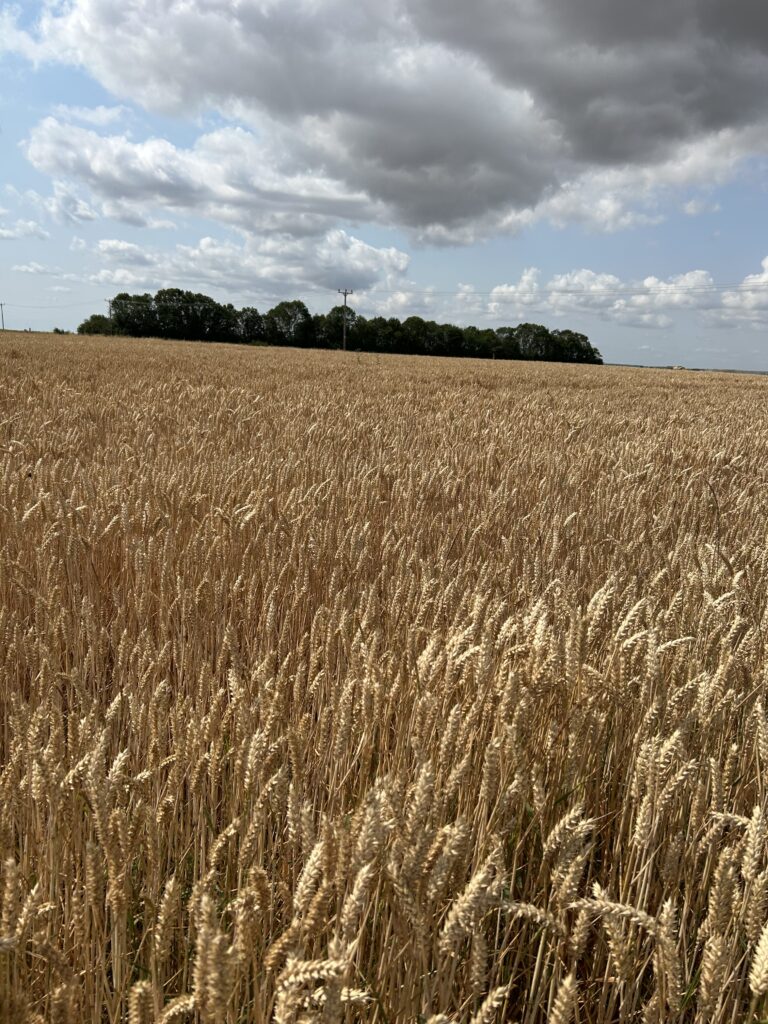
He went on to add, “Given this variety is completely new to us, we adopted a belt and braces approach in our fungicides strategy with both our T1 and T2 sprays built around a strong tank mix that included both Revystar (mefentrifluconazole + fluxapyroxad) and Stabilan (chlormequat chloride) – a PGR we use as additional insurance to prevent lodging and strengthen plant stems. The variety was straightforward to manage, fitting nicely into our normal spray pattern and all went smoothly through spring and early summer with the lack of rainfall our only serious concern.
Harvesting in the second week of August, it was his highest yielding winter wheat from five varieties grown in 2025, recording an average yield of 9.76t/ha – a great result given the near drought conditions. In terms of his initial observations, he felt Sparkler’s ability to get away quickly could potentially make it a good variety for late drilling. It tillered well, producing a lot of straw and coped better with the dry conditions than some of his other varieties.
For his 2026 Sparkler crop, Vic has gone with an earlier drilling date and increased his drilled area to 10ha.
He concluded, “Assuming different weather challenges next year I’m sure we’ll know a lot more about this variety by next harvest. It’s early days, but I certainly like what I’ve seen so far and its inclusion on the new RL looks fully justified.”