Written by Joe Stanley, Head of Sustainable Farming
A year ago I wrote in these pages about the relatively neglected state of interest in land drainage in recent decades and the increasingly degraded nature of much of our field drainage network. My hope at the time was to initiate a research project at the Allerton Project to highlight the benefits of field drainage and get the issue back on the political and supply chain agenda.
Happily, I can report that in the autumn of 2025 this ambition became a reality as our research and demonstration farm at Loddington in Leicestershire saw the first new-scheme install since at least the 1980s as the DRAIN-WISE (Drainage for Water, Income, Soil and Environment) project got underway.
DRAIN-WISE brings together a consortium of partners from across the industry led by the Allerton Project, all with an interest in generating modern, UK-specific data on the impact of a modern field drainage system for both production metrics but, perhaps more importantly, for the environmental impact of land drainage too.
And this, I believe, is key: although government pledges to release its ’25 Year Farming Roadmap’ in 2026 with its vision as to how to make British farming more profitable into the middle of the century, most farmers might look askance at such pledges from a government which has at a stroke undermined business confidence and investment with a range of measures directed against farm businesses, not least its move on IHT and BPR. Indeed, successive governments have done little to engender any confidence that they genuinely understand nor care about the economics of modern farming. What’s more, the UK has no legally binding target on domestic food production, which means that policies that might promote production are always going to come a distant second to those which address our numerous legally-binding environmental targets.
As such, this is the data which we are hoping to focus on with DRAIN-WISE. Afterall, the Environmental Improvement Plan (EIP) 2025 sets out a target of nitrogen, phosphate and sediment loss from farmland to be reduced by 12% by 2030 from a 2018 baseline – with a statutory target of 40% by 2038. There’s also an aim to see at least 40% of England’s agricultural soils under ‘sustainable management’ by 2028 and 60% by 2030, with a target of a 39% reduction in agricultural carbon emissions by 2040 from a 2022 baseline. There are also ambitious targets for reductions in the use of pesticides and increased IPM. All of these goals – not to mention wider goals associated with biodiversity recovery – are likely to be key outcomes of well-drained vs under-drained soils.
This is important; according to government figures, agriculture is responsible for the loss of some 2.9m tonnes of topsoil across England and Wales and some 75% of sediment loss into surface water, along with 75% of pesticides, 25% of phosphate and is the source of some 69% of nitrous oxide (N₂O) – 80% of which emanates from soil.
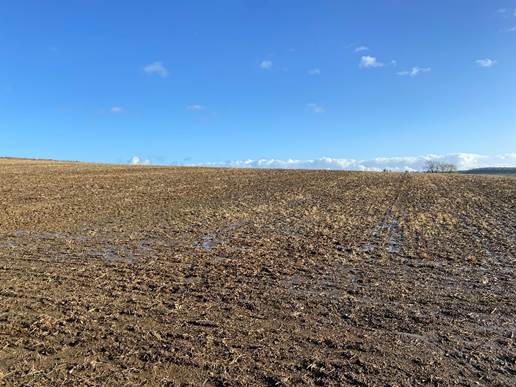
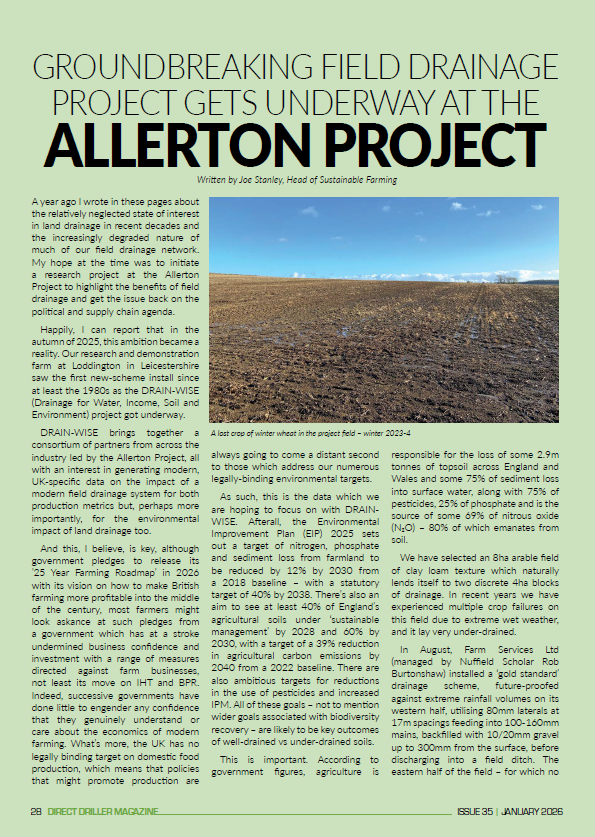
A lost crop of winter wheat in the project field – winter 2023-4
We have selected an 8ha arable field of clay loam texture which naturally lends itself to two discrete 4ha blocks of drainage. In recent years we have experienced multiple crop failures on this field due to extreme wet weather, and it lay very under-drained.
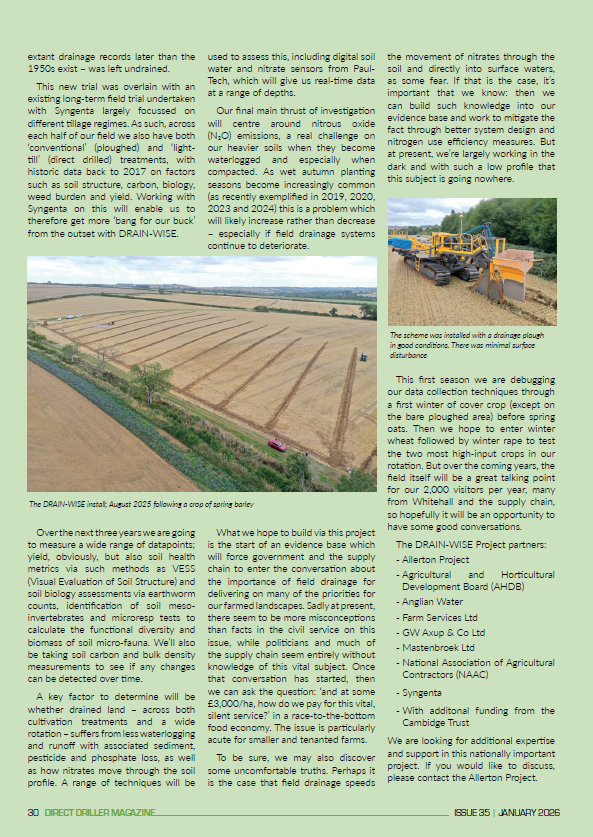
In August, Farm Services Ltd (managed by Nuffield Scholar Rob Burtonshaw) installed a ‘gold standard’ drainage scheme future-proofed against extreme rainfall volumes on its western half, utilising 80mm laterals at 17m spacings feeding into 100-160mm mains, backfilled with 10/20mm gravel up to 300mm from the surface, before discharging into a field ditch. The eastern half of the field – for which no extant drainage records later than the 1950s exist – was left undrained.
This new trial was overlain with an existing long-term field trial undertaken with Syngenta (see issue ***) largely focussed on different tillage regimes. As such, across each half of our field we also have both ‘conventional’ (ploughed) and ‘light-till’ (direct drilled) treatments, with historic data back to 2017 on factors such as soil structure, carbon, biology, weed burden and yield. Working with Syngenta on this will enable us to therefore get more ‘bang for our buck’ from the outset with DRAIN-WISE.
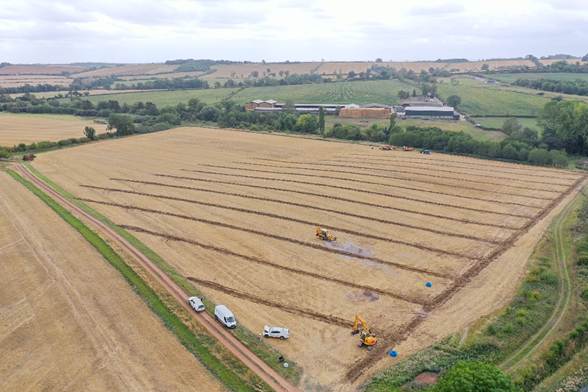
The DRAIN-WISE install; August 2025 following a crop of spring barley
Over the next three years we are going to measure a wide range of datapoints; yield, obviously, but also soil health metrics via such methods as VESS (Visual Evaluation of Soil Structure) and soil biology assessments via earthworm counts, identification of soil meso-invertebrates and microresp tests to calculate the functional diversity and biomass of soil micro-fauna. We’ll also be taking soil carbon and bulk density measurements to see if any changes can be detected over time.
A key factor to determine will be whether drained land – across both cultivation treatments and a wide rotation – suffers from less waterlogging and runoff with associated sediment, pesticide and phosphate loss, as well as how nitrates move through the soil profile. A range of techniques will be used to assess this, including digital soil water and nitrate sensors from Paul-Tech, which will give us real-time data at a range of depths.
Our final main thrust of investigation will centre around nitrous oxide (N₂O) emissions, a real challenge on our heavier soils when they become waterlogged and especially when compacted. As wet autumn planting seasons become increasingly common (as recently exemplified in 2019, 2020, 2023 and 2024) this is a problem which will likely increase rather than decrease – especially if field drainage systems continue to deteriorate.
What we hope to build via this project is the start of an evidence base which will force government and the supply chain to enter the conversation about the importance of field drainage for delivering on many of the priorities for our farmed landscapes. Sadly at present, there seem more misconceptions than facts in the civil service on this issue while politicians and much of the supply chain seem entirely without knowledge of this vital subject. Once that conversation has started, then we can ask the question: ‘and at some £3,000/ha, how do we pay for this vital, silent service?’ in a race-to-the-bottom food economy. The issue is particularly acute for smaller and tenanted farms.
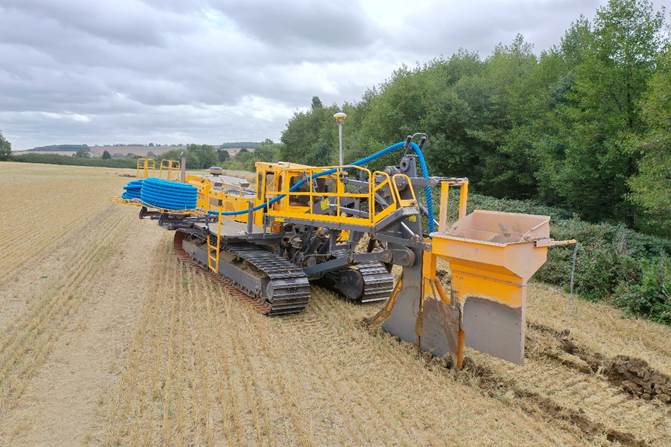
The scheme was installed with a drainage plough in good conditions. There was minimal surface disturbance
To be sure, we may also discover some uncomfortable truths. Perhaps it is the case that field drainage speeds the movement of nitrates through the soil and directly into surface waters, as some fear. If that is the case, it’s important that we know: then we can build such knowledge into our evidence base and work to mitigate the fact through better system design and nitrogen use efficiency measures. But at present, we’re largely working in the dark and with such a low profile that this subject is going nowhere.
This first season we are debugging our data collection techniques through a first winter of cover crop (except on the bare ploughed area) before spring oats. Then we hope to enter winter wheat followed by winter rape to test the two most high input crops in our rotation. But over the coming years, the field itself will be a great talking point for our 2,000 visitors per year, many from Whitehall and the supply chain, so hopefully it will be an opportunity to have some good conversations.
The DRAIN-WISE Project partners:
- Allerton Project
- Agricultural and Horticultural Development Board (AHDB)
- Anglian Water
- Farm Services Ltd
- GW Axup & Co Ltd
- Mastenbroek Ltd
- National Association of Agricultural Contractors (NAAC)
- Syngenta
- With additonal funding from the Cambidge Trust
We are looking for additional expertise and support in this nationally important project. If you would like to discuss, please contact the Allerton Project.