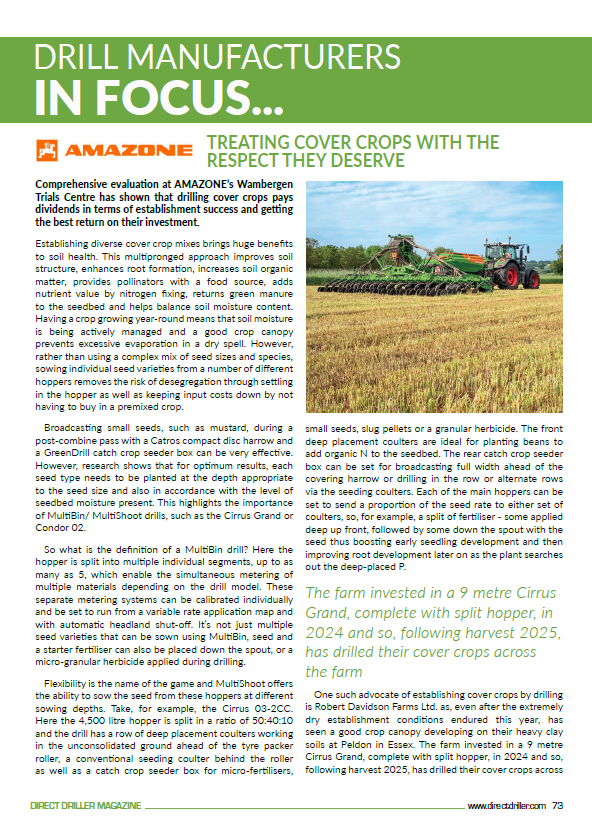
Comprehensive evaluation at AMAZONE’s Wambergen Trials Centre has shown that drilling cover crops pays dividends in terms of establishment success and getting the best return on their investment.
Establishing diverse cover crop mixes brings huge benefits to soil health. This multipronged approach improves soil
structure, enhances root formation, increases soil organic matter, provides pollinators with a food source, adds
nutrient value by nitrogen fixing, returns green manure to the seedbed and helps balance soil moisture content.
Having a crop growing year-round means that soil moisture is being actively managed and a good crop canopy
prevents excessive evaporation in a dry spell. However, rather than using a complex mix of seed sizes and species,
sowing individual seed varieties from a number of different hoppers removes the risk of desegregation through settling in the hopper as well as keeping input costs down by not having to buy in a premixed crop.
Broadcasting small seeds, such as mustard, during a post-combine pass with a Catros compact disc harrow and a GreenDrill catch crop seeder box can be very effective. However, research shows that for optimum results, each
seed type needs to be planted at the depth appropriate to the seed size and also in accordance with the level of
seedbed moisture present. This highlights the importance of MultiBin/ MultiShoot drills, such as the Cirrus Grand or
Condor 02.
So what is the definition of a MultiBin drill? Here the hopper is split into multiple individual segments, up to as many as 5, which enable the simultaneous metering of multiple materials depending on the drill model. These
separate metering systems can be calibrated individually and be set to run from a variable rate application map and
with automatic headland shut-off. It’s not just multiple seed varieties that can be sown using MultiBin, seed and a starter fertiliser can also be placed down the spout, or a micro-granular herbicide applied during drilling.
Flexibility is the name of the game and MultiShoot offers the ability to sow the seed from these hoppers at different
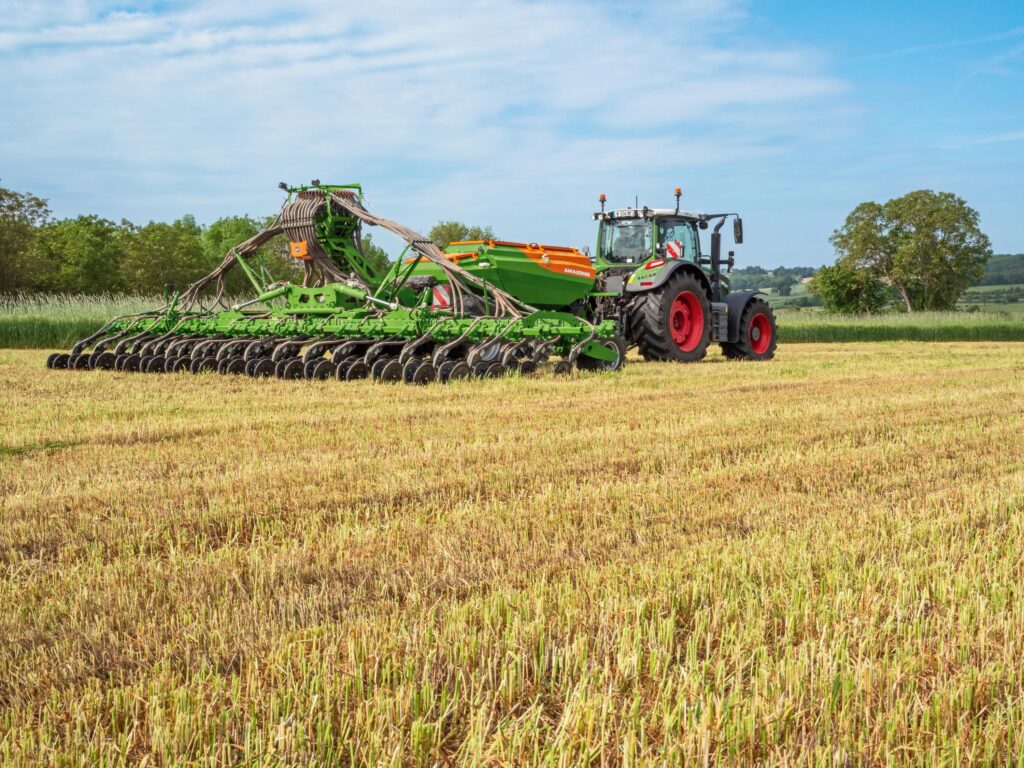
sowing depths. Take, for example, the Cirrus 03-2CC. Here the 4,500 litre hopper is split in a ratio of 50:40:10 and the drill has a row of deep placement coulters working in the unconsolidated ground ahead of the tyre packer roller, a conventional seeding coulter behind the roller as well as a catch crop seeder box for micro-fertilisers, small seeds, slug pellets or a granular herbicide. The front deep placement coulters are ideal for planting beans to
add organic N to the seedbed.
The rear catch crop seeder box can be set for broadcasting full width ahead of the covering harrow or drilling in the row or alternate rows via the seeding coulters. Each of the main hoppers can be set to send a proportion of the seed rate to either set of coulters, so, for example, a split of fertiliser – some applied deep up front, followed by some down the spout with the seed thus boosting early seedling development and then improving root development later on as the plant searches out the deep-placed P.
One such advocate of establishing cover crops by drilling is Robert Davidson Farms Ltd. as, even after the extremely dry establishment conditions endured this year, has seen a good crop canopy developing on their heavy clay soils at Peldon in Essex. The farm invested in a 9 metre Cirrus Grand, complete with split hopper, in 2024 and so, following harvest 2025, has drilled their cover crops across the farm. James Faulkner, Farms Director explains the rationale behind their decision, ‘Up until this year we had been using either our CatrosXL 5003-2TX with a GreenDrill 501 or a deeper work cultivator and Biodrill to broadcast the covers but felt that drilling direct would give much better results as we were consistently losing too much moisture by working the soils,’ he goes on to add ‘We can cover so much ground so quickly, putting them in with the drill is no problem and the establishment behind the drill has been excellent, achieving a good canopy and these will be kept going until the land goes into maize in the spring’.
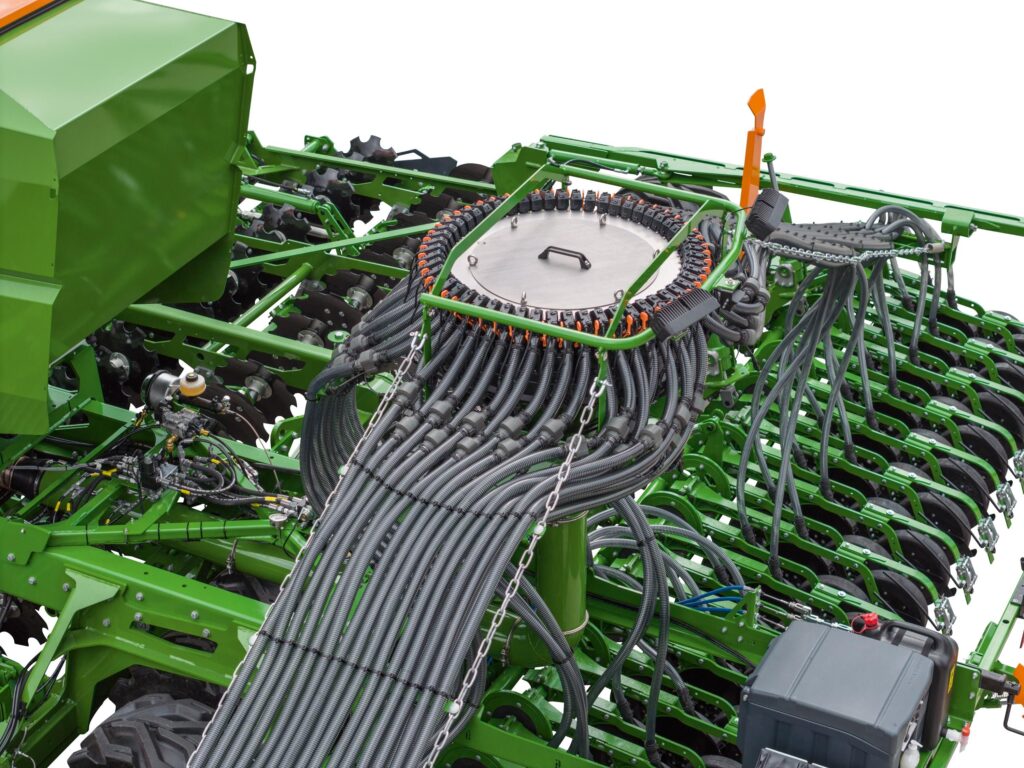
Another positive of modern drill technology enjoyed by Robert Davidson Farms Ltd. is the MultiSwitch distribution head which, with its individual row control, means that seed wastage on the headland caused by over-drilling is kept to as little as 1%. V-Compensation means that the longer seed pipes are fed earlier than the shorter pipes thus evening up the ins and outs. However, individual row control means that, not only can the tramline width and the tractor wheeling width be set at the press of a button, the system can also stop and start any row you choose to enable rape drilling to be done on 50 cm row widths with a companion plant planted in between whilst returning to 16.6 cm for cereals. And now, following on from the introduction of EasyTram, that same head can be used for putting in tramlines at an angle to the drilling to prevent erosion as well as sowing multiple tramlines for use by slurry tankers and inter-row hoes alongside any width of main spraying tramlines.
As cover cropping becomes an increasingly important tool in seedbed management, getting the best return from the time and money invested in paramount and so growers should look at all establishment permutations in order to achieve the best results.