From continuous cereals to growing multiple crops using no-till and other regenerative farming techniques, a group of Kenyan farms have made big strides in the past 15 years
Written by Mike Abram
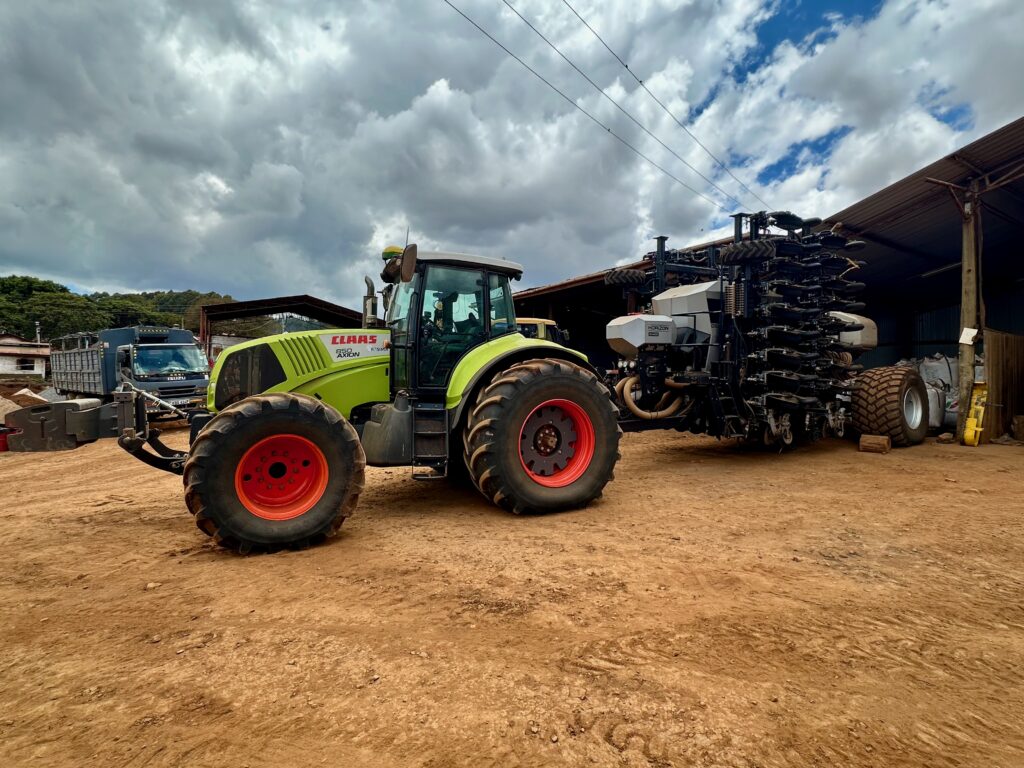
I’m standing in a farmyard next to a Horizon disc drill, discussing how the farm is getting on with using it in its first year, when it suddenly strikes me how much chirping from small birds is happening in the background.
It takes me back to my childhood when hosts of house sparrows and other small songbirds proliferated in my parents’ farmyard. Over the years, as we know, these birds have dwindled in number, but here there’s no shortage as I look over towards other buildings across the yard.
This farm isn’t in the UK though, despite the Horizon drill, but around 2000m above sea level in the foothills of Mount Kenya. The chatter from birds, including familiar-looking house sparrows, is a really noticeable difference between farms at home and the three farms I’ll visit on a three-day trip to Meru County, about four hours north of Nairobi.
These farms have some similarities with those at home, in cropping, mechanisation and size, unlike the majority of Kenyan farms. All are large-scale arable or mixed farms, owned or managed by fourth or fifth generation Kenyans, whose families arrived from Europe shortly after the First World War.
The main farm income was originally built on the wool trade from Merino sheep, but over the years gradually all three farms also incorporated arable farming. Unlike in the UK where rotation was introduced over 200 years ago, for a long time break crops were seldom grown, if at all.
Instead, continuous cereals, primarily wheat or barley, dominated and it wasn’t until the latter part of the ‘noughties’ that changed, when a major shift in philosophy occurred driven by a recognition that the previous model wasn’t sustainable, either financially or ecologically.
Visits from and to overseas advisers, especially in Australia, provided the inspiration and knowledge-base to make a change to a system based on no-till, controlled traffic farming and a more diverse rotation, including oilseed rape and peas.


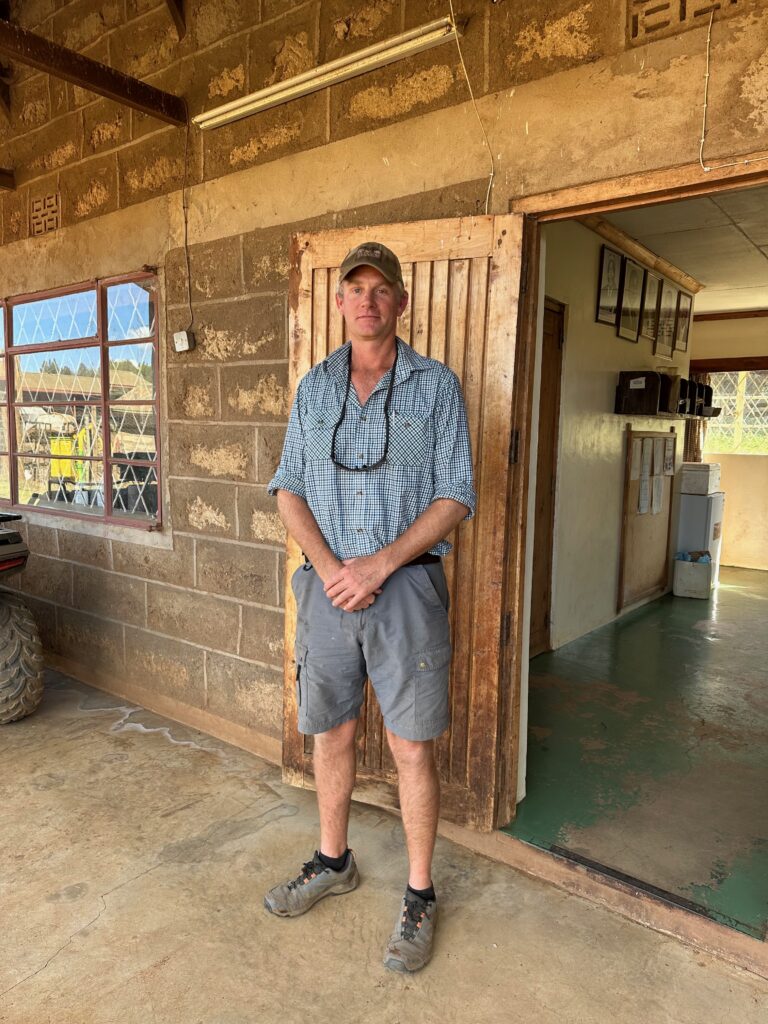
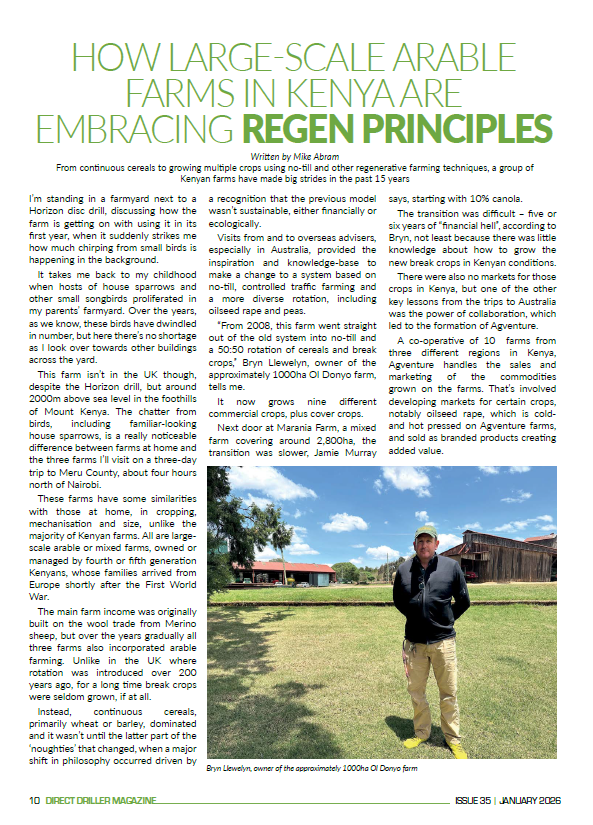
“From 2008, this farm went straight out of the old system into no-till and a 50:50 rotation of cereals and break crops,” Bryn Llewelyn, owner of the approximately 1000ha Ol Donyo farm, tells me.
It now grows nine different commercial crops, plus cover crops.
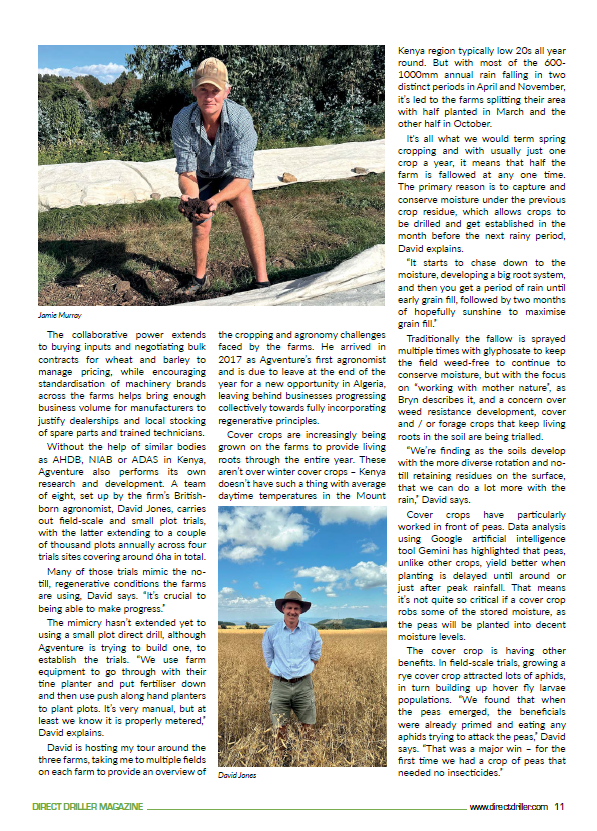
Next door at Marania Farm, a mixed farm covering around 2,800ha, the transition was slower, Jamie Murray says, starting with 10% canola.
The transition was difficult – five or six years of “financial hell”, according to Bryn, not least because there was little knowledge about how to grow the new break crops in Kenyan conditions.
There were also no markets for those crops in Kenya, but one of the other key lessons from the trips to Australia was the power of collaboration, which led to the formation of Agventure.
A co-operative of 10 farms from three different regions in Kenya, Agventure handles the sales and marketing of the commodities grown on the farms. That’s involved developing markets for certain crops, notably oilseed rape, which is cold- and hot-pressed on Agventure farms, and sold as branded products creating added value.
The collaborative power extends to buying inputs and negotiating bulk contracts for wheat and barley to manage pricing, while encouraging standardisation of machinery brands across the farms helps bring enough business volume for manufacturers to justify dealerships and local stocking of spare parts and trained technicians.
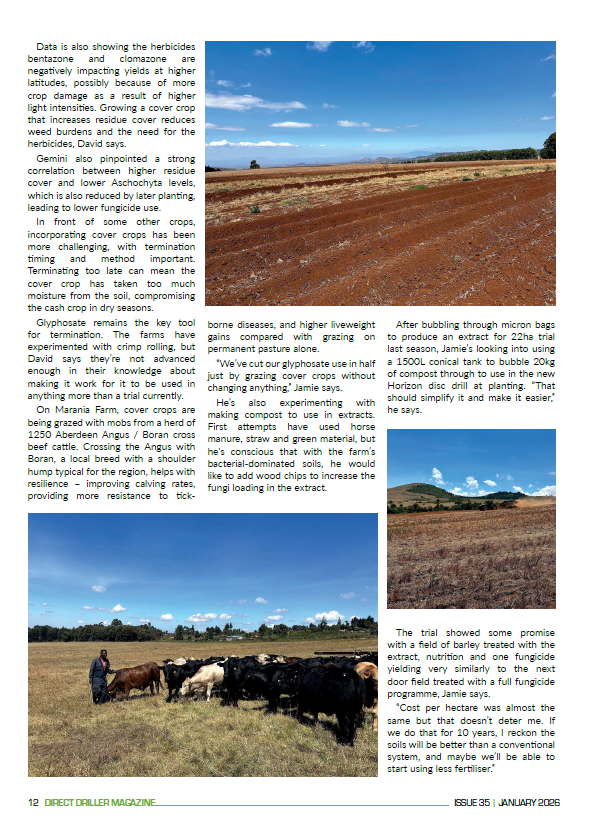
Without the help of similar bodies as AHDB, NIAB or ADAS in Kenya, Agventure also performs its own research and development. A team of eight, set up the firm’s British-born agronomist David Jones, carries out field-scale and small plot trials, with the later extending to a couple of thousand plots annually across four trials sites covering around 6ha in total.
Many of those trials mimic the no-till, regenerative conditions the farms are using, David says. “It’s crucial to being able to make progress.”
The mimicry hasn’t extended yet to using a small plot direct drill, although Agventure is trying to build one, to establish the trials. “We use farm equipment to go through with their tine planter and put fertiliser down and then use push along hand planters to plant plots. It’s very manual, but at least we know it is properly metered,” David explains.
David is hosting my tour around the three farms, taking me to multiple fields on each farm to provide an overview of the cropping and agronomy challenges faced by the farms. He arrived in 2017 as Agventure’s first agronomist and is due to leave at the end of the year for a new opportunity in Algeria, leaving behind businesses progressing collectively towards fully incorporating regenerative principles.
Cover crops are increasingly being grown on the farms to provide living roots through the entire year. These aren’t over winter cover crops – Kenya doesn’t have such a thing with average daytime temperatures in the Mount Kenya region typically low 20s all year round. But with most of the 600-1000mm annual rain falling in two distinct periods in April and November, it’s led to the farms splitting their area with half planted in March and the other half in October.
It’s all what we would term spring cropping and with usually just one crop a year, it means that half the farm is fallowed at any one time. The primary reason is to capture and conserve moisture under the previous crop residue, which allows crops to be drilled and get established in the month before the next rainy period, David explains.
“It starts to chase down to the moisture, developing a big root system, and then you get a period of rain until early grain fill, followed by two months of hopefully sunshine to maximise grain fill.”
Traditionally the fallow is sprayed multiple times with glyphosate to keep the field weed-free to continue to conserve moisture, but with the focus on “working with mother nature” as Bryn describes it and a concern over weed resistance development, cover and / or forage crops that keep living roots in the soil are being trialled.


“We’re finding as the soils develop with the more diverse rotation and no-till retaining residues on the surface, that we can do a lot more with the rain,” David says.
Cover crops have particularly worked in front of peas. Data analysis using Google artificial intelligence tool Gemini has highlighted that peas, unlike other crops, yield better when planting is delayed until around or just after peak rainfall. That means it’s not quite so critical if a cover crop robs some of the stored moisture, as the peas will be planted into decent moisture levels.
The cover crop is having other benefits. In field-scale trials, growing a rye cover crop attracted lots of aphids, in turn building up hover fly larvae populations. “We found that when the peas emerged, the beneficials were already primed and eating any aphids trying to attack the peas,” David says. “That was a major win – for the first time we had a crop of peas that needed no insecticides.”
Data is also showing the herbicides bentazone and clomazone are negatively impacting yields at higher latitudes, possibly because of more crop damage as a result of higher light intensities. Growing a cover crop that increases residue cover reduces weed burdens and the need for the herbicides, David says.
Gemini also pinpointed a strong correlation between higher residue cover and lower Aschochyta levels, which is also reduced by later planting, leading to lower fungicide use.
In front of some other crops, incorporating cover crops has been more challenging with termination timing and method important. Terminating too late can mean the cover crop has taken too much moisture from the soil, compromising the cash crop in dry seasons.
Glyphosate remains the key tool for termination. The farms have experimented with crimp rolling, but David says they’re not advanced enough in their knowledge about making it work for it to be used in anything more than a trial currently.
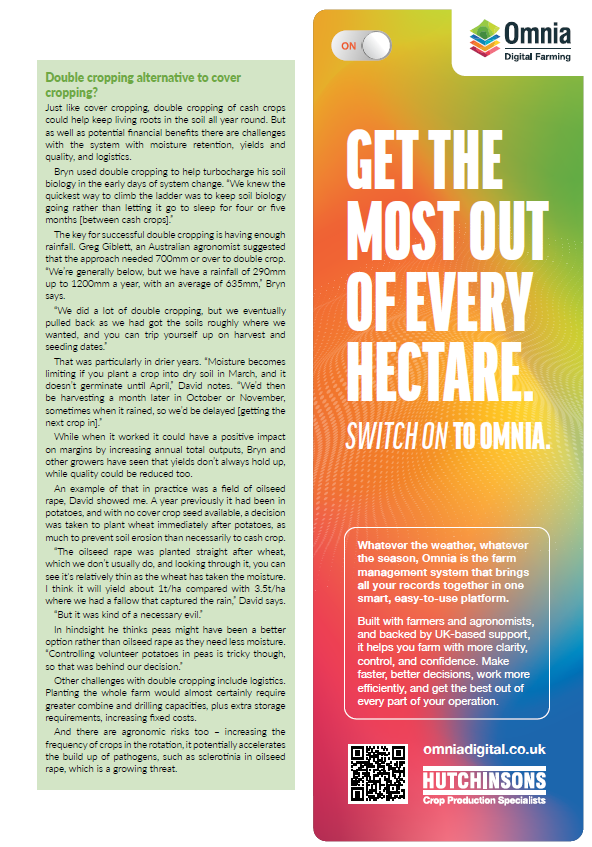
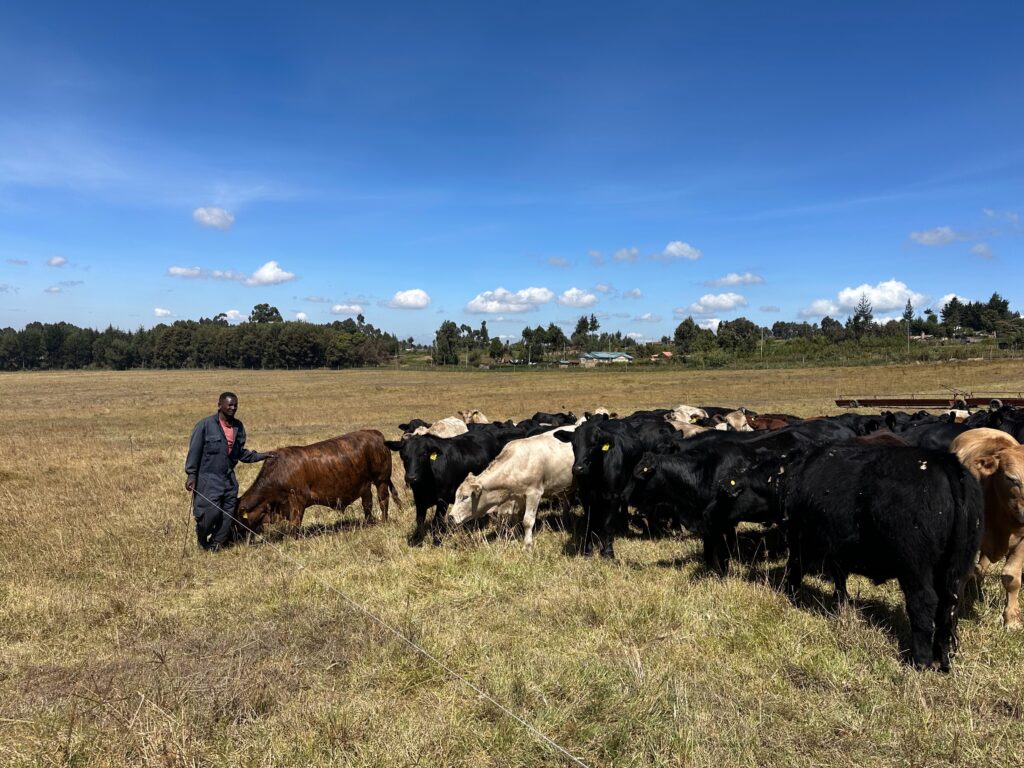
On Marania Farm, cover crops are being grazed with mobs from a herd of 1250 Aberdeen Angus / Boran cross beef cattle. Crossing the Angus with Boran, a local breed with a shoulder hump typical for the region, helps with resilience – improving calving rates, providing more resistance to tick-borne diseases, and higher liveweight gains compared with grazing on permanent pasture alone.
“We’ve cut our glyphosate use in half just by grazing cover crops without changing anything,” Jamie says.
He’s also experimenting with making compost to use in extracts. First attempts have used horse manure, straw and green material, but he conscious that with the farm’s bacterial-dominated soils, he would like to add wood chips to increase the fungi loading in the extract.
After bubbling through micron bags to produce an extract for 22ha trial last season, Jamie’s looking into using a 1500L conical tank to bubble 20kg of compost through to use in the new Horizon disc drill at planting. “That should simplify it and make it easier,” he says.
The trial showed some promise with a field of barley treated with the extract, nutrition and one fungicide yielding very similarly to the next door field treated with a full fungicide programme, Jamie says.
“Cost per hectare was almost the same but that doesn’t deter me. If we do that for 10 years, I reckon the soils will be better than a conventional system, and maybe we’ll be able to start using less fertiliser.”
Double cropping alternative to cover cropping?
Just like cover cropping, double cropping of cash crops could help keep living roots in the soil all year round. But as well as potential financial benefits there are challenges with the system with moisture retention, yields and quality, and logistics.
Bryn used double cropping to help turbocharge his soil biology in the early days of system change. “We knew the quickest way to climb the ladder was to keep soil biology going rather than letting it go to sleep for four or five months [between cash crops].”
The key for successful double cropping is having enough rainfall. Greg Giblett, an Australian agronomist suggested that the approach needed 700mm or over to double crop. “We’re generally below, but we have a rainfall of 290mm up to 1200mm a year, with an average of 635mm,” Bryn says.
“We did a lot of double cropping, but we eventually pulled back as we had got the soils roughly where we wanted, and you can trip yourself up on harvest and seeding dates.”
That was particularly in drier years. “Moisture becomes limiting. If you plant a crop into dry soil in March, and it doesn’t germinate until April,” David notes. “We’d then be harvesting a month later in October or November, sometimes when it rained, so we’d be delayed [getting the next crop in].”
While when it worked it could have a positive impact on margins by increasing annual total outputs, Bryn and other growers have seen that yields don’t always hold up, while quality could be reduced too.
An example of that in practice was a field of oilseed rape, David showed me. A year previously it had been in potatoes, and with no cover crop seed available, a decision was taken to plant wheat immediately after potatoes, as much to prevent soil erosion than necessarily to cash crop.
“The oilseed rape was planted straight after wheat, which we don’t usually do, and looking through it, you can see it relatively thin as the wheat has taken the moisture. I think it will yield about 1t/ha compared with 3.5t/ha where we had a fallow that captured the rain,” David says.
“But it was kind of a necessary evil.”
In hindsight he thinks peas might have been a better option rather than oilseed rape as they need less moisture. “Controlling volunteer potatoes in peas is tricky though, so that was behind our decision.”
Other challenges with double cropping include logistics. Planting the whole farm would almost certainly require greater combine and drilling capacities, plus extra storage requirements, increasing fixed costs.
And there are agronomic risks too – increasing the frequency of crops in the rotation, it potentially accelerates the build up of pathogens, such as sclerotinia in oilseed rape which is a growing threat.