Written by Jack Hind from Indigro
In today’s arable farming environment, everyone is feeling the financial squeeze. Reduced yields, lower commodity prices, higher input costs, no BPS and uncertainty over government support all have an impact on one thing – margin. When the pie is getting smaller, but pressure continues to rise, how can we improve returns while managing costs more effectively?
To understand where savings can be made, calculating the cost of production is a vital first step. Let’s explore how this is broken down and where the main issues reside.
Variable Costs – A Usual Suspect
Variable costs refer to the input costs that alter with cropping decisions and output levels, including fertiliser, seed, crop protection products and fuel for field operations. When looking at cost of production per tonne, they remain relatively consistent irrespective of acreage, with the main fluctuation coming in price. DEFRA’s Agricultural Price Index highlights how this figure has increased.
Comparing the 2020 baseline with the latest available data (September 2025), variable costs have increased by 30.62% overall. This includes seed (up 5.15%), fertilisers (up 74.88%), crop protection products (up 6.35%), and fuel (up 36.08%). Most prices peaked in 2022 and have since fallen back, however overall inflation remains on the rise. Between September 2024 and September 2025, costs increased by a further 4.00%, driven largely by fertilisers, which are up 17.89% year-on-year.
With input prices continuing to climb, it is understandable why growers are looking at cutting back. Whist this is something worth reviewing, the financial gain from doing so tends to be less impactful than expected due to yield decreases. Independent advice can certainly help refine input strategies and reduce spending through competitive purchasing, but even these incremental gains only go so far. So where does the actual problem lie?

Fixed Costs – The Real Margin Killer
Fixed costs are the ongoing business expenses that are largely independent of crop production. Some examples include machinery, labour, rent, and utilities – outgoings that must be paid regardless of cropped area.
Over the past five years, several elements of fixed-cost inflation have outpaced variable inputs. Machinery and equipment costs have risen by 34.9% since 2020, with a further 1.3% increase in the past year. Electricity has seen the sharpest rise, up 52.4% since 2020 and 8.0% year-on-year. Labour costs have also increased significantly. Office for National Statistics (ONS) data shows average agricultural wages climbing by around 32% between 2020 and September 2025, with the minimum wage rising another 6.1% in next April having a further impact.
Rent on the other hand has behaved differently. DEFRA’s Farm Rents statistics show average rents increasing only marginally, from £213/ha in 2020/21 to £217/ha in 2023/24 – a rise of just 1.9%. In real terms, rent is actually cheaper today than four years ago, with 2020/21 equating to roughly £240/ha when adjusted for inflation. Admittedly, local variation does exist, and some regions have seen much higher increases.
Compared with variable costs, fixed costs have therefore seen a greater overall rise since 2020. As they apply to a much larger cost basis (I don’t understand what this means), these changes have a stronger impact on farm profitability. It is now more important than ever to assess whether each overhead is financially sustainable and, if not, what can be done to change this. Understandably, many of these costs are tied up in longer-term agreements, but it is still worth considering their viability before renewal or expansion.
By asking these questions, not as criticisms, but as part of a healthier business review, growers can start to build a clearer picture of where fixed costs sit today and how there may be room to adjust, refine and rethink.
Once you understand your costs, working out your cost of production per tonne is then possible. This allows you to calculate your margin. But there’s still one final piece of the puzzle that can make or break profitability – the price the market is willing to pay.
Commodity Prices – Holding Profits Back
While input costs have risen sharply, output prices have not kept pace. Between 2020 and September 2025, cereal grain sale prices increased by 4.12% overall. Barley and oats have risen by 9.37% and 4.73% respectively, with wheat showing the weakest movement, up just 1.75% for feed and breadmaking actually 1.24% lower than 2020. Since September, prices have continued to decline, with May 2026 wheat futures trading at around £171.60/t at the end of November.
Other commodities have performed very differently. Potatoes are up 83.23%, sugar beet 65.45%, and oilseed rape 19.25%, illustrating how little support cereals have provided to margins when production costs have escalated.
To put this into perspective, based on the AHDB Farmbench tool, the forecasted cost of production for winter wheat is £1659/ha. With a sale price of £171.20/t (May-26 futures, 4th December), a crop must achieve 9.69t/ha just to break even. This is over 1.5 tonnes higher than the UK’s 25-year average. With poor weather conditions in recent years resulting in lacklustre yields (7t/ha in 2020 and 7.3t/ha in 2024), it is no wonder that finances are under pressure.
In simple terms, the margin for error has all but disappeared, with any dip in performance or price pushing a crop into loss. This reinforces the need to reassess cost structures and identify where meaningful improvements can be made.
What Needs to Happen Now?
It is clear that with rising costs and declining prices, interrogating the cost of production and working out ways to make savings is necessary.
For variable costs, reducing inputs while maintaining yield is a fine line. However, through independent advice and transparent buying, growers can be confident they are receiving the best value possible.
In practice, fixed costs represent a far larger proportion of total spend, and even small reductions can make a significant difference. More so than ever, it is essential to scrutinise the underlying structure of overheads and challenge whether each element still reflects the needs and scale of the business today.
For example, with commodity prices falling but rents edging upwards (albeit modestly), is the land cost and productivity aligned with the returns you can expect? For contract farming agreements, is the first charge still reflective of actual costs, or has it begun to erode the divisible surplus?
When looking at machinery, is the size and horsepower of kit proportionate to the acres being worked, or could a smaller/shared setup reduce running costs? In terms of labour, is the current staffing level appropriate for the area farmed, or are there opportunities to realign workloads and improve efficiency?
Managing fixed costs is both more impactful and complex, but by starting to make incremental changes where appropriate, businesses can strengthen margins and build a more resilient farming enterprise.
Tools and Support
Indigro is developing a platform to simplify how cost of production is calculated. Having successfully benchmarked the carbon footprint of our clients’ farms over the past five years, we now feel it is time to apply the same approach to variable and fixed costs. This service will allow farmers to compare their costs with others and identify opportunities to improve financial stability.
Along with providing independent agronomic advice, we consult on SFI and Stewardship agreements and can tailor options most appropriate to your business. With less than 50% of eligible farms enrolled (in what? SFI? Any stewardship scheme?), it is vital to prepare early and have a strategy in place before the scheme is set to reopen in 2026. SFI payments can make a major difference to your margin and so it is worth exploring what’s available.
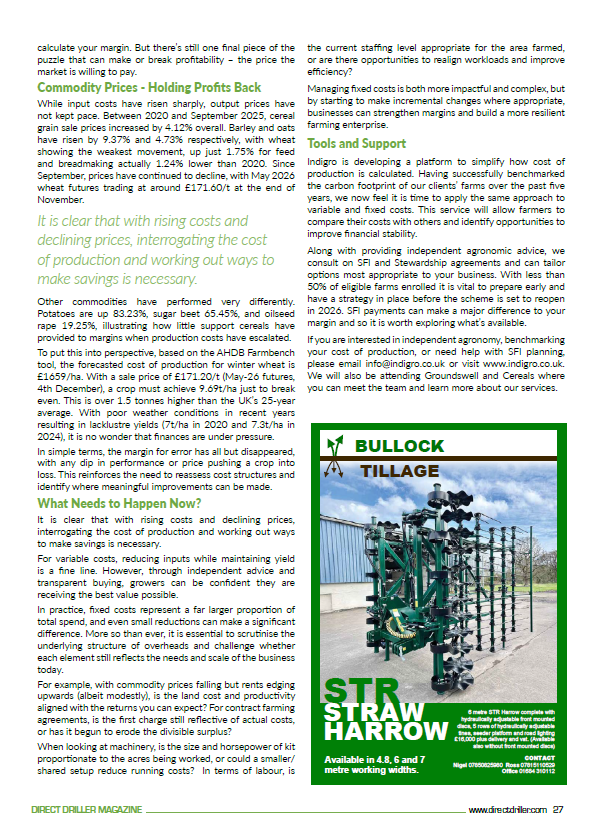
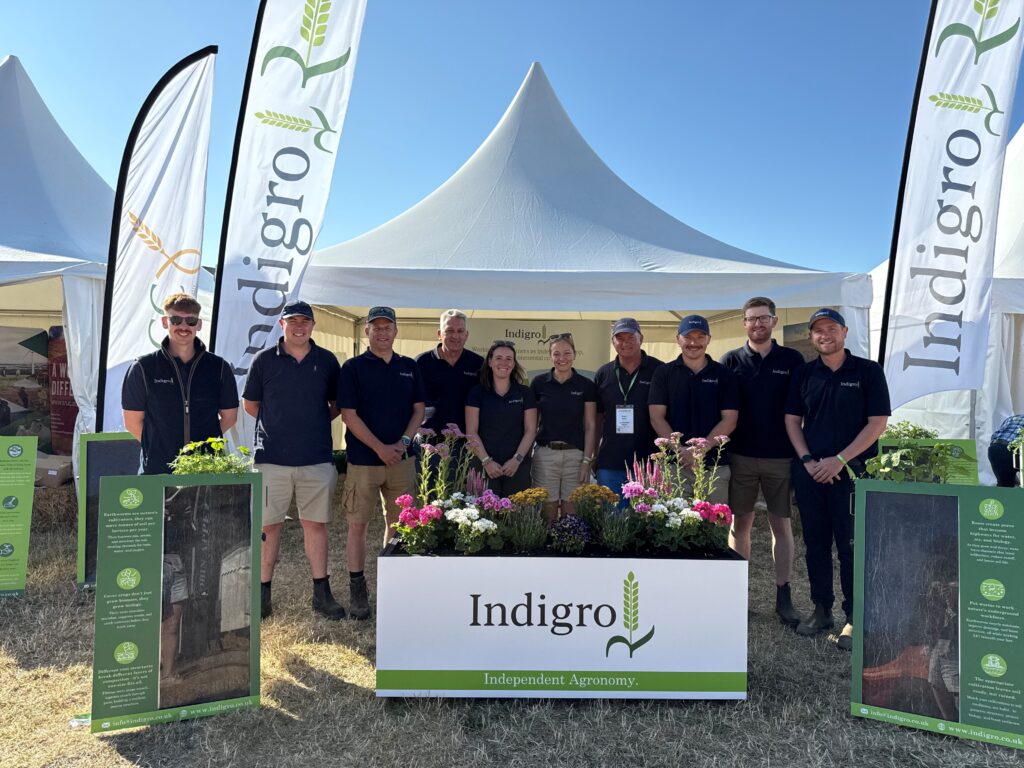
If you are interested in independent agronomy, benchmarking your cost of production, or need help with SFI planning, please email [email protected] or visit www.indigro.co.uk. We will also be attending Groundswell and Cereals where you can meet the team and learn more about our services.