It’s the middle of March already; this year is flying by. Even though in my last article I complained bitterly about the drought, the rain that fell in the latter half of 2025 brought our annual rainfall to just above the 30-year average, and of course, there has been an abundance of rainfall at the start of 2026. However, the drought did severely affect our yields, especially on the light sandy land. I was somehow hoping that by increasing our soil organic matter, our crops would have been more resilient to the drought, but I am not sure that it helped at all. We had grown hard and soft wheat on contract for Wildfarmed and adhered to their reduced nitrogen policy. Unfortunately, none of our wheat met the required protein, and we may never know if the problem was a lack of rain to mobilise the nitrogen or just not enough nitrogen.
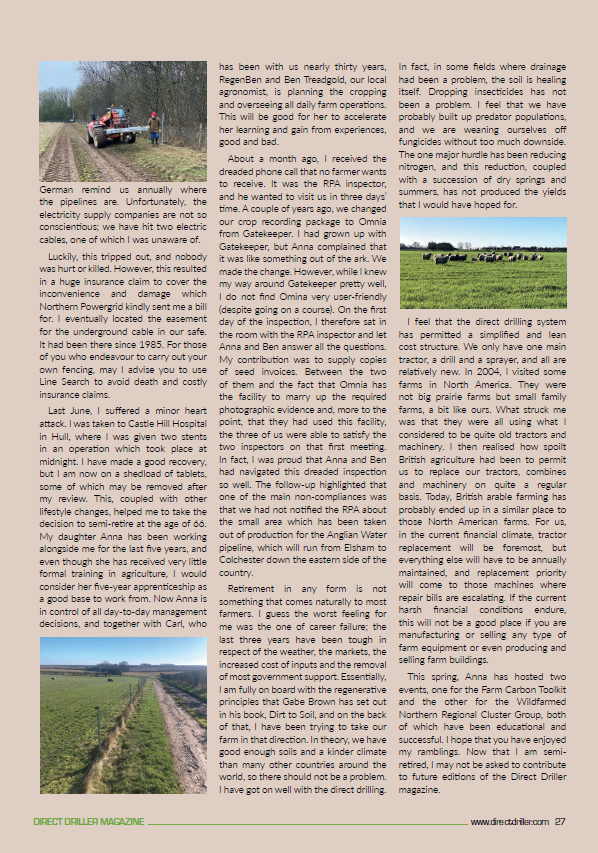
The boats (beans and oats) were also destined for Wildfarmed. (The year before last was our first year of growing boats.) We were advised not to apply any fertiliser or spray; this strategy contained production costs, but there was no bushel weight in the oats when harvested, so the oats ended up in the animal feed market. Last year, we applied 100Kg/N/Ha, the oats became dominant, and the beans nearly disappeared. This time, I am not sure if the problem was an increased rate of nitrogen, which encouraged the oats to smother the beans, or just the lack of rain. The oats nearly hit the desired bushel weight, and this week we are cleaning them to meet contract specifications.
The spring beans, which were grown on their own as a break crop, were a disappointing yield, leading me to conclude that spring beans are not financially viable in the succession of dry springs that we tend to have. We have just about tried every break crop in the toolbox and failed to make money. It does pose the question: are we bad farmers, are we failing due to the succession of dry springs, or is the market price too low? It may be a combination of all three factors.
To find a break crop which might not lose money, for this year’s cropping, we were able to add in a significant area of over-winter bird feed to our already quite big SFI commitment. This late addition to our SFI was only possible because we had participated in the SFI pilot. Rather than try to fit this option into the rotation, we have been advised to square up fields and utilise less productive areas. This year will be the first year where the combine will not be working on our home farm, which has sandy and drought-prone ironstone soils; a true sign of the times for a farm which in 1929 employed 29 full and part-time people.
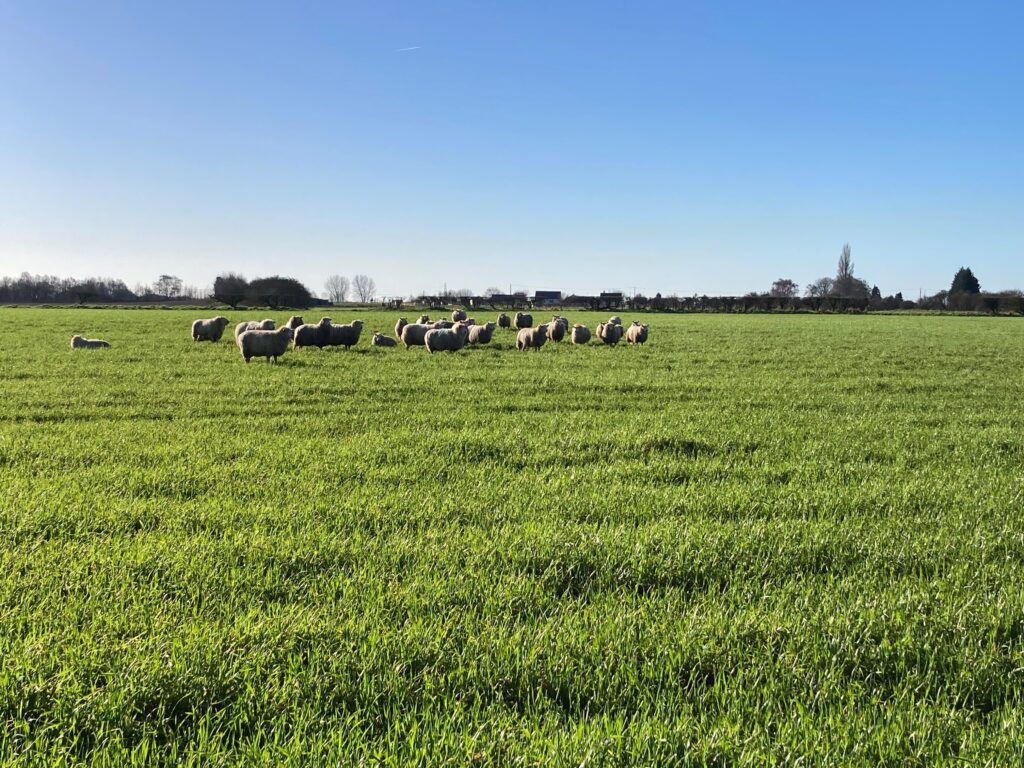
The final change in this year’s cropping is the introduction of spring wheat. I have never been a fan of spring wheat because it looks great when growing, but then the yield can be disappointing. We wanted to grow a crop which will command a premium and have a home to go to, and we have been told that there will be an increased chance of hitting the protein with spring wheat. There are some other advantages. We have been getting a build-up of rat’s-tail fescue, and this problem began when we started growing grass seed. Spring-sown wheat provides a chance of controlling the grass weeds with a well-timed pre-drilling, spring spray application. Another income stream can be gained by an autumn-sown cover crop within the SFI agreement; this also creates an overwinter grazing option. Finally, to improve the chance of hitting the desired protein, Wildfarmed has moved the goal posts a little to permit more nitrogen fertiliser to be applied, if it is applied in 40Kg/N/Ha dollops. As ever, one must be optimistic and hope that all the variables come together to allow you to produce a profitable crop.
Three years ago, we were lucky enough to be granted a Countryside Stewardship Capital Grant to help finance 15 kilometres of stock fencing on our Elsham farm. We have shared the work with our fencing contractors to hit the required 5km/ year, and this year will be the year of completion. During the period, we have carefully navigated around three gas pipelines, a high-pressure oil pipeline and two sewerage pipes, all of which we were aware of because the likes of Cadent and Fisher German remind us annually where the pipelines are. Unfortunately, the electricity supply companies are not so conscientious; we have hit two electric cables, one of which I was unaware of.
Luckily, this tripped out, and nobody was hurt or killed. However, this resulted in a huge insurance claim to cover the inconvenience and damage which Northern Powergrid kindly sent me a bill for. I eventually located the easement for the underground cable in our safe. It had been there since 1985. For those of you who endeavour to carry out your own fencing, may I advise you to use Line Search to avoid death and costly insurance claims.
Last June, I suffered a minor heart attack. I was taken to Castle Hill Hospital in Hull, where I was given two stents in an operation which took place at midnight. I have made a good recovery, but I am now on a shedload of tablets, some of which may be removed after my review. This, coupled with other lifestyle changes, helped me to take the decision to semi-retire at the age of 66. My daughter Anna has been working alongside me for the last five years, and even though she has received very little formal training in agriculture, I would consider her five-year apprenticeship as a good base to work from. Now Anna is in control of all day-to-day management decisions, and together with Carl, who has been with us nearly thirty years, RegenBen and Ben Treadgold, our local agronomist, is planning the cropping and overseeing all daily farm operations. This will be good for her to accelerate her learning and gain from experiences, good and bad.
About a month ago, I received the dreaded phone call that no farmer wants to receive. It was the RPA inspector, and he wanted to visit us in three days’ time. A couple of years ago, we changed our crop recording package to Omnia from Gatekeeper. I had grown up with Gatekeeper, but Anna complained that it was like something out of the ark. We made the change. However, while I knew my way around Gatekeeper pretty well, I do not find Omina very user-friendly (despite going on a course). On the first day of the inspection, I therefore sat in the room with the RPA inspector and let Anna and Ben answer all the questions. My contribution was to supply copies of seed invoices. Between the two of them and the fact that Omnia has the facility to marry up the required photographic evidence and, more to the point, that they had used this facility, the three of us were able to satisfy the two inspectors on that first meeting. In fact, I was proud that Anna and Ben had navigated this dreaded inspection so well. The follow-up highlighted that one of the main non-compliances was that we had not notified the RPA about the small area which has been taken out of production for the Anglian Water pipeline, which will run from Elsham to Colchester down the eastern side of the country.
Retirement in any form is not something that comes naturally to most farmers. I guess the worst feeling for me was the one of career failure; the last three years have been tough in respect of the weather, the markets, the increased cost of inputs and the removal of most government support. Essentially, I am fully on board with the regenerative principles that Gabe Brown has set out in his book, Dirt to Soil, and on the back of that, I have been trying to take our farm in that direction. In theory, we have good enough soils and a kinder climate than many other countries around the world, so there should not be a problem. I have got on well with the direct drilling. In fact, in some fields where drainage had been a problem, the soil is healing itself. Dropping insecticides has not been a problem. I feel that we have probably built up predator populations, and we are weaning ourselves off fungicides without too much downside. The one major hurdle has been reducing nitrogen, and this reduction, coupled with a succession of dry springs and summers, has not produced the yields that I would have hoped for.
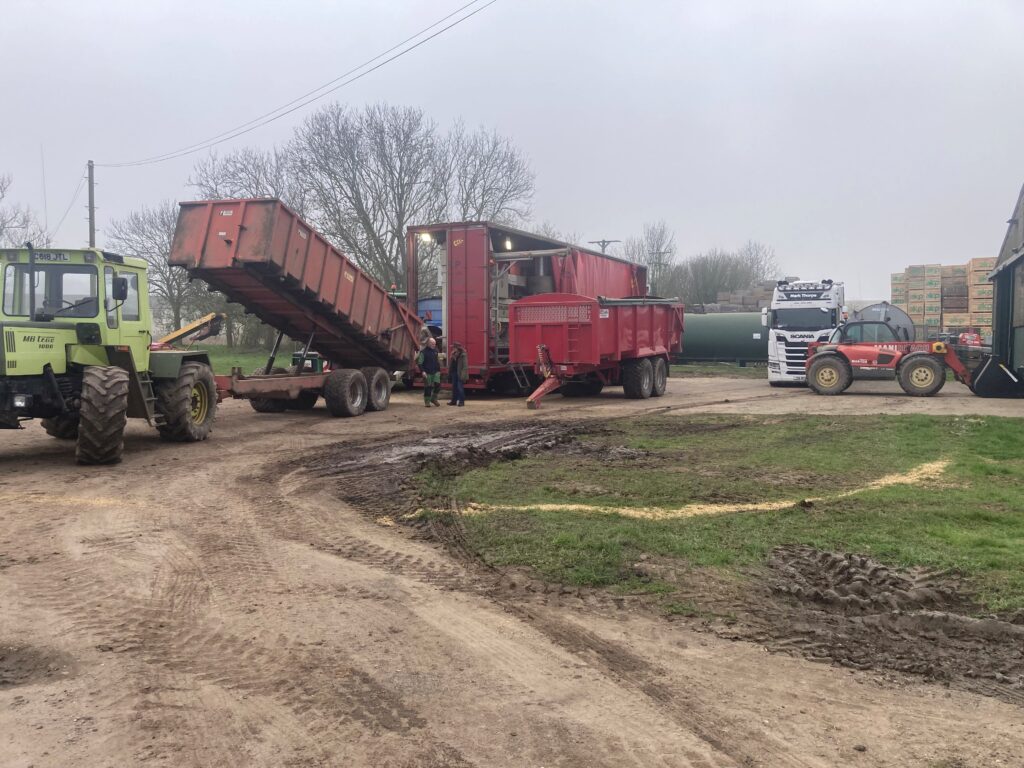
I feel that the direct drilling system has permitted a simplified and lean cost structure. We only have one main tractor, a drill and a sprayer, and all are relatively new. In 2004, I visited some farms in North America. They were not big prairie farms but small family farms, a bit like ours. What struck me was that they were all using what I considered to be quite old tractors and machinery. I then realised how spoilt British agriculture had been to permit us to replace our tractors, combines and machinery on quite a regular basis. Today, British arable farming has probably ended up in a similar place to those North American farms. For us, in the current financial climate, tractor replacement will be foremost, but everything else will have to be annually maintained, and replacement priority will come to those machines where repair bills are escalating. If the current harsh financial conditions endure, this will not be a good place if you are manufacturing or selling any type of farm equipment or even producing and selling farm buildings.
This spring, Anna has hosted two events, one for the Farm Carbon Toolkit and the other for the Wildfarmed Northern Regional Cluster Group, both of which have been educational and successful. I hope that you have enjoyed my ramblings. Now that I am semi-retired, I may not be asked to contribute to future editions of the Direct Driller magazine.