With many crops facing higher disease pressure this spring, Direct Driller takes a look at what this will mean for the crucial flag leaf (T2) fungicide timing
Of all the main wheat fungicide timings, the flag leaf (GS 37-39) application delivers by far the greatest return, with the top two leaves typically contributing two-thirds of total yield.
Protecting them for as long as possible will take careful planning, especially given the high pressure from both rust and Septoria that many parts of the country have experienced so far this season.
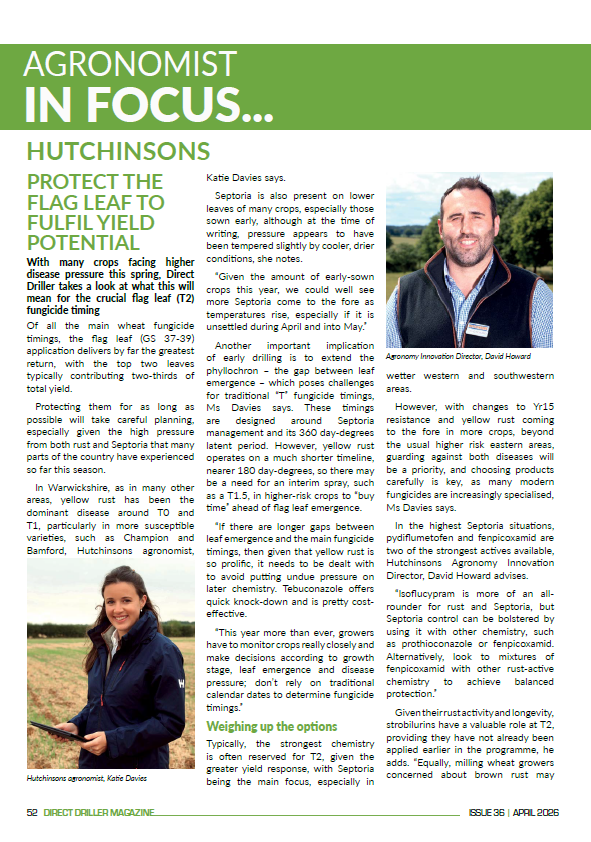
In Warwickshire, as in many other areas, yellow rust has been the dominant disease around T0 and T1, particularly in more susceptible varieties, such as Champion and Bamford, Hutchinsons agronomist, Katie Davies says.
Septoria is also present on lower leaves of many crops, especially those sown early, although at the time of writing, pressure appears to have been tempered slightly by cooler, drier conditions, she notes.
“Given the amount of early-sown crops this year, we could well see more Septoria come to the fore as temperatures rise, especially if it is unsettled during April and into May.”
Another important implication of early drilling is to extend the phyllochron – the gap between leaf emergence – which poses challenges for traditional “T” fungicide timings, Ms Davies says. These timings are designed around Septoria management and its 360 day-degrees latent period. However, yellow rust operates on a much shorter timeline, nearer 180 day-degrees, so there may be a need for an interim spray, such as a T1.5, in higher-risk crops to “buy time” ahead of flag leaf emergence.
“If there are longer gaps between leaf emergence and the main fungicide timings, then given that yellow rust is so prolific, it needs to be dealt with to avoid putting undue pressure on later chemistry. Tebuconazole offers quick knock-down and is pretty cost-effective.
“This year more than ever, growers have to monitor crops really closely and make decisions according to growth stage, leaf emergence and disease pressure; don’t rely on traditional calendar dates to determine fungicide timings.”
Weighing up the options
Typically, the strongest chemistry is often reserved for T2, given the greater yield response, with Septoria being the main focus, especially in wetter western and southwestern areas.
However, with changes to Yr15 resistance and yellow rust coming to the fore in more crops, beyond the usual higher risk eastern areas, guarding against both diseases will be a priority, and choosing products carefully is key, as many modern fungicides are increasingly specialised, Ms Davies says.
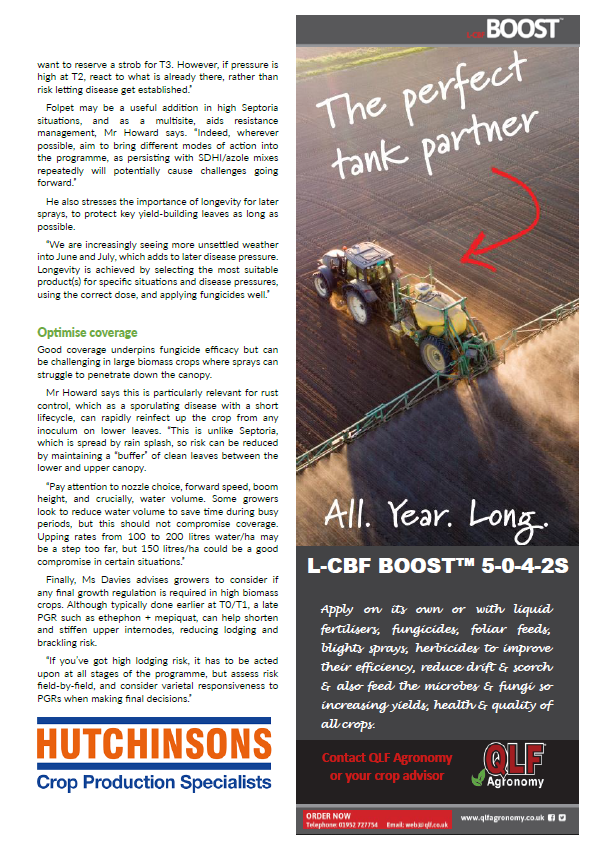
In the highest Septoria situations, pydiflumetofen and fenpicoxamid are two of the strongest actives available, Hutchinsons Agronomy Innovation Director, David Howard advises.

“Isoflucypram is more of an all-rounder for rust and Septoria, but Septoria control can be bolstered by using it with other chemistry, such as prothioconazole or fenpicoxamid. Alternatively, look to mixtures of fenpicoxamid with other rust-active chemistry to achieve balanced protection.”
Given their rust activity and longevity, strobilurins have a valuable role at T2, providing they have not already been applied earlier in the programme, he adds. “Equally, milling wheat growers concerned about brown rust may want to reserve a strob for T3. However, if pressure is high at T2, react to what is already there, rather than risk letting disease get established.”
Folpet may be a useful addition in high Septoria situations, and as a multisite, aids resistance management, Mr Howard says. “Indeed, wherever possible, aim to bring different modes of action into the programme, as persisting with SDHI/azole mixes repeatedly will potentially cause challenges going forward.”
He also stresses the importance of longevity for later sprays, to protect key yield-building leaves as long as possible.
“We are increasingly seeing more unsettled weather into June and July, which adds to later disease pressure. Longevity is achieved by selecting the most suitable product(s) for specific situations and disease pressures, using the correct dose, and applying fungicides well.”
Optimise coverage
Good coverage underpins fungicide efficacy but can be challenging in large biomass crops where sprays can struggle to penetrate down the canopy.
Mr Howard says this is particularly relevant for rust control, which as a sporulating disease with a short lifecycle, can rapidly reinfect up the crop from any inoculum on lower leaves. “This is unlike Septoria, which is spread by rain splash, so risk can be reduced by maintaining a “buffer” of clean leaves between the lower and upper canopy.
“Pay attention to nozzle choice, forward speed, boom height, and crucially, water volume. Some growers look to reduce water volume to save time during busy periods, but this should not compromise coverage. Upping rates from 100 to 200 litres water/ha may be a step too far, but 150 litres/ha could be a good compromise in certain situations.”
Finally, Ms Davies advises growers to consider if any final growth regulation is required in high biomass crops. Although typically done earlier at T0/T1, a late PGR such as ethephon + mepiquat, can help shorten and stiffen upper internodes, reducing lodging and brackling risk.
“If you’ve got high lodging risk, it has to be acted upon at all stages of the programme, but assess risk field-by-field, and consider varietal responsiveness to PGRs when making final decisions.”