If, like me, you wondered if Mzuri had stopped all production and was going to fade away, read on.
When I first heard the news that Mzuri were stopping production in the UK, naturally, I was gutted. Although they are still providing spares and support, I tried to plan what to do next. The Mzuri Pro-Til has been the catalyst for reforming my farming system, and I wanted to continue with the brand. The principle of the machine seems to fit perfectly with my land and my expectations. I spoke with some other Mzuri users in the area, and it seemed we had all concluded that if we were unable to replace our machines for some time, we would run them for as long as possible and hope that would give us time to formulate a plan. None of us wanted to move from the brand, as it works well for us all.
First stop was to speak to the people in the UK who had provided the excellent service and backup since I bought my first drill in 2016. They gave me some contacts at Mzuri World Poland, and I took it from there. The contact was Wojciech Żurek, head of UK sales, based in Śmielin, near Bydgoszcz, in northern Poland. He seemed very young, but every salesperson now looks very young as I get older. He speaks very good English, better than my Polish, or my English, now I think about it, and he was very keen to engage and reassure us of their commitment to the brand. He organised a Zoom meeting, during which I also briefly met Lukas, head of sales. The conversation was very positive, and they were keen to explain that Mzuri had never stopped production and were planning on coming back to the UK bigger and better than ever.
Wojciech made a special trip to Scotland to meet me and the other users I had invited to my farm. He talked us through the changes to the machine, of which there were many, and the desire to restart the UK marketing. Since then, he has made other trips to the UK, speaking to distributors and farmers alike. When he visited Scotland, we suggested a factory trip to Poland to see the new facilities and the production/assembly line. Wojciech was very keen and was quickly on the case, with flights and a visit booked in mid-March, only two or three weeks after the first chat. There were only three of us who were able to go, but it was a trip we won’t forget.
We flew into Gdansk, where we were picked up by Wojciech, easy to spot in his branded Mzuri car. We then drove down a very quiet but pristine motorway, heading south for 90 minutes. The country looked a little like home, but flatter, and the hard frost had made crops less green. We later found out the soil was considerably colder, lighter and sandier than at home. I think at the time, the daytime temperature in Poland was warmer than Scotland, but the nights were still very cold, and the crops were very much in shutdown and waiting for heat. You wouldn’t have risked putting your bum on the soil to check if it was warming, as I think the old saying suggests, or have I been had by someone!
We stayed in a hotel with other visitors to the factory, which was very interesting. After arriving, we joined a group of Ukrainian farmers from Odesa and through a combination of their good English and fruit-flavoured vodkas, we understood they had been buying many six-metre machines to take back home, ready for when the war ends. We hoped that was soon. They were passionate about the system, running multiple drills on their very large-scale operations.


The following day, the trip to the factory started with a visit to the old production line. Noise, smoke and good old-fashioned welding stations all around, recognisable to anyone as a machinery production line. Wojciech explained that in the new plant, most of the welding was now done by robot, removing human error from the process. There were some spares and various parts for the Pro-Til and Rezult rake, which looked familiar but had been given this “beefing up” touch.
Next stop, the new product testing building and office. This had a stress-testing machine, which tests the parts to destruction to check whether they can cope with the forces applied. We also visited the corrosion testing tub and then the training area, where the engineers learn all there is to know from Michael, head of the design and manufacturing team. Michael then took time to talk through some of the improvements and the beefing up of many of the moving parts. His enthusiasm for the new, improved machine was palpable. A big hit with us was the addition of an auto-lubrication system, guaranteeing that “every” one of those grease nipples gets what it needs; hopefully, this addresses one of the issues for some on the old machine. The display machine showed us how to adjust the frequency of dosage, and how the dosage itself is different for each set of grease points as required.
The laboratory was next, with an area to test plant health, soil profile, OM and texture. They also had my favourite, a penetrometer, to test compaction. The lab was growing different crops drilled in different ways and at differing depths to find the optimum. The attention to detail regarding the benefits of using the system stood out during the tour. This led to a discussion about the certification of the Mzuri drills’ green credentials. Mzuri World have undergone the strict testing and result-based procedures required to obtain actual EU accreditation for carbon sequestration when using the Mzuri system. This is a very important and pertinent topic to be discussed at greater length than we managed on the trip, but it is something which may become a very strong selling point to many inside and outside the EU – something to ask them about at Cereals 26.
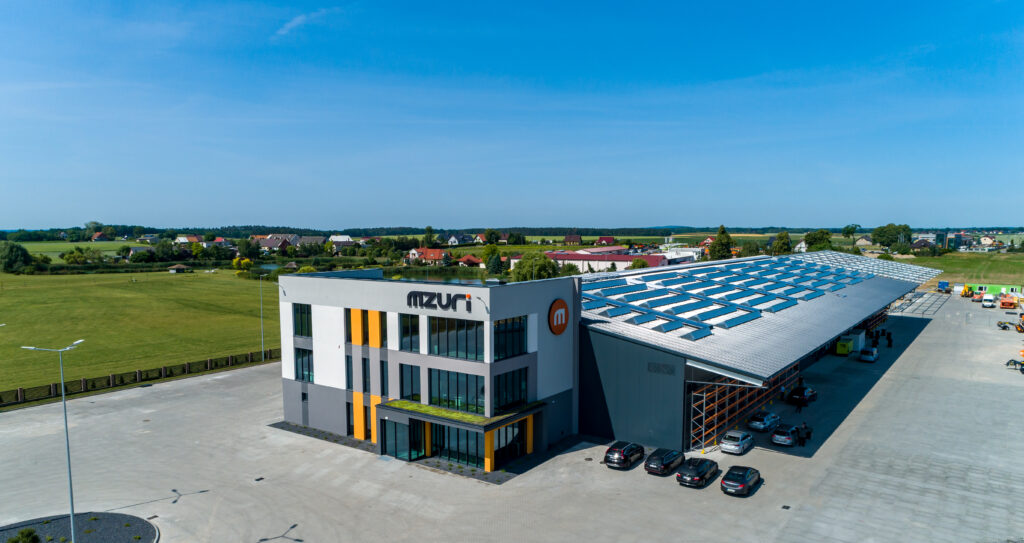
Next up was the assembly building. We drove past the almost completed hotel, purpose-built to look after visitors to the factory; the swimming pool was being added as we passed. We looked forward to staying there at some time in the future. Having laid concrete recently, I was immediately very jealous of the acres of hand-laid cobbles surrounding all the buildings. The assembly building was very impressive: huge, modern, and full of cutting-edge tech. In contrast to the original factory, this building was quieter and more airy. At one end, women sat at a workstation with brightly coloured cables, making up the wiring looms ready to be handed over to their colleagues on the assembly floor. The machines weren’t moving on a conveyor but sat in various stages next to boxes of parts waiting to be added. This building had state-of-the-art parts stores with computer-controlled rotisserie-style systems, rotating the shelves of various components until your desired one appeared. The larger boxes were in a racking system, which will soon be stocked and fed to the assembly line by automated forklifts – all really interesting stuff.


From that building, we entered another large adjoining one, which still had a sand floor; this is soon to be the paint shop, keeping it all in-house. Outside the factory were Rezult rakes and Pro-Til drills, ready to go out to many different countries. The drills were all slightly different specs, reminding me of the Valtra factory and the individual service. We felt very reassured by the levels of investment and their obvious commitment to improving the product. We finished that day with a chat about money, over some fine food and, obviously, more vodka. I pointed out that there are no EU grants for us, so kit must earn its keep from day one, just like my other two Mzuri drills have.
On Saturday, we took a trip to the home farm of Marek, the owner of Mzuri World. This didn’t help the inferiority complex, as it was as impressive as the Mzuri buildings. The drive around the crops was a nice bit of fresh air after the very hospitable evening. Marek is a businessman and a farmer with vision, using his products on his own ground and making it work, too.
Warning: if you go to Mzuri in Poland, the level of investment in product development and infrastructure is very impressive and great to see, and it is matched by the welcome and the hospitality of the people living and working there. I think this is a working relationship which will continue for many years and for many people. Just go easy on the vodka.