Written by Ben Makowiecki, Agriculture Sustainability Director, Lloyds
Regenerative farming is rapidly becoming one of the most important strategic shifts in UK agriculture. At its core, it focuses on building healthier soils, reducing input dependency, strengthening biodiversity, and increasing the resilience of farming businesses to climate and market volatility.
Although approaches might vary, the underlying principles – minimising disturbance, keeping soils covered, maintaining living roots, increasing diversity, and integrating livestock where appropriate – are proving consistently beneficial across multiple farming systems.
Why regenerative farming matters
The UK food system is increasingly exposed to environmental risk. Extreme weather, shifting climate patterns and soil degradation threaten both production and profitability, and rising input costs exert additional pressure. For the financial sector, these challenges translate directly into higher volatility and increased risk across agricultural lending portfolios.
Supporting regenerative farming is, therefore, not only environmentally responsible – it is a strategic approach to risk reduction. Transitioning to resilient, lower‑input agricultural systems enhances long-term business viability. Farms with healthier soils, diversified systems and lower cost bases should be better positioned to manage shocks and deliver stable financial performance. As such, facilitating the transition aligns both climate and nature objectives with the fundamentals of prudent agricultural lending.
Lloyds Agriculture Transition Finance
Transition requires time, experimentation and investment. Actions such as adopting direct drilling, redesigning rotations, implementing herbal leys or improving nitrogen efficiency each carry upfront costs – whether through capital expenditure or short-term yield uncertainty.
Agriculture Transition Finance offers arrangement fee-free lending for capital investment as well as cash flow headroom via an interest-only period of up to 5 years for new and existing lending, with the repayment period taking the total loan term to 25 years. This flexibility is designed to give farm businesses the confidence to find the regenerative practices that work for them.
Building resilience: the advantages of regenerative practices
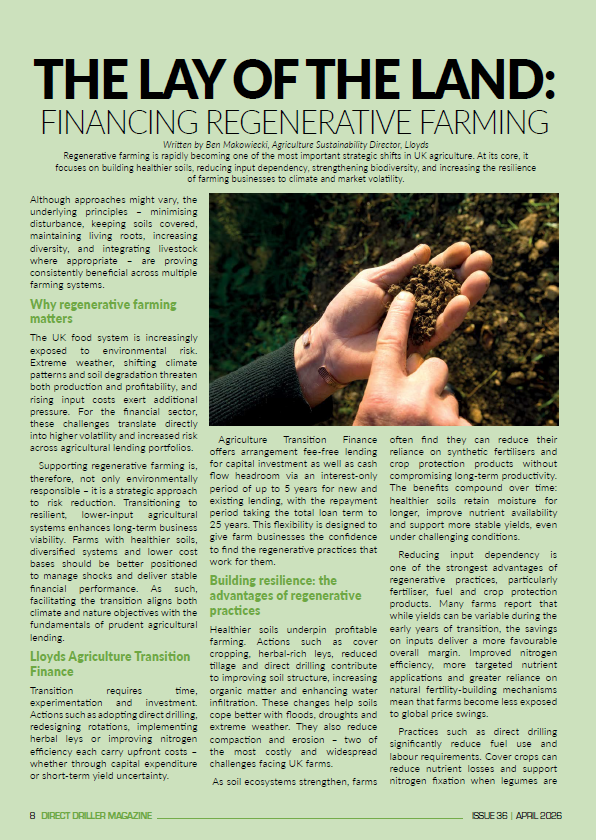
Healthier soils underpin profitable farming. Actions such as cover cropping, herbal-rich leys, reduced tillage and direct drilling contribute to improving soil structure, increasing organic matter and enhancing water infiltration. These changes help soils cope better with floods, droughts and extreme weather. They also reduce compaction and erosion – two of the most costly and widespread challenges facing UK farms.
As soil ecosystems strengthen, farms often find they can reduce their reliance on synthetic fertilisers and crop protection products without compromising long-term productivity. The benefits compound over time: healthier soils retain moisture for longer, improve nutrient availability and support more stable yields, even under challenging conditions.
Reducing input dependency is one of the strongest advantages of regenerative practices, particularly fertiliser, fuel and crop protection products. Many farms report that while yields can be variable during the early years of transition, the savings on inputs deliver a more favourable overall margin. Improved nitrogen efficiency, more targeted nutrient applications and greater reliance on natural fertility-building mechanisms mean that farms become less exposed to global price swings.
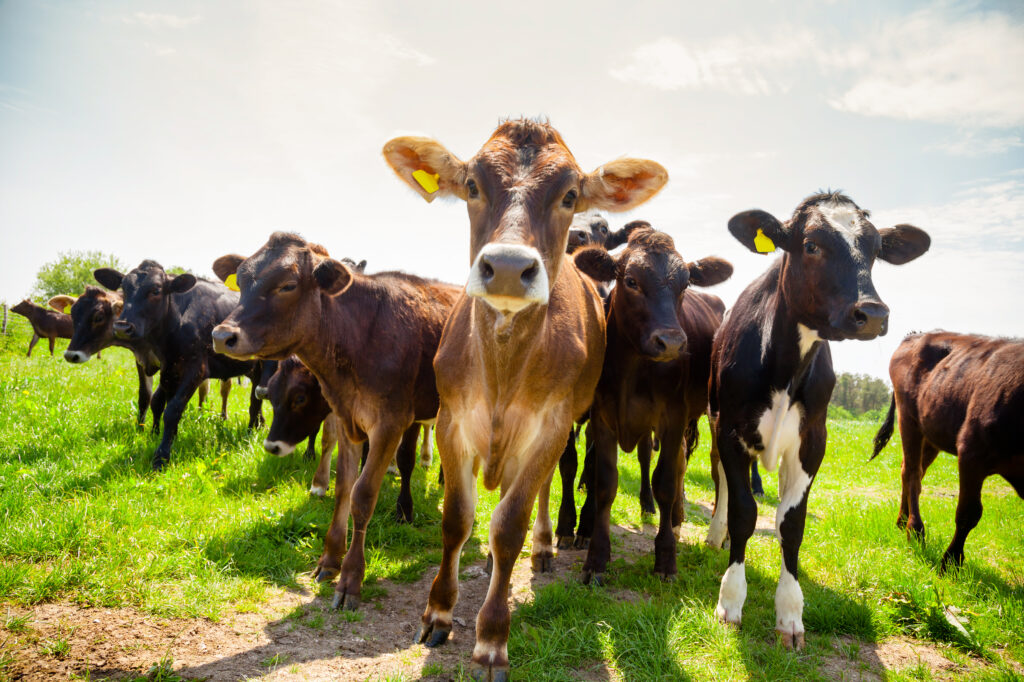
Practices such as direct drilling significantly reduce fuel use and labour requirements. Cover crops can reduce nutrient losses and support nitrogen fixation when legumes are incorporated. Integrating livestock into arable rotations can create further efficiencies by turning cover crops into feed, recycling nutrients and replacing some purchased fertiliser.
Yield stability and long-term performance is nota quick fix. A transition period is typical – often around five years – where new practices are trialled, adapted and refined. In the early stages, yields may dip or fluctuate as soils recover and farmers adjust systems. This pattern is well understood: initial investment and learning are followed by operational savings, stronger soil performance and improved yield stability.

Over time, regenerative systems tend to reduce the severity of “bad years”. With more resilient soils and lower dependency on inputs, the troughs in performance shrink. As a result, the cumulative profitability across multiple seasons often exceeds that of more input-intensive systems. Many farmers also report an improvement in the consistency of crop establishment and fewer yield-limiting issues linked to soil structure.
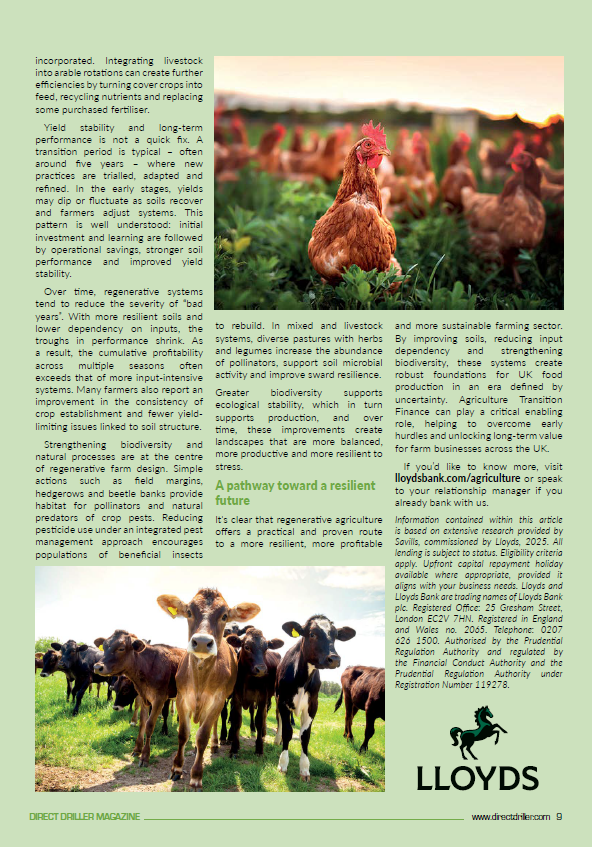
Strengthening biodiversity and natural processes are at the centre of regenerative farm design. Simple actions such as field margins, hedgerows and beetle banks provide habitat for pollinators and natural predators of crop pests. Reducing pesticide use under an integrated pest management approach encourages populations of beneficial insects to rebuild. In mixed and livestock systems, diverse pastures with herbs and legumes increase the abundance of pollinators, support soil microbial activity and improve sward resilience.
Greater biodiversity supports ecological stability, which in turn supports production, and over time, these improvements create landscapes that are more balanced, more productive and more resilient to stress.
A pathway toward a resilient future
It’s clear that regenerative agriculture offers a practical and proven route to a more resilient, more profitable and more sustainable farming sector. By improving soils, reducing input dependency and strengthening biodiversity, these systems create robust foundations for UK food production in an era defined by uncertainty. Agriculture Transition Finance can play a critical enabling role, helping to overcome early hurdles and unlocking long-term value for farm businesses across the UK.
If you’d like to know more, visit lloydsbank.com/agriculture or speak to your relationship manager if you already bank with us.
Information contained within this article is based on extensive research provided by Savills, commissioned by Lloyds, 2025. All lending is subject to status. Eligibility criteria apply. Upfront capital repayment holiday available where appropriate, provided it aligns with your business needs. Lloyds and Lloyds Bank are trading names of Lloyds Bank plc. Registered Office: 25 Gresham Street, London EC2V 7HN. Registered in England and Wales no. 2065. Telephone: 0207 626 1500. Authorised by the Prudential Regulation Authority and regulated by the Financial Conduct Authority and the Prudential Regulation Authority under Registration Number 119278.