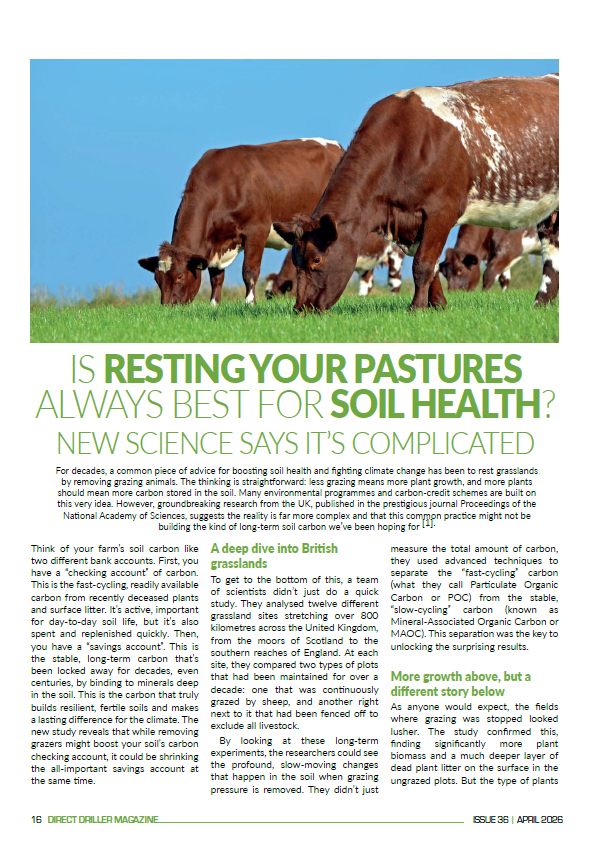
For decades, a common piece of advice for boosting soil health and fighting climate change has been to rest grasslands by removing grazing animals. The thinking is straightforward: less grazing means more plant growth, and more plants should mean more carbon stored in the soil. Many environmental programmes and carbon-credit schemes are built on this very idea. However, groundbreaking research from the UK, published in the prestigious journal Proceedings of the National Academy of Sciences, suggests the reality is far more complex and that this common practice might not be building the kind of long-term soil carbon we’ve been hoping for [1].
Think of your farm’s soil carbon like two different bank accounts. First, you have a “checking account” of carbon. This is the fast-cycling, readily available carbon from recently deceased plants and surface litter. It’s active, important for day-to-day soil life, but it’s also spent and replenished quickly. Then, you have a “savings account”. This is the stable, long-term carbon that’s been locked away for decades, even centuries, by binding to minerals deep in the soil. This is the carbon that truly builds resilient, fertile soils and makes a lasting difference for the climate. The new study reveals that while removing grazers might boost your soil’s carbon checking account, it could be shrinking the all-important savings account at the same time.
A deep dive into British grasslands
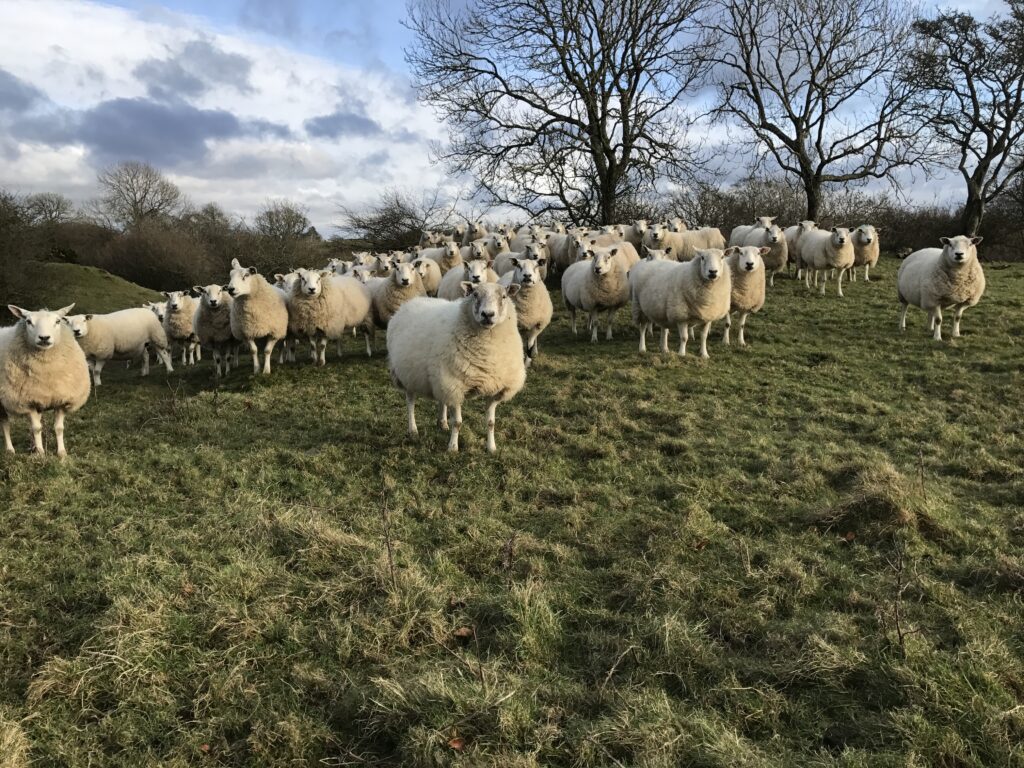
To get to the bottom of this, a team of scientists didn’t just do a quick study. They analysed twelve different grassland sites stretching over 800 kilometres across the United Kingdom, from the moors of Scotland to the southern reaches of England. At each site, they compared two types of plots that had been maintained for over a decade: one that was continuously grazed by sheep, and another right next to it that had been fenced off to exclude all livestock.
By looking at these long-term experiments, the researchers could see the profound, slow-moving changes that happen in the soil when grazing pressure is removed. They didn’t just measure the total amount of carbon, they used advanced techniques to separate the “fast-cycling” carbon (what they call Particulate Organic Carbon or POC) from the stable, “slow-cycling” carbon (known as Mineral-Associated Organic Carbon or MAOC). This separation was the key to unlocking the surprising results.
More growth above, but a different story below
As anyone would expect, the fields where grazing was stopped looked lusher. The study confirmed this, finding significantly more plant biomass and a much deeper layer of dead plant litter on the surface in the ungrazed plots. But the type of plants had also changed dramatically. The familiar grasses and sedges that thrive under grazing pressure had given way to tougher, woodier dwarf shrubs, like heather.
This shift from a grass-dominated to a shrub-dominated landscape is where the carbon story takes an unexpected turn. While the total amount of carbon stored in the soil didn’t change much between the grazed and ungrazed plots, its form did. The ungrazed plots had more of the fast-cycling POC— the checking account was fuller, thanks to the buildup of tough, slow-to-decompose shrub litter. However, they had significantly less of the stable, long-term MAOC. The critical savings account of soil carbon had been depleted.
| Carbon Pool | Grazed Pasture | Ungrazed Pasture (Rested >10 years) | The Takeaway |
| Aboveground plants | Lower biomass | Higher biomass | Land looks lusher without grazing. |
| Plant type | Dominated by grasses | Dominated by woody shrubs | A fundamental shift in the ecosystem. |
| Fast-cycling carbon (POC) | Baseline | Higher | More carbon in the short-term, active pool. |
| Slow-cycling carbon (MAOC) | Baseline | Lower | Less carbon in the stable, long-term pool. |
The hidden workers: Why stable carbon was lost
So, why would a field with more plants end up with less stable carbon? The answer lies in the hidden world of soil microbes and their relationship with different plants.
Grasses co-exist with a type of friendly fungi on their roots called arbuscular mycorrhizal (AM) fungi. These fungi are excellent at helping grasses pull existing nutrients and water from the soil. It’s a partnership that builds soil structure and helps lock carbon away.
Shrubs, on the other hand, partner with a different, more aggressive set of fungi known as ericoid mycorrhizal (ErM) fungi. These fungi are specialists at surviving in tough conditions. They release powerful enzymes and organic acids into the soil to break down complex organic matter, unlocking nutrients that would otherwise be unavailable. This has a dual effect on soil carbon.
First, the aggressive enzymes from the shrub-fungi partnerships don’t just break down fresh litter, they also “prime the pump”, waking up other microbes that begin to attack and consume the old, stable carbon that was supposed to be safely locked away in the soil’s savings account.
Second, the shift to shrubbery changes the soil’s physical environment. The thicker plant cover leads to higher soil moisture. This, combined with the acids released by the shrub roots, reduces the amount of reactive iron and aluminium oxides in the soil. These minerals are like glue, binding to carbon and protecting it from being eaten by microbes. With less of this protective mineral “glue,” the long-term carbon becomes vulnerable and is lost to the atmosphere as CO2.
In essence, removing grazers set off a chain reaction: grasses were replaced by shrubs, which in turn changed the soil’s microbial and chemical environment in a way that favoured the breakdown of the most valuable, long-lasting form of soil carbon.
What this means for your farm
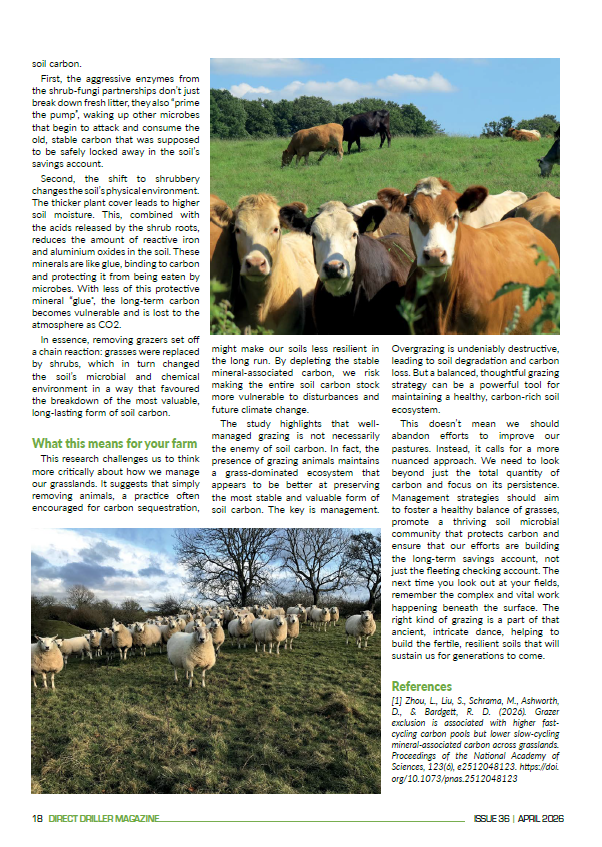
This research challenges us to think more critically about how we manage our grasslands. It suggests that simply removing animals, a practice often encouraged for carbon sequestration, might make our soils less resilient in the long run. By depleting the stable mineral-associated carbon, we risk making the entire soil carbon stock more vulnerable to disturbances and future climate change.
The study highlights that well-managed grazing is not necessarily the enemy of soil carbon. In fact, the presence of grazing animals maintains a grass-dominated ecosystem that appears to be better at preserving the most stable and valuable form of soil carbon. The key is management. Overgrazing is undeniably destructive, leading to soil degradation and carbon loss. But a balanced, thoughtful grazing strategy can be a powerful tool for maintaining a healthy, carbon-rich soil ecosystem.
This doesn’t mean we should abandon efforts to improve our pastures. Instead, it calls for a more nuanced approach. We need to look beyond just the total quantity of carbon and focus on its persistence. Management strategies should aim to foster a healthy balance of grasses, promote a thriving soil microbial community that protects carbon and ensure that our efforts are building the long-term savings account, not just the fleeting checking account. The next time you look out at your fields, remember the complex and vital work happening beneath the surface. The right kind of grazing is a part of that ancient, intricate dance, helping to build the fertile, resilient soils that will sustain us for generations to come.
References
[1] Zhou, L., Liu, S., Schrama, M., Ashworth, D., & Bardgett, R. D. (2026). Grazer exclusion is associated with higher fast-cycling carbon pools but lower slow-cycling mineral-associated carbon across grasslands. Proceedings of the National Academy of Sciences, 123(6), e2512048123. https://doi.org/10.1073/pnas.2512048123