Written by Chris Fellows
The term “regenerative agriculture” is on everyone’s lips, from the halls of government to the supermarket aisles. With it comes the tantalising promise of premium prices for our crops and livestock. But as the market floods with a dizzying array of certifications, standards and claims, many of us on the ground are left wondering: is this a genuine opportunity to build a more profitable and resilient farming future, or are we heading for a great divide that leaves farmers footing the bill for corporate greenwashing?
This isn’t just a hypothetical question. I wrote about this in the last Direct Driller; we are seeing a split between two distinct visions of regenerative agriculture [1]. On one side, we have the corporate-friendly, “checklist” approach, which focuses on a few easily marketable practices. On the other, a more holistic, farmer-led vision of whole-system transformation. The danger is that the shallow, corporate-led model, with its deep pockets and marketing muscle, could drown out the authentic, farmer-driven movement, leaving us with a system that ticks boxes but fails to deliver real change on the ground.
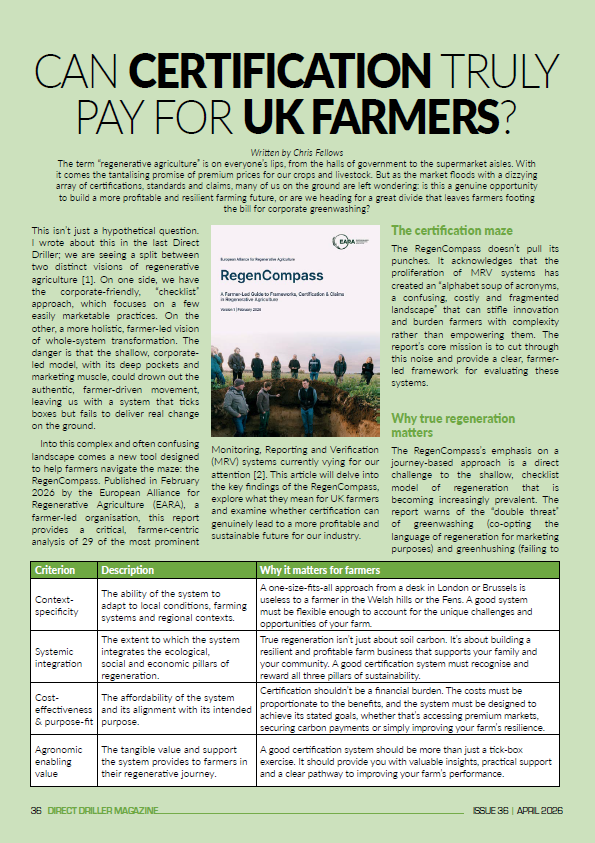
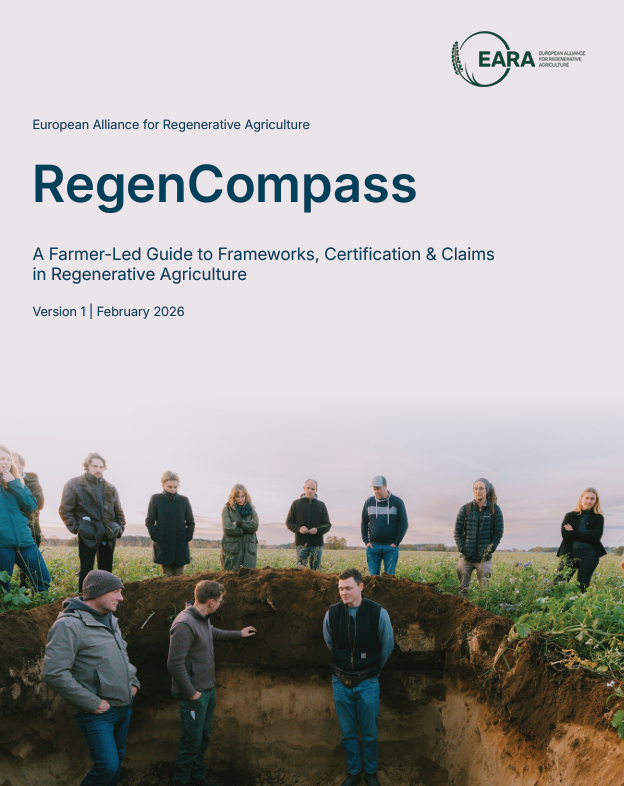
Into this complex and often confusing landscape comes a new tool designed to help farmers navigate the maze: the RegenCompass. Published in February 2026 by the European Alliance for Regenerative Agriculture (EARA), a farmer-led organisation, this report provides a critical, farmer-centric analysis of 29 of the most prominent Monitoring, Reporting and Verification (MRV) systems currently vying for our attention [2]. This article will delve into the key findings of the RegenCompass, explore what they mean for UK farmers and examine whether certification can genuinely lead to a more profitable and sustainable future for our industry.
The certification maze
The RegenCompass doesn’t pull its punches. It acknowledges that the proliferation of MRV systems has created an “alphabet soup of acronyms, a confusing, costly and fragmented landscape” that can stifle innovation and burden farmers with complexity rather than empowering them. The report’s core mission is to cut through this noise and provide a clear, farmer-led framework for evaluating these systems.
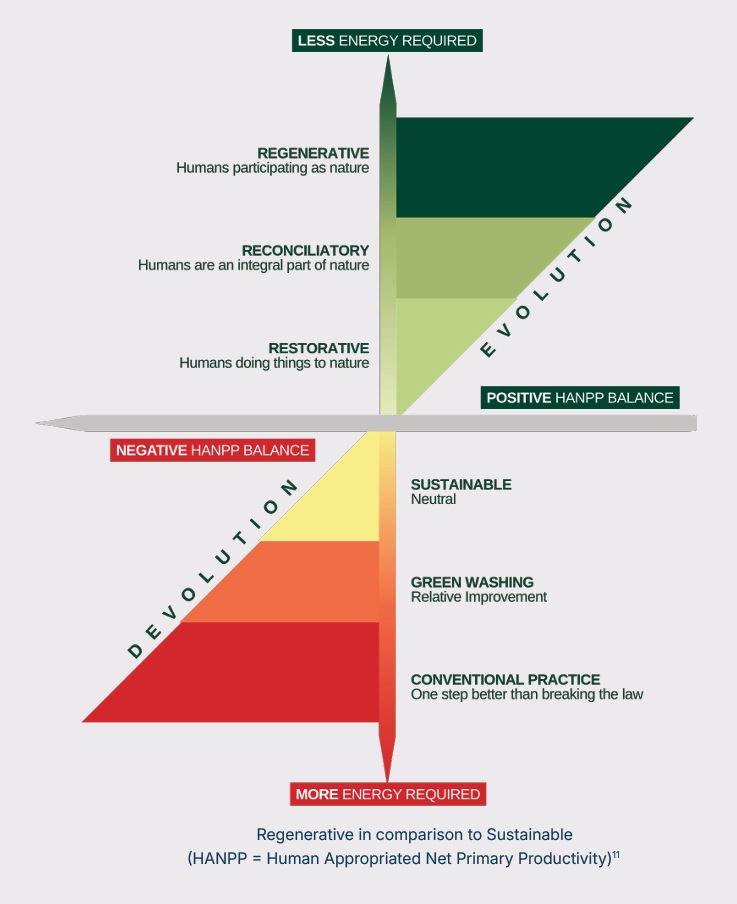
At the heart of the RegenCompass is a fundamental philosophical shift. It rejects the static, binary logic of conventional certification – the simple “certified/not” model. Instead, it champions a vision of regeneration as a continuous journey. The critical question, according to EARA, is not “Are you regenerative?” but “Are you moving towards more holistic regeneration?” This approach recognises that every farm is different and that the journey towards greater sustainability will look different for everyone. It enables entry at any stage, values continuous improvement over static perfection and transforms the certification framework from a top-down audit into a long-term learning partnership.
To help farmers navigate this journey, the RegenCompass proposes four key criteria for evaluating any MRV system:
| Criterion | Description | Why it matters for farmers |
| Context-specificity | The ability of the system to adapt to local conditions, farming systems and regional contexts. | A one-size-fits-all approach from a desk in London or Brussels is useless to a farmer in the Welsh hills or the Fens. A good system must be flexible enough to account for the unique challenges and opportunities of your farm. |
| Systemic integration | The extent to which the system integrates the ecological, social and economic pillars of regeneration. | True regeneration isn’t just about soil carbon. It’s about building a resilient and profitable farm business that supports your family and your community. A good certification system must recognise and reward all three pillars of sustainability. |
| Cost-effectiveness & purpose-fit | The affordability of the system and its alignment with its intended purpose. | Certification shouldn’t be a financial burden. The costs must be proportionate to the benefits, and the system must be designed to achieve its stated goals, whether that’s accessing premium markets, securing carbon payments or simply improving your farm’s resilience. |
| Agronomic enabling value | The tangible value and support the system provides to farmers in their regenerative journey. | A good certification system should be more than just a tick-box exercise. It should provide you with valuable insights, practical support and a clear pathway to improving your farm’s performance. |
These four criteria provide a powerful lens through which to evaluate any certification scheme that comes your way. They empower you to ask the right questions and to choose a system that will genuinely support your farm’s journey towards a more regenerative future.
Why true regeneration matters
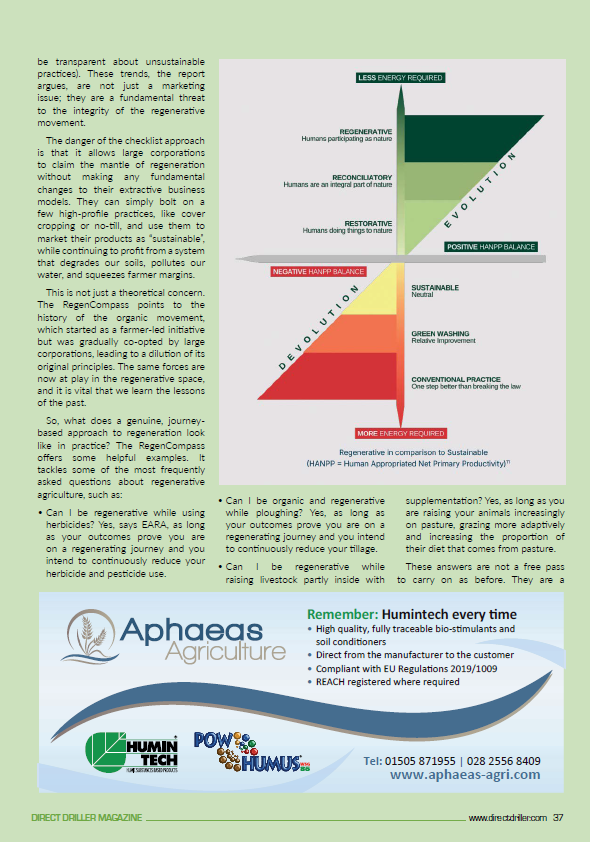
The RegenCompass’s emphasis on a journey-based approach is a direct challenge to the shallow, checklist model of regeneration that is becoming increasingly prevalent. The report warns of the “double threat” of greenwashing (co-opting the language of regeneration for marketing purposes) and greenhushing (failing to be transparent about unsustainable practices). These trends, the report argues, are not just a marketing issue; they are a fundamental threat to the integrity of the regenerative movement.
The danger of the checklist approach is that it allows large corporations to claim the mantle of regeneration without making any fundamental changes to their extractive business models. They can simply bolt on a few high-profile practices, like cover cropping or no-till, and use them to market their products as “sustainable”, while continuing to profit from a system that degrades our soils, pollutes our water, and squeezes farmer margins.
This is not just a theoretical concern. The RegenCompass points to the history of the organic movement, which started as a farmer-led initiative but was gradually co-opted by large corporations, leading to a dilution of its original principles. The same forces are now at play in the regenerative space, and it is vital that we learn the lessons of the past.
So, what does a genuine, journey-based approach to regeneration look like in practice? The RegenCompass offers some helpful examples. It tackles some of the most frequently asked questions about regenerative agriculture, such as:
- Can I be regenerative while using herbicides? Yes, says EARA, as long as your outcomes prove you are on a regenerating journey and you intend to continuously reduce your herbicide and pesticide use.
- Can I be organic and regenerative while ploughing? Yes, as long as your outcomes prove you are on a regenerating journey and you intend to continuously reduce your tillage.
- Can I be regenerative while raising livestock partly inside with supplementation? Yes, as long as you are raising your animals increasingly on pasture, grazing more adaptively and increasing the proportion of their diet that comes from pasture.
These answers are not a free pass to carry on as before. They are a recognition that regeneration is a process of continuous improvement and that the journey is just as important as the destination. They challenge us to be honest about where we are, to set ambitious goals for the future and to continuously learn and adapt as we go.
The £20/tonne question
All of this is well and good, but for most of us, the bottom line is the bottom line. Can certification actually pay? The good news is that there is growing evidence from the UK market that it can (although not included in the 29 systems in the EARA report). A prime example is the new regenerative wheat standard launched by the Green Farm Collective, which offers a £20/tonne premium for compliant farmers.
This standard, which is certified by Food Integrity Assurance (FIA), provides a concrete example of what a farmer-led, journey-based approach to certification can look like in practice. The requirements are clear and practical, focusing on outcomes rather than rigid prescriptions. They include:
- The use of strip-till or no-till practices
- A maximum of 180kg N/ha
- A diverse crop rotation with a minimum of six crops
- No pre-harvest glyphosate
- A maximum of two fungicide applications and one plant growth regulator
- No insecticides
What is particularly interesting about this standard is its approach to auditing. Stephen Sanderson from FIA explains that the audits are designed to be a “meaningful conversation”, focusing on continuous improvement rather than fault-finding. This is a world away from the top-down, punitive approach of many conventional certification schemes, and it reflects a genuine commitment to supporting farmers on their regenerating journey.
The Green Farm Collective standard is not the only game in town. There are a number of other certification schemes operating in the UK that are worth considering, including:
- A Greener World’s Certified Regenerative: A UK-based certification that is unique in its requirement for audited, high-welfare production, transport and slaughter practices.
- Fair to Nature: The only UK certification scheme that is specifically focused on biodiversity.
- LEAF (Linking Environment and Farming): A long-established scheme that promotes and supports more sustainable farming practices.
These schemes, and others like them, are creating a new market for regeneratively produced food and drink in the UK. They are providing a clear signal to farmers that there is a real and growing demand for products that are not only good for the planet, but also good for our health and our communities.
Navigating the divide
The emergence of these new, farmer-focused certification schemes is a welcome development, but it does not mean that the threat of greenwashing and co-option has gone away. The “great divide” between the two visions of regenerative agriculture is real, and it is up to us, as farmers, to ensure that the authentic, farmer-led vision prevails.
This is where tools like the RegenCompass become so valuable. They provide us with the knowledge and the framework we need to ask the right questions of certification bodies, food companies and policymakers. They empower us to demand a system that is transparent, credible and genuinely supportive of our efforts to build a more regenerative future.
As we navigate this complex landscape, we must be guided by a healthy scepticism. We must be wary of any scheme that promises a quick and easy path to regeneration, or that focuses on a few isolated practices rather than whole-system transformation. We must be prepared to challenge the claims of large corporations and to hold them to account for their environmental and social impacts.
But we must also be guided by a sense of optimism and opportunity. The regenerative agriculture movement is gaining momentum, and there is a growing recognition that farmers are the key to solving some of the most pressing challenges of our time. By working together, we can build a food system that is not only more sustainable and resilient, but also more profitable and rewarding for us, the farmers who make it all possible.
Conclusion
The journey towards a more regenerative future will not be easy. It will require us to challenge old ways of thinking, embrace new ideas and work together in new and creative ways. But as the RegenCompass makes clear, it is a journey that we must embark on, for the sake of our farms, our families and our planet.
The certification maze can be daunting, but it is not impassable. By arming ourselves with the right knowledge, asking the right questions and demanding a system that is fair, transparent and farmer-led, we can ensure that certification becomes a powerful tool for building a more profitable and sustainable future for UK agriculture. The £20/tonne question has been answered. But with Organic worth a £160 a tonne premium – is £20 enough?
The real question now is: are we ready to seize the opportunity?
Read the full EARA report here – https://www.eara.farm/wp-content/uploads/EARA_RegenCompass_20250204-2.pdf
References
[1] Direct Driller. (2026). Regenerative Agriculture: Are We Heading for a Great Divide? https://directdriller.com/regenerative-agriculture-are-we-heading-for-a-great-divide/
[2] European Alliance for Regenerative Agriculture. (2026). RegenCompass: A Farmer-Led Guide to Frameworks, Certification & Claims in Regenerative Agriculture. https://eara.farm/wp-content/uploads/EARA_RegenCompass_20250204.pdf