Mar 2026
Copys Green Farm, North Norfolk – 223 hectares, sandy loam over chalk with flint, pH averages 8, annual rainfall 600 mm.
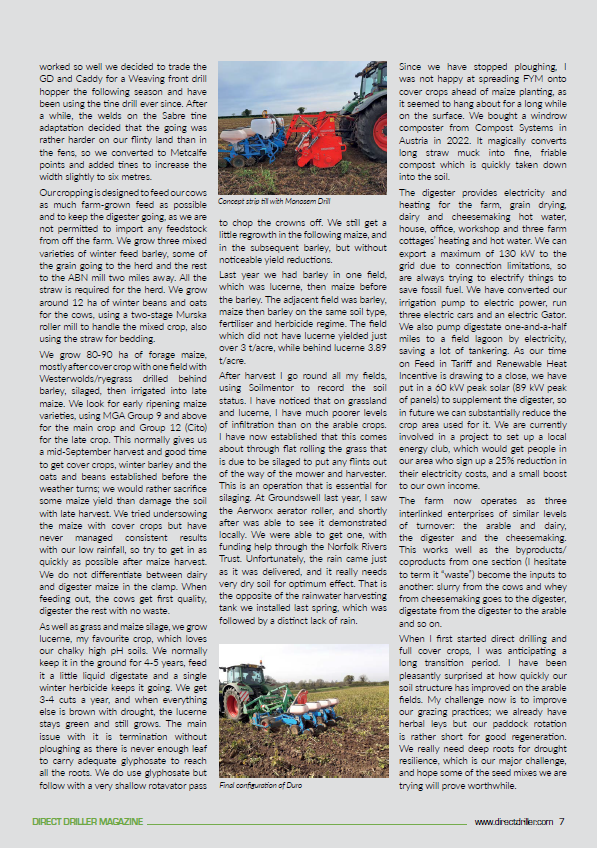
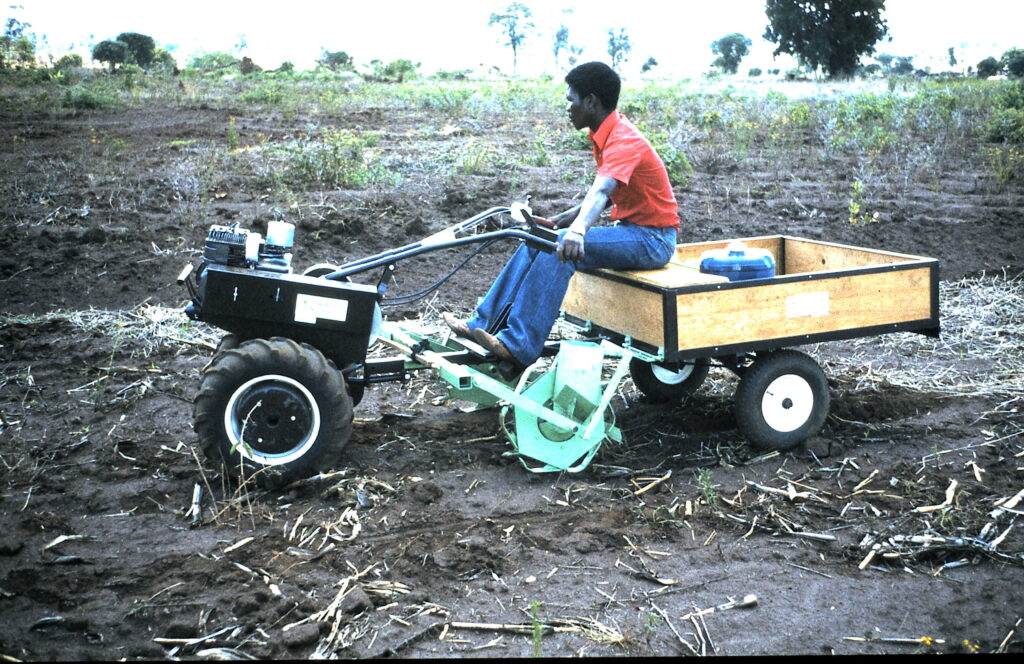
Our family have been farming in Wighton since 1912, but I only started in 2005 after the death of my father. After university, I was at the Scottish Institute of Agricultural Engineering, where my work included direct drilling with the Bettinson 3D and other machines. (When writing about this work I came across a Babylonian direct drill picture – nothing new under the sun!) I went to work in Malawi from 1975 to 1998, trialling zero-till maize, amongst other things. On my return to Britain in 1998, I wrote up my research and applied some of my work to British grain storage, developing and producing the Barn Owl monitoring and control system, sold through Martin Lishman.
On the death of my father in 2005, I became a farmer; as a novice, I relinquished about 800 acres of land rented from the Holkham Estate and concentrated on the 540 acres of land we own, plus a few acres of rented grazing. We were milking about 110 Holsteins, and my wife was making cheese for local sale with a proportion of it. We decided to break away from the black and white tradition, moving to Brown Swiss for a more robust, lower cost animal, with milk quality benefits for the cheesemaking enterprise which my wife started in 2001.
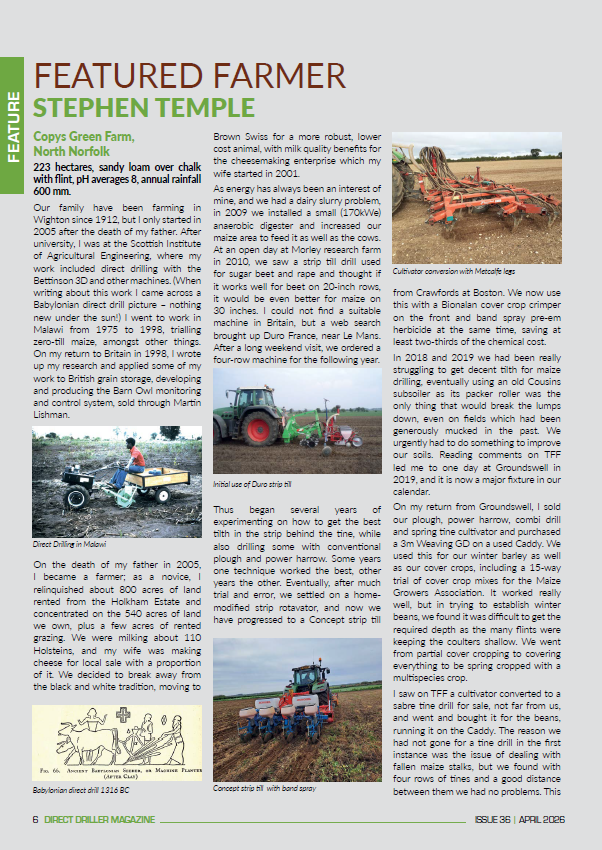
As energy has always been an interest of mine, and we had a dairy slurry problem, in 2009 we installed a small (170kWe) anaerobic digester and increased our maize area to feed it as well as the cows. At an open day at Morley research farm in 2010, we saw a strip till drill used for sugar beet and rape and thought if it works well for beet on 20-inch rows, it would be even better for maize on 30 inches. I could not find a suitable machine in Britain, but a web search brought up Duro France, near Le Mans. After a long weekend visit, we ordered a four-row machine for the following year.


Thus began several years of experimenting on how to get the best tilth in the strip behind the tine, while also drilling some with conventional plough and power harrow. Some years one technique worked the best, other years the other. Eventually, after much trial and error, we settled on a home-modified strip rotavator, and now we have progressed to a Concept strip till from Crawfords at Boston. We now use this with a Bionalan cover crop crimper on the front and band spray pre-em herbicide at the same time, saving at least two-thirds of the chemical cost.
In 2018 and 2019 we had been really struggling to get decent tilth for maize drilling, eventually using an old Cousins subsoiler as its packer roller was the only thing that would break the lumps down, even on fields which had been generously mucked in the past. We urgently had to do something to improve our soils. Reading comments on TFF led me to one day at Groundswell in 2019, and it is now a major fixture in our calendar.
On my return from Groundswell, I sold our plough, power harrow, combi drill and spring tine cultivator and purchased a 3m Weaving GD on a used Caddy. We used this for our winter barley as well as our cover crops, including a 15-way trial of cover crop mixes for the Maize Growers Association. It worked really well, but in trying to establish winter beans, we found it was difficult to get the required depth as the many flints were keeping the coulters shallow. We went from partial cover cropping to covering everything to be spring cropped with a multispecies crop.
I saw on TFF a cultivator converted to a sabre tine drill for sale, not far from us, and went and bought it for the beans, running it on the Caddy. The reason we had not gone for a tine drill in the first instance was the issue of dealing with fallen maize stalks, but we found with four rows of tines and a good distance between them we had no problems. This worked so well we decided to trade the GD and Caddy for a Weaving front drill hopper the following season and have been using the tine drill ever since. After a while, the welds on the Sabre tine adaptation decided that the going was rather harder on our flinty land than in the fens, so we converted to Metcalfe points and added tines to increase the width slightly to six metres.
Our cropping is designed to feed our cows as much farm-grown feed as possible and to keep the digester going, as we are not permitted to import any feedstock from off the farm. We grow three mixed varieties of winter feed barley, some of the grain going to the herd and the rest to the ABN mill two miles away. All the straw is required for the herd. We grow around 12 ha of winter beans and oats for the cows, using a two-stage Murska roller mill to handle the mixed crop, also using the straw for bedding.
We grow 80-90 ha of forage maize, mostly after cover crop with one field with Westerwolds/ryegrass drilled behind barley, silaged, then irrigated into late maize. We look for early ripening maize varieties, using MGA Group 9 and above for the main crop and Group 12 (Cito) for the late crop. This normally gives us a mid-September harvest and good time to get cover crops, winter barley and the oats and beans established before the weather turns; we would rather sacrifice some maize yield than damage the soil with late harvest. We tried undersowing the maize with cover crops but have never managed consistent results with our low rainfall, so try to get in as quickly as possible after maize harvest. We do not differentiate between dairy and digester maize in the clamp. When feeding out, the cows get first quality, digester the rest with no waste.


As well as grass and maize silage, we grow lucerne, my favourite crop, which loves our chalky high pH soils. We normally keep it in the ground for 4-5 years, feed it a little liquid digestate and a single winter herbicide keeps it going. We get 3-4 cuts a year, and when everything else is brown with drought, the lucerne stays green and still grows. The main issue with it is termination without ploughing as there is never enough leaf to carry adequate glyphosate to reach all the roots. We do use glyphosate but follow with a very shallow rotavator pass to chop the crowns off. We still get a little regrowth in the following maize, and in the subsequent barley, but without noticeable yield reductions.
Last year we had barley in one field, which was lucerne, then maize before the barley. The adjacent field was barley, maize then barley on the same soil type, fertiliser and herbicide regime. The field which did not have lucerne yielded just over 3 t/acre, while behind lucerne 3.89 t/acre.
After harvest I go round all my fields, using Soilmentor to record the soil status. I have noticed that on grassland and lucerne, I have much poorer levels of infiltration than on the arable crops. I have now established that this comes about through flat rolling the grass that is due to be silaged to put any flints out of the way of the mower and harvester. This is an operation that is essential for silaging. At Groundswell last year, I saw the Aerworx aerator roller, and shortly after was able to see it demonstrated locally. We were able to get one, with funding help through the Norfolk Rivers Trust. Unfortunately, the rain came just as it was delivered, and it really needs very dry soil for optimum effect. That is the opposite of the rainwater harvesting tank we installed last spring, which was followed by a distinct lack of rain.
Since we have stopped ploughing, I was not happy at spreading FYM onto cover crops ahead of maize planting, as it seemed to hang about for a long while on the surface. We bought a windrow composter from Compost Systems in Austria in 2022. It magically converts long straw muck into fine, friable compost which is quickly taken down into the soil.
The digester provides electricity and heating for the farm, grain drying, dairy and cheesemaking hot water, house, office, workshop and three farm cottages’ heating and hot water. We can export a maximum of 130 kW to the grid due to connection limitations, so are always trying to electrify things to save fossil fuel. We have converted our irrigation pump to electric power, run three electric cars and an electric Gator. We also pump digestate one-and-a-half miles to a field lagoon by electricity, saving a lot of tankering. As our time on Feed in Tariff and Renewable Heat Incentive is drawing to a close, we have put in a 60 kW peak solar (89 kW peak of panels) to supplement the digester, so in future we can substantially reduce the crop area used for it. We are currently involved in a project to set up a local energy club, which would get people in our area who sign up a 25% reduction in their electricity costs, and a small boost to our own income.
The farm now operates as three interlinked enterprises of similar levels of turnover: the arable and dairy, the digester and the cheesemaking. This works well as the byproducts/coproducts from one section (I hesitate to term it “waste”) become the inputs to another: slurry from the cows and whey from cheesemaking goes to the digester, digestate from the digester to the arable and so on.
When I first started direct drilling and full cover crops, I was anticipating a long transition period. I have been pleasantly surprised at how quickly our soil structure has improved on the arable fields. My challenge now is to improve our grazing practices; we already have herbal leys but our paddock rotation is rather short for good regeneration. We really need deep roots for drought resilience, which is our major challenge, and hope some of the seed mixes we are trying will prove worthwhile.