
Another two Groundswell Session summaries from Mike Abram’s Regenerative Farmer Substack newsletter.
Telling the regenerative story in the media
Some brilliant advice on how to tell the regenerative farming story in the media, whether on TV, in a podcast or on social media from those who are doing it successfully
Location: Groundswell Festival
Seminar: Telling the Regenerative Story: Farming in Media & Culture
Published: 02-Mar-2026
Length: 59:51
Summary
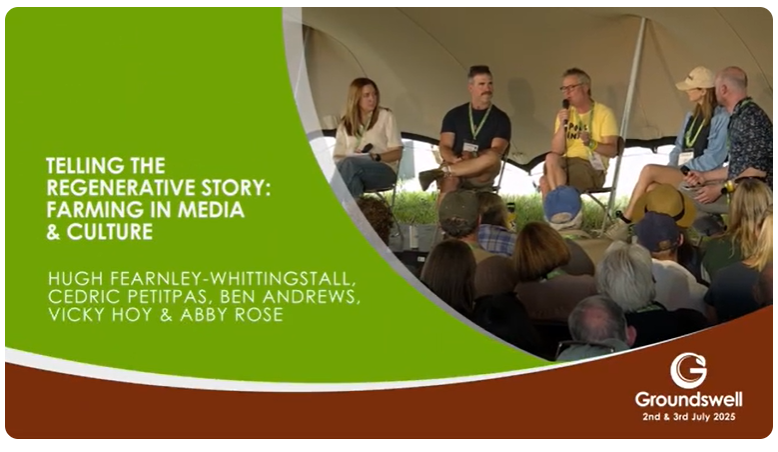
Chaired by Cedric Petitpas, this session explores how farming and regenerative agriculture are portrayed through different media, and why storytelling matters for public understanding. The panel brings together a mix of voices including Hugh Fearnley-Whittingstall (River Cottage), Vicky Hoy (producer on Clarkson’s Farm), Abby Rose (Farmerama podcast) and Ben Andrews (organic farmer and social media creator). Each shares how their work connects audiences with farming, from television and podcasts to Instagram.
A central theme is that most people remain disconnected from how food is produced, and media plays a key role in bridging that gap. Programmes like Clarkson’s Farm have helped show the realities and risks of farming, while podcasts and social media allow for deeper or more personal storytelling. The panel agrees that authenticity is essential. Audiences respond best to real experiences, whether that is the emotional highs and lows of livestock farming or the day-to-day observations from the field.
For farmers, the discussion highlights both an opportunity and a responsibility. Sharing stories can influence how the public, policymakers and markets view agriculture. While large food companies still dominate messaging, there is growing power in farmer-led communication, especially through social media and community engagement. Education, particularly through schools and direct contact with farms, is seen as key to building a more informed public that values good food and farming.
Key takeaways
- Tell real, personal stories from your farm to build trust and engagement with the public
- Use simple, relatable moments to explain complex farming systems and decisions
- Engage directly with consumers through social media, markets and on-farm experiences
- Focus on authenticity rather than polished content, as audiences respond to honesty
- Support education by connecting with schools and helping people understand where food comes from
Digging deeper
Why storytelling matters in farming
Hugh Fearnley-Whittingstall reflects on how stories about food have always been central to human culture. Modern media can reconnect people with farming, but only if it captures genuine experiences rather than idealised versions.
He argues that people are naturally interested in food stories, and that connection can help shift attitudes towards better farming and diets.
Showing the realities of farming on screen
Vicky Hoy explains that Clarkson’s Farm resonates because it shows real challenges, including financial risk, animal welfare and emotional strain. The unpredictability of farming creates compelling stories that cannot be scripted.
For many viewers, this is their first real insight into the pressures farmers face.
Long-form storytelling and system complexity
Abby Rose highlights the value of podcasts for exploring complex issues such as grain production, supply chains and nutrition. By following a product from field to plate, listeners can understand the wider system and the decisions behind it.
This format allows nuance that is often missing from shorter media.
Social media from the farm gate
Ben Andrews describes how sharing everyday observations, such as pest control through natural predators, can engage large audiences. Short, honest updates from the field help bridge the gap between farmers and the public.
“If you’re just spitting facts out, it’s not engaging.”
— Ben Andrews, farmer
Cutting through misinformation
The panel stresses that farmer voices are key to countering misinformation. Direct communication, whether through video, podcasts or farm visits, helps audiences understand the realities behind headlines and marketing claims.
There is also recognition that structural barriers remain, including dominant narratives from large food companies and policy constraints.
Education and future audiences
A strong focus is placed on education, particularly in schools. Giving children access to good food, farm visits and accurate teaching is seen as essential for long-term change. The panel suggests that building understanding early can reduce reliance on misleading marketing and create more informed consumers.
“We have to keep finding these stories.”
— Hugh Fearnley-Whittingstall, broadcaster
Original link
Watch the session on YouTube
Young voices in regenerative agriculture
How do young people get into regenerative agriculture? This panel highlighted the career stories from four young people
Location: Groundswell Festival
Seminar: Emergent Generation – Young Voices in Regenerative Agriculture
Published: 09-Mar-2026
Length: 57:00
Summary
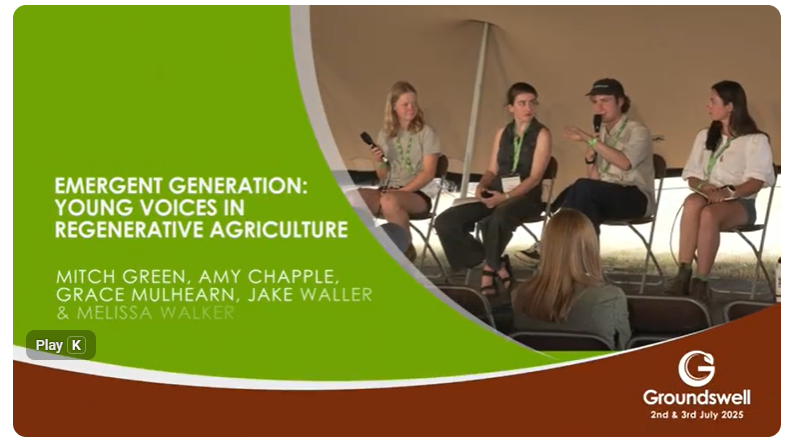
This session brings together members of the Emergent Generation network to share their experiences as young people working in or entering regenerative agriculture. Introduced by founders Jonty Brunyee and Becky Grove, the discussion focuses on the challenges of finding a place in the sector, building careers without clear pathways, and creating opportunities where none exist. The panel led by Mitch Green features Amy Chapple, Grace Mulhearn, Jake Waller and Melissa Walker, each offering a different route into farming and food systems, from family farms to new entrants and veterinary work.
A key theme is that there is no single route into regenerative agriculture. Several speakers describe piecing together careers through internships, short-term roles and networking rather than formal education. For many, regenerative agriculture made immediate sense but was not well covered in training or university courses. This has led to a reliance on peer networks, events and informal learning to build knowledge and confidence.
The session also explores the social side of working in agriculture as a young person. Feelings of isolation, imposter syndrome and lack of local support are common, particularly for those not from farming backgrounds. The Emergent Generation network is presented as a way to connect like-minded people, share opportunities and build confidence. The overall message is that the next generation will shape the future of farming by being proactive, collaborative and willing to take risks.
Key takeaways
- Build your own pathway by taking opportunities, even if they are informal or short term.
- Use networks, events and peer groups to find jobs, advice and support.
- Do not wait for the perfect role; start somewhere and shape it over time.
- Overcome imposter syndrome by backing yourself and focusing on learning.
- Look for opportunities to create new enterprises or income streams on existing land.
Digging deeper
Creating opportunities rather than waiting
Amy Chappell explains how she developed her own business on the family farm after being told it could not support another income. Starting with pigs during COVID, she now runs a diversified enterprise selling direct to customers and restaurants. Her experience highlights how new ventures can sit alongside existing farm businesses rather than replace them.
“It’s kind of been a journey of discovering what you can actually do with land.”
— Amy Chappell, farmer
Learning outside formal education
Several speakers note that regenerative agriculture was not covered in their formal training. Grace Mulhearn describes leaving veterinary school unsure how her career would fit with environmental concerns, leading her to seek out farmers, networks and alternative approaches. Melissa Walker similarly built her skills through work experience, consultancy and on-farm roles rather than relying solely on university education.
The importance of networks
Emergent Generation is presented as a key support system for young people in the sector. Members use it to find jobs, share knowledge and build confidence. Melissa credits networking events with helping her secure both consultancy and on-farm roles, while others highlight the value of WhatsApp groups and newsletters in sharing opportunities.
Imposter syndrome and belonging
A recurring issue is the feeling of not belonging, particularly for those without a farming background. Jake Waller describes feeling out of place both in traditional farming settings and in regenerative spaces, while others highlight how constantly explaining their background reinforces this feeling. The panel encourages young people to persist and build confidence through experience.
“You feel like… what am I doing here?”
— Jake Waller, dairy manager
Diversity of careers and lifestyles
The panel shows that careers in regenerative agriculture are varied and often non-linear. Grace combines veterinary work with community food projects and alternative therapies, while others balance livestock, arable and business ventures. This diversity is seen as a strength, allowing people to shape roles that suit their interests and lifestyles.
Isolation and rural life
Living and working in rural areas can be isolating, especially for young people. The panel discusses the contrast between rural and urban life, and the importance of maintaining social connections. While rural work offers independence and connection to land, it requires effort to build a supportive community.
Encouraging new entrants
For those looking to enter the sector, the advice is to be proactive. Contact farmers, visit different systems and take advantage of any opportunity to learn. The willingness of people in the sector to share knowledge is highlighted as a major strength, making it possible to build a career from scratch with persistence and curiosity.
Original link
Watch the session on YouTube.
Disclaimer: These summaries are produced using AI tools. They may not be 100% accurate and should not be taken as fact. Feedback welcome.