Cover crop establishment has been a serious challenge for many this season, with the extreme dry soils after the long hot summer. However, years of soil improvement and a minimal soil movement strategy have achieved good results at low cost for Northamptonshire grower, David Beesley, even on his light, free-draining ironstone soils.
“It’s been very pleasing that the improved soil structure we’ve built up over the years has really helped with the cover crop establishment this season,” he reports. All straw has been chopped and returned across the farm for the past 12 years, with a long-term strategy of cover crops to give continuous ground cover as much as possible.
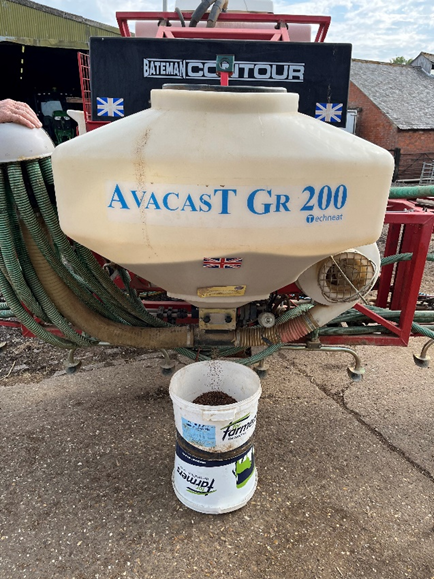
David’s cover crops are sown with a Techneat Multicast 200 (formerly the Avacast GR200), mounted on a Bateman RB16 sprayer with 12 splash plate distribution heads across a 12-metre working width. The simple set-up can easily cover eight to nine hectares an hour, he says.
This year, he’s also fitted a new cover crop metering system, specifically designed for consistently distributing small seeds through the Multicast. The rubber roller construction ensures a smooth flow without blockages and a gentler action on the seeds.
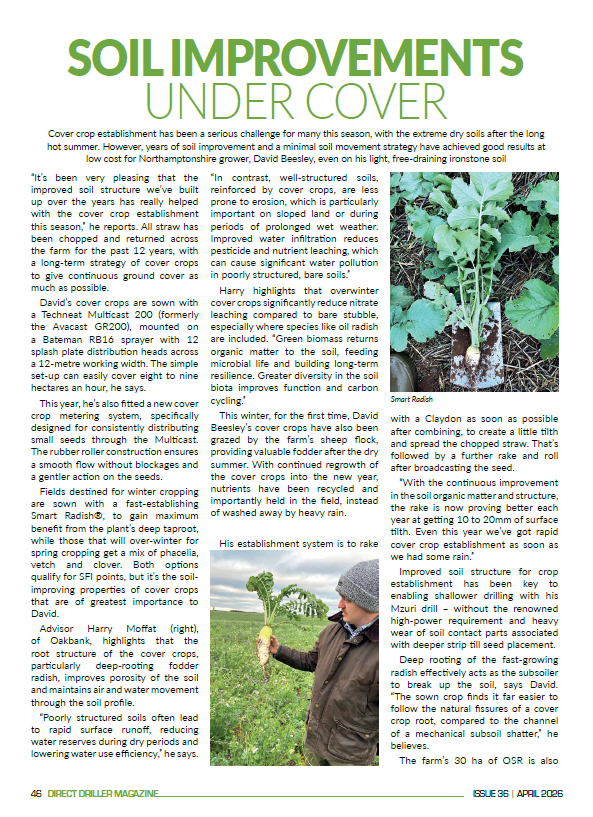
Fields destined for winter cropping are sown with a fast-establishing Smart Radish®, to gain maximum benefit from the plant’s deep taproot, while those that will over-winter for spring cropping get a mix of phacelia, vetch and clover. Both options qualify for SFI points, but it’s the soil-improving properties of cover crops that are of greatest importance to David.
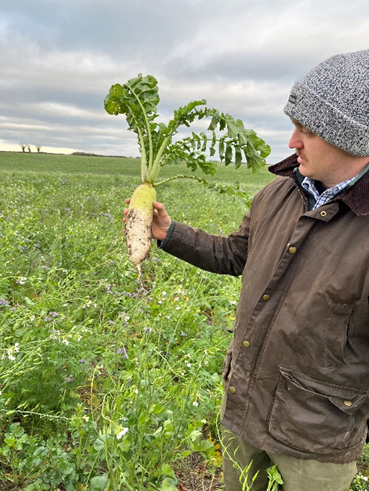
Advisor Harry Moffat (above), of Oakbank, highlights that the root structure of the cover crops, particularly deep-rooting fodder radish, improves porosity of the soil and maintains air and water movement through the soil profile.
“Poorly structured soils often lead to rapid surface runoff, reducing water reserves during dry periods and lowering water use efficiency,” he says. “In contrast, well-structured soils, reinforced by cover crops, are less prone to erosion, which is particularly important on sloped land or during periods of prolonged wet weather. Improved water infiltration reduces pesticide and nutrient leaching, which can cause significant water pollution in poorly structured, bare soils.”
Harry highlights that overwinter cover crops significantly reduce nitrate leaching compared to bare stubble, especially where species like oil radish are included. “Green biomass returns organic matter to the soil, feeding microbial life and building long-term resilience. Greater diversity in the soil biota improves function and carbon cycling.”
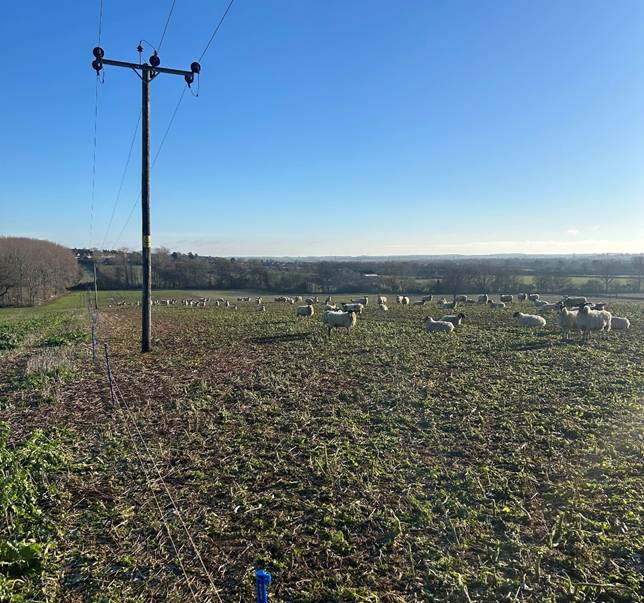
This winter, for the first time, David Beesley’s cover crops have also been grazed by the farm’s sheep flock, providing valuable fodder after the dry summer. With continued regrowth of the cover crops into the new year, nutrients have been recycled and importantly held in the field, instead of washed away by heavy rain.
His establishment system is to rake with a Claydon as soon as possible after combining, to create a little tilth and spread the chopped straw. That’s followed by a further rake and roll after broadcasting the seed.
“With the continuous improvement in the soil organic matter and structure, the rake is now proving better each year at getting 10 to 20mm of surface tilth. Even this year we’ve got rapid cover crop establishment as soon as we had some rain.”
Improved soil structure for crop establishment has been key to enabling shallower drilling with his Mzuri drill – without the renowned high-power requirement and heavy wear of soil contact parts associated with deeper strip till seed placement.
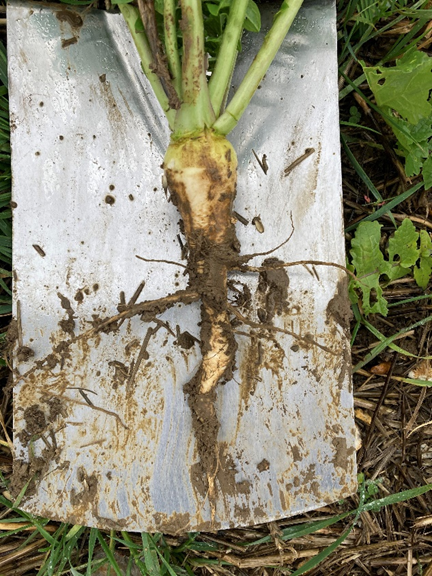
Deep rooting of the fast-growing radish effectively acts as the subsoiler to break up the soil, says David. “The sown crop finds it far easier to follow the natural fissures of a cover crop root, compared to the channel of a mechanical subsoil shatter,” he believes.
The farm’s 30 ha of OSR is also established with a companion crop of buckwheat and vetch, which is broadcast by the Multicast, the day before the crop is drilled with an Accord drill. “The system has been working well, although we’re thinking that maybe in future to establish the companion crop first, and then drill through with the Mzuri to create a competition-free strip for the oilseed rape to grow,” he suggests.
David acknowledges that with the continuous cover crop strategy there had been concerns about losing opportunities for a stale seedbed. However, since the cover crops are removed with a robust glyphosate rate, and then autumn crops established with minimal soil movement that could trigger weed germination, the farm’s overall grass weed populations have declined and, while not completely clear, are certainly in control.
The autumn grass weed programme, based around pre-emergence herbicide followed by peri-emergence Luximo, along with Avadex granules that are also applied with the Multicast 200, has been extremely effective this season, he reports.
Improved workability of the soil with the cover crop strategy has seen fuel use halved across the farm rotation, while yields have been maintained. “The organic matter is certainly improving soil moisture retention, which is helping with crop resilience against drought.
“While the better structure also helps drainage, so crops are not sitting in water so much when we have heavy rainfall.” The farm at Ecton, between Northampton and Wellingborough, covers around 200 ha of cropping, including 85 ha of spring barley and oats, along with winter wheat and oilseed rape.
With the combination of establishing the cover crops, companion crops and application of Avadex granules, as well as slug pellet spreading where required, the Techneat Multicast has proven to be one of the most used bits of machinery on the farm this year.