Feb 2026
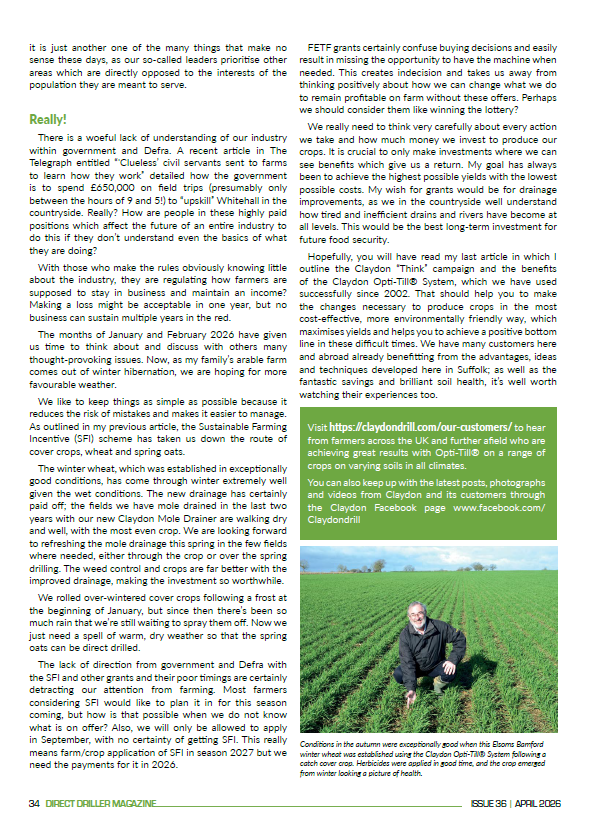
The apparent lack of understanding of the agricultural sector by government / Defra is making it almost impossible for farmers to operate viable businesses and do their job of feeding the nation, says Suffolk arable farmer Jeff Claydon.
23 February 2026
Since the start of 2026 it has rained virtually every day here on the Claydon farm. The prolonged dull, drab conditions have meant little has been happening in the way of field work, but at least we’ve had time to get machinery out of hibernation and ensure that it’s in tip-top condition for the busy spring drilling period. We have also had an opportunity to reflect on the current state of farming and contemplate the future, although that has done little to lift the mood.
One can’t help but think about how poorly farmers are treated by government and the food manufacturing sector, despite all the talk. Commodity prices are now so low that one must question whether it’s even worth growing food crops at these levels.
A visit to our village pub brought home to me just how easy it is to “spend” a tonne of wheat on a meal and a few drinks. It also highlighted that farm-gate prices are but a tiny fraction of what consumers pay in shops and restaurants. Someone is making a lot of money out of what farmers produce, but unfortunately, it’s not us. How did we get to this point and how can we change it for the better?
The government and Defra appear to be like confused rabbits in the headlights, not knowing which way to turn or what to do. No business that must make a profit to survive could be so inept, and the situation would be funny were it not so serious. It’s no surprise that they held back publication of Baroness Minette Batters’ comprehensive Farming Profitability Review, which outlines why farming is different from any other part of the economy and the need for financial/policy certainty for our industry to thrive and deliver the expectations which society has of it.
Preserving the countryside
The government’s recent grand raid on the country’s “silver” through increases in Inheritance Tax and Business Property Relief means that businesses throughout the country, including farmers, are bearing the burden. It makes me question whether their goal is to do away with family farms altogether and over time force them to sell out to large faceless institutions which have no inherent interest in the vitality and wellbeing of rural communities.
Over the last two years, within four miles of us, seven other farmers have retired or packed up because they can’t make the job pay and the land is being “redeployed” to four existing businesses. That indicates just how tough farming is right now. The situation has been made worse by increases in the minimum wage and National Insurance, which make it incredibly difficult for small businesses to turn a profit, including my friends at the village pub.
Many farmers would not even make the minimum wage if they divided what they draw from the business by the hours worked. How can it be that people with a lifetime’s experience and specialist knowledge earn less than someone with few qualifications who flips burgers in a fast-food franchise?
During the last few weeks, I have noted various advertisements highlighting the government’s mental health awareness campaign. How ironic is that, at a time when its own policies and red tape are creating so much concern throughout the farming community and rural business sector?
It is painfully obvious that those who work in government are not on the same wavelength as those of us who operate in the real world. Seemingly, most have little or no idea how to run a business and are either unaware or do not care about the devastating impact their actions are having on rural villages, towns and communities. Nor do these officials appreciate the value of rural businesses or their potential to increase employment given a favourable legislative and economic environment.
Every area where politicians of any party are involved has progressively become unnecessarily complicated and could be simplified dramatically. There must be a better way, because the country cannot go on being led by people with no experience of working in a business which must make profit to survive.
With the government sucking the financial lifeblood from the countryside, where will the funding come from to ensure that it remains the great place we all want to see? Should they carry on down this reckless path, it will change forever, so future generations will miss out on the things we love about living and working in a rural environment.
Certainty needed
The cheap food policy that successive governments have maintained since World War II has reduced the percentage of consumer food spending that goes to farmers. With good harvests all over the world in 2025, commodity prices have dropped to such low levels that farmers in every nation are in much the same dire predicament, as governments seek to make up for budget shortfalls caused by their own failure to control spending in other, often wasteful and non-productive, areas.
Under the previous Integrated Administration and Control Scheme (IACS), which was introduced in 1993 to manage and control payments to farmers under the MacSharry Common Agricultural Policy (CAP) reforms, there was a known budget for farming, which was paid out at the same level across all farms.
Currently, there is no clear direction from government as to whether farmers should produce food, go for Biodiversity Net Gain (BNG), regenerative farming, rewilding or the many other schemes which Defra has been tasked with delivering. That makes it incredibly hard to plan for the future, even for someone who has been in the farming industry for as long as I have. Currently, buying land at £10,000+ per acre, just to gain an income from producing food, is a complete non-starter, while any young person considering a career in our industry will think long and hard when they see farmers struggling to even make minimum wage. There are easier options!
Given the current volatile global geopolitical situation, where does that leave the country’s food security, which should surely be any government’s main priority? Instead, it is just another one of the many things that make no sense these days, as our so-called leaders prioritise other areas which are directly opposed to the interests of the population they are meant to serve.
Really!
There is a woeful lack of understanding of our industry within government and Defra. A recent article in The Telegraph entitled “’Clueless’ civil servants sent to farms to learn how they work” detailed how the government is to spend £650,000 on field trips (presumably only between the hours of 9 and 5!) to “upskill” Whitehall in the countryside. Really? How are people in these highly paid positions which affect the future of an entire industry to do this if they don’t understand even the basics of what they are doing?
With those who make the rules obviously knowing little about the industry, they are regulating how farmers are supposed to stay in business and maintain an income? Making a loss might be acceptable in one year, but no business can sustain multiple years in the red.
The months of January and February 2026 have given us time to think about and discuss with others many thought-provoking issues. Now, as my family’s arable farm comes out of winter hibernation, we are hoping for more favourable weather.
We like to keep things as simple as possible because it reduces the risk of mistakes and makes it easier to manage. As outlined in my previous article, the Sustainable Farming Incentive (SFI) scheme has taken us down the route of cover crops, wheat and spring oats.
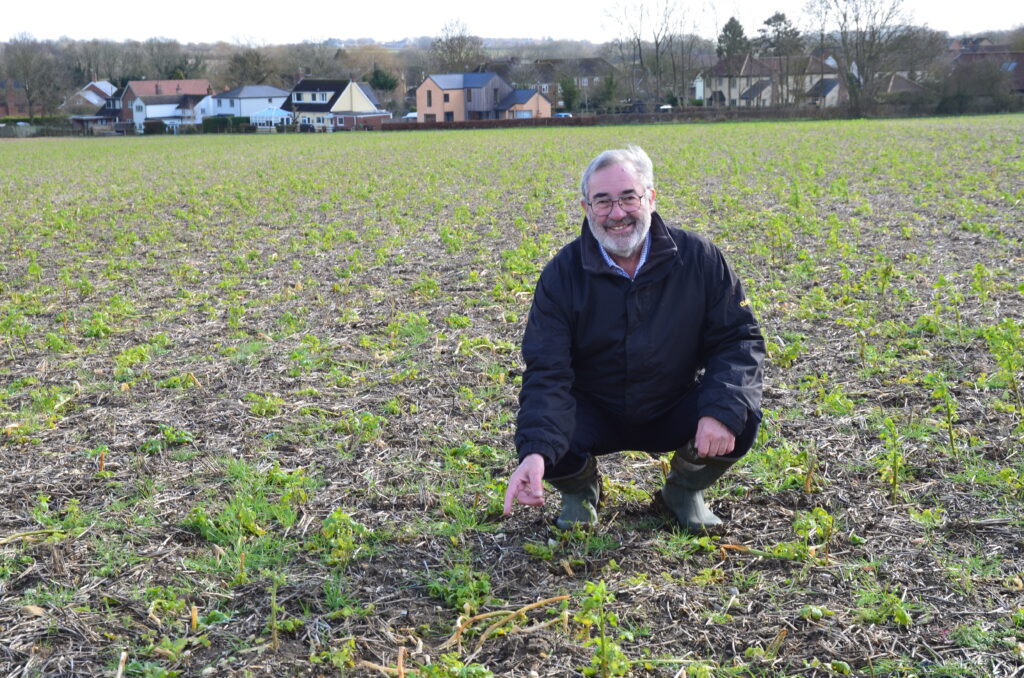
The winter wheat, which was established in exceptionally good conditions, has come through winter extremely well given the wet conditions. The new drainage has certainly paid off; the fields we have mole drained in the last two years with our new Claydon Mole Drainer are walking dry and well, with the most even crop. We are looking forward to refreshing the mole drainage this spring in the few fields where needed, either through the crop or over the spring drilling. The weed control and crops are far better with the improved drainage, making the investment so worthwhile.
We rolled over-wintered cover crops following a frost at the beginning of January, but since then there’s been so much rain that we’re still waiting to spray them off. Now we just need a spell of warm, dry weather so that the spring oats can be direct drilled.
The lack of direction from government and Defra with the SFI and other grants and their poor timings are certainly detracting our attention from farming. Most farmers considering SFI would like to plan it in for this season coming, but how is that possible when we do not know what is on offer? Also, we will only be allowed to apply in September, with no certainty of getting SFI. This really means farm/crop application of SFI in season 2027 but we need the payments for it in 2026.
FETF grants certainly confuse buying decisions and easily result in missing the opportunity to have the machine when needed. This creates indecision and takes us away from thinking positively about how we can change what we do to remain profitable on farm without these offers. Perhaps we should consider them like winning the lottery?
We really need to think very carefully about every action we take and how much money we invest to produce our crops. It is crucial to only make investments where we can see benefits which give us a return. My goal has always been to achieve the highest possible yields with the lowest possible costs. My wish for grants would be for drainage improvements, as we in the countryside well understand how tired and inefficient drains and rivers have become at all levels. This would be the best long-term investment for future food security.
Hopefully, you will have read my last article in which I outline the Claydon “Think” campaign and the benefits of the Claydon Opti-Till® System, which we have used successfully since 2002. That should help you to make the changes necessary to produce crops in the most cost-effective, more environmentally friendly way, which maximises yields and helps you to achieve a positive bottom line in these difficult times. We have many customers here and abroad already benefitting from the advantages, ideas and techniques developed here in Suffolk; as well as the fantastic savings and brilliant soil health, it’s well worth watching their experiences too.
Visit https://claydondrill.com/our-customers/ to hear from farmers across the UK and further afield who are achieving great results with Opti-Till® on a range of crops on varying soils in all climates.
You can also keep up with the latest posts, photographs and videos from Claydon and its customers through the Claydon Facebook page www.facebook.com/Claydondrill