Written by James Warne from Soil First Farming
“Feed the soil” is one of those phrases that sounds faintly virtuous, like taking a cardigan to the theatre or remembering to write thank-you letters. You hear it and think, yes, quite right, very sensible. Though what it actually involves, and why we’ve not been doing it all along, is another matter entirely.
For years, we have behaved towards the soil rather as an impatient diner might behave towards a waiter: less interested in the kitchen than in what arrives on the plate. We have fed the plants directly, tipped nutrients at them in tidy, measurable quantities, and expected gratitude in the form of larger carrots and more obliging wheat. And for a time, the soil complied. Or at least, it did not complain audibly. Soil is good like that: long-suffering, not given to scenes.
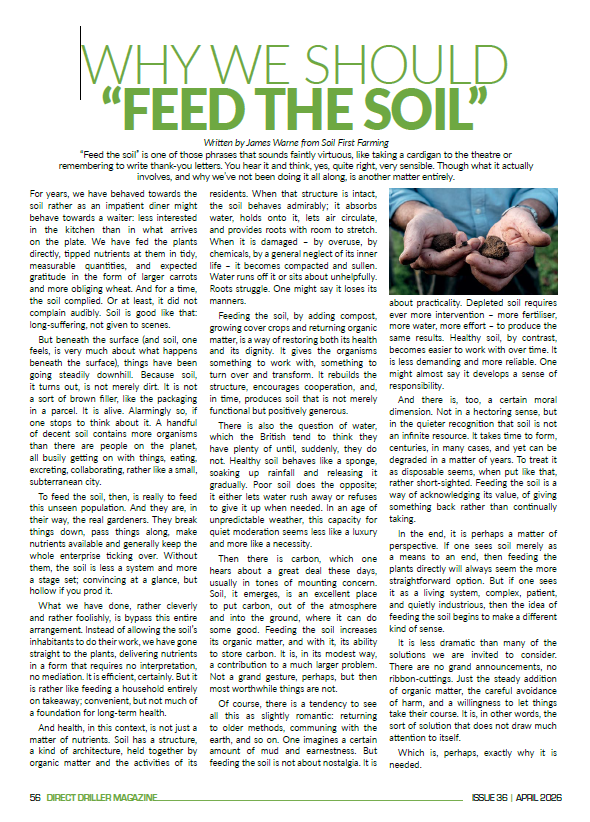
But beneath the surface (and soil, one feels, is very much about what happens beneath the surface), things have been going steadily downhill. Because soil, it turns out, is not merely dirt. It is not a sort of brown filler, like the packaging in a parcel. It is alive. Alarmingly so, if one stops to think about it. A handful of decent soil contains more organisms than there are people on the planet, all busily getting on with things, eating, excreting, collaborating, rather like a small, subterranean city.
To feed the soil, then, is really to feed this unseen population. And they are, in their way, the real gardeners. They break things down, pass things along, make nutrients available and generally keep the whole enterprise ticking over. Without them, the soil is less a system and more a stage set; convincing at a glance, but hollow if you prod it.
What we have done, rather cleverly and rather foolishly, is bypass this entire arrangement. Instead of allowing the soil’s inhabitants to do their work, we have gone straight to the plants, delivering nutrients in a form that requires no interpretation, no mediation. It is efficient, certainly. But it is rather like feeding a household entirely on takeaway; convenient, but not much of a foundation for long-term health.
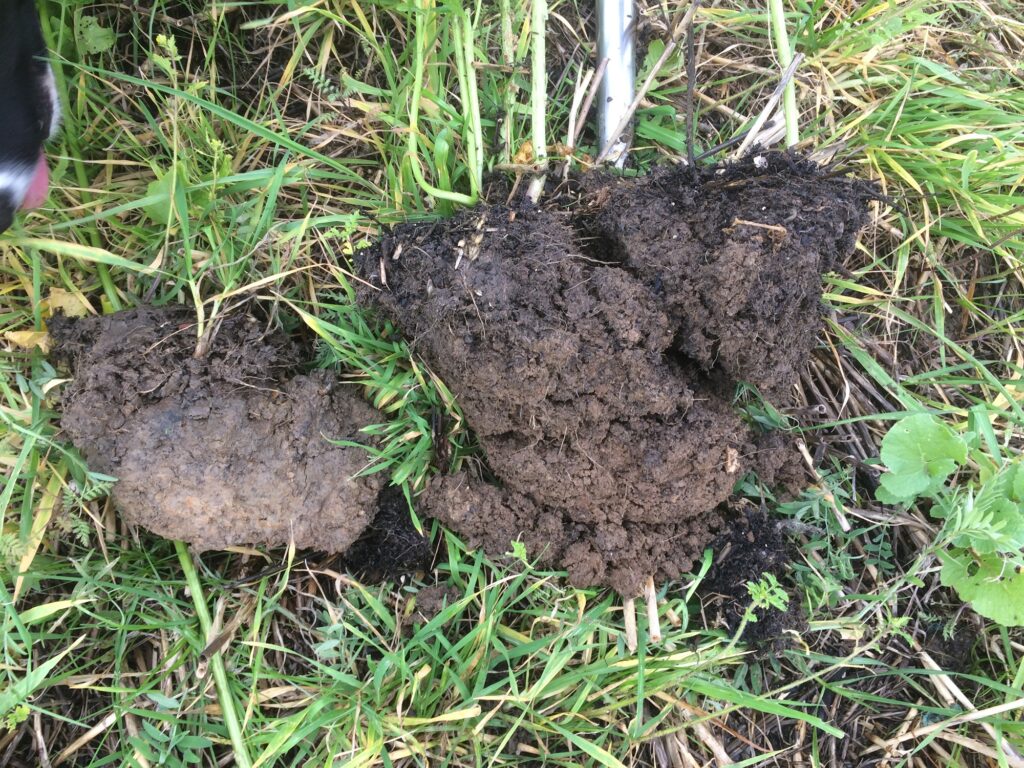
And health, in this context, is not just a matter of nutrients. Soil has a structure, a kind of architecture, held together by organic matter and the activities of its residents. When that structure is intact, the soil behaves admirably; it absorbs water, holds onto it, lets air circulate, and provides roots with room to stretch. When it is damaged – by overuse, by chemicals, by a general neglect of its inner life – it becomes compacted and sullen. Water runs off it or sits about unhelpfully. Roots struggle. One might say it loses its manners.
Feeding the soil, by adding compost, growing cover crops and returning organic matter, is a way of restoring both its health and its dignity. It gives the organisms something to work with, something to turn over and transform. It rebuilds the structure, encourages cooperation, and, in time, produces soil that is not merely functional but positively generous.
There is also the question of water, which the British tend to think they have plenty of until, suddenly, they do not. Healthy soil behaves like a sponge, soaking up rainfall and releasing it gradually. Poor soil does the opposite; it either lets water rush away or refuses to give it up when needed. In an age of unpredictable weather, this capacity for quiet moderation seems less like a luxury and more like a necessity.
Then there is carbon, which one hears about a great deal these days, usually in tones of mounting concern. Soil, it emerges, is an excellent place to put carbon, out of the atmosphere and into the ground, where it can do some good. Feeding the soil increases its organic matter, and with it, its ability to store carbon. It is, in its modest way, a contribution to a much larger problem. Not a grand gesture, perhaps, but then most worthwhile things are not.
Of course, there is a tendency to see all this as slightly romantic: returning to older methods, communing with the earth, and so on. One imagines a certain amount of mud and earnestness. But feeding the soil is not about nostalgia. It is about practicality. Depleted soil requires ever more intervention – more fertiliser, more water, more effort – to produce the same results. Healthy soil, by contrast, becomes easier to work with over time. It is less demanding and more reliable. One might almost say it develops a sense of responsibility.
And there is, too, a certain moral dimension. Not in a hectoring sense, but in the quieter recognition that soil is not an infinite resource. It takes time to form, centuries, in many cases, and yet can be degraded in a matter of years. To treat it as disposable seems, when put like that, rather short-sighted. Feeding the soil is a way of acknowledging its value, of giving something back rather than continually taking.
In the end, it is perhaps a matter of perspective. If one sees soil merely as a means to an end, then feeding the plants directly will always seem the more straightforward option. But if one sees it as a living system, complex, patient, and quietly industrious, then the idea of feeding the soil begins to make a different kind of sense.
It is less dramatic than many of the solutions we are invited to consider. There are no grand announcements, no ribbon-cuttings. Just the steady addition of organic matter, the careful avoidance of harm, and a willingness to let things take their course. It is, in other words, the sort of solution that does not draw much attention to itself.
Which is, perhaps, exactly why it is needed.