A rumination on scale in three songs
I’ve got a brand new combine harvester,
‘an I’ll give you the key.
Come on now let’s get together
In perfect harmony.
I’ve got twenty acres,
an’ you’ve got forty-three.
I’ve got a brand new combine harvester,
an’ I’ll give you the key.
I am sure that this well-known chorus is still sung by young farmers at some of their more debauched gatherings, but the words written in 1976 by the Somerset super-ish group The Wurzels proved to be alarmingly prophetic.
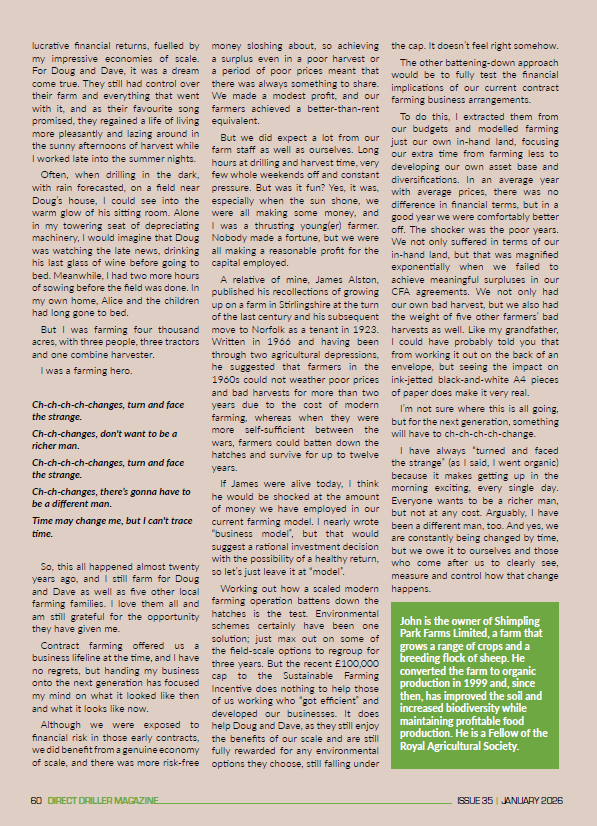
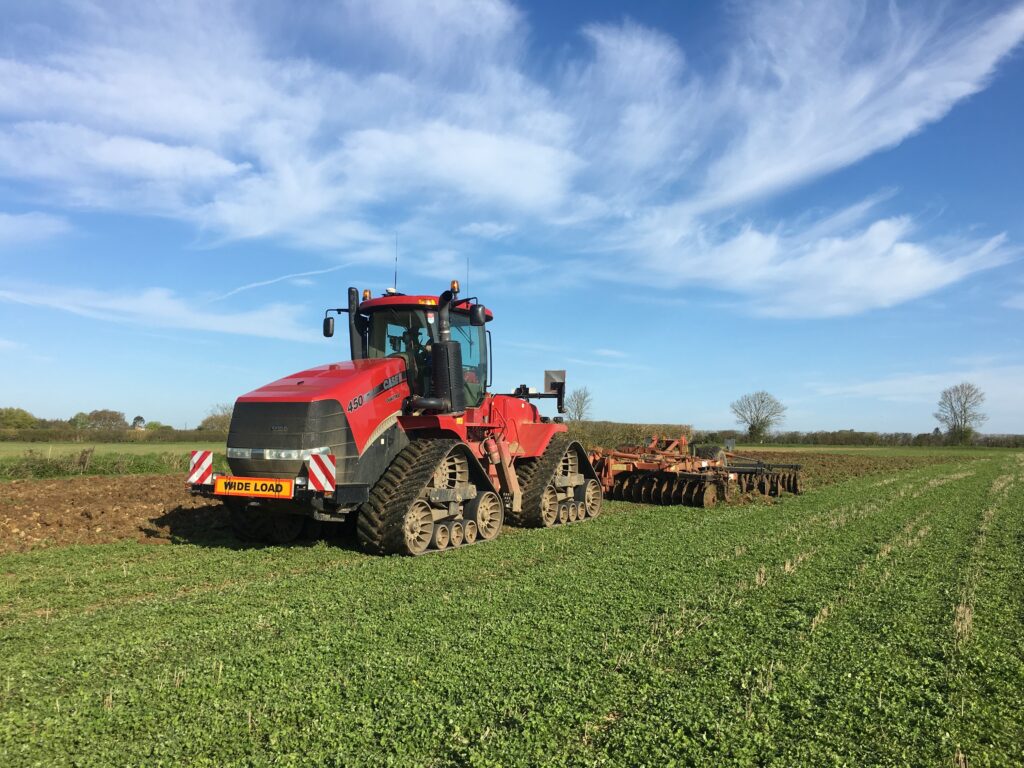
Back in the early 1980s, when I first started farming with my maternal grandfather, farm machinery costs were much lower, relative to the farm’s output, and labour was readily available. In fact, we had an embarrassment of willing hands – ten including myself – farming a thousand acres. On some mornings, I remember walking across the meadow from the farmhouse to the tractor shed, which is where the farm men congregated at seven o’clock every morning, trying to work out what everyone was going to do that day, such was the embarrassment of people. And thinking about my grandfather in his latter years, I’m not sure what he did, but I do know that he had a bath before breakfast, read the paper after lunch, followed by a snooze, and spent most of August in Derbyshire shooting grouse.
The barn was called the “tractor shed” because it was full of tractors. Thirteen, in fact. One for every man, with a few to spare. One had a hedge cutter permanently on it, because we could. The farm foreman came to work on a Massey Ferguson 135 and then went home on it at the end of the day. That’s all it did.
Pretty soon after I arrived, it all changed. Any notion I had of spending most of the year in tweed in the field of sport was clouded by falling cereal prices and exploding machinery costs. The nail in the coffin was hearing a chap called Simon Ward from Bidwells speaking at the annual winter Suffolk Farming Conference, lecturing a room full of farmer types, still flushed from the shooting field, or indeed, the Alps. Simon announced that if we wanted to remain in business, we needed to get off the slopes and get behind the wheel of a tractor. One man to a thousand acres, Mr Ward said. The audience looked decidedly uncomfortable.
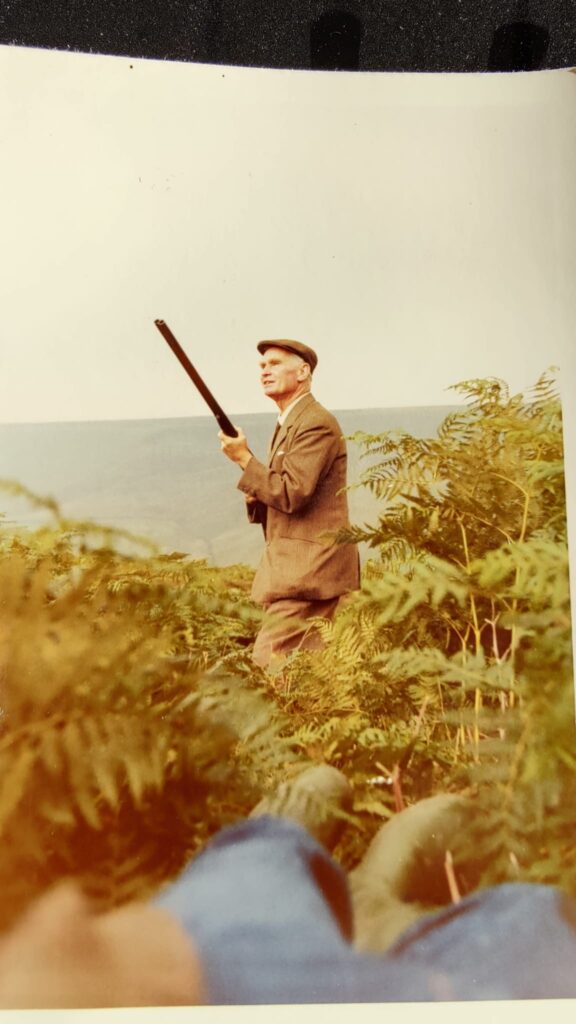
Because I had recently left college, I came armed to the farm with an Apple IIc and a floppy disc, and although my grandfather was able to work out that the farm was unprofitable on the back of an envelope, it seemed much more real when printed out in dot matrix on six feet of continuous paper. It’s probably what killed him.
His demise left me wondering what I was to do with a business that demanded more cash every month, and it seemed entirely sensible that the first course of action was to share my combine harvester key with my neighbour and join our two farms together so that we could live in perfect harmony. I hasten to add that the kind of harmony I arranged with my neighbour was not the same kind that The Wurzels had planned with their hopefully gingham-dressed counterpart; my plan was to make hay with them rather than roll around in it.
However, The Wurzels not only reimagined the 1971 song Brand New Key by the American folk singer Melanie, they also reworked the way that many farmers collaborated in the late 1980s to the early 1990s. The Contract Farming Arrangement (CFA) was born. As I said, they were prophetic.
Although there was no government edict of the day to “Get efficient or get out”, farming was expected to behave more like a business, rather than a protected way of life. The MacSharry Reforms of 1992, cutting price support and introducing area-based payments, certainly forced most farmers’ hands. The CFA was the perfect vehicle for farmers who did want to “get out”, but who needed to remain being a “farmer” to enjoy tax relief and the ability to capture the new payments. You know the wheeze.
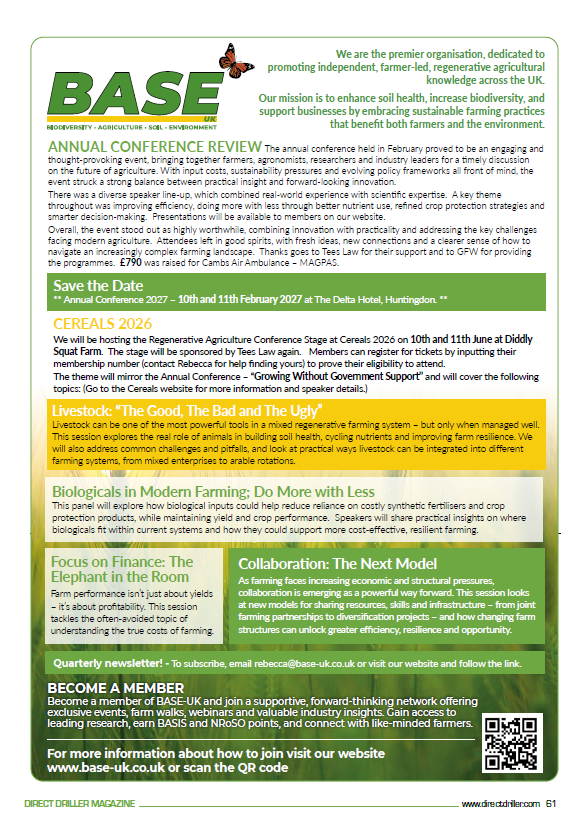
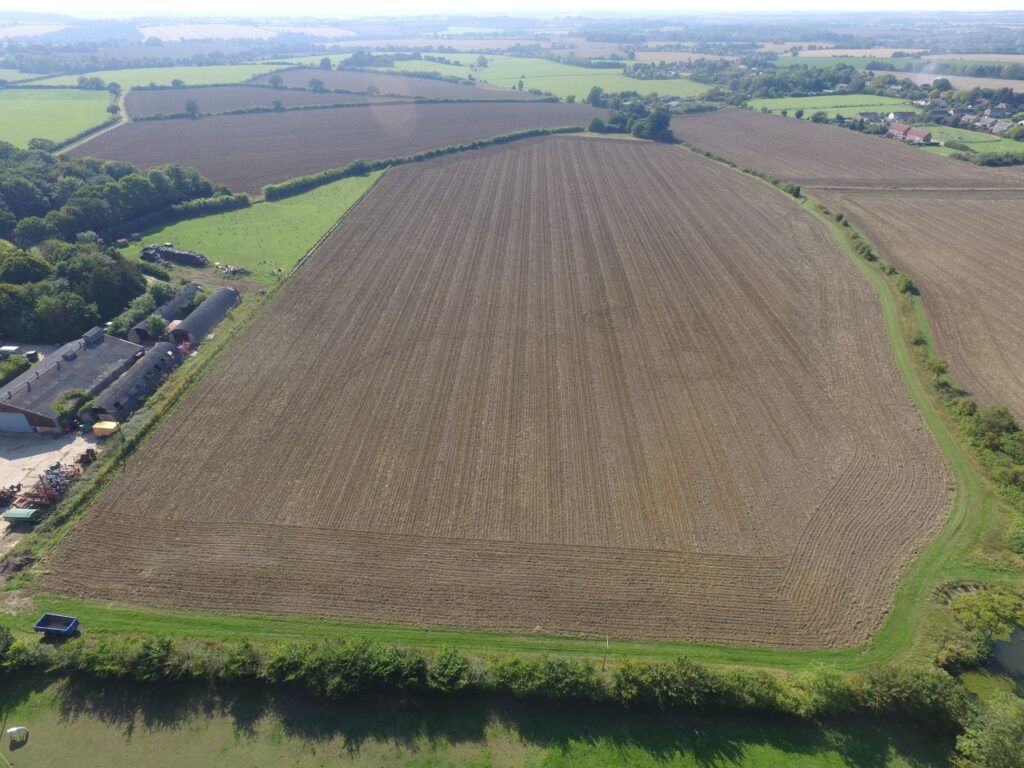
I wanted to “get efficient”; I wanted in. I did exactly what Simon Ward told me to do, and made half of my workforce redundant, got on a huge tractor and took on most of the fieldwork myself. We bought the next-door farm, almost doubling our size and took on six different CFAs within a seven-mile radius of the farm, including my neighbours, doubling our farmed area again. All redundant farm buildings were repurposed and let. To effect all of this, I took on a huge amount of financial risk to fund the transition and lapped up all the stress that the bank could throw at me. I enthusiastically engaged with every environmental scheme going, even before wildlife had been invented. I even went organic.
I was a farming hero.
Save me, save me, save me from this squeeze.
I got a big fat mama tryin’ to break me.
And I love to live so pleasantly,
Live this life of luxury.
Lazin’ on a sunny afternoon
While The Wurzels’ earworm drove me to expansion, my neighbouring farming brothers, let’s call them Doug and Dave, had been listening to a very different song.
Both had realised that their two hundred acres under the new reforms couldn’t support the lifestyle that they had become used to; the kind that my grandfather had latterly enjoyed.
Farming part-time, Doug had spent his remaining hours working on his website business while Dave converted the farm lorry into a mobile workshop to aid fellow farmers weld up their overworked implements in the field. Doug and Dave quickly realised that their time was much better spent doing something else and began to resent the time that they had to spend in the summer evenings and weekends tending to their struggling farm. They decided to “get out”.
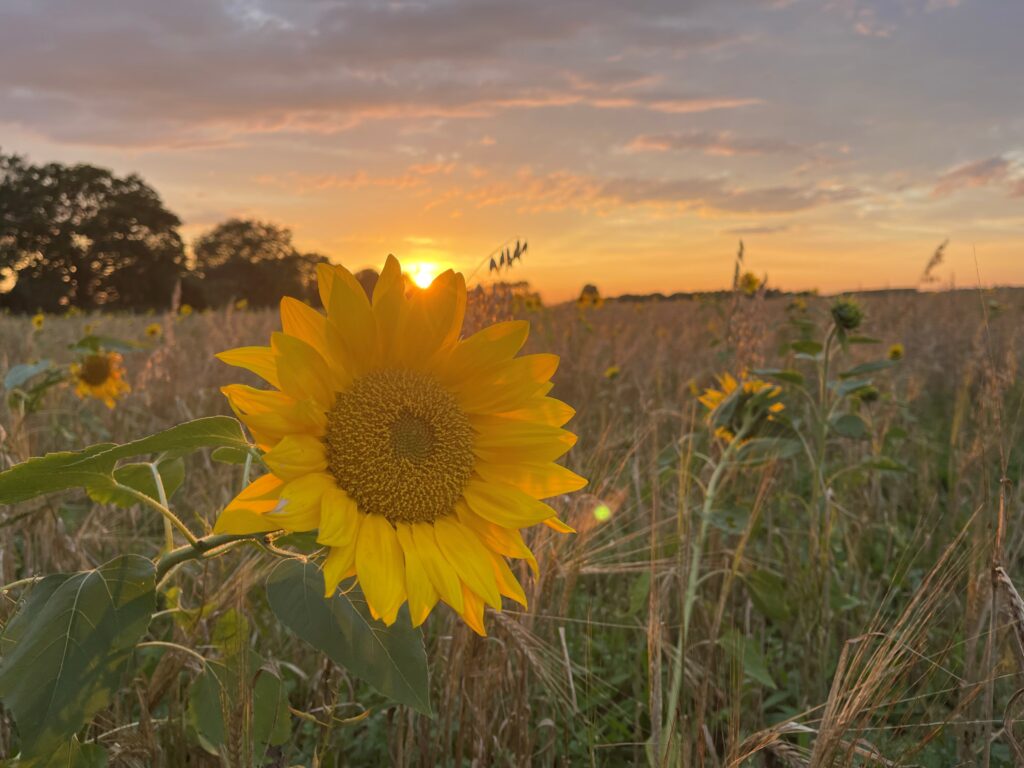
Luckily for them, they had an eager terrier on their doorstep – me. I arrived tail wagging, slavering, promising lucrative financial returns, fuelled by my impressive economies of scale. For Doug and Dave, it was a dream come true. They still had control over their farm and everything that went with it, and as their favourite song promised, they regained a life of living more pleasantly and lazing around in the sunny afternoons of harvest while I worked late into the summer nights.
Often, when drilling in the dark, with rain forecasted, on a field near Doug’s house, I could see into the warm glow of his sitting room. Alone in my towering seat of depreciating machinery, I would imagine that Doug was watching the late news, drinking his last glass of wine before going to bed. Meanwhile, I had two more hours of sowing before the field was done. In my own home, Alice and the children had long gone to bed.
But I was farming four thousand acres, with three people, three tractors and one combine harvester.
I was a farming hero.
Ch-ch-ch-ch-changes, turn and face the strange.
Ch-ch-changes, don’t want to be a richer man.
Ch-ch-ch-ch-changes, turn and face the strange.
Ch-ch-changes, there’s gonna have to be a different man.
Time may change me, but I can’t trace time.
So, this all happened almost twenty years ago, and I still farm for Doug and Dave as well as five other local farming families. I love them all and am still grateful for the opportunity they have given me.
Contract farming offered us a business lifeline at the time, and I have no regrets, but handing my business onto the next generation has focused my mind on what it looked like then and what it looks like now.
Although we were exposed to financial risk in those early contracts, we did benefit from a genuine economy of scale, and there was more risk-free money sloshing about, so achieving a surplus even in a poor harvest or a period of poor prices meant that there was always something to share. We made a modest profit, and our farmers achieved a better-than-rent equivalent.
But we did expect a lot from our farm staff as well as ourselves. Long hours at drilling and harvest time, very few whole weekends off and constant pressure. But was it fun? Yes, it was, especially when the sun shone, we were all making some money, and I was a thrusting young(er) farmer. Nobody made a fortune, but we were all making a reasonable profit for the capital employed.
A relative of mine, James Alston, published his recollections of growing up on a farm in Stirlingshire at the turn of the last century and his subsequent move to Norfolk as a tenant in 1923. Written in 1966 and having been through two agricultural depressions, he suggested that farmers in the 1960s could not weather poor prices and bad harvests for more than two years due to the cost of modern farming, whereas when they were more self-sufficient between the wars, farmers could batten down the hatches and survive for up to twelve years.
If James were alive today, I think he would be shocked at the amount of money we have employed in our current farming model. I nearly wrote “business model”, but that would suggest a rational investment decision with the possibility of a healthy return, so let’s just leave it at “model”.
Working out how a scaled modern farming operation battens down the hatches is the test. Environmental schemes certainly have been one solution; just max out on some of the field-scale options to regroup for three years. But the recent £100,000 cap to the Sustainable Farming Incentive does nothing to help those of us working who “got efficient” and developed our businesses. It does help Doug and Dave, as they still enjoy the benefits of our scale and are still fully rewarded for any environmental options they choose, still falling under the cap. It doesn’t feel right somehow.
The other battening-down approach would be to fully test the financial implications of our current contract farming business arrangements.
To do this, I extracted them from our budgets and modelled farming just our own in-hand land, focusing our extra time from farming less to developing our own asset base and diversifications. In an average year with average prices, there was no difference in financial terms, but in a good year we were comfortably better off. The shocker was the poor years. We not only suffered in terms of our in-hand land, but that was magnified exponentially when we failed to achieve meaningful surpluses in our CFA agreements. We not only had our own bad harvest, but we also had the weight of five other farmers’ bad harvests as well. Like my grandfather, I could have probably told you that from working it out on the back of an envelope, but seeing the impact on ink-jetted black-and-white A4 pieces of paper does make it very real.
I’m not sure where this is all going, but for the next generation, something will have to ch-ch-ch-ch-change.
I have always “turned and faced the strange” (as I said, I went organic) because it makes getting up in the morning exciting, every single day. Everyone wants to be a richer man, but not at any cost. Arguably, I have been a different man, too. And yes, we are constantly being changed by time, but we owe it to ourselves and those who come after us to clearly see, measure and control how that change happens.
John is the owner of Shimpling Park Farms Limited, a farm that grows a range of crops and a breeding flock of sheep.
He converted the farm to organic production in 1999 and, since then, has improved the soil and increased biodiversity while maintaining profitable food production. He is a Fellow of the Royal Agricultural Society.