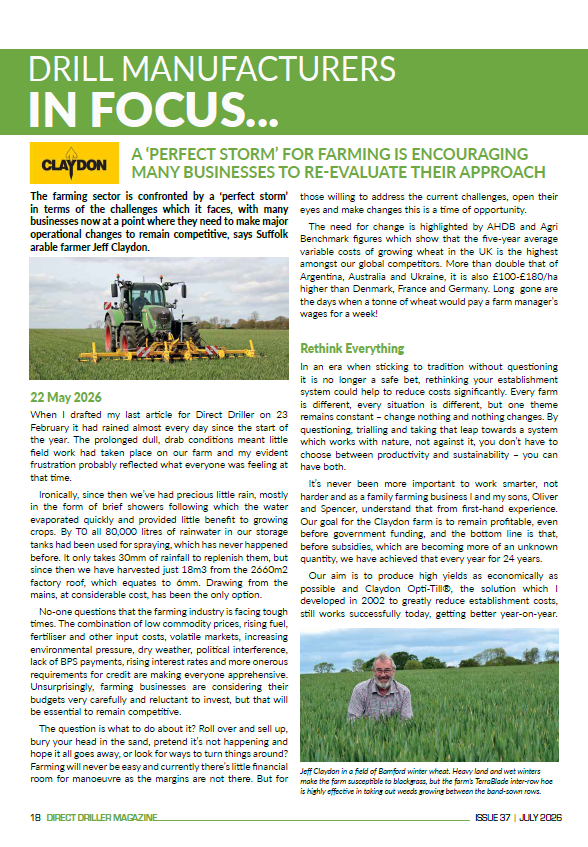
The farming sector is confronted by a ‘perfect storm’ in terms of the challenges which it faces, with many businesses now at a point where they need to make major operational changes to remain competitive, says Suffolk arable farmer Jeff Claydon.
Rethink Everything
22 May 2026
When I drafted my last article for Direct Driller on 23 February it had rained almost every day since the start of the year. The prolonged dull, drab conditions meant little field work had taken place on our farm and my evident frustration probably reflected what everyone was feeling at that time.
Ironically, since then we’ve had precious little rain, mostly in the form of brief showers following which the water evaporated quickly and provided little benefit to growing crops. By T0 all 80,000 litres of rainwater in our storage tanks had been used for spraying, which has never happened before. It only takes 30mm of rainfall to replenish them, but since then we have harvested just 18m3 from the 2660m2 factory roof, which equates to 6mm. Drawing from the mains, at considerable cost, has been the only option.
No-one questions that the farming industry is facing tough times. The combination of low commodity prices, rising fuel, fertiliser and other input costs, volatile markets, increasing environmental pressure, dry weather, political interference, lack of BPS payments, rising interest rates and more onerous requirements for credit are making everyone apprehensive. Unsurprisingly, farming businesses are considering their budgets very carefully and reluctant to invest, but that will be essential to remain competitive.
The question is what to do about it? Roll over and sell up, bury your head in the sand, pretend it’s not happening and hope it all goes away, or look for ways to turn things around? Farming will never be easy and currently there’s little financial room for manoeuvre as the margins are not there. But for those willing to address the current challenges, open their eyes and make changes this is a time of opportunity.
The need for change is highlighted by AHDB and Agri Benchmark figures which show that the five-year average variable costs of growing wheat in the UK is the highest amongst our global competitors. More than double that of Argentina, Australia and Ukraine, it is also £100-£180/ha higher than Denmark, France and Germany. Long gone are the days when a tonne of wheat would pay a farm manager’s wages for a week!
In an era when sticking to tradition without questioning it is no longer a safe bet, rethinking your establishment system could help to reduce costs significantly. Every farm is different, every situation is different, but one theme remains constant – change nothing and nothing changes. By questioning, trialling and taking that leap towards a system which works with nature, not against it, you don’t have to choose between productivity and sustainability – you can have both.
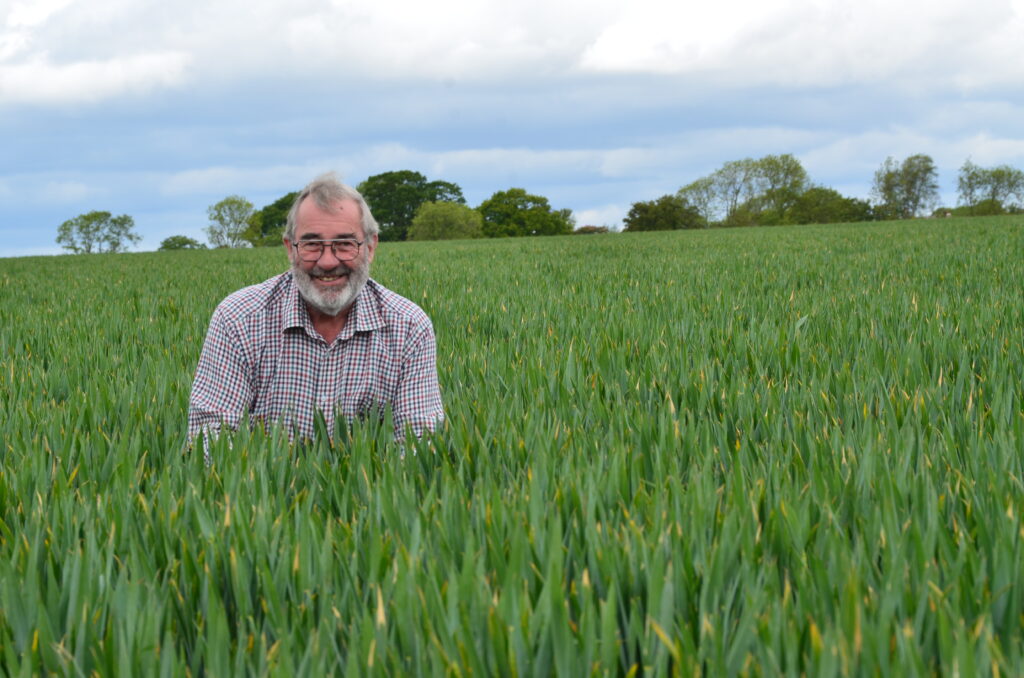
It’s never been more important to work smarter, not harder and as a family farming business I and my sons, Oliver and Spencer, understand that from first-hand experience. Our goal for the Claydon farm is to remain profitable, even before government funding, and the bottom line is that, before subsidies, which are becoming more of an unknown quantity, we have achieved that every year for 24 years.
Our aim is to produce high yields as economically as possible and Claydon Opti-Till®, the solution which I developed in 2002 to greatly reduce establishment costs, still works successfully today, getting better year-on-year. Over that time we’ve made mistakes, and we’re still learning, but we continue to change, adapt and refine the process.
A one-pass direct crop establishment system which delivers practical solutions to today’s most pressing issues, Opti-Till® reduces fuel usage, lowers input costs, saves time and improves performance, soil health and yields, our top priority. By enhancing soil biology and reducing erosion, it also helps to meet environmental goals and stewardship requirements while building a more sustainable, profitable business.
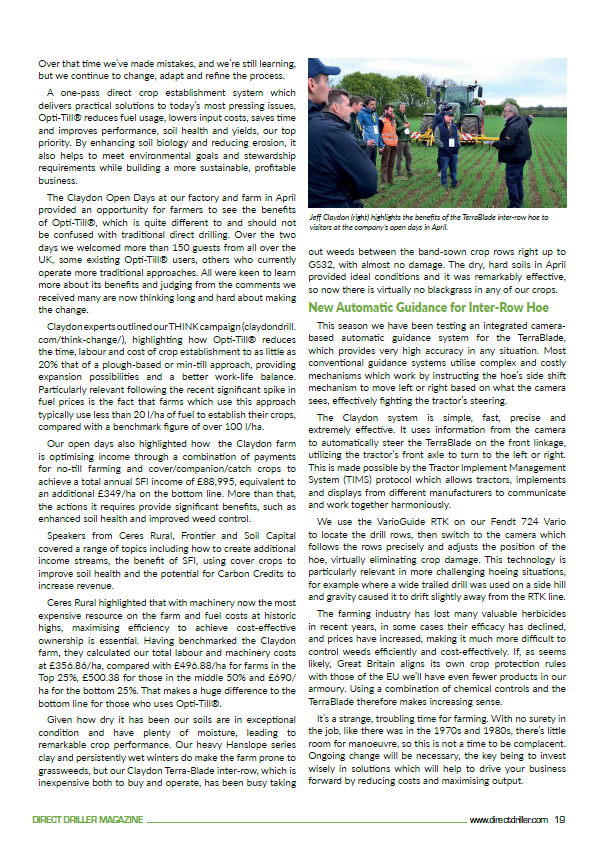
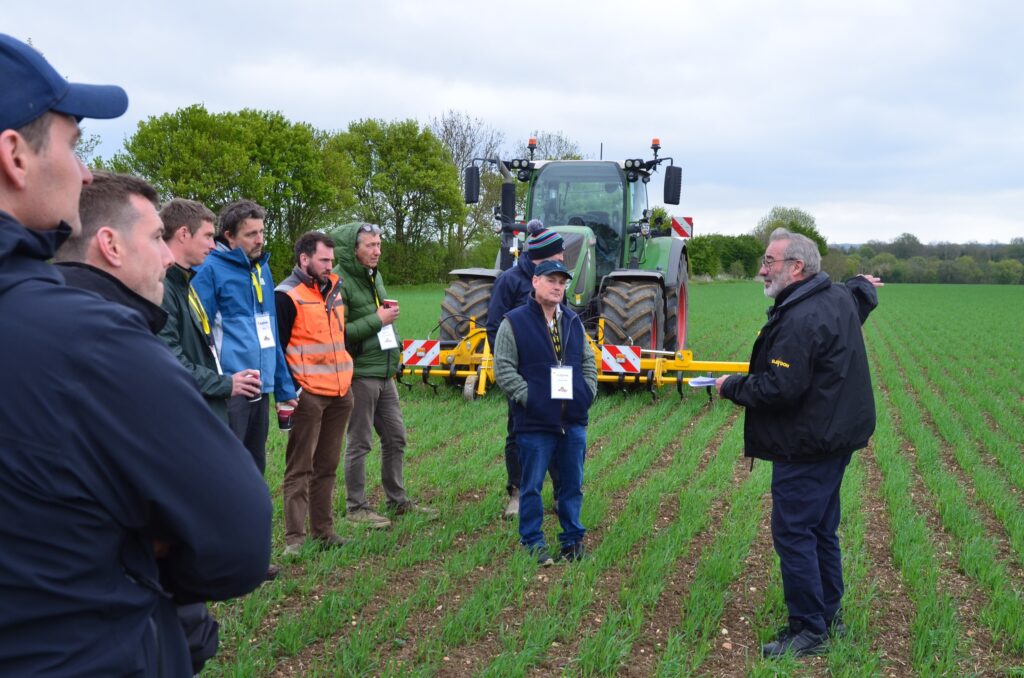
The Claydon Open Days at our factory and farm in April provided an opportunity for farmers to see the benefits of Opti-Till®, which is quite different to and should not be confused with traditional direct drilling. Over the two days we welcomed more than 150 guests from all over the UK, some existing Opti-Till® users, others who currently operate more traditional approaches. All were keen to learn more about its benefits and judging from the comments we received many are now thinking long and hard about making the change.
Claydon experts outlined our THINK campaign (claydondrill.com/think-change/), highlighting how Opti-Till® reduces the time, labour and cost of crop establishment to as little as 20% that of a plough-based or min-till approach, providing expansion possibilities and a better work-life balance. Particularly relevant following the recent significant spike in fuel prices is the fact that farms which use this approach typically use less than 20 l/ha of fuel to establish their crops, compared with a benchmark figure of over 100 l/ha.
Our open days also highlighted how the Claydon farm is optimising income through a combination of payments for no-till farming and cover/companion/catch crops to achieve a total annual SFI income of £88,995, equivalent to an additional £349/ha on the bottom line. More than that, the actions it requires provide significant benefits, such as enhanced soil health and improved weed control.
Speakers from Ceres Rural, Frontier and Soil Capital covered a range of topics including how to create additional income streams, the benefit of SFI, using cover crops to improve soil health and the potential for Carbon Credits to increase revenue.
Ceres Rural highlighted that with machinery now the most expensive resource on the farm and fuel costs at historic highs, maximising efficiency to achieve cost-effective ownership is essential. Having benchmarked the Claydon farm, they calculated our total labour and machinery costs at £356.86/ha, compared with £496.88/ha for farms in the Top 25%, £500.38 for those in the middle 50% and £690/ha for the bottom 25%. That makes a huge difference to the bottom line for those who uses Opti-Till®.
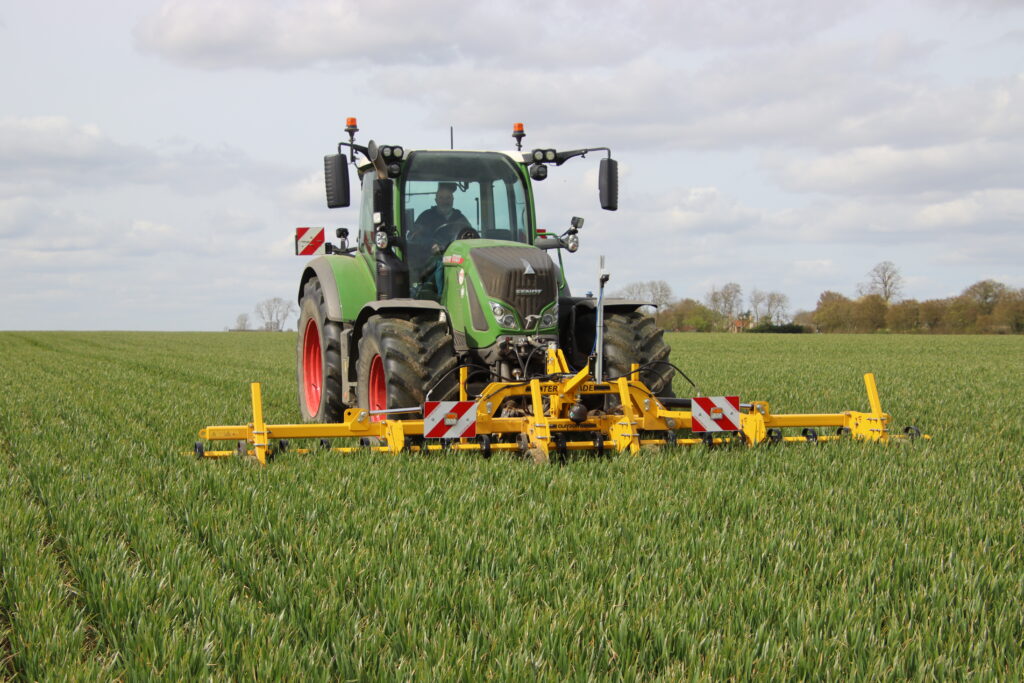
Given how dry it has been our soils are in exceptional condition and have plenty of moisture, leading to remarkable crop performance. Our heavy Hanslope series clay and persistently wet winters do make the farm prone to grassweeds, but our Claydon Terra-Blade inter-row, which is inexpensive both to buy and operate, has been busy taking out weeds between the band-sown crop rows right up to GS32, with almost no damage. The dry, hard soils in April provided ideal conditions and it was remarkably effective, so now there is virtually no blackgrass in any of our crops.
New Automatic Guidance for Inter-Row Hoe
This season we have been testing an integrated camera-based automatic guidance system for the TerraBlade, which provides very high accuracy in any situation. Most conventional guidance systems utilise complex and costly mechanisms which work by instructing the hoe’s side shift mechanism to move left or right based on what the camera sees, effectively fighting the tractor’s steering.
The Claydon system is simple, fast, precise and extremely effective. It uses information from the camera to automatically steer the TerraBlade on the front linkage, utilizing the tractor’s front axle to turn to the left or right. This is made possible by the Tractor Implement Management System (TIMS) protocol which allows tractors, implements and displays from different manufacturers to communicate and work together harmoniously.
We use the VarioGuide RTK on our Fendt 724 Vario to locate the drill rows, then switch to the camera which follows the rows precisely and adjusts the position of the hoe, virtually eliminating crop damage. This technology is particularly relevant in more challenging hoeing situations, for example where a wide trailed drill was used on a side hill and gravity caused it to drift slightly away from the RTK line.
The farming industry has lost many valuable herbicides in recent years, in some cases their efficacy has declined, and prices have increased, making it much more difficult to control weeds efficiently and cost-effectively. If, as seems likely, Great Britain aligns its own crop protection rules with those of the EU we’ll have even fewer products in our armoury. Using a combination of chemical controls and the TerraBlade therefore makes increasing sense.
It’s a strange, troubling time for farming. With no surety in the job, like there was in the 1970s and 1980s, there’s little room for manoeuvre, so this is not a time to be complacent. Ongoing change will be necessary, the key being to invest wisely in solutions which will help to drive your business forward by reducing costs and maximising output.